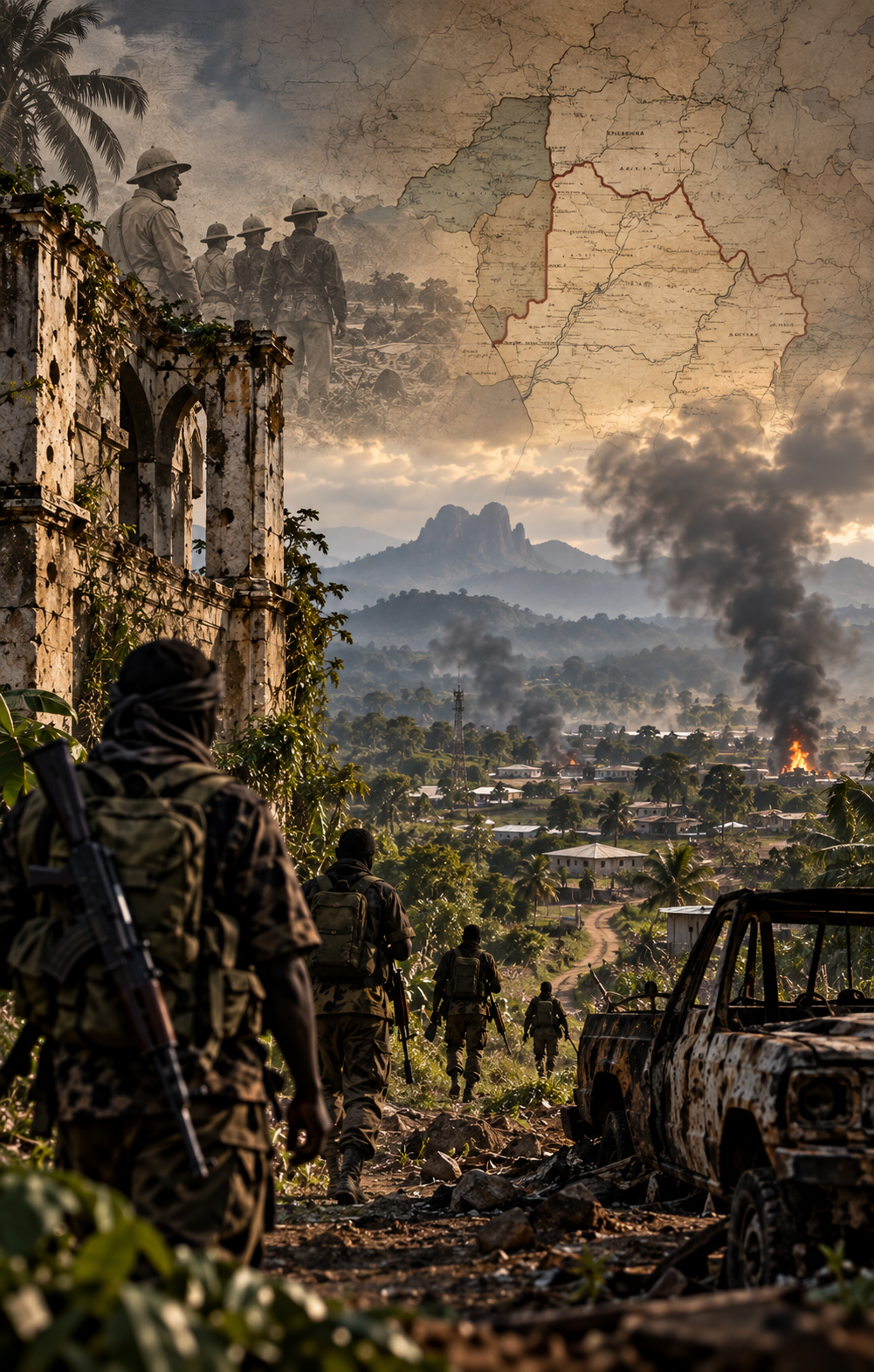
The end of the European colonial rule in Central Africa did not establish stable sovereign states, but it ended up producing fragile and compromised states post-independence. For decades, colonial rule has changed their traditional political institutions and concentrated wealth in the hands of foreign powers, corrupt officials, and frameworks that were not designed to govern populations of those countries but rather continue to control and exploit them.[1], [2] As a result, the political institutions, the redrawing of borders, and economic structures that were inherited post-independence were not supposed to be used as foundations for self-governance, but they were instruments of extraction that were repurposed to serve as states. When European colonial rule ended, the remnants of their rule left behind fragile states, competing interest groups for power, and economies that were built around resource extraction. Consequently, those conditions bred corruption, delegitimized governments across the region, but most importantly it created a power vacuum.[3]
Ultimately, non-state armed groups stepped into this power vacuum, and it included groups like the Islamic State in West Africa Province (ISWAP) in the Lake Chad Basin region, Boko Haram in Nigeria, and finally the Allied Democratic Forces (ADF) across the Central African Republic where they have weaponized local grievances, absorbed and persuaded marginalized groups, and financed their operations through illicit networks and resource extraction.[4] The consequences for those countries have been extreme. In the Democratic Republic of Congo alone, 7 million people have been displaced, and almost 80% of those displacements were connected to non-state armed attacks.[5] On the other hand, Boko Haram and ISWAP killed nearly 30,000 people between 2006 and 2019 alone,[6] while in the Central African Republic, competing armed groups have deposed the state authorities across the country and left behind UN agencies and international humanitarian actors.[7]
This insight explores the extent to which post-colonial state fragility created the structural conditions that enabled non-state armed groups and extremist organizations to emerge across Central Africa. The main argument is that terrorism and insurgency that spread throughout the region is not coincidental or an ideological phenomenon but a predictable outcome of colonial state design and failed institutions that were implemented post-independence. Ultimately, it argues that any security solution presented for the region must directly address the inherent problems of post-colonial institutional failure rather than treat it as an isolated incident.
The colonial blueprint: how states were built for extractions and not governance
When it comes to understanding how Central Africa arrived at where it is today in terms of corruption and conflict, it must be traced back to European colonialism and how those colonial entities dismantled what already existed and replaced it with what served their interests. The administration, infrastructure, and political institutions that they left behind were not products of a failed development project but rather served as an extraction system for colonial powers, and they operated in their favor.
This is evident across Central Africa, where no proper infrastructure was built, including roads or railways to facilitate trade; however, networks were built to transport raw materials like rubber, ivory, copper, and timber. Similarly, the ports also served as an extraction point. Furthermore, there was no investment considered for healthcare or education, and local government was discarded and suppressed.[8] Ultimately, the main goal at the time was not to create a self-governing state but rather a dependent and compliant state that would serve a colonial economy. Even though some might argue that public institutions did exist, they solely existed to serve the colonial administration in terms of policing, taxing, and labor extraction rather than focusing on the welfare of the population that they were supposed to govern.[9]
As a result, this logic of extraction spread across the region, and its purpose remained consistent. For example, the extraction system that was operational in Congo under Leopold II and later under the Belgian state was treated as a private source to be looted rather than a territory to be governed. Furthermore, the rubber quota system that was implemented in place was enforced through violence and punishment, and it became one of the most known atrocious incidents in colonial history. Subsequently, historians have predicted that approximately 10 million people, which is almost half of Congo’s population, died between 1880 and 1920 as a result of Leopold’s forced labor and systematic extraction system.[10] At the same time, when the Belgians hastily withdrew in 1960, what they left behind was a territory the size of Western Europe, which barely had college graduates, barely any Congolese civilians in the army, and an economy that was structured to survive solely around the export of raw material.[11] Therefore, one can argue confidently that the Congolese state did not fail post its independence, because it was never equipped to succeed from the beginning.
Another case of colonialism was the British rule in Nigeria, which operated through different mechanisms but, nonetheless, produced similar outcomes. British colonialism mainly operated through indirect rule and thrived on already established traditional networks of governance and ethnic power structures. This was the case in Nigeria, where the British thrived on deepening the already entrenched ethnic divisions rather than unifying them under one administrative structure that they could have overseen. Moreover, in the north, indirect rule had imposed an emirate governing structure on communities that had not accepted it historically, which produced a degree of forced assimilation and widened the gap between the north and the south.[12]
Existing ethnic and religious groups in the north, like Hausa Fulani, the Yoruba in the southwest, and the Igbo in the southeast, all had different governing systems in their regions, which created a competitive political environment as well as competing loyalties and various institutional frameworks that could not be reconciled. As a direct consequence, indirect rule had managed to deepen those divisions which promoted uneven development and left behind an ungovernable Nigeria where its political landscape remains unstable, and the consequences can be felt today.[13] Similar to the Belgian departure, the British also left behind a religiously and ethnically divided state as a consequence of their colonial governance. This is evident in northeastern Nigeria, where Boko Haram originally started its operations. This then became a direct outcome of uneven administrative investment and will remain part of the legacy of British colonialism.
Finally comes the third form of colonialism, and that is French colonialism. It spread across Central Africa, mainly in Chad, the Central African Republic, and the Republic of Congo, and all had a similar extractive economy in place and puppet government institutions. Early 20th century, the French divided this area among various companies that had absolute power, which forced African laborers to collect crops and raw materials under coercive conditions.[14] Moreover, it was not the case where African laborers benefited from these extortionist tendencies; rather, those French companies resold those resources for higher prices across Europe while African laborers barely had minimum wages.[15]
On the other hand, assimilation through the French model was simply non-existent as the French administration selectively chose who could participate in French civic life, which left the majority of the population entirely outside any political and institutional framework. One can argue that even though French colonial powers invested in infrastructure, it was only prioritized and created for easier resource extraction rather than improving living conditions. Furthermore, once those countries gained their independence, the ‘assimilated’ class was small, French-educated, but most importantly, they were disconnected from the communities that they were supposed to govern.[16]
Consequently, all these various colonial powers were bound to change the geographical borders of Central Africa. During the Berlin Conference of 1884, the boundaries were redrawn as each colonial power started carving out its territories in Africa based on its strategic interests without any consideration for the linguistic, ethnic, and even cultural communities that existed in those countries.[17] As a result, this led to various communities being spread across various colonial jurisdictions and rival groups operating within a single administrative unit. In addition to this, the ‘effective occupation clause’ formalized this, which ended up producing ethnically divided groups through a process that was externally imposed.[18] Subsequently, once those states gained independence, those borders represented the new borders for sovereign African states, and the ethnic and religious tensions that were suppressed under colonial empires did not dissolve. They erupted. Arguably, those tensions and violence that spread throughout Central Africa were not a product of tribal hatred as is depicted in Western media, but a direct consequence of colonial division and redrawing of borders.[19]
Therefore, independence did not deliver sovereignty, but rather it was a handover of an ungovernable state. The newly independent governments had inherited extractive economic structures, skeletal bureaucracies, and the external making of a state that did not have the institutional power to make it function. Arguably, by colonial design, they were states that were set up to be governed from abroad, and when that external governing structure was removed, the vacuum it left behind would prove to have dire consequences.
Independence without institutions: the roots of the power vacuum
As mentioned previously, when Central African countries started gaining their independence throughout the 1950s and 60s, the celebrations that followed were short-lived because those states were inheriting a system of their own subjugation. Those countries did not receive functional democracies or administrations, but they received the opposite of that, where those states again were not built for national defense but rather to be controlled and suppressed.[20] Ultimately, the inherited colonial apparatus, including the military, the courts, and the police, had been created to serve colonial domination, not protection, and that main purpose did not change simply because authority at the top of the hierarchy changed. Thus, post-independent leaders did not dismantle or build a new governing structure, but they stepped back into the same vicious cycle of their former colonizers and exploited the exact same methods for personal and political gain.[21]
The militaries that these states had inherited were unsuitable for the demands to govern autonomously. On the one hand, colonial armed forces had no connection to the communities that they were supposed to govern and protect, were not rooted in national liberation, and mostly occupied themselves with pacifying those communities rather than providing external defense.[22] Instead of reforming and resolving the entrenched ethnic and religious biases within the armed forces, they ended up exploiting the structural shortcomings and building security to protect their oppressive regimes instead of protecting their population.[23] Therefore, those countries remain stuck in the same vicious cycle that they were entrapped in for decades, where they kept protecting the ones in power instead of the newly formed sovereign states.
Hence, with this came an institutional vacuum that defined the post-colonial governance across Central Africa, and that is ‘neopatrimonialism’. In the absence of functional political institutions, leadership becomes deeply personalized, and that usually occurs through loyal networks, informal agreements, and distribution of the wealth among themselves instead of the citizens.[24] Additionally, most of the African leaders exercised their authority or maintained it through personal patronage instead of ideology or law, and whoever was placed in a position of power was not there to carry out the mandate of serving the country but to use as an opportunity to accumulate wealth further.[25] Therefore, corruption was not a deviation within a system, and they purely operated through it. Similarly, institutions that were created to provide justice and transparency were repurposed to be used as outlets for power and wealth.19 Nonetheless, the consequence of that was creating the shell of a state and stripping it of its capacity to act as capable and sovereign, because governments that were supposed to act autonomously were not delivering on their promises, or providing justice, but most importantly, they could not provide security for their populations.
The consequences of that were felt in the peripheral regions where most rural and border areas lay far from capital cities and the concentration of power and wealth. Thus, the absolute absence of the state or any authoritative figure, for that matter, allowed everything and anything to be settled by force. Moreover, not having that security meant that communities had to defend themselves against armed threats without support from the government. Adding to that, not having access to basic services like schools, clinics, and infrastructure essentially left those populations abandoned by their governments, which vowed to improve their conditions.[26] Subsequently, the geopolitical challenges that were left behind as a result of colonialism had essentially left those spaces ungoverned. However, it was not in the sense that no form of government had existed there, but more like the former government had withdrawn from those areas.[27]
It is in this context that the concept of power vacuum becomes quite concrete within those ungoverned spaces. This is where the state that is incapable of projecting power and asserting its authority within its borders collides with actors that are willing to step in and fill its place.[28] Combining weak governance, political instability, corruption, and poverty, which all undermine state authority, leaves behind territories that are not only ungovernable but also easily exploited and influenced.[29] Hence, these conditions across Central Africa did not just randomly emerge or occur gradually, but they were direct and inherited because of a colonial system that never intended to build states to govern themselves. The same is applicable to the power vacuum: it did not just appear because of independence, but again, it was due to the inherited political architecture. This would then lead to the eventual action of non-state armed groups that would step into this vacuum and move with speed and purpose, which would have dire consequences internally and internationally.
Into the vacuum and how armed groups took hold
Due to the failure of the governments and the power vacuum that was left behind by post-colonial institutional failure, this vacuum did not last long. In those ungoverned spaces, non-state armed groups exploited the absence of governmental authority, weaponized local grievances, and absorbed marginalized groups while providing them with an alternative for security and services that the governments had failed to provide. This was the case with three various non-state armed groups: Boko Haram in Nigeria, Islamic State West Africa Province (ISWAP) and its offshoot the Islamic State (IS) operating in the Lake Chad Basin, and finally the Allied Democratic Forces (ADF) in the eastern Democratic Republic of Congo (DRC).
Boko Haram, ISWP, and IS
The first non-state armed group is Boko Haram, which operates out of Nigeria. However, Boko Haram did not emerge from nowhere. Its original roots can be traced to northeastern Nigeria, which was a region that was systematically left underdeveloped under Britain’s indirect rule, and its population was marginalized by the post-independence government that had power and resources in the hands of corrupt officials.[30] Furthermore, when it came to British policy towards Nigeria, they chose to rule through indirect rule and the pre-existing structure, which created ethno-religious and political divides between the north and south that even independence could not reconcile those differences. Additionally, the successive governments did not solve those divides, but they exploited them.[31] By 2000, northeastern Nigeria was lagging in terms of development, whereas the rest of the country had infrastructure, access to education, political representation, and economic opportunities. Those apparent disparities created discontent among the youths, and that bred the early stages of radicalization.[32]
Boko Haram was founded in 2002 by Mohammed Yusuf in Maiduguri, where it positioned itself to represent the marginalized and to channel the grievances of the local population against the Nigerian State into a violent rejection against a Western model of governance.[33] Moreover, its name can be directly attributed to ‘Western education is forbidden,’ and originally this was not a religious association but a political one, which was directly linked to their colonial history of dominance and culture erasure.[34]
On the other hand, ISWAP emerged in 2016 as an offshoot of Boko Haram due to a disagreement over their tactical and doctrinal plans and thereby aligned themselves with the Islamic State’s global network. Arguably, what set ISWAP and Boko Haram apart was the shift in their strategy away from violent terrorist activity and more toward a governance model. Toward the end of 2022, ISWAP managed to establish four governorates across the Lake Chad Basin, where each governorate had its own administrative structures, military command, councils, and approximately 800,000 to 3 million civilians were living under ISWAP rule.[35] Ultimately, this state model was not incidental, but it was ideologically important to the Islamic State’s global project to prove that it can govern states, where formal governments have failed to do so.[36] Eventually, this contributed to the Islamic State’s global operations, which spread across the African continent, where the ISWP was at the center of that expansion.[37]
Lastly, when it came to the recruitment process, both organizations illustrated the power vacuum that was present. On the one hand, Boko Haram relied on coercion, abduction, and exploiting desperate youths, while ISWAP combined targeted recruitment and provided basic services like food, security, and even justice, which at the time the Nigerian state had failed to provide in the northeast region.[38] Nonetheless, in both cases, recruitment was not ideological. It was relying on people’s deprivations, which included non-existent economic opportunities, no education, no state protection, and most importantly, they did not have a reason to resonate with a government that had failed to serve and protect them.
The Allied Democratic Forces (ADF) in Eastern DRC
On the other hand, the Allied Democratic Forces represents a different but structurally similar and parallel case. The ADF can be traced back to its original roots in Uganda, where it was formed in 1995, which merged two rebel groups. The ADF fled into the eastern territory of the DRC following the pressure of the Ugandan government and had embedded itself in the ungoverned spaces of North Kivu and Ituri, which were part of the Congolese territory that was never controlled by the government.[39] Similar to Boko Haram, the presence of the ADF can be traced back to the Belgian colonial legacy, where the eastern territory was the most exploited under King Leopold II, its population was terrorized and coerced into brutal labor conditions, and the original government structure was dismantled. Therefore, once they gained their independence, the ADF exploited the absence of the government and established its presence, where it became deeply embedded in the social landscape. Ultimately, by 2023, the ADF forces had committed their highest number of civilian killings in the DRC in comparison to other armed groups, where they killed approximately 1,000 people—predominantly civilians.[40]
At the same time, the M23 group was operating on similar grounds, which also represented another stream of the long-lasting colonial legacy. M23 was formally known as the Mouvement du 23 Mars and emerged in 2012 as former combatants who had been integrated into the Congolese army after the peace deal in 2009; their grievances mostly revolved around the Congolese government’s failure to honor that peace deal.[41] They operated across the Banyamulenge area, which is a Tutsi-speaking majority whose presence in the DRC was a result of colonial border redrawing. Moreover, their own identity remains contested because of the colonial partition between Rwanda and Congo.[42] Therefore, post-independence, this contestation did not end and M23 exploited those unresolved tensions. They mobilized the narrative around ethnic persecution and the failure of the Congolese government to protect the Tutsi populations in the east and transformed a complicated border issue into a contemporary armed movement.[43] In this case, M23 did not create the conflict but inherited and instrumentalized colonial-produced contradictions and post-colonial state fragility. Lastly, Rwanda’s support for the M23 was widely associated as a proxy mechanism that would allow M23 access to the northeastern region of the DRC and its wealth, resources and continued the extraction logic that was implemented by colonial rule.[44]
As a result, the recruitment trends in all three cases are similar, and it comes as an outcome of conditions that were created by the post-colonial institutional failure. Most of those groups end up absorbing marginalized communities and populations that have been abandoned by the state, where they combine coercive measures, and economic incentives, but most importantly, they provide them with a sense of belonging that the former government had failed to provide. In the case of the DRC, coercion overlaps with economic push and pull factors, where young people cannot refuse because then their economic and personal security becomes threatened, alongside the fact that they face pressure from their communities to join. This is why it becomes difficult to refuse being absorbed into those groups, either through coercion or voluntarily.[45] Furthermore, forced recruitments, kidnappings, and threats are common and widely documented across the region, where not only adults are targeted by those groups, but children are also recruited as spies, fighters, lookouts, and, in most cases, they are also subjected to sexual violence.[46]
Beyond this coercion, armed groups across Central Africa have sustained themselves throughout the region by filling the security and service gaps that were left behind by the state. On the one hand, ISWAP administers territory and delivers basic governance, while ADF taxes the local populations and sustains a violent order across Congolese areas where the state is non-existent. On the other hand, Boko Haram, in its early stages, had created a parallel justice system that was rooted in Sharia Law, where it presented to communities a more consistent form of jurisdiction than corrupt or even absent courts.[47] Therefore, each armed group’s ability to survive, expand, but most importantly sustain its governance is not simply a product of violence but rather a product of relevance and filling a void that post-colonial states, by design and failure, left wide open.
Funding the fight: resource exploitation as the engine
The armed groups that spread across Central Africa as a consequence of the power vacuum were not sustained only because of ideology. Behind every insurgency, there is a financial scheme, and in Central Africa, it was based on the extraction and illegal trafficking of natural resources. This power dynamic between those groups and their funding is important because trade routes, extraction networks, and transportation routes used by those armed groups are not recently constructed but are a direct outcome of colonial extraction infrastructure that European powers had built and embedded across the region.[48]
Ultimately, the scale at which those illicit markets are operating is quite staggering. Every year, various raw materials, including timber, charcoal, and ivory, are valued between US$700 million and US$1.3 billion, which are illegally extracted and smuggled out of the eastern zones in the DRC.[49] On the other hand, the Congolese gold illicit trade alone has been generating US$120 million annually, which is approximately ten times the value of the country’s legal gold exports, alongside other illegal trade of timber, cannabis, and elephant ivory.[50] Consequently, with this consistent illegal trade, revenues have sustained over 8,000 armed fighters annually across different armed groups across the region. Moreover, those revenues have not only sustained current armed groups but also allowed for the re-emergence of disarmed groups to destabilize the region.[51] Additionally, the ADF and M23 armed groups control gold mines and smuggling routes while also illegally taxing local miners. Those groups end up blurring the lines between them and organized criminal networks as profit becomes more important than political security.[52]
Therefore, the connection between the current illicit networks and the colonial networks is not a historical but a structural one. The extractive institutional practices that existed and were established by colonial companies did not simply disappear or disintegrate after independence, but they were sustained and absorbed into the informal and illicit economies.[53] Subsequently, those same networks were used to transport rubber, ivory, and gold from internal ports to coastal ports in Congo, which serve as the main channels of illegal smuggling. At the same time, there is an institutional vacuum characterized by no border regulations, the presence of corrupt officials, and weak law enforcement, which the colonial order had created, and the post-colonial governments had inherited and maintained.[54] Furthermore, colonial administrations operated this extractive system where raw materials were shipped to European economies, leaving behind underdeveloped and politically corrupt African countries. That same colonial legacy laid the foundation for the post-independence dependency and external interference that armed groups exploit.[55]
Illicit smuggling and trafficking are not only an internal issue, but the international dimension is just as important. Armed groups across Central Africa do not operate in isolation; their extractive system is connected to regional and international buyers alongside smuggling operations and global markets. For example, gold smuggled from eastern DRC is smuggled through Rwanda, which is a supporter of M23, where 120 tons of gold have been smuggled out from Rubaya to Rwanda alone, which was then laundered through legitimate supply chains and generated tax revenues for M23.[56] At the same time, countries like Russia and China represent a significant external actor in this political landscape where they operate through distinct mechanisms. Most Chinese-owned state enterprises have secured a share of Africa’s mining sector through their own strategy of operating within conflict zones where Western countries will not. As a result, the absence of competing interests allows for unlimited access to resources, where they can leverage political superiority and provide subsidies to African governments, which they can later negotiate directly regarding resource access.[57] Nonetheless, China’s willingness to operate amid this politically unstable environment does not just tolerate this conflict environment; it sustains it with the continuous demand for raw materials and resources through the same networks that armed groups tax, control, and profit from.
Russia, on the other hand, has deployed a different approach. It has deployed its private military companies, like the Wagner Group and its successor, Africa Corps, across Central Africa to provide security services to fragmented governments also in exchange for resource extraction that directly sponsors the Russian state and its oligarchy.[58] In the Central African Republic, the Wagner group has acted alongside the government and was linked to illegal gold and diamond extraction, which in essence replicated the colonial extraction system that was first institutionalized in the region.[59]
Therefore, what emerges out of this is an ecosystem that has been built on resource exploitation and simultaneously operates on three fronts: local, regional, and international, where armed groups, corrupt officials, and geopolitical actors are all operating within the same bounds of extraction and exploitative logic, which was engineered through colonialism. This leaves the populations vulnerable, caught in the middle, and reliving the same oppressive post-colonial cycle.
Conclusion
The transitions from extraction economies exploited by European colonial powers to the hollow states in Central Africa left power vacuums because of institutional failure. Into those power vacuums, armed groups exploited the situation and sustained themselves through the illicit smuggling of resources, which contributed to the cycle of violence that those countries experience to this day. Each stage that those countries experienced cannot be described as an isolated incident, but it is a continuous structural cycle.
Additionally, terrorism and insurgency in Central Africa are not random or isolated acts. Rather, both are outcomes of a governance architecture that was designed to extract rather than build, to control rather than serve, but most importantly to concentrate the wealth within the hands of a small minority rather than distribute it. Ultimately, when the same corrupt governmental structure was inherited by post-independent states, it was not reformed to govern, but it was replicated to exploit. Loyalty and patronage replaced colonial hierarchies, personal leadership replaced institutional government, and in the peripheral regions where governments were absent, the conditions for organized violence were not just present; they were guaranteed.
The various armed groups mentioned are not aberrations, but they are responses to the politically volatile environment that the failures of post-colonial powers had created. Ultimately, they filled security gaps, provided so-called justice to marginalized communities, recruited from the same marginalized populations, and financed themselves through the same extractive measures that colonialism had built, and post-colonial governments had failed to dismantle. Moreover, the violence that they perpetrate across the region has had devastating consequences politically, socially, and economically.
Understanding that the causes of this are not an instant effect but something that has culminated over decades is essential. Misunderstanding this leads to failed attempts to understand why certain security solutions do not work or have failed. These include military interventions, peacekeeping missions, and counter-terrorism operations, which have all proved their limited power in containing insurgency and terrorism across the region.
Terrorism across Central Africa is not a coincidence, but it is an inheritance of a structurally predicted outcome based on decisions that were not made by the people of the region, but decisions made for them and against them. Therefore, this inheritance is not where the conversation ends, but where it begins, to explain the security dilemma countries face in this region.
[1] Rollin F. Tusalem, “The Colonial Foundations of State Fragility and Failure,” Polity 48, no. 4 (October 2016): 445–495, https://www.jstor.org/stable/26358277.
[2] Victor H. Mlambo, “Unravelling Africa’s Misgovernment: How State Failures Fuel the Emergence of Violent Non-State Actors: Selected Case Studies,” Cogent Social Sciences 9, no. 1 (December 31, 2023), https://www.tandfonline.com/doi/abs/10.1080/23311886.2023.2228127.
[3] Antoine Nyagatoma, “States Designed for Conflict: Colonial State Formation and the Structural Reproduction of Violence: Evidence from Rwanda and the Eastern Democratic Republic of Congo,” Journal of Political Science and International Relations 9, no. 1 (March 16, 2026a): 100–112, http://article.sciencepg.com/pdf/j.jpsir.20260901.17.
[4] OCHA, “Democratic Republic of Congo: Internally Displaced Persons and Returnees,” March 2024 (2024), https://www.unocha.org/publications/report/democratic-republic-congo/democratic-republic-congo-internally-displaced-persons-and-returnees-march-2024.
[5] Ibid.
[6] Virginia Camolli, “The Evolution and Impact of Boko Haram in the Lake Chad Basin,” Humanitarian Practice Network, no. 70 (October 2017), https://odihpn.org/en/publication/the-evolution-and-impact-of-boko-haram-in-the-lake-chad-basin/.
[7] Amy Niang, “Beyond State Collapse: A CAR Notebook,” (accessed June 16, 2026).
[8] Mlambo, “Unravelling Africa’s Misgovernment: How State Failures Fuel the Emergence of Violent Non-State Actors.”
[9] Rollin F. Tusalem, “The Colonial Foundations of State Fragility and Failure,” Polity 48, no. 4 (October, 2016): 445–495, https://www.jstor.org/stable/26358277
[10] Sara Lowes and Eduardo Montero, “King Leopold’s Ghost: the legacy of labour coercion in the DRC” (2017): 75–86, http://www.econis.eu/PPNSET?PPN=886935504.
[11] Antoine Nyagatoma, “States Designed for Conflict: Colonial State Formation and the Structural Reproduction of Violence: Evidence from Rwanda and the Eastern Democratic Republic of Congo,” Journal of Political Science and International Relations 9, no. 1 (March 16, 2026b): 100–112, http://article.sciencepg.com/pdf/j.jpsir.20260901.17.
[12] Ibid.; David Olayinka Ajayi, “British Colonial Policies and the Challenge of National Unity in Nigeria, 1914-2014,” Journal for Contemporary History 47, no. 1 (June 1, 2022): 27–50, https://hdl.handle.net/10520/ejc-contemp1_v47_n1_a3.
[13] Benjamin Maiangwa, Muhammad Dan Suleiman, and Chigbo Arthur Anyaduba, “The Nation as Corporation: British Colonialism and the Pitfalls of Postcolonial Nationhood in Nigeria,” Peace and Conflict Studies 25, no. 1 (2018): I, https://www.proquest.com/docview/2088076152.(Maiangwa, Dan Suleiman, and Arthur Anyaduba 2018, I)
[14] FEDERICO TADEI, “Measuring Extractive Institutions,” European Review of Economic History 24, no. 1 (February 1, 2020): 1–23, https://www.jstor.org/stable/26955400.
[15] Ibid.; Chanda Chansa Thelma and others, “French Colonialism and Neocolonialism in Africa: A Comprehensive Analysis,” World Journal of Advanced Research and Reviews 23, no. 3 (September 30, 2024): 2062–2073, https://wjarr.com/sites/default/files/WJARR-2024-2832.pdf.
[16] Ibid.; Chanda Chansa Thelma and others, “French Colonialism and Neocolonialism in Africa: A Comprehensive Analysis,” World Journal of Advanced Research and Reviews 23, no. 3 (September 30, 2024): 2062–2073, https://wjarr.com/sites/default/files/WJARR-2024-2832.pdf.
[17] Rwigema Celestin, “Impact of the Berlin Conference (1884 – 1885) on Eac Development 140 Years After the Divide of Africa,” International Journal of Political Science and Public Administration 6, no. 1 (March 27, 2025): 25–58, https://mail.reviewedjournals.com/index.php/rijpspa/article/view/312/286.
[18] JACK PAINE, XIAOYAN QIU, and JOAN RICART-HUGUET, “Endogenous Colonial Borders: Precolonial States and Geography in the Partition of Africa,” The American Political Science Review 119, no. 1 (February 2025): 1–20, https://www.cambridge.org/core/product/identifier/S0003055424000054/type/journal_article.
[19] Mlambo, “Unravelling Africa’s Misgovernment: How State Failures Fuel the Emergence of Violent Non-State Actors.”
[20] Joel Ntile, “Military Coups in Africa: A Failure of Post-Colonial States Or Politics by Other Means?” The Chanzo, August 2023, https://thechanzo.com/2023/08/02/military-coups-in-africa-a-failure-of-post-colonial-states-or-politics-by-other-means/ (accessed 20th June, 2026).
[21] Daniel N. Mlambo, Mandla A. Mubecua, and Victor H. Mlambo, “Post-Colonial Independence and Africa’s Corruption Conundrum: A Succinct South African Critique Post-Democratisation,” Insight on Africa 15, no. 2 (July 2023): 184–202, https://journals.sagepub.com/doi/full/10.1177/09750878231176260.
[22] Ouedraogo Emile, Obstacles to Military Professionalism, The African Center for Strategic Studies, 2019, https://africacenter.org/publication/obstacles-military-professionalism/ (accessed June 18, 2026).
[23] Celestin, “Impact of the Berlin Conference (1884 – 1885) on Eac Development 140 Years After the Divide of Africa.”
[24] Zubairu Wai, “Neo-Patrimonialism and the Discourse of State Failure in Africa,” Review of African Political Economy 39, no. 131 (Mar, 2012): 27–43, https://www.tandfonline.com/doi/abs/10.1080/03056244.2012.658719.
[25] Wellington Garikai Bonga, Exploring the Impact of Neopatrimonialism Dominance in Africa, SSRN, (2021), http://www.econis.eu/PPNSET?PPN=1806465515.
[26] Muhammad Dan Suleiman, Hakeem Onapajo, and Ahmed Badawi Mustapha, “External Influence, Failed States, Ungoverned Spaces and Small Arms Proliferation in Africa,” in The Palgrave Handbook of Small Arms and Conflicts in Africa (Switzerland: Springer International Publishing AG, 2021), 161–185, http://ebookcentral.proquest.com/lib/SITE_ID/reader.action?docID=6534961&ppg=205&c=UERG.
[27] Emile, Obstacles to Military Professionalism.
[28] John Sunday Ojo, “Governing “Ungoverned Spaces” in the Foliage of Conspiracy: Toward (Re)Ordering Terrorism, from Boko Haram Insurgency, Fulani Militancy to Banditry in Northern Nigeria,” African Security 13, no. 1 (January 2, 2020): 77–110, https://www.tandfonline.com/doi/abs/10.1080/19392206.2020.1731109.
[29] Ntile, “Military Coups in Africa: A Failure of Post-Colonial States Or Politics by Other Means?”
[30] Kingsley E. Amaechi and Rendani Tshifhumulo, “Unpacking the Socio-Political Background of the Evolution of Boko Haram in Northern Nigeria,” Journal for the Study of Religion 32, no. 2 (January 1, 2019): 1–29, https://www.jstor.org/stable/26900041.
[31] Emile, Obstacles to Military Professionalism.
[32] Gershon Adela, ““Small Fires Causing Large Fires”: The Rise of Boko Haram in Northeastern Nigeria and its Transnational Posture in the Lake Chad Basin,” The Journal of Intelligence, Conflict, and Warfare 4, no. 2 (November 23, 2021): 46–67, https://journals.lib.sfu.ca/index.php/jicw/article/download/2952/3011.
[33] Celestin, “Impact of the Berlin Conference (1884 – 1885) on Eac Development 140 Years After the Divide of Africa.”
[34] Emile, Obstacles to Military Professionalism.
[35] Norman Sempijja, Paula Mora Brito, and Zineb Moutaouakil, “Countering the Islamic State in the Lake Chad Basin: A Case for a Security-Development-Governance Nexus?” Cogent Social Sciences 9, no. 1 (December 31, 2023), https://www.tandfonline.com/doi/abs/10.1080/23311886.2023.2209988.
[36] Atta Barkindo, “Boko Haram-ISWAP and the Growing Footprint of Islamic State (IS) in Africa,” Counter Terrorist Trends and Analyses 15, no. 2 (March 1, 2023): 12–17, https://www.jstor.org/stable/48718087.
[37] Ibid.
[38] David Silas, “A Review on Security Failures and the Five Drivers of Terrorism in Nigeria,” Mediterranean Journal of Social Sciences 17, no. 1 (January 13, 2026): 53, https://www.richtmann.org/journal/index.php/mjss/article/download/14620/14229.
[39] “Focusing on M23 Allows ADF Insurgents to Expand in Eastern DR Congo,” AllAfrica.Com, September 22, 2025a, https://www.proquest.com/docview/3252860580.
[40] “DRC: Rampant ADF Abuses Against Civilians ‘War Crimes which the World must Not Continue to Ignore’ – New Report,” M2 Presswire, May 5, 2026, https://link.gale.com/apps/doc/A886610852/PPCM?sid=summon&u=[LOC_ID].
[41] Stearns, Jason K., Dancing in the glory of monsters: The collapse of the Congo and the great war of Africa (New York: Public Affairs, 2012), https://cir.nii.ac.jp/crid/1970586434831333044.
[42] Mahmood Mamdani, When victims become killers, 2. impression ed. Kampala: Fountain Publ. [u.a.], 2001.
[43] Jason K. Stearns and Christoph Vogel, The Landscape of Armed Groups in the Eastern Congo, Congo Research Group at New York University, CIC, 2015, https://www.zora.uzh.ch/120157.
[44] “Risk of Regional Conflict Following Fall of Goma and M23 Offensive in the DRC,” AllAfrica.Com, January 29, 2025b, https://www.proquest.com/docview/3161452709.
[45] Alexandra H. Blackwell and others, “Drivers of ‘Voluntary’ Recruitment and Challenges for Families with Adolescents Engaged with Armed Groups: Qualitative Insights from Central African Republic and Democratic Republic of Congo,” PLOS Global Public Health 3, no. 5 (2023): e0001265, https://www.ncbi.nlm.nih.gov/pubmed/37224144.
[46] Naomi Haupt, “Ending the exploitation cycle of child soldiers in Africa,” ISS African Futures, November 12, 2024, https://futures.issafrica.org/blog/2024/Ending-the-exploitation-cycle-of-child-soldiers-in-Africa.
[47] Habeeb Abdulrauf Salihu and Ali Oladimeji Shodunke, “Crisis in Crisis: Boko Haram Violence, Orphaned Children, and the Precariousness in Human Survival in Northeast Nigeria,” Medicine, Conflict, and Survival 40, no. 3 (September 2024): 233–255, https://www.tandfonline.com/doi/abs/10.1080/13623699.2024.2361382.
[48] Véronique Pouillard and Kristin Ranestad, “Diamond Artisanal Mining and Trafficking in the South Kasaï Region of the Congo during the Decolonization Period (1957–1964),” Resources Policy 112 (January 2026): 105763, https://dx.doi.org/10.1016/j.resourpol.2025.105763.
[49] “Discussion on Enhancing Mechanisms for Curbing Illegal Exploitation of Natural Resources by Armed and Terrorist Groups in Africa,” Amani Africa, November 25, 2024, https://amaniafrica-et.org/discussion-on-enhancing-mechanisms-for-curbing-illegal-exploitation-of-natural-resources-by-armed-and-terrorist-groups-in-africa/ (accessed July 5, 2026).
[50] Organized Crime and Instability in Central Africa: A Threat Assessment; 2011 IIS 4387-M25 (2011), https://statistical.proquest.com/statisticalinsight/result/pqpresultpage.previewtitle?docType=PQSI&titleUri=/content/2011/4387-M25.xml.
[51] Stearns, Dancing in the glory of monsters: The collapse of the Congo and the great war of Africa.
[52] Felix Haass, “Insurgency and Ivory: The Territorial Origins of Illicit Resource Extraction in Civil Conflicts,” Comparative Political Studies 54, no. 8 (July 1, 2021): 1327–1361, https://journals.sagepub.com/doi/full/10.1177/0010414020957682.
[53] DRC: Rampant ADF Abuses Against Civilians ‘War Crimes which the World must Not Continue to Ignore,’ https://link.gale.com/apps/doc/A886610852/PPCM?sid=summon&u=[LOC_ID].
[54] Iva Peša, “Toxic Coloniality and the Legacies of Resource Extraction in Africa,” International Review of Environmental History (Online) 9, no. 2 (February 21, 2024): 33–50, https://doi.org/10.22459/ireh.09.02.2023.03.
[55] Africa Policy Research Institute, “From Minerals to Influence: Resource-for-Security Deals Reshaping Power Dynamics in Africa,” (2025), https://afripoli.org/from-minerals-to-influence-resource-for-security-deals-reshaping-power-dynamics-in-africa.
[56] Dr Joana de Deus Pereira and Anne-Marie Weeden, “Congo’s Fragile Truce? Foreign Interference and Conflict Minerals in the DRC,” RUSI, (May 7, 2025), https://www.rusi.org/explore-our-research/publications/commentary/congos-fragile-truce-foreign-interference-and-conflict-minerals-drc.
[57] Paul Nantulya, “China’s Critical Minerals Strategy in Africa,” Africa Center for Strategic Studies (December 2025), https://africacenter.org/spotlight/china-africa-critical-minerals/.
[58] Haupt, “Ending the exploitation cycle of child soldiers in Africa.”
[59] Africa Policy Research Institute, “From Minerals to Influence: Resource-for-Security Deals Reshaping Power Dynamics in Africa.”