
Much of the contemporary counterterrorism architecture is organized around an essential question: who constitutes a threat? The objective is, therefore, to identify the radicalized individual, cell, organization, or network that may be preparing a violent act, and then to assess its intentions, resources, and targets.
This approach remains indispensable. It nevertheless has a structural limitation: by the time an actor becomes identifiable as an operational threat, several decisive transformations may already have occurred. Grievances may have acquired particular significance; an antagonistic worldview may have emerged; violence may have become morally acceptable; an intention may have crystallized; and, finally, certain resources, skills, or opportunities may have narrowed the distance between intention and action.
The hypothesis developed here, therefore, consists in shifting the unit of analysis. The issue is no longer simply to ask who is dangerous, but rather how the possibility of a transition to violence is constructed and at which points this process can be interrupted.
The three works mobilized in this study make it possible to examine, in sequence, three dimensions that are generally studied separately. Rousseau and her co-authors illuminate the psychosocial terrain and trajectories of vulnerability and grievance; Tinnes maps the production of legitimacy through which violence can be justified; and Becker and his co-authors show how a potential intention does—or does not—encounter the capabilities necessary for its operational translation.[1]
Bringing these three perspectives together suggests that terrorism should not be understood as the automatic outcome of ideological radicalization. Rather, it corresponds to a contingent convergence of multiple transformations.
1. Susceptibility: Why Grievance Is Not Enough
The study by Rousseau, Ngov, and Brouillette-Alarie provides a first decisive insight. Drawing on 170 individuals who received services between 2016 and 2024 through a specialized clinical program in Montreal, it examines violent extremism and violent nihilism together with their psychosocial and clinical dimensions. The findings highlight the presence of psychological vulnerabilities and cumulative grievances, while showing that diagnostic profiles and types of grievances are broadly comparable across different referral pathways.
The theoretical significance of this finding is twofold.
First, it cautions against reducing extremist violence to a psychological diagnosis. Second, it challenges the assumption that a coherent ideology is always the primary condition for violence.
The authors distinguish violent extremism from violent nihilism, characterized by a glorification of violence that may develop without a structured ideological system. At the same time, they point to increasingly fluid boundaries between different forms of extremism in an environment shaped by ideological and digital hybridization.
This observation allows us to introduce the first component of the proposed model: susceptibility to the transition to violence.
Susceptibility is neither a diagnosis nor a synonym for radicalization. It refers to a configuration in which certain grievances, emotions, vulnerabilities, or identity crises become susceptible to incorporation into an antagonistic interpretation of the surrounding environment.
Grievance, therefore, is not in itself causal.
Trauma, discrimination, harassment, isolation, family problems, and educational or professional difficulties are among the categories identified in the study by Rousseau and her co-authors. Yet such experiences are clearly far more widespread than trajectories leading to political violence. Their mere presence cannot, therefore, explain terrorism.
The more decisive variable is the transformation of grievance through interpretation.
An initially personal experience may be reinterpreted as a symptom of a broader system of oppression; responsibility may then be attributed to a particular group; this attribution may become constitutive of a victim identity; and that identity may progressively generate an antagonistic representation of the world.
The process may be represented as follows:
negative experience → interpretation → attribution → identity → antagonism
This sequence is neither universal nor irreversible. It simply makes it possible to distinguish between experienced grievance and grievance transformed into an interpretive framework.
Rousseau’s study offers an especially important corrective in relation to social ties. These should not be assessed solely in terms of whether they exist, but also according to the function they perform in relation to distress and identity. A social network may be protective; under certain circumstances, however, it may also reinforce an antagonistic perception.
Thus, this first level does not yet produce terrorism. Rather, it creates a space of possibility within which the use of violence may subsequently acquire meaning.
2. Legitimization: When Grievance Shifts from an Interpretation of Reality to a Justification for Violence
Between antagonism and violent action lies a fundamental normative and ethical threshold: the prohibition of violence as a legitimate means of advancing claims or redressing grievances. It is at this level that Judith Tinnes’s bibliographic work becomes particularly important. It directly examines the literature on the legitimization and delegitimization of terrorist violence, bringing together a wide range of studies on the mechanisms through which violence is justified and the ways in which such justifications can be challenged and dismantled.
The significance of this literature lies, in particular, in its ability to distinguish between the existence of a grievance or a radical belief and the legitimization of recourse to violence. A grievance—whether real, perceived, or discursively amplified—does not in itself confer any right to use violence, particularly when such violence targets civilians, innocent people, or groups that bear no direct responsibility for the alleged harm. The transition from a sense of injustice to the justification of violence is therefore not a natural extension of grievance; rather, it constitutes a normative transformation requiring a specific discursive and ideological construction.
The decisive question, then, is not simply why an individual perceives themselves as a victim of injustice, but rather: how is that grievance reconstructed so that it becomes a pretext for rendering morally acceptable what remains ethically and legally prohibited?
We propose to describe this process as the legitimization bridge. This concept does not imply that violence possesses any genuine justification. On the contrary, it refers to a sequence of discursive operations that produces in the actor a constructed sense of legitimacy.
This bridge rests on four principal operations. The first is framing the grievance within a closed narrative, whereby disparate experiences are transformed into evidence of generalized oppression or systemic injustice. The second is reductive attribution of responsibility, through which an actor, group, or institution is assigned overarching responsibility for that injustice, thereby erasing the complexity of causes and contexts. The third is delegitimization of the adversary: the other is no longer regarded merely as a political or ideological opponent but as an entity stripped of moral legitimacy and, in some cases, progressively dehumanized. The fourth is the reclassification of violence, whereby it is presented as defense, resistance, revenge, duty, or necessity, even when it may in fact constitute an illegitimate act of violence.
It is here that one of the most dangerous functions of extremist ideology becomes apparent. Ideology does not necessarily create violence ex nihilo, but it can contribute to removing the moral barrier that previously constrained its use. Its function is therefore no longer merely to interpret the world, but to redefine what is regarded as permissible and impermissible within it.
A critical distinction must consequently be maintained: recognizing the existence of a grievance does not mean recognizing the legitimacy of violence committed in its name. Real injustices, documented violations, and legitimate political or social conflicts may exist without automatically generating a right to resort to violence outside legal and ethical frameworks, particularly against non-combatants or individuals who bear no direct responsibility.
One of the essential tasks in preventing extremism is, therefore, to decouple grievance from the authorization of violence. The debate should not focus solely on whether a grievance is valid or invalid; it should also seek to break the link that extremist narratives attempt to construct between an alleged injustice and the purported legitimacy of violence.
Three levels can thus be distinguished: accepting the proposition that violence may be justified, adopting violence as a legitimate means, and subsequently developing a personal or operational intention to use it. These levels are not identical, nor is progression from one to another inevitable.
The chain, therefore, remains interruptible precisely at this stage. A grievance may remain within the political or social sphere without leading to the delegitimization of others; an antagonistic worldview may develop without becoming a justification for violence; and an abstract justification may exist without developing into an actual intention to act.
Delegitimizing violence, therefore, does not mean denying grievances. Rather, it means reaffirming the boundary between the right to contest, protest, or engage in forms of civil resistance, on the one hand, and the claim that violence constitutes a legitimate or necessary means, on the other. This distinction represents one of the ethical and strategic foundations of any rigorous policy for preventing extremism and terrorism.
3. Capability: The Distance Between Willing and Being Able to Act
The third contribution comes from Becker and his co-authors. Their study examines the use by violent non-state actors of commercial geospatial technologies such as unmanned systems, geographic information systems, and the Internet of Things. Based on twenty expert interviews, the authors identify two principal variables: barriers to adoption and the actor’s technical capabilities.
This conclusion introduces an element often underestimated in models of radicalization: willingness to act does not mean capability to act.
It also helps challenge a form of technological determinism common in security analysis. The availability of a technology does not automatically lead to its adoption. Violent actors may retain older methods when these remain simpler, safer, or more effective.
The relationship is, therefore, more complex:
availability ≠ adoption ≠ mastery ≠ operational use
According to the rationalist approach employed in the study, innovation becomes attractive when the anticipated utility of a technology outweighs its costs, risks, and available alternatives.
We propose to capture this relationship through the concept of a capability threshold: the minimum level of skills, information, access, resources, and organization required to convert an intention into an operationally viable option.
This concept becomes particularly important in the context of contemporary technological change.
Artificial intelligence, the abundance of data, and the simplification of interfaces may reduce the skills required to exploit certain tools. Several experts cited by Becker and his co-authors emphasize that access to abundant data and simpler software lowers certain technical barriers.
Technology, therefore, does not merely “increase” capability. It may redistribute capability by making certain functions accessible to less specialized actors.
This phenomenon may be described as the democratization of disruptive capability.
The phenomenon remains relative: not all technologies become simple, nor do all possess operational utility. Yet an innovation that currently requires a high degree of adaptive expertise may gradually become routine as it diffuses commercially. Becker and his co-authors specifically highlight this potential shift from adaptive expertise to routine expertise.
The strategic implication is significant: anticipation should focus not only on technologies already in use, but also on those whose threshold of adoption is rapidly declining.
Capability must also be understood as extending beyond technical competence. The study shows that organizational access, including through an insider or certain service providers, may enable actors to circumvent substantial technological or financial barriers.
Operational capability, therefore, encompasses:
knowledge + technology + data + access + resources + human capital + organization.
4. From Capability to Opportunity: The Integrated Model
Even when an individual has progressively legitimized violence and acquired operational capability, violent action is not yet inevitable.
It must encounter an opportunity.
Opportunity here refers to the convergence of capability, a target, a vulnerability, and a moment that makes action possible. It introduces the external environment into the model and prevents any deterministic reading of the process.
This dimension corresponds to Becker and his co-authors’ analysis of the attack cycle, which distinguishes, among other stages, target selection and surveillance, planning, rehearsal, execution, and subsequent exploitation, while emphasizing that the process is not strictly linear.
Technology may play a role at each of these stages. It is therefore not merely the weapon used at the moment of attack: it may enhance information gathering, surveillance, navigation, modeling, or preparation.
This model does not constitute a universal causal sequence. Rather, it is a heuristic of transitions. Certain stages may be absent, reversed, or interrupted, while several may develop simultaneously.
The central theoretical contribution is precisely to shift attention from the presence of individual factors to the connectivity between those factors.
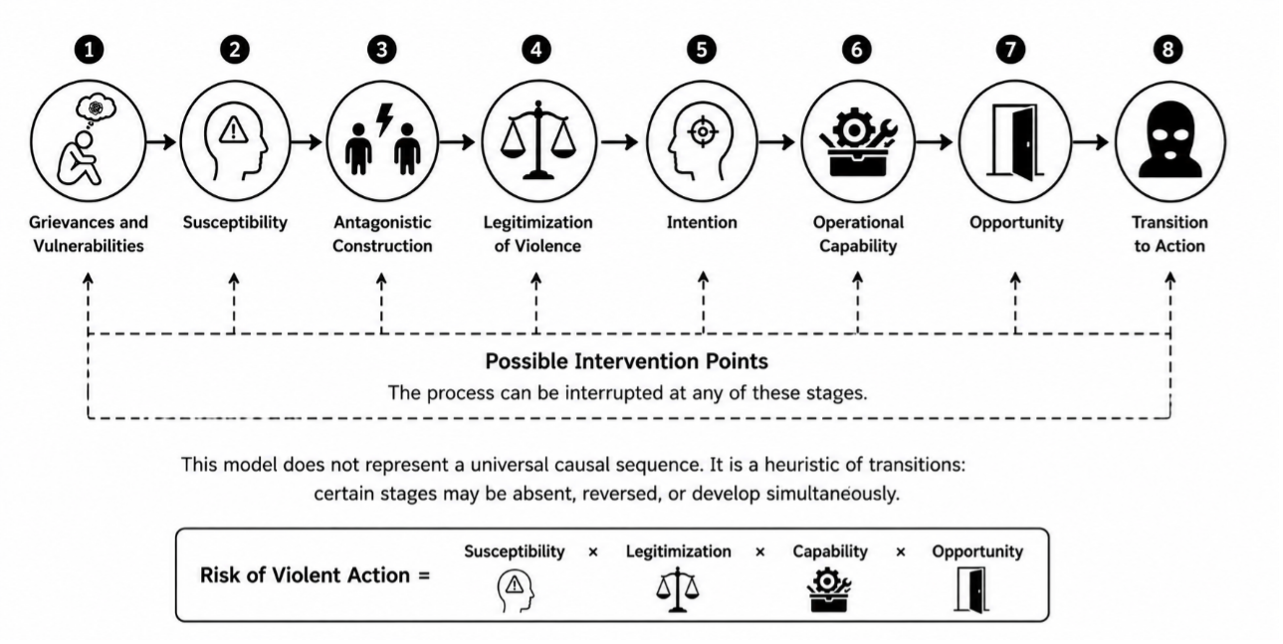
For analytical rather than statistical purposes, the relationship may therefore be expressed as:
Risk of violent action = Susceptibility × Legitimization × Capability × Opportunity
The multiplicative formulation simply underscores that a high level in one dimension may remain without consequence if another essential component remains weak.
5. Disrupting the Chain: Toward a New Architecture of Prevention
The strategic implication of the model is direct.
A policy primarily centered on the actor asks: Who is radicalized? Which network does the individual belong to? What capabilities does the actor possess? What target is being considered?
A disruption-oriented policy adds another question:
At what point can we prevent the next transition?
Four areas of intervention emerge.
The first consists in disrupting susceptibility. This does not mean automatically securitizing psychological difficulties or social grievances. Rousseau and her co-authors instead advocate clinical and multi-actor approaches capable of addressing distress and integration while avoiding the reduction of the problem to a purely security issue.
The second consists in disrupting legitimization. Counter-narratives should focus less on mechanically producing an opposing narrative and more on dismantling the mechanisms that convert a grievance into normative authorization to harm: totalizing attribution, delegitimization of the other, and the transformation of violence into necessity.
The third consists in disrupting capability. This means increasing the barriers separating intention from action: securing data and access, designing safeguards into technologies, addressing organizational vulnerabilities, and anticipating the declining thresholds associated with emerging technologies.
The fourth consists in disrupting opportunity by strengthening target resilience and reducing the circumstances in which intention and capability can converge within an exploitable environment.
The strength of this architecture lies in its redundancy.
No single intervention needs to succeed on its own.
If susceptibility persists, legitimization may still be interrupted. If violence becomes legitimate in the eyes of the individual, the acquisition of capabilities can still be constrained. If capability exists, the target vulnerability can still be reduced. And if these mechanisms fail, conventional security intervention retains its full role.
The objective, therefore, is not to replace security with prevention, but to construct a multi-layered prevention architecture for disrupting the transition to violent action.
Conclusion
The three works mobilized here were not designed to produce a unified theory of terrorism. Yet their intersection reveals a productive analytical articulation. Rousseau and her co-authors show that trajectories toward violent extremism or violent nihilism emerge within configurations involving vulnerabilities, grievances, identity, and social relationships. Tinnes illuminates the normative processes through which violence is constructed as legitimate—or, conversely, can be delegitimized. Becker and his co-authors demonstrate that even intention is insufficient: its translation into action depends on capabilities, barriers to adoption, technological conditions, and opportunities for operationalization.
Taken together, these perspectives suggest that terrorism does not reside in any isolated characteristic of the actor, but in the progressive connection of conditions that make the transition to violence possible. Prevention should therefore shift its analytical focus from the profile to the transition, and from individual transitions to the chain that connects them.
Within this chain, however, legitimization constitutes a particularly critical threshold. A grievance—whether real, perceived, or discursively amplified—does not in itself authorize violence. Recognizing an injustice must never be conflated with recognizing the legitimacy of violence committed in its name. The decisive transformation occurs when grievance is reframed as a moral license to harm: responsibility is generalized, the adversary is delegitimized or dehumanized, and violence is reclassified as defense, resistance, justice, duty, or necessity. The legitimization bridge, therefore, represents not the natural consequence of grievance but a constructed normative rupture through which violence is made to appear permissible.
This distinction has major implications for counterterrorism. Effective prevention should neither deny grievances nor allow their existence to become a rhetorical shield for violence. Its task is to decouple grievance from the authorization of violence: to preserve legitimate spaces for political contestation, protest, and civil resistance while firmly challenging the ideological and discursive mechanisms that seek to transform injustice—real or alleged—into permission to harm.
The proposed model consequently reframes counterterrorism as the strategic disruption of transitions. It seeks to prevent vulnerability from developing into susceptibility, grievance from hardening into antagonism, antagonism from crossing the legitimization threshold, legitimization from becoming operational intent, intent from acquiring capability, and capability from encountering an exploitable opportunity.
This does not diminish the importance of detecting and neutralizing dangerous actors. Rather, it expands the preventive architecture around them. The most mature counterterrorism strategy is therefore not simply one that intervenes earlier against the actor, but one capable of identifying and disrupting the connections that make violent action possible.
The paradigm shift proposed by this study can thus be summarized in a single proposition:
Move from countering the actor to disrupting the pathway to violence: recognize grievances without legitimizing violence, break the normative bridge that turns perceived injustice into permission to harm, and multiply the points at which the progression toward terrorist action can be interrupted.
References
Becker, Michael H., Eleanor Greenbaum, Louis M. Wasser, Steve Sin, and Austin Doctor, “Lethal Adaptation or Overpriced Junk? A Practitioner-Informed Assessment of Geospatial-Enabled Threats by Non-State Adversaries,” Perspectives on Terrorism 20, no. 2 (June 2026): 9–34. DOI: 10.19165/NDZG7382.
Rousseau, Cécile, Cindy Ngov, and Sébastien Brouillette-Alarie, “Referral Pathways and Clinical Profiles among Individuals Involved in Violent Extremism and Violent Nihilism,” Perspectives on Terrorism 20, no. 2 (June 2026): 101–111. DOI: 10.19165/XBOM1483.
Tinnes, Judith, “Bibliography: Legitimisation and Delegitimisation of Terrorism,” Perspectives on Terrorism 20, no. 2 (June 2026): 129–163.
[1] See the detailed references at the end of this study.