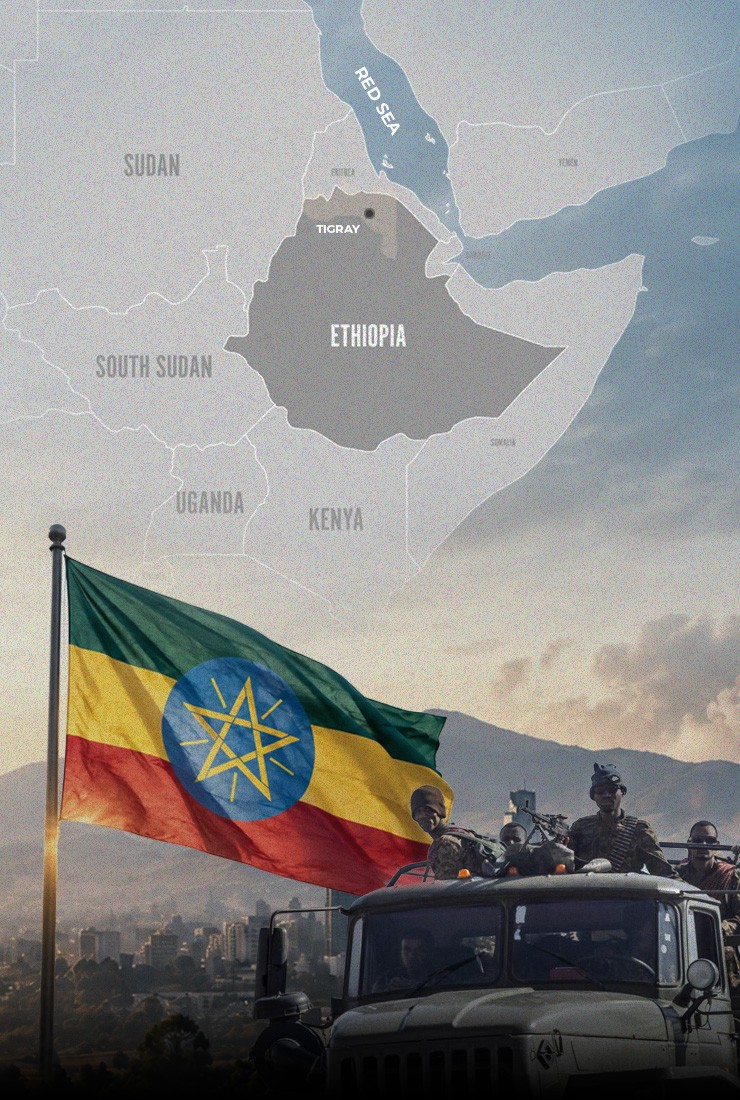
The world is no longer organized around a single center of power. The emergence of a multipolar world order has heightened the strategic significance of regions across the globe.[1] Among these regions, the Horn of Africa has gained particular significance due to its history, geography, demography, culture, and politics.[2] Conventionally encompassing Djibouti, Eritrea, Ethiopia, Somalia, and the de facto but internationally unrecognized Somaliland, the Horn of Africa is marked by remarkable demographic and linguistic diversity, with an estimated 115 million inhabitants and approximately 130 languages.[3]
Within this regional landscape, Ethiopia occupies a distinctive and pivotal position as the Horn’s most populous and territorially largest country.[4] It borders every core Horn country, as well as Sudan, South Sudan, and Kenya. Yet Ethiopia’s significance extends far beyond demographic and territorial weight. Its historical place in the recovery of African history and civilizational achievement, together with its role in the struggle against colonial domination, has given it a distinctive position in projects of continental unity and regional security. Given this broader continental and regional significance, Ethiopia’s domestic politics rarely remain purely domestic. Developments within the country can reverberate across its borders, shaping regional relations and the wider political order of the Horn.[5]
This complexity that defines Ethiopia has long expressed itself in consequential ways. Against this backdrop, the civil war that erupted in November 2020 between the Ethiopian federal government and the Tigray People’s Liberation Front (TPLF) quickly evolved beyond an internal constitutional dispute. The conflict spilled into neighboring Ethiopian regions, drew Eritrean forces into the fighting, triggered significant refugee flows, and tested the capacity of African and international institutions to respond to mass atrocities and uphold the principles of the Responsibility to Protect (R2P).[6] In November 2022, the parties signed the Pretoria Cessation of Hostilities Agreement, which brought a substantial reduction in large-scale fighting but did not fully resolve the underlying territorial, political, security, and accountability issues stemming from the conflict.[7]
Fast forward to 2026, the civil war returns amid the seven-rebel-group coalition aimed at overthrowing the incumbent government under Prime Minister Abiy Ahmed.[8] However, this renewed crisis cannot be simply understood as another recurrence of the previous civil war.[9] Rather, it must be situated within the structural configuration of Ethiopia as a federal state and the broader context of the regional security complex.
This raises a central question: Why has conflict re-emerged in northern Ethiopia despite the 2022 Pretoria Agreement, and what does its resurgence mean for security and stability in the Horn of Africa?
Return to Conflict
The TPLF was the dominant force within the Ethiopian People’s Revolutionary Democratic Front (EPRDF), the coalition that governed Ethiopia after the fall of the Derg in 1991. Although the EPRDF comprised several regional parties, the TPLF exercised disproportionate influence over federal political institutions, the security apparatus, and national economic decision-making.
This political order shifted in 2018, when Abiy Ahmed Ali became prime minister and launched reforms that sought to restructure the country’s political, security, and economic institutions. The TPLF subsequently withdrew to Tigray and increasingly distanced itself from the federal reform process. This positioning escalated to the point where, in November 2020, the political rupture transformed into open armed conflict.[10]
The immediate trigger for the war remains contested. The federal government stated that TPLF forces attacked the Northern Command of the Ethiopian National Defense Force in November 2020, making a military response necessary to restore constitutional order and protect national troops. The TPLF argued that it acted defensively amid an encircling federal campaign and threats to Tigray’s autonomy.
Beneath these competing accounts lay deeper disputes over constitutional authority, elite power, federalism, ethnic insecurity, and control of the Ethiopian state.[11] The breakdown of political bargaining turned those disputes into armed confrontation, claiming the lives of approximately 600,000 people and destroying massive infrastructure.
Two years later, the Pretoria Cessation of Hostilities Agreement was signed to end the large-scale fighting and to establish a framework for disarmament, reintegration, restoration of federal-regional relations, and reconstruction.[12] Accordingly, the federal government began the restoration process, which culminated in the TPLF officially being removed from Ethiopia’s national terrorist designation as part of the broader normalization process in 2023.
The agreement, however, was a cessation framework rather than a complete political settlement; therefore, despite efforts toward restoration and normalization, the civil war produced consequences that cannot be resolved in the short term.[13] It undermined state authority and governance, expanded the number of armed actors, deepened ethnic polarization, and strained military and economic resources. Collectively, these effects reinforced unresolved federal, political, territorial, and security tensions whose consequences extend beyond Ethiopia into the broader regional security complex of the Horn of Africa.[14]
These unresolved tensions have also contributed to renewed armed confrontation. Following the incumbent government’s parliamentary majority in the June 2026 national elections, a coalition of seven rebel groups reportedly emerged under the name “Ethiopian Peoples’ Forces Alliance for Survival,” or “Alliance for Survival,” with the stated objective of regime change. The coalition brings together former adversaries, including the TPLF, Amhara Fano, and the Oromo Liberation Army (OLA), alongside groups from the Somali, Afar, and Benishangul-Gumuz regions. Despite their distinct grievances, the groups share a stated objective.
The alliance marks a significant convergence of Ethiopia’s otherwise fragmented armed opposition. It also introduces a wider regional dimension. For instance, the federal government has accused Eritrea of supporting the coalition, an allegation Eritrea has denied.[15], [16]
Source: BBC[17]
Stakeholders
Adding to the complexity of the renewed armed confrontation is the growing diversity of actors with vested interests in the conflict. Unlike the 2020 civil war, which was primarily framed around the confrontation between the federal government and the TPLF, the current security environment involves a wider constellation of internal and external actors whose interests, alliances, and strategic calculations may create a more fragmented conflict environment that could transform localized confrontations into broader security challenges.
The internal actors add up to 8, including the federal government of Ethiopia and the 7 rebel groups.[18] As for the external actors, there could be no definitive number as the conflict is still unfolding. However, this article will take into account the countries and institutions that have directly expressed concern over the issue through their state ministry or press secretariat. Accordingly, the U.S., the EU, the AU, France, the UK, the UAE, Russia, Qatar, and Japan have condemned the renewed confrontation and urged rebel groups to stop undermining the sovereignty of the country.
Moreover, regional actors such as Eritrea, Somalia, Sudan, South Sudan, Kenya, Djibouti, and Somaliland should also be considered as stakeholders, as the renewed confrontation can have more extensive and less predictable spillover effects into these states. Thus, the significance of the renewed confrontation extends beyond the immediate parties to the conflict. Its trajectory could have implications for regional stability, interstate relations, humanitarian conditions, and the broader security architecture of the Horn of Africa.[19]
Implications for Security and Stability
With so many actors, interests, and competing calculations converging around the conflict, a fundamental question emerges: what is at stake for those directly involved, and what might its consequences be for the wider security and stability of the Horn of Africa?
Ethiopia
Despite its complex geopolitical position, Ethiopia will inevitably bear the most direct and severe consequences of renewed instability. Security is often framed in political and military terms. In the context of the Northern War, however, human security is more urgent. The 2020 war demonstrated the scale of these human costs, with civilians subjected to killings, conflict-related sexual violence, forced displacement, food insecurity, and severe restrictions on humanitarian access.[20], [21] Against this backdrop, the current disruption of telecommunications, suspension of flights, and closure of roads raise serious humanitarian concerns. Such disruptions can heighten civilian vulnerability and deepen the human costs of renewed instability.[22]
Moreover, the conflict, if prolonged, drains Ethiopia’s military and economic capacity. This conspicuously exhausts its ability to manage a wider regional security environment. War at home can therefore weaken strategic rooms abroad. Neighboring states may respond to domestic instability by hardening their own security postures, particularly around questions of territorial sovereignty.
Ethiopia’s pursuit of Red Sea access is consequently also at stake. A state consumed by internal conflict has less political space to reassure its neighbors, sustain diplomatic coalitions, and credibly communicate its strategic intentions. Domestic instability can thus reverberate outward, constraining Ethiopia’s regional ambitions precisely when its external position requires greater diplomatic room.
Eritrea
Eritrean forces have a recent history of participating alongside the Ethiopian federal government during the 2020 war.[23] More importantly, since the post-war period did not produce a stable security settlement between the two states and Ethiopia’s subsequent pursuit of Red Sea access has contributed to renewed tensions, the renewed conflict therefore has a high potential to transform from an internal Ethiopian security issue into a potential point of interstate confrontation and create a broader regional conflict involving neighboring states.
On this note, Ethiopia’s decision to close its embassy in Eritrea and the expulsion of 10 Eritrean diplomats from Addis Ababa on 1 October 2026, should be understood as a calculated threshold in an accumulating security crisis, rather than an isolated deterioration in bilateral relations.[24] From Addis Ababa’s perspective, renewed fighting in northern Ethiopia, alleged Eritrean support for armed groups, and threats to strategically important areas have demonstrated that normal diplomatic engagement is no longer sufficient to protect Ethiopia’s interests.
Somalia
The renewed conflict could significantly affect Ethiopia’s role in Somalia. For decades, Ethiopia has been a central military and diplomatic actor in Somalia, particularly in counterterrorism and regional security arrangements. Yet sustained warfare at home could place these external commitments under strain. The diversion of troops, resources, political attention, and diplomatic capacity toward the domestic front may reduce the scope and consistency of Ethiopia’s engagement in Somalia.
More significantly, the implications extend beyond security cooperation. Tensions between Ethiopia and Somalia have intensified over Red Sea access [25] and Ethiopia’s engagement with Somaliland. Renewed internal conflict could therefore create strategic space for Somalia to advance its position on these questions. Ethiopia’s domestic political pathologies could thus echo through its bilateral relations and alter the wider balance of security in the Horn.
Djibouti
For Djibouti, the implications of the renewed conflict will be strategically significant because of Ethiopia’s dependence on Djibouti for external trade. Ethiopia’s landlocked position makes access to maritime infrastructure essential to its economic security, and Djibouti has become its principal logistical gateway.[26] The renewed conflict, therefore, occurs against a broader context in which Ethiopia is already confronting the strategic vulnerability associated with dependence on a single major maritime corridor. Consequently, the security implications extend beyond military conflict: instability in Ethiopia can affect regional trade routes, transport infrastructure, and the economic relationship linking Ethiopia and Djibouti.
Moreover, the implications extend beyond bilateral relations. Djibouti hosts several foreign military bases, making instability in the surrounding region particularly consequential for its strategic environment.[27] As a result, any spillover of the conflict into Djibouti is unlikely to remain confined to the bilateral or regional level and could have wider international security implications. Given Djibouti’s strategic position at the Bab el-Mandeb Strait and its role as a major logistical and maritime hub, heightened instability could disrupt military operations, commercial shipping, humanitarian corridors, and the movement of goods between the Red Sea and the Gulf of Aden.[28]
What begins as an Ethiopian security crisis could thus acquire consequences far beyond Ethiopia’s borders. Any spillover into Djibouti would intersect with the strategic interests of external powers operating in the Horn. The conflict could consequently reverberate through one of the region’s most important commercial and military corridors.
Sudan
The conflict also has the potential to produce direct security and humanitarian consequences for Sudan. The 2020–2022 war had large numbers of people crossing into eastern Sudan, placing additional pressure on already limited humanitarian and administrative capacities in border areas. The presence of displaced populations and armed actors near the border created additional security concerns, while longstanding territorial disputes over Al-Fashaga between Ethiopia and Sudan complicated bilateral relations. These dynamics have become particularly significant given Sudan’s own ongoing civil war. [29]
Thus, the renewed conflict will likely contribute to an increasingly interconnected conflict environment in which instability in northern Ethiopia can interact with Sudan’s internal war, border disputes, displacement, and competing regional alliances. Therefore, the renewed conflict would contribute to a more militarized regional environment in which border disputes, refugee movements, and armed mobilization become more dangerous. It will add another layer of insecurity to a frontier already affected by contested land, weak governance, and competing security actors.
Is the Future of the Horn Guaranteed?
Taken together, the conflict illustrates the interconnected nature of the Horn of Africa’s security complex. A domestic conflict in one state can alter the strategic calculations, security capacities, and external relations of neighboring states.[30] More importantly, the fragile nature of the Horn region contributes greatly to the spillover effect of conflict across borders.
However, beyond regional fragility, what gives this contemporary political pathology its raison d’être is the persistence of contested state authority, unresolved political grievances, porous borders, and transnational security networks. These factors make domestic instability difficult to contain within national boundaries, allowing conflict to generate refugee flows, armed mobilization, and shifts in the strategic calculations of neighboring states.
A similar (not exactly the same) situation to bear in mind is the Alliance of the Sahel states, where the military leaders of Burkina Faso, Mali, and Niger came under the control of military governments after successive coups between 2020 and 2023. Although this scenario might seem very far from the current situation in Ethiopia, the slightest likelihood could never be ruled out. As the military governments in the Sahel initially started as junta groups and later grew in force through interstate alliances, the intrastate alliance formation of the seven rebel groups within Ethiopia could potentially transform otherwise fragmented actors into a more cohesive political and military bloc.
More importantly, if this alliance finds space within the already fragile Horn region (where Al-Shabaab exists),[31] it could potentially replicate the West African crisis on the East African front. Such an alignment could increase their collective capacity to challenge state authority, expand territorial influence, and negotiate from a stronger position. If the alliance were to become more institutionalized, its implications could extend beyond military coordination to questions of political representation, territorial governance, and the future configuration of states in the Horn of Africa.
The broader concern, therefore, is not simply the existence of multiple armed groups in Ethiopia, but whether their alliance could develop into a sustained political-security coalition capable of reshaping the internal balance of power and consequently the longer-term security architecture of the region.
[1] Tobias Bunde and Sophie Eisentraut, “Introduction: Multipolarization,” in Munich Security Report 2025: Multipolarization (Munich Security Conference, 2025), 13–31, https://doi.org/10.47342/EZUC8623-1; Liu Lingling, “The Transition to a Multipolar World: An Inevitable Reality,” Global Times, 2025, https://www.globaltimes.cn/page/202502/1328926.shtml.
[2] Alexander Rondos, “The Horn of Africa—Its Strategic Importance for Europe, the Gulf States, and Beyond,” Horizons, no. 6 (Winter 2016), https://cirsd.org/horizon-article/the-horn-of-africa-its-strategic-importance-for-europe-the-gulf-states-and-beyond/.
[3] Sundus Ahmed, “The Horn of Africa,” BlackPast, August 11, 2021, https://blackpast.org/global-african-history/the-horn-of-africa/.
[4] Bora Askinoglu, “Understanding Ethiopian Geopolitics: A Historical and Contemporary Assessment,” Venice Diplomatic Society, August 31, 2026, https://www.venicediplomaticsociety.com/understanding-ethiopian-geopolitics-a-historical-and-contemporary-assessment/.
[5] Mihretu Shanko Gidi, “Ethiopia’s Strategic Influence: Shaping Geopolitical and Economic Dynamics in the Horn of Africa,” Asian Journal of Social Science Studies 10, no. 1 (2025), https://doi.org/10.20849/ajsss.v10i1.1490.
[6] Israel Nyaburi Nyadera and Census O. Osedo, “Civil War between the Ethiopian Government and the Tigray People’s Liberation Front: A Challenge to Implement the Responsibility to Protect Doctrine,” African Journal on Conflict Resolution 23, no. 1 (2023): 35–59, https://doi.org/10.17159/ajcr.v23i1.16771.
[7] Abel Abate Demissie, Navigating the Regionalization of Ethiopia’s Tigray Conflict: How Regional and International Actors Can Help Consolidate Peace (Chatham House, September 2023), https://www.chathamhouse.org/sites/default/files/2023-09/2023-09-07-regionalization-tigray-conflict-abate-demissie.pdf.
[8] Council on Foreign Relations, “Conflict in Ethiopia,” Global Conflict Tracker, updated September 29, 2026, https://www.cfr.org/global-conflict-tracker/conflict/conflict-ethiopia.
[9] Horn Review, “Ethiopia’s Tigray Crisis in Context,” September 24, 2026, https://hornreview.org/2026/09/24/ethiopias-tigray-crisis-in-context/.
[10] Frederick Appiah Afriyie et al., “Diagnosing Ethiopia’s Tigray War: Reverberations in the Horn of Africa,” Insight on Africa 15, no. 2 (2023): 139–51, https://doi.org/10.1177/09750878231170177.
[11] Franz Kassa, “Who Started the War on Tigray?,” Tghat, March 31, 2021, https://www.tghat.com/2021/03/31/who-started-the-war-on-tigray/.
[12] Fana Gebresenbet and Yonas Tariku, “The Pretoria Agreement: Mere Cessation of Hostilities or Heralding a New Era in Ethiopia?,” Review of African Political Economy 50, no. 175 (2023): 96–106, https://library.au.int/pretoria-agreement-mere-cessation-hostilities-or-heralding-new-era-ethiopia.
[13] Africa Center for Strategic Studies, “Rising Tensions in Tigray Risk Regional Conflict,” Spotlight, March 24, 2025, updated March 26, 2025, https://africacenter.org/spotlight/rising-tensions-tigray/.
[14] Abel Abate Demissie, Navigating the Regionalization of Ethiopia’s Tigray Conflict.
[15] Bacha Debele, “Interview with Ambassador General Bacha Debele on Current Developments in Northern Ethiopia, and Eritrea,” interview by Blen Mamo, Horn Review, September 26, 2026, https://hornreview.org/2026/09/26/interview-with-ambassador-general-bacha-debele-on-current-developments-in-northern-ethiopia-and-eritrea/.
[16] Lucy Fleming, “Are Ethiopians Marching Back to War in Tigray?,” BBC News, 2026, https://www.bbc.com/news/articles/c6d94wywx0ypo.
[17] Michael Teferi and Basillioh Rukanga, “Seven Ethiopian Rebel Groups Form New Alliance,” BBC News, 2026, https://www.bbc.com/news/articles/ckp84pj8zpngo.
[18] Fleming, “Are Ethiopians Marching Back to War in Tigray?”
[19] Antonio Cascais, “How Tigray’s Renewed Fighting Could Spread in Horn of Africa,” Deutsche Welle, September 25, 2026, https://amp.dw.com/en/how-renewed-fighting-in-tigray-could-spread-across-the-horn-of-africa/a-79410333.
[20] International Commission of Human Rights Experts on Ethiopia, Report of the International Commission of Human Rights Experts on Ethiopia (United Nations, 2023), https://digitallibrary.un.org/record/4041317.
[21] Human Rights Watch, “Crimes against Humanity and Ethnic Cleansing in Ethiopia’s Western Tigray Zone,” April 6, 2022, https://www.hrw.org/news/2022/04/06/crimes-against-humanity-and-ethnic-cleansing-ethiopias-western-tigray-zone.
[22] Council on Foreign Relations, “Conflict in Ethiopia.”
[23] International Crisis Group, Ethiopia’s Tigray War: A Deadly, Dangerous Stalemate, Africa Briefing no. 171 (April 2, 2021), https://www.crisisgroup.org/brf/africa/ethiopia/b171-ethiopias-tigray-war-deadly-dangerous-stalemate.
[24] Horn Review Editorial, “Ethiopia Closes Its Embassy in Asmara, What Could This Mean?,” Horn Review, October 1, 2026, https://hornreview.org/2026/10/01/ethiopia-closes-its-embassy-in-asmara-what-could-this-mean/.
[25] Emrakel Sileshi, “The Corridor Logic: Ethiopia’s Sea-Access Strategy,” The Reporter, March 28, 2026, https://www.thereporterethiopia.com/49904/.
[26] Sileshi, “The Corridor Logic.”
[27] Kelechukwu Dennis Ezeh and Gerald Ekenedirichukwu Ezirim, “Foreign Military Bases (FMBs) and Economic Security in Africa: Overview of FMBs in Djibouti,” International Journal of Geopolitics and Governance 2, no. 1 (2023): 10–26, https://doi.org/10.37284/ijgg.2.1.1214.
[28] Adhithyan K. P., “Djibouti: A Strategic Choke Point in the Bab el-Mandeb Region,” Electronic Journal of Social and Strategic Studies 5, no. 2 (2024): 283–94, https://doi.org/10.47362/EJSSS.2024.5211.
[29] Erika Holmquist and Anna Ida Rock, Regional Security Dynamics in the Horn of Africa, FOI Memo 8194 (Swedish Defence Research Agency, June 2023), https://www.foi.se/rest-api/report/FOI%20Memo%208194.
[30] Cascais, “How Tigray’s Renewed Fighting Could Spread in Horn of Africa.”
[31] Holmquist and Rock, Regional Security Dynamics in the Horn of Africa.