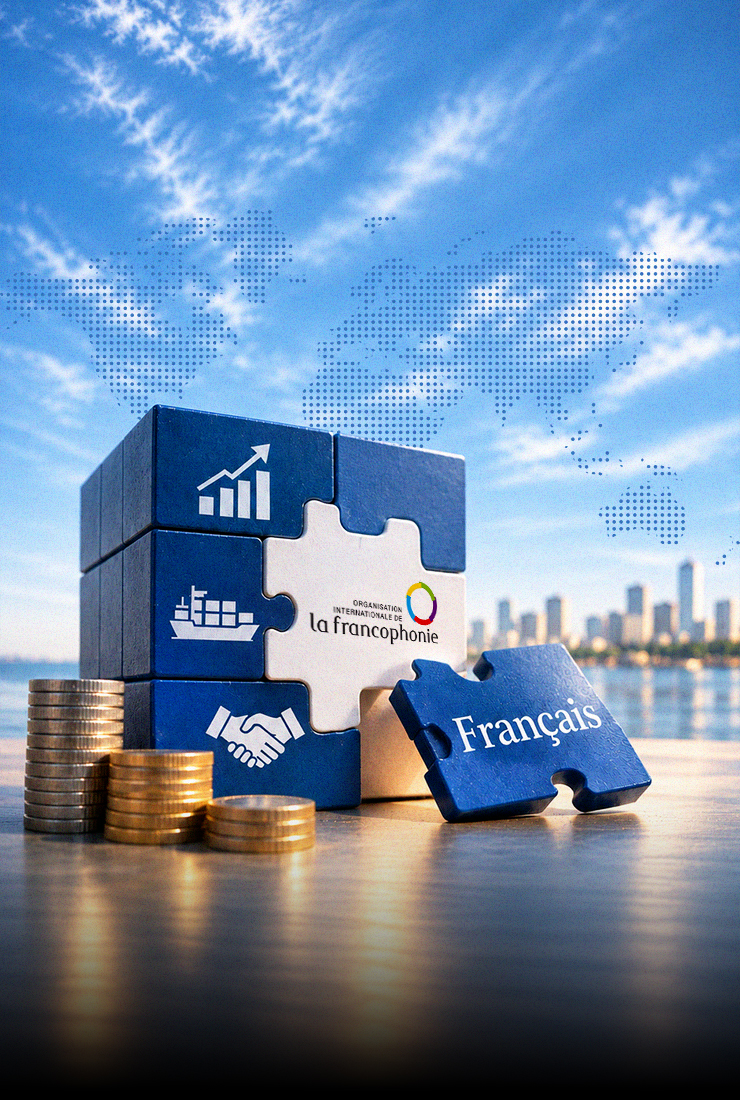
The international position of French depends not only on the individual economic weight of Francophone states and governments but also on their capacity to organize a coherent, integrated, and influential economic space. The Francophonie has expanded geographically and institutionally, yet this expansion raises the question of whether numerical growth is accompanied by sufficient economic integration and collective capacity for action. This insight examines the structural limits of Francophone economic integration through trade disparities, weak intraregional cooperation, the absence of a clearly identified institutional operator devoted to economic programming, and the broader question of the geopolitical and geoeconomic weight of member states. It then considers the implications of these constraints for Francophone diplomacy and for the positioning of French in the international public sphere.
Hesitations in constructing and structuring of an integrated and cohesive French-speaking economic area
Another obstacle to the Francophonie’s prominent and relevant positioning as a balancing force in the global political arena can be found in the lack of progress in building an integrated French-speaking economic area. This state of affairs, which is clear evidence of the “procrastination observed in the management of the economic component” (Collectif, 2009), can be seen in the disparity in trade within the Francophone area and in the absence of a Francophone institutional operator responsible for economic planning.
The issue of trade disparities within the French-speaking world and weak intraregional economic cooperation
As shown above, the French-speaking world has considerable and significant capabilities and potential in terms of economic and trade exchanges; it is therefore likely to have a significant impact on the global geo-economy. However, it is important to note that trade between member countries of the French-speaking community is marked by inequality and disparity, which leads to weak economic growth in the French-speaking world (Tabi Manga, 2010) and makes the French-speaking world unattractive (Tabi Manga, 2010). This situation of trade disparity is a major obstacle to the creation of a strong, integrated Francophone economic area. In this regard, the analyses carried out by Aymeric Chauprade—in L’espace économique francophone, Paris, Ellipses, 1996—and taken up by Jean Tabi Manga (2010) are particularly evocative and revealing of this reality.
Indeed, as Aymeric CHAUPRADE, a member of the Francophone Business Forum (FFA), points out, “trade between French-speaking countries accounts for 14% of the total trade of the member states of this community.”
Trade with other French-speaking countries accounts for 5% of the total for Canada, between 5% and 10% for Bulgaria, Cape Verde, Romania, and the Seychelles, between 10% and 20% for Cambodia, Egypt, France, Guinea, Lebanon, Mauritius, and Vietnam, between 20% and 30% for Gabon, between 30% and 40% for Ivory Coast, Madagascar, Morocco, Mauritania, Senegal, and Tunisia, and between 40% and 50% for Cameroon, Luxembourg, Niger, and Chad… (Tabi Manga, 2010).
From the same analytical perspective, Jean Tabi Manga emphasizes that “Trade between French-speaking countries accounts for 14% of their total trade. In fact, nearly 25% of French and Belgian exports are destined for French-speaking countries, while Canada devotes only 5% of its foreign trade to French-speaking countries. French-speaking countries in the South conduct most of their trade with French-speaking countries in the North. The most knowledgeable observers recognize that this trade exceeds 10%. Overall, it is observed that within the Francophone economic space, North-North exchanges are clearly dominant. They account for 60% of the total, while South-South flows represent only 2%” (Tabi Manga, 2010).
It appears that French-speaking countries in the South mainly trade with their former colonial powers (Tabi Manga, 2010). This imbalance in trade within the French-speaking world contributes to France’s hypercentrality and “exorbitant weight” in the galaxy of French-speaking trade (Tabi Manga, 2010).
The early stages of the Francophone Business Forum and the absence of an institutional operator within the OIF responsible for economic programming
Although this statement may surprise many, it should be noted that the Francophonie does not currently have an institutional operator dedicated to addressing economic issues within the French-speaking community. Indeed, an international organization such as the Francophonie, which aspires to power and influence in the political arena of international relations, should not normally lack a body that, mandated by the Conference of Heads of State and Government—as the supreme and highest authority of the Organization—would be responsible for the implementation, execution, and application of the decisions taken and programs defined by the Summit, specifically and strictly in economic matters. Such an institutional vacuum is clearly not conducive to promoting and encouraging the establishment of the “economic cause in Francophonie” (Tabi Manga, 2010) as a fundamental concern of the Organization, at a time when it sorely lacks “strong symbols with sufficient economic impact” (Collectif, 2009).
As Jean Tabi Manga rightly points out, the lack of a “formally identified operator in the economic sphere” (Tabi Manga, 2010) has two serious consequences for the Francophonie: on the one hand, the preponderance of bilateralism over multilateralism in the conduct of Francophone economic relations—which supports and maintains the North-South dialectic, particularly to the benefit of France (Tabi Manga, 2010)—and, on the other hand, the dispersion of actors and the absence of genuine synergy between them (Tabi Manga, 2010).
However, it should be noted that if such an operator does not exist within the Francophone institutional framework, it is not because it has never been considered. Indeed, at the second Francophonie Summit held in Quebec City (Canada) in 1987, a Francophone Business Forum (FFA) was created with a view to facilitating cooperation between Francophone companies and, correlatively, promoting the development of exchanges and other relations between economic actors and operators in the Francophone community (Phan & Guillou, 2010). This body, which has the advantage of being at the crossroads of politics and economics, is therefore the only economic organization associated with the OIF (Gentili, 2010/4). However, the concrete results of this body remain very modest, and there is even a feeling that it is content merely to “hold consultations between French-speaking businesspeople” (Tabi Manga, 2010).
It is therefore necessary—indeed, urgent and essential—to rethink and redefine its role, with the aim of making it a genuine “instrument of economic and commercial strategy” (Collectif, 2009) for development in the French-speaking world.
From this research perspective, it is clear that La Francophonie is attempting to counterbalance American and Anglo-Saxon “hyperpower” by positioning itself against the manifest intentions of hegemonic, uniformist, and unilateralist control of world affairs. However, it has been pointed out that the Francophonie cannot effectively and efficiently operationalize this anti-hegemonic stance as long as it does not carry significant weight in terms of global geoeconomics and as long as it does not consider structuring itself into a solid and prosperous economic space, given the importance of economics in the power dynamics of major contemporary international players.
The nagging problem of the overall weakness and powerlessness of French-speaking states and governments
One of the factors hindering the global influence of the Francophonie, and by extension of the French language, from a power perspective, is the fact that the countries that have joined it since its creation in 1986 in Versailles (France) are not particularly powerful on a global scale. Indeed, it should be noted that of the 29 states and governments that have joined the Francophone community since the Hanoi Summit (1997), very few enjoy international renown and notoriety that is recognized and legitimized by their ability and skill to establish and position themselves as dominant actors in global politics in all its components. It is no exaggeration to point out that the states that have been part of La Francophonie for some time do not show any serious desire to appropriate and harness the various channels, niches, and networks of influence and dominance on the global political and economic stage.
In principle, numbers are a factor of power. Isn’t it said that alliances are “power multipliers”? (Massart-Pierard, 2007). It is based on this principle that La Francophonie has opted for widespread expansion with a view to increasing its numbers and exerting quantitative influence on the international stage. However, quantity is not and should not be exclusive of quality. Expansion, yes. But with whom? Can a powerful entity be built by aggregating and superimposing powerless states? Can power be built by adding up powerlessness? In other words, the question is whether it is possible to become a powerful entity with states and governments that, from a global geopolitical and geoeconomic perspective, are not powerful. This is a powerful question with many implications for the Francophonie, as it is true that we cannot build a lasting dynamic of macro-power and macro-influence by agglutinating and associating micro-powerlessness and micro-failures.
It is therefore important for the Francophonie to avoid embarking on the path of becoming a “powerless entity,” which would have a detrimental impact on the French language that it defends and promotes. An area with little economic influence is an unattractive area that lacks vitality and dynamism.
The insufficient deployment of Francophone diplomacy toward the established and emerging powers of today’s world
As we have stated in previous sections, the dynamics of enlarging the Francophone community should not be seen or perceived as contradictory or antithetical to the logic of deepening. This is a dialectic that must be carefully thought out and intelligently conducted, with a view to better rationalizing the Francophonie’s action in the international political arena. It would also be useful to note that “it is important, however, not to oppose enlargement and deepening. The new Francophonie is an acceleration that must be based on a dual movement of enlargement and deepening” (Phan & Guillou, 2011). In other words, the Francophonie must not halt the enlargement process on the pretext of the need to strengthen its institutional coherence and cohesion. From our point of view, the Francophonie must strive to open its doors to a number of states and governments that are likely to bring added value in terms of promoting the French language on the international stage.
As a logical continuation of the argument developed on the need to avoid a powerless spatial entity, this perspective gives priority to integrating into the Francophone community states and governments that are proving their worth on the global geopolitical and geoeconomic stage. In other words, La Francophonie should focus its expansion strategy on current and emerging world powers. This approach could lead Francophone diplomacy to work toward integrating the BRICS countries (Brazil, Russia, India, China, and South Africa) into the Francophone community. This is not a fanciful assertion, as these countries have a certain Francophone sensibility in terms of their relationship with French as a linguistic tool for better international order and governance. The integration of all these emerging powers will enable the Francophonie to establish itself not only as an influential and more widely heard pressure group on the international political scene, but also as a more respected and valued actor in this arena. And by extension, the French language will establish itself de facto as the language of global diplomacy.
Furthermore, the Francophone expansion strategy could be directed toward the United States of America, which is, from a holistic point of view, currently the world’s leading power. The idea may seem purely superficial and simply artificial, as it is unrealistic to think of integrating the American “superpower” into the Francophonie. That is not what we are talking about here. At this level of analysis, the aim is to enable the Francophonie to penetrate American territory by integrating the state of Louisiana into the Francophone world. What may seem insignificant is nevertheless of particular importance. Louisiana is a state in the southern United States bordered by Texas, Arkansas, Mississippi, and the Gulf of Mexico. The Louisiana Territory was sold to the United States by Napoleon I in 1803, when it was predominantly populated by settlers of French origin who spoke French. The French language remained predominant there until the Civil War. Despite the considerable decline of French in Louisiana, the state currently has a French-speaking minority, the Cajuns (Phan & Guillou, 2011), which means that the French-speaking population of Louisiana is around 5%. This makes Louisiana the most French-speaking state in the United States. For the Francophonie, expanding in this way carries a unique symbolic significance, as it is a means of introducing or maintaining elements of the Francophonie within the territory of the world’s leading power, and of adding a layer of power to the French language.
Conclusion
The aim of this article was to demonstrate how the French language stands out for its shortcomings due to the overall weakness and powerlessness of French-speaking states and governments, and the overall geo-economic powerlessness of almost all countries in the Francophonie. Our approach consisted of analyzing microeconomic and macroeconomic data from states and governments in the Francophonie. These data were analyzed using “comparative variation” (Guillemette and Luckerhoff, 2023, p. 294). The results show that the French language is a victim of the geo-economic powerlessness of most of the countries that use it. In other words, the French language cannot be a language of power as long as the countries that use it are not powerful themselves. In other words, the power of a language depends on the power of the country that uses it. The language of power in the global arena is the language of countries that are powerful in geoeconomic, geopolitical, and geostrategic terms. This is something that the Francophonie does not have on a global scale. However, it should be noted that La Francophonie, an institution promoting the French language around the world, cannot effectively and efficiently operationalize a hegemonic position in terms of language as long as it does not carry significant weight in terms of global geoeconomics and as long as it does not consider structuring itself into a solid and prosperous economic space, given the importance of the economy in the power dynamics of major contemporary international players.
References
Collectif. (2009), Francophonie et relations internationales (AUF/Éditions des Archives Contemporaines).
Gentili, S. (2010), « Le FFA, seule organisation économique internationale associée au Sommet des chefs d’État et de gouvernement francophones », Géoéconomie, 4(55), 87–97.
Massart-Pierard, F. (2007), La Francophonie des Sommets, Consensus et déchirures, Revue internationale de politique comparée, 14(1), 69–93.
Phan, T., and Guillou, M. (2011), Francophonie et mondialisation. Histoire et institutions des origines à nos jours, Belin.
Tabi Manga, J. (2010), La Francophonie. Lieu de mémoire, projet d’espoir, Afrédit.