The Transatlantic Fracture and the Brussels Pivot
The return of Donald Trump as President of the United States in January 2025 has precipitated global trade in a new phase, one where long-established criteria of market openness and non-discrimination have been discarded in favor of the use of tariffs as a primary tool of economic statecraft. While Trump is much more a symptom than a cause of the decline of globalization,[1] nonetheless his presidency embodies much of this change, especially siny131213ce the United States had been the steward of free trade and open markets in much of the late 20th and early 21st centuries. Nowhere else has the return of aggressive American protectionism, sweeping unilateral tariffs, and de facto retreat from the World Trade Organization (WTO) been more impactful than on the European Union. On the one side, free trade and market integration have long been foundational pillars of European geoeconomic power. On the other side, Europe has been a preferred target of the U.S. administration, with a tariff escalation only partially restrained by a trade deal achieved in July 2025 in Turnberry, Scotland, and partially implemented in May 2026. Nonetheless, this represents a fragile truce more than a stable economic partnership, and transatlantic trade remains exposed to risks of economic coercion.
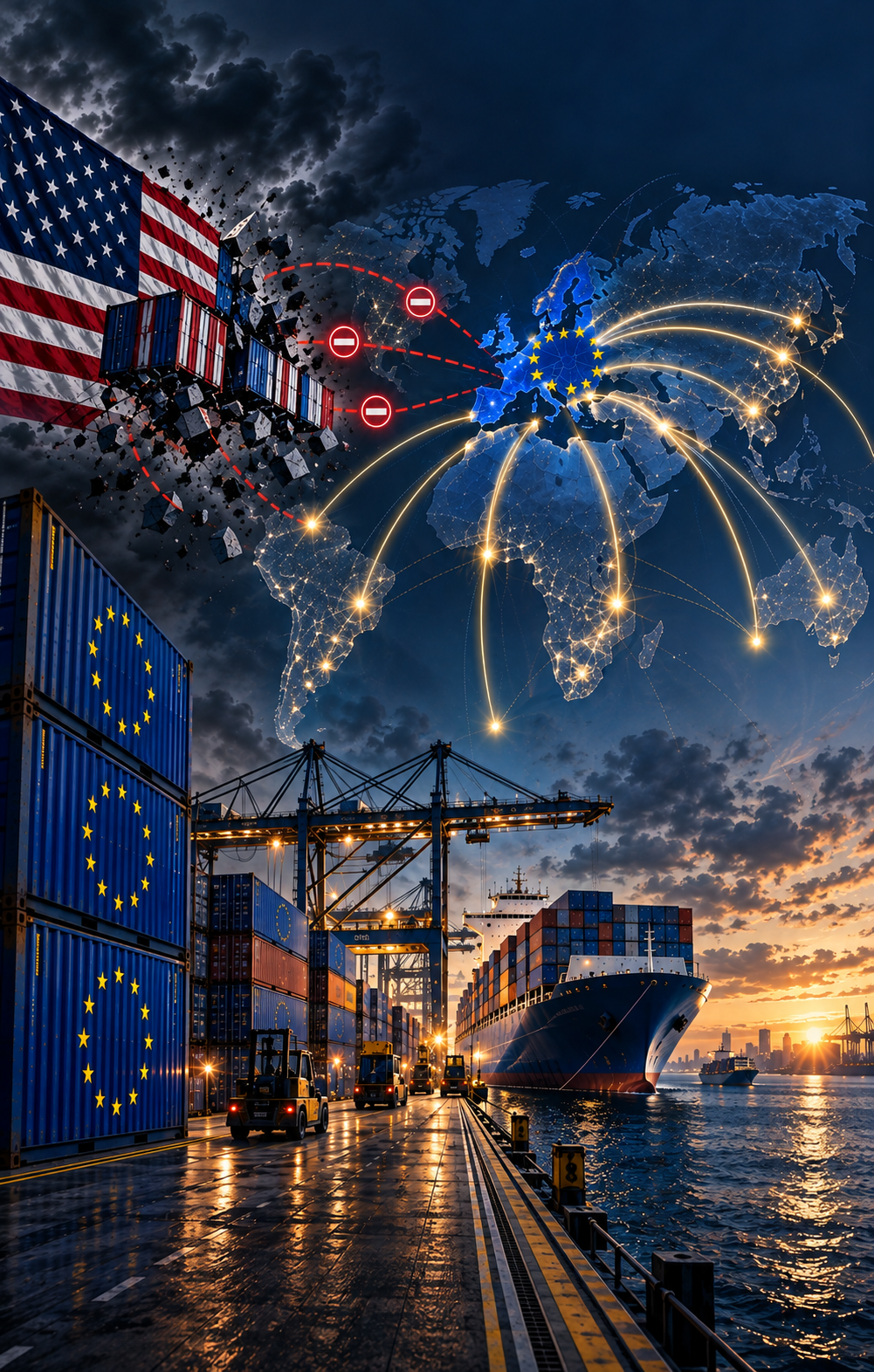
The European response has been characterized by two parallel tracks: safeguarding, as much as possible, the economic engagement with the United States, and diversifying its partners at the global level. This is particularly remarkable since a traditionally defensive economic power like the EU has launched a multi-directional and unprecedented trade “offensive”, seeking to build trade partnerships all around the globe to diversify and potentially substitute the American market. This pivot is driven by the realization that in a world of “fortress” economies, security is found not in the height of one’s tariff walls but in the breadth of one’s network. By accelerating Free Trade Agreements (FTAs) with the Mercosur bloc, India, and key Indo-Pacific partners, the EU is aggressively moving to fill the geoeconomic vacuum left by Washington.
The Geoeconomic Vacuum: A Dismantled Multilateralism and the EU’s Role
Europe has long been a champion of free trade; however, the international context in which it is now moving has dramatically changed. For nearly eight decades, the European project thrived under the umbrella of a rules-based multilateral trading system. Yet, by the late 2010s, that umbrella has effectively folded, giving way to a global trade architecture fractured into three overlapping yet distinct regimes: one dominated by the U.S., one by China, and one made of countries coalescing around regional trade systems.[2] The crisis of multilateralism reached a likely terminal phase following the chaotic imposition of sweeping U.S. unilateral import levies, dubbed the “Liberation Day” tariffs, which disrupted the very concept of a North Atlantic economic space. Even though much of the legal architecture for Trump’s tariff has been dismantled by the U.S. Supreme Court, the attitude of his administration has not changed—it has merely shifted the legal framework. For the EU, this structural American shift represents more than a commercial hurdle; it is a systemic threat to its economic model, which remains far more dependent on external trade than either the United States or China.
The paralysis of the WTO’s Appellate Body—now a permanent feature of the international landscape—has removed the legal custodian of global commercial treaties.[3] In this vacuum, trade is no longer governed by consensus rules, but by raw bargaining power, transactionalism, and industrial capacity. We are witnessing the emergence of a predatory geoeconomic order where the EU is squeezed between the American retreat into tariff-walled isolationism and Chinese aggressive deployment of state-subsidized industrial overcapacity. China’s primary response to sluggish domestic demand has been to export its way to growth, flooding global markets with electric vehicles, advanced solar modules, and wind turbines at prices that market-driven actors simply cannot match.[4] For Brussels, the threat is twofold: the immediate hollowing out of its domestic industrial base and the long-term risk of being permanently shut out of the “markets of tomorrow” in the Global South by Chinese dominance. This group is characterized by non-Western emerging economies in a phase of demographic expansion that will increase their role in global trade.[5]
In this context, the EU has progressively understood that its only path to maintaining any form of strategic autonomy is through a radical, rapid diversification of its trade partnerships. If the U.S. is no longer a fully reliable partner for open trade, and China remains a systemic rival that threatens key industries, Europe must construct its own international network of trade partners, safeguarding free trade if not globally at least within a group of countries that share its concerns. This geoeconomic vacuum has transformed Free Trade Agreements from mere economic instruments into essential geoeconomic tools of international engagement. By securing preferential access to diverse markets, the EU is seeking to insulate its domestic industries from U.S. tariff shocks and dilute its structural reliance on Chinese supply chains. While both are long-term objectives and can hardly be reached in the span of one or two European legislatures, nonetheless Europe is devoting itself to diversifying its exports away from the United States and imports away from China.[6]
Furthermore, the EU is using its position as the largest remaining defender of rules-based commerce to attract partners who are equally wary of being forced into zero-sum alignments in a new commercial Cold War. Emerging economies in Asia and Latin America increasingly view the EU as a stabilizing force—a partner that offers reliable market access and predictable legal protections without the erratic unilateralism of Washington or the debt-trap and sovereign risks frequently associated with Beijing’s state-backed initiatives.[7] This Brussels pivot is thus a bid to rewrite the rules of global engagement before the geoeconomic vacuum is filled by more coercive economic statecraft. Here lies the biggest geoeconomic value of Europe’s trade offensive: building a network of trade and economic partners that can act as an alternative pole in global geoeconomics.
From India to the Americas: Mapping the EU’s FTAs Offensive
Europe’s post-Trump trade offensive combines the exploration for new partners, the deepening of existing relationships—including the rapprochement with the United Kingdom—and the acceleration of already existing negotiations.
The most visible manifestation of the EU’s new trade urgency is the major institutional breakthrough with the Mercosur bloc, formed by Argentina, Brazil, Paraguay, Uruguay, and Bolivia. Following more than twenty-five years of intermittent negotiations, the EU successfully accelerated the final rounds of discussion with Latin American countries and, despite some last-minute attempts to sabotage the deal, the Council of the European Union approved the landmark trade deal by qualified majority in January 2026, leading directly to the announcement of its provisional application (on the trade component) under Article 218(5) TFEU on February 27, 2026. The resulting agreement creates an integrated marketplace of nearly 770 million people, progressively eliminating tariffs on over 90% of bilateral trade and granting European firms a crucial first-mover advantage in Latin America. While the full implementation of the deal will depend on final ratification and some resistance in member states can be expected, the achievement remains a crucial success, with the EU passing a fundamental credibility test vis-à-vis the rest of the world.
Just two weeks after greenlighting the milestone Mercosur deal, the EU signed another landmark FTA, this time with India. This represents the single largest commercial deal in the Union’s history. The agreement goes far beyond traditional tariff reduction on industrial goods; it also tackles complex regulatory domains such as digital trade data flows, public procurement markets, and intellectual property rights. For India, a country that has historically pursued a cautious approach to external trade and has only recently adopted a more open trade approach to diversify its economic ties, the deal provides a vital strategic counterweight to Chinese economic hegemony.[8] For the EU, it offers a monumental demographic and digital hedge against an increasingly complex international environment and a domestic population decline.
In Southeast Asia, the EU has moved with similar velocity. The finalization of the Indonesia-EU Comprehensive Economic Partnership Agreement (CEPA) resolved years of deep diplomatic frictions due to environmental regulations, unprocessed minerals exports, and emission standards. Brussels successfully navigated these resource-sovereignty disputes by integrating provisions that offer Jakarta technical and financial support for local green industrialization in exchange for guaranteed market access.[9] A similar template is now being used in ongoing fast-tracked negotiations with the Philippines, another key partner in the Asia-Pacific region. The EU aims to conclude a modernized and effective deal that liberalizes trade in services and raw materials while also safeguarding sustainable development. Additionally, the European Union has achieved a crucial modernization of the trade agreement with another victim of Trump’s tariffs, Mexico.[10] This updated deal expands the old one—largely limited to manufactured goods—to trade in services, public procurement, agricultural products and digital trade and underlines a shared desire to diversify away from the United States. By securing this vast arc of trade partnerships from Asia-Pacific to Latin America, the EU is building a resilient commercial architecture designed to outlast transatlantic volatility. Those markets are unable in themselves to fully substitute the U.S. one, but they provide essential diversification that compensates for an increasingly closed American market. Beyond trade, those deals also allow Europe to consolidate its global standing during uncertain times and shifting geopolitics.
A Global South Approach: Derisking, Overcapacity, and Green Industrialization
The acceleration of recent FTAs by Europe is fundamentally linked not just to U.S. unilateral tariffs but also to the EU’s overarching de-risking strategy regarding China.[11] However, unlike the blunt decoupling strategy pursued by the United States, the EU is attempting a more sophisticated—and more difficult—geoeconomic maneuver: using its comprehensive trade deals to integrate the Global South into its own trade network and green transition. At the heart of this strategy lies the stark realization that Europe’s ambitious electrification objectives cannot succeed if its supply chains remain entirely dependent on Chinese-processed lithium, cobalt, and rare earth elements, as well as on Chinese-produced electric vehicles (EVs) and batteries or solar panels.[12]
The newly implemented agreements with Chile and the Mercosur countries contain specific provisions on critical raw materials to secure access for European importers and prevent the establishment of mineral monopolies. On top of this, Europe seeks to avoid an extractive approach and looks to establish joint value chains with Latin American partners. For instance, within the finalized EU-Brazil commercial framework, European capital and technology are being directly channeled into local mineral processing facilities.[13] This targeted approach addresses a long-standing structural grievance of emerging economies: the desire to advance downstream in industrial value chains rather than remain mere exporters of raw commodities. By fostering local industrialization in partner countries, the EU seeks to build deep-rooted, industrial alliances that are far more durable than transactional purchases of unprocessed commodities.
This new deepening of partnership with Global South countries could also function as a critical frontline defense against Chinese industrial overcapacity. Countries like India and Indonesia are increasingly concerned that subsidized Chinese industrial exports may place sustained competitive pressure on their manufacturing industries. This is a concern shared by Europe, which also has the machinery manufacturing and technical expertise to support those countries in their industrialization journeys. A potential end goal of those FTAs is therefore to build an area of joint industrial production, enhancing resilience to competitive pressures from low-cost Chinese imports and concerns over industrial subsidies. To achieve this and establish a high-quality trade network, however, a progressive alignment of technical and regulatory standards through FTA provisions is necessary. Such frameworks should prioritize rigorous environmental, social, and governance (ESG) metrics, creating effective tariff and non-tariff barriers that shield local markets.
Furthermore, the EU is leveraging its Global Gateway initiative to provide the hard infrastructure necessary to make these trade agreements functional. Trade deals on paper are functionally meaningless without the physical deep-water ports, cross-border railways, and secure digital grids required to support high-volume commerce. In different Asia-Pacific countries, the EU is financing transport and energy infrastructure that will help boost bilateral trade and establish local industries. This embodies the ultimate European objective of establishing a joint trade and industrial network of integrated economies and developed value chains, where infrastructural investments support economic security.
Strategic Challenges: Domestic Hurdles, Industrial Balancing, and Global Rivals
Despite rapid progress on the trade agreements front, the EU’s trade offensive faces profound internal and external challenges. The most acute dilemma is the systemic tension between the external push for free trade and the growing domestic pressure within Europe for trade defenses and “European Preference” clauses. With the introduction of the ambitious Industrial Accelerator Act (IAA) in March 2026, which explicitly aims to ramp up domestic manufacturing, Brussels is facing an increasingly difficult balance between trade defenses and external cooperation. This profound and only partially resolved dilemma between sovereignty and openness threatens to undermine the credibility of EU trade efforts.[14] If Brussels demands that external partners fully liberalize public procurement while simultaneously restricting its own internal markets to “Made in Europe” clean technologies, diplomatic friction could threaten ongoing trade negotiations.
Furthermore, the operational complexity of building fragmented international supply chains through a patchwork of bilateral FTAs is significant. Rules of origin—a key technical component of trade agreements—have become increasingly cumbersome to enforce. For a European manufacturer to successfully utilize an FTA, they must precisely document that a substantial, legally mandated percentage of their product was processed within the designated partner country. In an era of deeply integrated global component supply chains, this administrative burden often leads to low utilization rates, particularly among small and medium-sized enterprises (SMEs).
Externally, the rivalry with China remains an overarching structural challenge. Beijing has not remained passive as the EU expands its treaty network. The constant expansion of the Regional Comprehensive Economic Partnership (RCEP) and the institutional development of the BRICS+ bloc, despite its internal diversity and differing member interests, present an alternative model to the EU’s regulatory approach.
China often provides financing and infrastructure investment with fewer explicit policy conditions than the EU, making these offers attractive to governments seeking investment without the environmental, labor, and human rights requirements typically associated with EU partnerships. This friction creates the risk that interested partners could resent the EU’s initial heavily binding anti-deforestation mechanisms or emission reductions, allowing China to actively pursue parallel, direct bilateral commodity agreements with individual states, bypassing regional sustainability frameworks entirely. Recently, China decided to scrap tariffs for all its imports from African countries, with the exception of Eswatini, which recognizes Taiwan’s sovereignty.[15]
Finally, domestic resistance within the European Union remains a potent political force. The widespread, highly disruptive farmer protests across France, Germany, and Poland over the Mercosur deal highlighted deep anxieties over agricultural competition from low-cost global producers. While the Commission’s split agreement strategy successfully bypassed certain legislative hurdles, it has amplified criticisms against the institutional framework of trade agreements. Additionally, this makes European trade policy increasingly exposed to the whims of a noisy minority: governments with crumbling consensus would be extremely wary of approving trade agreements that are opposed by particularly vocal swathes of their public opinion. Balancing the geoeconomic mandate for diversification and economic security with the defense of European agrarian and industrial constituencies is an extraordinarily delicate task for policymakers. If the macroeconomic benefits of these accelerated FTAs are large, they are also widely distributed, making them harder to be felt rapidly by the European middle class. On the other hand, the few “losers” of trade deals are often geographically and industrially concentrated, meaning they are also immediately visible and exploitable by populist movements in the political arena.
Conclusions and Policy Frameworks for European Leaders
The rapid acceleration of the EU’s free trade agenda in 2026 represents a critical act of geoeconomic survival. Squeezed between systemic American tariff regimes and pervasive Chinese state-capitalism, the European Union has rightly recognized that its vast internal market and standard-setting regulatory power are geoeconomic levers only if actively deployed abroad. The major institutional breakthroughs achieved with the Mercosur bloc and India demonstrate a vital new pragmatic agility in Brussels, prioritizing executive velocity and strategic supply chain alignment over the historically slow-moving negotiations on trade agreements.
To sustain this momentum and defend its global commercial position, European leadership must swiftly resolve its internal industrial paradox. Policymakers must ensure that defensive measures like the Industrial Accelerator Act do not devolve into a mirror image of the protectionism they seek to counter. Moving forward, the European Commission should prioritize three core objectives: first, defining the most promising global partners and crafting tailored trade agreements to ensure significant buy-in from both sides; second, consolidating the low-hanging fruit of completing the Single Market, whose finalization will also make Europe more appealing to third countries; and third, deepening partnerships that offer real infrastructure and industrialization incentives to the Global South. Ultimately, Europe’s relevance as a global power depends on its ability to keep global commerce open and rules-based, turning trade diversification and industrial partnerships into its ultimate geopolitical shield.
[1] Elisabeth Braw, Goodbye Globalization: The Return of a Divided World (Yale University Press, 2024).
[2] Hung Q. Tran, “A New World Trade Architecture With Three Regimes Takes Shape in 2026,” Policy Center for the New South, April 6, 2026, https://www.policycenter.ma/publications/new-world-trade-architecture-three-regimes-takes-shape-2026.
[3] Kristen Hopewell, “Unravelling of the Trade Legal Order: Enforcement, Defection and the Crisis of the WTO Dispute Settlement System,” International Affairs 101, no. 3 (2025): 1103-17, https://doi.org/10.1093/ia/iiaf055.
[4] Alicia Garcia-Herrero and Haoxin Mu, “China Can Decarbonise the World – but Even That Won’t Fix Its Overcapacity Problem,” Bruegel, September 24, 2025, https://www.bruegel.org/analysis/china-can-decarbonise-world-even-wont-fix-its-overcapacity-problem.
[5] Abdul Shaban, “Regional Economic Growth and Development in the Global South,” Regional Science Policy & Practice 15, no. 5 (2023): 934–38, https://doi.org/10.1111/rsp3.12684.
[6] Alberto Rizzi, “Art of the Deal: Four Ways Europeans Can Find New Trade Partners in the Trump Era,” ECFR, July 9, 2025, https://ecfr.eu/article/art-of-the-deal-four-ways-europeans-can-find-new-trade-partners-in-the-trump-era/.
[7] Elisabeth Braw, “Europe’s business advantage: Rule of law,” POLITICO Europe, June 1, 2026, https://www.politico.eu/article/europes-business-advantage-rule-of-law/.
[8] Priyanka Salve, “This Is What’s in the India-EU Trade Deal — and Who Stands to Gain,” CNBC, January 27, 2026, https://www.cnbc.com/2026/01/27/india-eu-trade-deal-tariffs-exports.html?msockid=0a27f80dc36e6bc4174eef1ec2bc6ade.
[9] Dandy Rafitrandi, “The Indonesia-European Union Comprehensive Economic Partnership Agreement (I-EU CEPA): Opportunity to Accelerate Green and Digital Transformation in Indonesia,” Indonesian Quarterly 52, no. 2 (2025).
[10] Emily Green, Philip Blenkinsop et al., “Mexico, EU sign stalled trade deal as they aim to diversify from US,” Reuters, May 22, 2026, https://www.reuters.com/world/americas/mexico-eu-sign-stalled-trade-deal-they-aim-diversify-us-2026-05-22/.
[11] Agathe Demarais, “The Bigger Picture: The Case for an EU-Mercosur Free Trade Deal,” ECFR, July 9, 2025, https://ecfr.eu/article/the-bigger-picture-the-case-for-an-eu-mercosur-free-trade-deal/.
[12] Alberto Rizzi, “The Electric Endgame: Europe’s Clean Path Out of Vassalage,” ECFR, March 3, 2026, https://ecfr.eu/publication/the-electric-endgame-europes-clean-path-out-of-vassalage.
[13] “Brazil–EU Critical Minerals Partnership Reshapes Global Supply Chains and Secures Strategic Resources,” Mining South East Europe, April 25, 2026, https://www.miningsee.eu/brazil-eu-critical-minerals-partnership-reshapes-global-supply-chains-and-secures-strategic-resources/.
[14] Ignacio García Bercero, Ben McWilliams, Antoine Mathieu Collin, and Simone Tagliapietra, “The Flaws in the European Union’s Proposed Industrial Accelerator Act and How to Fix Them,” Bruegel, May 21, 2026, https://www.bruegel.org/policy-brief/flaws-european-unions-proposed-industrial-accelerator-act-and-how-fix-them.
[15] Kelly Ng, “China Scraps Tariffs for All but One African Nation,” BBC News, May 1, 2026, https://www.bbc.com/news/articles/cwy2v509217o.