Why does governing the care economy matter today?
The next major infrastructure crisis may not be in energy, transport or technology, but in care. Care encompasses the paid and unpaid work, services and relationships that support people throughout their lives, including childcare, healthcare, disability support, eldercare, domestic work and assistance provided within households and communities. Although it is essential to economic participation and social stability, governments have historically treated it as a private family responsibility or a secondary area of social policy.[1] This is no longer sustainable.
The pressure on care systems is already visible. Climate change, ecological disasters, conflict, pandemics and public-health emergencies have demonstrated how rapidly care shortages can spread across hospitals, households, workplaces and public services. Demographic aging is simultaneously increasing demand for long-term care. The World Health Organization estimates that one in six people globally will be aged 60 or over by 2030, approximately 1.4 billion people, rising to 2.1 billion by 2050.[2] Advances in medicine have extended life expectancy, increasing the number of people living with chronic illness and complex care needs. At the same time, the global shortage of health workers is projected to reach 11 million by 2030, concentrated mainly in low- and lower-middle-income countries.[3]
These pressures are being intensified by declining fertility, smaller households and changing family structures, which are reducing the supply of relatives available to provide care informally. Women’s increased participation in paid employment has also exposed the limits of systems built on the assumption that families possess an endless reserve of unpaid female labor. Artificial intelligence (AI), digital health, and assistive technologies may improve access and coordination, but they also raise new questions about skills, regulation, data governance and which elements of care cannot, or should not, be separated from human relationships.
Care pressures are also moving across borders. Wealthier states are increasingly addressing workforce shortages through transnational care chains—the recruitment of nurses, domestic workers, and other care professionals from lower-income countries. This fills an immediate vacancy but is transferring shortages and responsibilities onto origin-country services, migrant households and unpaid family members. Care deficits are not being solved; they are being displaced, shifting onto those with the least power and fewest resources to absorb them.
The resulting policy challenge is clear: care is increasingly global and interdependent, while the institutions used to measure, finance, and govern it remain predominantly national, fragmented and short-term. This insight examines four connected governance weaknesses: measurement, investment, accountability for care displacement, and institutional fragmentation. It argues that care must be treated as strategic social and economic infrastructure.
Drawing on a long-term governance approach, this insight proposes a ‘Care Risk and Responsibility Assessment’, informed by the School of International Futures.[4] This framework would help governments anticipate future needs, identify where policies transfer care costs and risks, and coordinate responsibility across ministries, borders, and generations. The central test of resilient care governance is not simply whether care is provided today, but whether doing so strengthens, or quietly weakens, the systems and people on which care depends.
Why do current governance models fall short?
Measurement
The first limitation lies in how care is measured within mainstream economic frameworks. Paid care is recognized through national accounts and public budgets, although it is usually undervalued and underpaid. While unpaid care goes unrecognized. Instead, it remains outside the economic measures used to assess national performance and shape government policy. Gross Domestic Product (GDP) records the market value of goods and services produced within an economy. It therefore recognizes labor that generates a monetary transaction as economically ‘productive’, while much of the ‘reproductive’ labor performed without pay in households and communities remains uncounted.[5] This includes the birthing, cooking, cleaning, feeding, nurturing and caring for those with disabilities, unwell, or elderly. This is the daily work of making and remaking life, which sustains human capabilities, replenishes the workforce, and enables economies and societies to function.[6] Care labor, therefore, makes entry into the labor market and ‘productive’ output possible, yet it remains largely invisible within the economic frameworks used to measure productivity and national prosperity and is often deemed ‘unproductive’.
The International Labor Organization (ILO) has estimated that if unpaid care work were valued at minimum wage, it would amount to approximately US$11 trillion, which is equivalent to around 9% of global GDP.[7] This is three times the value of the global technology industry.[8] The failure to account for this work creates a significant economic blind spot. The same activity can be treated as economically visible when purchased in the market, but invisible when performed without pay within a household, community, or informal setting. This work is disproportionately undertaken by women, and thus it is no surprise that they are the gender most excluded from the workforce. According to the World Inequality Report 2022, women receive only around one-third of global labor income. This does not mean that women work less. Many are already performing essential unpaid care work, but their labor is neither counted nor compensated, producing this economic inequality. When women engage in paid employment alongside unpaid care work, their total contribution to the economy becomes far greater, making their disproportionately low share of global labor income even more unequal.
There has been important progress in addressing this US$11 trillion blind spot. International statistical frameworks, such as the 2025 System of National Accounts (SNA), adopted by the United Nations Statistical Commission, provide greater space for extended accounts that measure wellbeing, sustainability, and household production beyond core GDP.[9] This creates a stronger conceptual basis for governments to recognize the economic value of unpaid care through regular time-use surveys, care satellite accounts, and disaggregated indicators.[10] However, these measures remain supplementary rather than embedded within the core indicators that routinely guide a nation’s fiscal policy, budgeting, and economic planning. As a result, governments are not consistently required to produce unpaid-care accounts or act on their findings, meaning care may be measured without materially shaping policy or investment decisions.[11]
The United Kingdom (UK) and Mexico demonstrate what national measurement can look like in practice. The UK’s Household Satellite Account estimates the value of unpaid adult care, childcare, cooking, transport, volunteering, and other household services excluded from its core national accounts. In 2023, the UK valued unpaid household services at £1.7 trillion, equivalent to approximately 61% of GDP.[12] Mexico’s satellite account for unpaid household work goes further in demonstrating the gendered distribution of this labor. It measures activities including feeding, cleaning, laundry, shopping, household management, care, and emotional support. In 2020, Mexico valued unpaid household work at 27.6% of GDP, with women contributing to most of its value.[13]
These two country examples demonstrate that unpaid care can be measured and officially valued by governments. However, their approaches remain limited because these figures sit outside the core economic indicators that guide fiscal policy, productivity debates, budget allocations, and government decision-making. Unpaid and invisible care may now be counted by some nations, but it is still not systematically planned for. This matters because this oversight can weaken a government’s ability to anticipate future care needs and incorporate them into long-term investment planning, infrastructure spending, workforce development, social protection, and crisis preparedness. Measurement is therefore not merely a statistical issue. It determines whether care continues to be treated as an invisible social cost or is recognized as strategic social and economic infrastructure requiring sustained public investment.
Investment
The second limitation is the failure to translate recognition into sustained public investment. Even where governments measure the scale and value of care, this evidence does not automatically lead to greater spending, stronger services or long-term planning. Care continues to be treated as a social cost to be contained rather than as strategic social and economic infrastructure that supports workforce participation, human development, demographic resilience, and economic productivity. As a result, investment is often fragmented, short-term, and reactive, increasing only when care systems reach a crisis point rather than being planned in anticipation of future need. This underinvestment does not reduce care needs; it shifts their costs and responsibilities onto overstretched public services, low-paid and migrant workers, families, women, and future generations.[14] This weakens national resilience to demographic change and future shocks, while leaving care-related spending dispersed and uncoordinated across government.
This failure is particularly visible in childcare. The World Bank estimates that nearly 40% of children below primary-school age, around 350 million globally, need childcare but do not have access to it.[15] For households, this can force parents to reduce their working hours, leave paid employment, rely on unpaid family members, or turn to underpaid and insecure care alternatives. For governments, they absorb the cost of underinvestment indirectly through lower labor-force participation, reduced productivity and household income, weaker early childhood development, and a smaller future tax base. This can lead to greater inequality and increased pressure on future public spending to resolve these care deficits through long-term planning and investment.
Recent ILO evidence estimates that gaps in childcare provision cost the global economy between US$3 trillion and US$4 trillion in lost GDP, while every US$1 invested in closing those gaps could generate an average return of US$3.76 by 2035.[16] The wider economic case for care investment is equally strong. An ILO study covering 82 countries found that expanding universal childcare, long-term care, and adequate care leave could create nearly 300 million jobs by 2035, with women accounting for 78% of employment gains and 84% of new jobs being formal.[17] Such investment would bring care currently performed unpaid or informally within households into recognized, paid, and protected employment, converting previously invisible reproductive labor into formal economic activity. Although this package would require gross annual investment equivalent to 4.2% of GDP, increased employment, income and tax revenues would reduce the net funding requirement to 3.2%. Governments should therefore assess care investment against the productivity, employment, public revenues and future human capacity it generates, rather than treating its upfront cost as a permanent fiscal burden.
South Korea provides a national example of how investment in one part of the care system can reduce costs elsewhere. Following the introduction of public long-term care insurance in 2008, a quasi-experimental study found that hospitalization among eligible older people fell by 2.7%, while the length of inpatient stays declined by 15.6% and inpatient expenditure by 9.5%.[18] By expanding access to home-based and institutional long-term care, the system enabled some needs previously managed through prolonged hospital stays to be met in more appropriate care settings. This demonstrates how sustained and coordinated investment in care can reduce reliance on expensive, crisis-based services and improve the efficiency of public spending across the wider care system.
The COVID-19 pandemic showed how sustained investment shapes national resilience during shocks. South Korea entered the crisis with established public-health capacity and rapidly mobilized testing, tracing, and coordinated treatment systems. England, by contrast, entered the pandemic after real-terms adult social care spending per person had fallen by around 12% between 2010–11 and 2018–19, with approximately 122,000 vacancies, high staff turnover and fragmented responsibility between the NHS and social care. These weaknesses left the sector less able to protect residents, retain workers, or absorb sudden demand; between 2 March and 12 June 2020, 18,562 deaths were recorded among care-home residents in England involved COVID-19. The government released emergency funding and expanded overseas recruitment through the Health and Care Worker visa, but these measures could fill immediate gaps rather than rapidly create a stable domestic workforce or coordinated care infrastructure. The comparison shows that emergency spending and international recruitment cannot substitute for sustained investment before a crisis: funding can be released quickly, but trained workers, institutional capacity, and resilient care systems cannot be built overnight.
Accountability
The third limitation is the failure to track where care responsibilities move when formal provision falls short. Within and across borders, care deficits are passed from governments and institutions onto families, women, low-paid workers, migrant workers, and origin-country care systems. Responsibility is then fragmented across households, employers, recruitment agencies, ministries and states, leaving no institution accountable for the full chain. Care shortages, therefore, move downward and outward until they are absorbed by those with the least power and fewest resources to refuse them. The figure below, adapted from Maria Mies’s iceberg model of the economy, illustrates this well. It shows that market production accounted for in global GDPs rests on a much larger base of unpaid care, community work and ecological reproduction, creating a care displacement that should be accounted for.[19]
Figure 1: The Iceberg Model
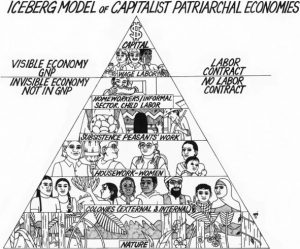
Source: Maria Mies, Patriarchy and Accumulation on a World Scale: Women in the International Division of Labour (2014)
The COVID-19 pandemic exposed how underinvestment had left wealthier countries reliant on migrant labor to sustain essential care systems. In the United States, women from Asia, Africa, the Caribbean, and Central and South America represented 75% of foreign-born healthcare workers and 83% of foreign-born registered nurses; although deemed essential, many faced heightened exposure, insecurity, and weaker social protection. The UK similarly expanded overseas recruitment to address severe social-care shortages, granting 89,236 visas to care workers and home carers in 2023.[20] However, from 11 March 2024, new care-worker applicants were no longer permitted to bring dependent partners or children. Together, these cases reveal the accountability gap: destination countries can stabilize their own systems by importing care labor while shifting the costs of risk, family separation, and replacement care onto migrant workers, their households, and origin communities. One country’s solution can therefore create a less visible care deficit elsewhere.[21]
This points to a wider failure: destination countries account for the labor they receive, but not for the care deficits their recruitment may create elsewhere. This can be seen in global childcare chains.[22] When migrant women enter paid childcare work abroad, their contribution becomes visible through wages, employment, and national output, while the care they leave behind is often transferred to grandmothers, daughters, sisters, or lower-paid women whose labor usually remains unpaid and uncounted.[23] A destination country may recruit workers; an origin country may train them; a private agency may place them; a household may employ them; and another woman or public system may absorb the care responsibilities left behind. With no actor accountable for this full chain, the care deficits are passed along unaccounted for.
The ILO recognizes this directly, noting that migrant women’s care responsibilities may be taken on by family members and sometimes at the expense of girls’ education and future labor-market opportunities.[24] This should not be read as a gender equality issue but rather as an economic planning statistic. When governments fail to account for care displacement, they weaken the very care chains they rely upon. This matters to destination countries because weakening origin-country care systems also weakens the future workforce pipelines on which they depend. This increases recruitment instability, turnover, and vulnerability during future crises. In an interconnected care economy, displaced shortages do not remain elsewhere; they eventually return to the systems that created them. A care system is only truly resilient if it does not create care deficits somewhere else.
The Philippines makes this interdependence visible. It is a major source country for nurses and care workers, while also facing severe shortages in its own health and care systems. In 2023, the Department of Health estimated that the country needed an additional 127,000 nurses to meet the WHO-recommended ratio of 27 nurses per 10,000 people. The Philippines had only 16 per 10,000.[25] Meanwhile, roughly one-third of the country’s 900,000 registered nurses were working abroad by the end of 2021.[26] Thus, the care gap left behind in the Philippines is unaccounted for by the countries that use their workforce. Destination countries gain trained staff, while the Philippines records remittances, but neither measure captures the loss of publicly financed skills, weakened domestic capacity, or additional care absorbed by families and communities. This also creates long-term risk for receiving countries: recruitment cannot remain sustainable if the systems training their workers are continually depleted.[27]
Existing frameworks recognize parts of this problem but do not yet govern its cumulative effects. The WHO Global Code of Practice, bilateral labor agreements, and ethical recruitment schemes seek to improve contracts, qualification recognition, worker protections, and mutual benefit between origin and destination countries.[28] However, they mainly regulate the movement and treatment of the individual worker, not the wider care deficit left in origin-country services, households, and communities. A destination country can therefore comply with recruitment standards while still benefiting from training financed elsewhere and leaving others to absorb the resulting shortages, with no institution enforcing this accountability. While these bilateral agreements recognize the principle of mutual benefit for both source and destination countries, they focus on accountability in the recruitment transaction, rather than the resilience of the full care chain and the shifting of care deficits.[29]
The ILO’s 5R Framework (2024) goes furthest in articulating a comprehensive care economy agenda.[30] It is the first international tripartite resolution which calls for unpaid care to be recognized, reduced and redistributed, and for paid care workers to be rewarded and represented. However, its main tools still operate largely within national labor markets and social protection systems. It does not establish binding responsibilities between origin and destination countries for care displacement or address the cumulative effects of recruitment and therefore provides no governance framework for the full transnational care chain. Similarly, the UN 3R to 5R framework[31] and the World Bank care-related agendas[32] have helped raise the visibility of unpaid care, gender equality, and childcare, but they do not yet provide a binding international mechanism for tracing, valuing, or compensating care displaced across borders. This is the gap that future care governance must address, and the point this insight aims to highlight.
Fragmentation
The accountability gap persists because care is governed in pieces. Care needs cut across health, education, labor, finance, migration, housing, and social protection. However, governments typically divide these responsibilities among separate ministries, budgets and legal frameworks. Childcare may sit within education, eldercare within health or social protection, domestic work within labor regulation, and migrant recruitment within immigration policy. Each institution manages one part of the system, but few are responsible for how decisions in one area create pressures elsewhere. Measurement is similarly fragmented, with different institutions collecting incompatible or incomplete data, while funding is divided across separate budgets and planning cycles. Responsibility may also be split between national and local government, and across origin and destination countries in global care chains. As a result, each institution governs only one part of care, while nobody is accountable for how shortages, costs, and responsibilities move between them and across the whole system. This impacts how governments govern care.
Japan demonstrates how even a well-established care scheme can remain disconnected from the workforce needed to deliver it. Its national long-term care insurance system, introduced in 2000, created a dedicated mechanism for financing services as the population aged. However, their financing expansion did not resolve the parallel question of who would provide the growing volume of care in the country.[33] Japan employed approximately 2.15 million care workers by 2022 but projects that it will require around 2.72 million by 2040, which is a gap of 570,000 workers.[34] The government has pursued better pay, domestic recruitment, retention, technology and international recruitment, but these measures have developed through partly separate care, labor, and migration systems. Under Economic Partnership Agreements with Indonesia, the Philippines, and Vietnam, candidates applying as care workers in Japan faced demanding language and licensure requirements with limited institutional support. By 2019, only around 3,165 EPA care workers were in the system, and many who passed the licensure exam left Japan rather than remain in the workforce.[35] This has left the system weak and on a shaky trajectory to deliver the care promised by 2040. Japan, therefore, illustrates the limitation of planning how care will be financed without integrating workforce supply and migration policy into the same long-term strategy.
Uruguay provides an important attempt to overcome this fragmentation. In 2015, it created the National Integrated Care System, recognizing care as a social right and bringing ministries and public bodies into a shared structure covering children, people with disabilities, older people and caregivers. It is the first country in Latin America to establish a legally grounded National Integrated Care System linking 10 public institutions. However, institutional integration has not produced universal or equal provision. By 2024, public coverage for children aged under three had reached approximately 57% (partly because the child population had declined).[36] Coverage for older people and people with disabilities remained around 15%.[37] A 2025 sustainability review also concluded that further financing reforms would be needed to expand the system. It also found that underlying fragmentation persists as participating institutions have no clear hierarchical relationship, and budgets and responsibilities sometimes overlap.[38] Uruguay’s case shows that a national law and coordinating body can make care visible as a whole-of-government responsibility, but integration remains incomplete without sufficient financing, clear authority, and equitable provision across the life course.
Regional frameworks are beginning to address the same problem. The European Union’s 2022 EU Care strategy brings childcare, long-term care, and workforce conditions into a single EU agenda alongside recommendations on early childhood education and long-term care access.[39] This is after the estimated finding that the EU will need 11 million care workers to close the care deficit by 2030.[40] However, its central instruments are recommendations, monitoring, and financial support, while delivery remains primarily the responsibility of member states. Latin America’s Buenos Aires Commitment goes further in recognizing care as a right, calling for a fairer social organization of responsibility across states, markets, communities, and families. Notably, subsequent ILO and ECLAC modeling suggest the payoff could be substantial: care investment across the region could generate roughly 32 million jobs by 2035, most of them in long-term care.[41] However, the agenda itself remains a political commitment rather than a binding system of shared financing and enforcement. Together, these regional agendas move care beyond ministry-by-ministry policy, but without binding financing, enforcement, or shared accountability, fragmentation remains embedded in implementation. Together, these frameworks mark a shift from ministry-by-ministry approaches toward system-wide care governance. Except, without binding financing or enforcement, implementation remains dependent on national priorities, leaving fragmentation unresolved in practice.
Recommendations: A long-term governance framework for the global care economy
To address the key governance gaps, these recommendations apply a long-term governance framework that is anticipatory and systems-focused and informed by the School of International Futures. [42]
- Firstly, to avoid further fragmentation, governments should apply a ‘Care risk and responsibility assessment’ across policy (inspired by Fiji’s whole-of-government risk-informed development model).[43] Every major care, labor, migration, social protection, childcare, aging, climate or economic policy should ask: Who provides the care? Who pays for it? Whose time is being used? Which workers are protected or exposed? Which households benefit? Which countries lose care capacity? Are costs being reduced, or simply shifted onto women, poorer households, migrant workers, origin countries, or future generations? How could these costs be anticipated, recognized, prepared for, and settled?
- Governments should anticipate and measure care demand. National planning ministries, finance ministries and statistical offices should forecast care needs over 10-, 20- and 30-year horizons, using demographic projections, fertility trends, labor-market data, migration patterns, climate risks and time-use surveys. Local authorities should map care pressures in communities, including childcare gaps, older people living alone, limited transport, climate exposure and unpaid carers under strain. International organizations, such as the ILO, WHO, OECD, World Bank and UN agencies, should support the use of shared indicators so that care becomes visible in global planning, not only in national social policy.
- Governments should coordinate and invest in care as infrastructure. This does not mean creating another isolated care program. It means making care a whole-of-government priority. Centers of government and finance ministries should work with ministries of health, labor, education, migration, housing, gender equality, and climate adaptation to develop national care strategies with clear accountability. Investment should focus on childcare, long-term care, disability support, community care, respite services, accessible housing, care transport, digital systems and decent work for the paid care workforce. The aim is not simply to spend more, but to prevent the hidden costs of underinvestment: women leaving work, children missing early development opportunities, older people entering hospitals unnecessarily, families absorbing unsustainable pressure, and workers leaving care sectors because pay and conditions are poor.
- Finally, and most importantly, governments should cooperate and adapt across borders. National care systems increasingly depend on international labor markets. Migration can support care systems and create opportunities for workers, but it should not become a way of solving one country’s care shortage by deepening another’s. Destination countries should improve domestic pay, training, and retention rather than relying on migration as a substitute for reform. Origin countries should be supported to strengthen their own care systems and training capacity, especially when tasked with sending their care workforce abroad.[44] Bilateral and multilateral agreements should include ethical recruitment, portability of rights, recognition of qualifications, worker protection, and reinvestment in source-country care capacity. Therefore, care migration should be governed not only as labor mobility but as part of a wider globalized care chain.
Conclusion
Care is undercounted, underfunded, and routinely displaced across borders and generations, with no institution accountable for where the deficit lands. These are not separate failures. They are one failure surfacing at four points in the same system: governments do not yet treat care as the infrastructure that makes all other productivity possible.[45] The states best positioned for the next decade will not be those that simply spend more on care, but those that govern it as a long-term, cross-border, whole-of-government responsibility. A Care Risk and Responsibility Assessment offers one practical mechanism to start the strategic transition of investing in care as economic and social infrastructure for long-term resilience and prosperity. It asks, before any policy is signed off, who provides the care it assumes, who absorbs the cost if that assumption fails, and which country, household, or generation is left holding the deficit. This is not a call for a single global institution to solve care. It is a call for the same discipline that states already apply to fiscal risk, security risk, and climate risk to be applied to care risk. The cost of ignoring care risk does not disappear. It resurfaces later, in workforces that cannot be recruited and systems that cannot be rebuilt quickly once depleted. After all, there is no productivity without people, no people without care, and no resilient future for any state that does not govern the global care economy in a way that is prosperous for all.[46]
[1] Silvia Federici, Caliban and the Witch (Autonomedia, 2004).
[2] World Health Organization, “Ageing and Health,” 2025.
[3] World Health Organization, “Health Workforce,” 2026.
[4] School of International Futures, Working for the Wellbeing of Current and Future Generations, 2024, https://soif.org.uk/app/uploads/2024/09/SOIF_DFG_Implementation_Handbook_Sept-2024.pdf.
[5] Maria Mies, Patriarchy and Accumulation on a World Scale: Women in the International Division of Labour, 2014.
[6] Nancy Fraser, “Contradictions of capital and care,” New Left Review 2, no. 100, 2016.
[7] ILO Care, “Care Jobs for the Future of Decent Work,” 2018.
[8] Oxfam Sweden, “Women’s Unpaid Work Worth £100 Trillion,” January 20, 2020.
[9] United Nations Statistics Division, System of National Accounts, 2025.
[10] Maria Floro, “Time allocation and time-use surveys,” in The Routledge Handbook of Feminist Economics, 2021.
[11] Alessandra Mezzadri, Susan Newman, and Sara Stevano, “Feminist global political economies of work and social reproduction,” Review of International Political Economy 29, no. 6 (2022).
[12] Office for National Statistics, “Household Satellite Account, UK: 2023.”
[13] “Unpaid Household Work Satellite Account of Mexico,” Instituto Nacional de Estadística, Geografía, 2022.
[14] ILO, “The impact of care responsibilities on women’s labour force participation,” 2024.
[15] World Bank, “Nearly 350 Million Children Lack Quality Childcare in the World,” 2021.
[16] International Labour Organization, “Closing Childcare Policy Gaps Offers High Return on Investment,” 2023.
[17] ILO, “The impact of care responsibilities on women’s labor force participation,” 2024.
[18] Yoon-Min Cho and Soonman Kwon, “Effects of Public Long-Term Care Insurance on the Medical Service Use by Older People in South Korea,” Health, Economics, Policy and Law 18, no. 2. 2023.
[19] Maria Mies, Patriarchy and Accumulation on a World Scale: Women in the International Division of Labour, 2014.
[20] United Kingdom, Home Office, “Summary of Latest Statistics,” Immigration System Statistics, 2023, https://www.gov.uk/government/statistics/immigration-system-statistics-year-ending-december-2023/summary-of-latest-statistics.
[21] Zophia Edwards, “Racial capitalism and COVID-19,” Monthly Review 72, no. 10, March 2021.
[22] Arlie Russell Hochschild, “Global Care Chains and Emotional Surplus Value,” in Justice, Politics, and the Family, Routledge, 2014.
[23] Florencia Caro Sachetti, “Women in global care chains: The need to tackle intersecting inequalities in G20 countries,” 2020.
[24] ILO, “Resolution concerning decent work and the care economy,” 2024.
[25] Mariejo Ramos, “Philippines Nurse Exodus Leaves Hospitals Short-Staffed,” Reuters, May 12, 2023.
[26] Ibid.
[27] Nicola Yeates, Globalizing Care Economies and Migrant Workers: Explorations in Global Care Chains, 2009.
[28] World Health Organization, “WHO Global Code of Practice on the International Recruitment of Health Personnel Amended,” 2026.
[29] United Nations Network on Migration, Guidance on Bilateral Labour Migration Agreements, 2022.
[30] ILO, “Resolution concerning decent work and the care economy,” 2024.
[31] UN Women, A Toolkit on Paid and Unpaid Care Work: From 3Rs to 5Rs, 2022.
[32] World Bank, The Care Economy and Disability Inclusion in Low- and Middle-Income Countries, 2025.
[33] John Creighton Campbell, “Japan’s Long-Term Care Insurance System,” in Eldercare Policies in Japan and Scandinavia (New York: Palgrave Macmillan, 2014).
[34] U.S. International Trade Administration, “Japan Healthcare Caregiving Technologies,” U.S. Department of Commerce, 2025.
[35] Edward Asis and Rogie Royce Carandang, “The Plight of Migrant Care Workers in Japan: A Qualitative Study of Their Stressors on Caregiving,” Journal of Migration and Health, 2020.
[36] Carmen Estrades and Florencia Amábile, “Uruguay’s Lessons for Building a Care Economy,” International Economic Association, August 20, 2024.
[37] Ibid.
[38] Balsa, Verónica, and Cecilia Zak, “Servicios de cuidados para la primera infancia,” 2025.
[39] European Commission, Communication from the Commission to the European Parliament, the Council, the European Economic and Social Committee and the Committee of the Regions on the European Care Strategy, 2022.
[40] “The EU Strategy on Care: A New Paradigm for Carers across Europe?,” Euro Carers, 2022.
[41] International Labour Organization and Economic Commission for Latin America and the Caribbean, “ILO and ECLAC Call for Strengthening Care Policies in Latin America and the Caribbean,” 2025.
[42] School of International Futures, Working for the Wellbeing of Current and Future Generations.
[43] United Nations Office for Disaster Risk Reduction, “Integrating Risk into National Development: Fiji’s Approach to a Risk-Informed Disaster Risk Reduction Strategy,” 2025.
[44] Yeates, Globalizing Care Economies and Migrant Workers, 2009.
[45] Tim Jackson, The Care Economy, 2025.
[46] Katherine Trebeck, “Building a wellbeing economy,” 2018.