The Middle East’s instability has exposed the EU to a new energy crisis, stemming from longstanding vulnerabilities in Europe’s energy, and the shortcomings are a result of the diversification strategy adopted after 2022. As Russia became an unstable energy source, EU member states were forced to deepen partnerships with traditional suppliers while seeking new energy partners.
As part of the EU’s energy diversification strategy, Qatar has emerged as a reliable and profitable partner, holding the world’s second-largest natural gas reserves, allowing Doha to increase exports to offset the gradual reduction of Russian gas imports. [1]
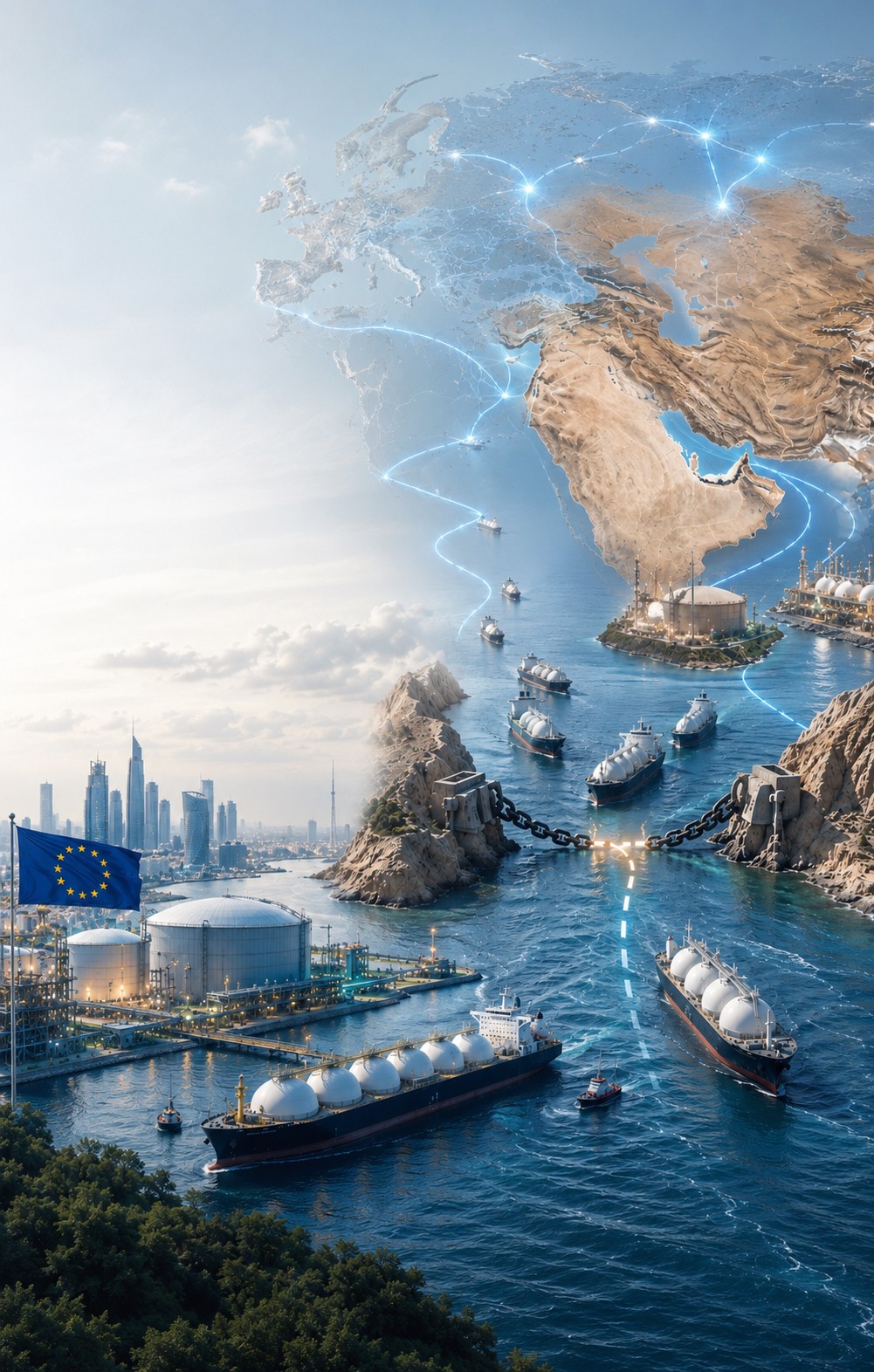
However, the closure of the Strait of Hormuz and the continued attacks targeting the region’s critical energy infrastructure have resulted in a sudden disruption of the energy supply from the Arabian Gulf, while the destabilization of the region could have long-term impacts on the perceived “reliability” of the Middle East suppliers. Even if the EU’s dependence on Qatari gas imports is not so marked (8 percent of total imports in 2025), the Hormuz blockage has triggered a global energy crisis, leading to market volatility, high prices and sharp competition among major economies to ensure control of the reduced availability of oil and gas supplies, which severely affects the EU economy and energy security.
Moreover, the EU’s political decision to progressively shift away from pipeline gas imports toward seaborne Liquefied Natural Gas (LNG) imports appears insufficient to prevent the negative impacts of energy supply disruptions, mainly because its reliance on oil and gas imports remains largely unchanged. To address such vulnerabilities, the EU should strengthen its energy diplomacy strategy, increasing the number of supplier countries from different geographic areas and reducing its dependence on a single supplier, thereby avoiding mistakes of the past.
How the Hormuz energy crisis undermines the EU energy diplomacy’s ambitions
The recent conflict involving Iran and the U.S., and its implications for the region, have highlighted a long-feared worst-case scenario in energy geopolitics, the closure of the Hormuz Strait. Often described as a “nightmare scenario”, such a disruption has the potential to trigger global economic and energy repercussions. The Strait of Hormuz is one of the most critical global energy chokepoints, with 20 million barrels per day (mb/d) of crude oil and oil products passing through it. It accounts for 25 percent of the world’s seaborne oil trade, with 80 percent of exports mainly shipped to Asian markets. [2]
From the EU perspective, oil import disruptions linked to the Hormuz blockade have a limited impact, barely importing 600,000 barrels of oil per day (just 4 percent of the region’s crude flows are routed into Europe), which could be offset by increasing supply from the U.S., Norway and Kazakhstan, the three largest oil suppliers for the EU. [3]
Conversely, the Hormuz Strait has become strategically relevant for EU energy security as one of the most reliable and long-term potential sources of natural gas, especially after 2022, when European countries have been engaged in searching for alternative gas suppliers to replace Russian imports.
Qatar and the United Arab Emirates (UAE) cover almost 20 percent of global LNG exports, which are entirely shipped through the Strait of Hormuz as a necessary gateway to reach international markets.
In the EU, energy diplomacy was promoted wisely after 2022. Qatar has been clearly identified as the key and reliable partner, benefiting from the second largest natural gas reserves in the world (24.700 billion cubic meters (bcm), which accounts for 11 percent of the global natural gas reserves and 30 percent of Middle East reserves), which legitimizes Doha’s role as the world’s second largest LNG supplier (112 bcm in 2025) after the United States. [4]
Even if only 10 percent of the total gas volumes exported along the Hormuz waterway are directed to Europe, accounting for 7 percent of the EU’s total LNG imports, the sudden closure of the energy chokepoint has considerably affected the European strategy of diversification, further emphasizing the well-known geopolitical vulnerability of the Strait, namely the lack of alternative LNG export options to the maritime route. As a matter of fact, unlike oil exports from the Arabian Gulf, which could partially bypass Hormuz using the Petroline pipeline crossing Saudi Arabia to the Red Sea and the Abu Dhabi Crude Oil Pipeline, there are no overland pipelines able to deliver natural gas avoiding Hormuz transit, thus halting exports in the case of the Strait’s closure [5].
Moreover, in addition to the lack of alternative export routes, Iran’s retaliatory attacks targeting the Qatari Ras Laffan energy complex in March 2026 have further exacerbated the scenario, temporarily stopping gas production and reducing the export capacity for the future. According to Qatar Energy company, Doha would have to cancel long-term liquefied natural gas supply contracts because 17 percent of the export capacity (12.8 million tons of LNG per year) will be offline and unavailable for an estimated three to five years, which entails that Qatar cannot export 50-90 bcm of LNG between 2026 and 2030. [6]
This curtailment of the Qatar export capacity impacts the European targets of the energy diplomacy based on diversification of gas suppliers in order to offset the lack of Russian gas imports.
In spite of reducing gas consumption, which fell by 19 percent between 2021 and 2024, the EU has progressively increased its reliance on LNG imports compared to imports by pipeline to compensate for the phase-out of Russian gas imports: LNG accounted for 62 percent of total European gas imports (January-March 2026), but this strategic shift has been affected by supply disruptions from the Arabian Gulf (-29 percent in the first quarter of 2026), foreshadowing a new threat that further undermines EU energy security. [7]
Even if the EU’s dependence on Qatari gas appears relatively low (6 percent in 2026), the picture is different through the lens of individual member states: Italy is more reliant on Qatari LNG than any other European country (33 percent of its 2025 LNG imports), followed by Poland and Belgium, which respectively depend on 25 percent and 16 percent of their 2025 LNG imports. [8] For the other EU member states, LNG from the Arabian Gulf could represent a promising alternative for receiving additional volumes of gas as well as for diversifying imports because of Qatar’s huge potential in terms of reserves.
European political reactions: new and old supply dependencies
Since the beginning of this new energy crisis, EU Commission President Ursula von der Leyen and Energy Commissioner Dan Jørgensen have tried to reassure markets and citizens about supply security. Von der Leyen stressed that diversification strategies have been successful, reducing the dependence on fossil fuel imports, but the main problem to urgently deal with is price spikes: after 10 days of conflict, gas prices have risen by 50 percent and oil prices by 27 percent, representing an additional cost of 3 billion euros in fossil fuel imports. [9] In parallel, in early March, the Director-General for Energy at the European Commission, Ditte Juul-Jørgensen, met with Saad Sherida Al-Kaabi, Qatari Minister of State for Energy Affairs and CEO of Qatar Energy, to discuss how to preserve the regional energy supply and enhance energy cooperation, within which Qatar remains a perceived reliable gas supplier for the EU. [10]
In April 2026, the EU Commission released the new Accelerate EU strategy, aimed at addressing rising energy costs (24 billion euros in additional spending for fossil fuels since March 2026) and further reducing dependence on volatile fossil fuel markets, particularly in light of the escalating Middle East conflict. In line with the REPower EU initiative—launched in 2022 to contain the energy crisis triggered by the Russia-Ukraine conflict—this strategy calls for a closer coordination of energy policies among member states to contain energy shocks, increase resilience, and promote and support a green energy transition through domestic energy production of renewable energy to replace imported fossil fuels. [11]
One of the main concerns to address in the short term is represented by the gas storage levels to ensure a large availability of energy for the next winter. Through the REPower EU document, the European Commission has decided that the existing underground gas storage facilities must be filled to at least 90 percent of their capacity by 31 October each year (starting from April to reconstitute gas reserves) in order to increase the resilience of countries and their ability to deal with sudden disruptions. On 1 April 2026, EU gas storage levels stood at 28 percent (29 bcm), lower than in the previous three years and at the same levels achieved before the 2022 energy crisis, mainly due to a cold winter, which contributed to the extensive use of storage facilities, especially in Northern Europe. In June, EU storage was at 37 percent of capacity, the lowest seasonal level in 2022-2025. [12]
Consequently, the EU member states need to increase LNG imports for refilling gas storage facilities in preparation for the winter 2026-2027, mitigating the combined effect of the lack of Qatari gas and the ban on Russian LNG, which will become effective in January 2027. According to ENTSOG, reaching the target of 90 percent storage level by the end of summer 2026 will require higher LNG imports (86-90 bcm) than previously observed and increased utilization of gas infrastructure. [13]
The need to offset the sudden disruption of Qatari LNG imports has, however, entailed two controversial trends in the EU energy strategy. The decision to increase LNG imports from the U.S. represents the main and feasible short-term option for the EU, moving from 58 percent in 2025 to 63 percent in 2026 (January-March). However, this scenario clearly highlights a new condition of unbalanced dependence for the EU on a single supplier (similar to the Russian case before 2022), also considering that if the energy waterway crossing Hormuz remains closed, IEEFA forecasts that the U.S. could cover two-thirds of EU LNG imports in 2026, thus weakening the strategic goal of achieving a geographic diversification of energy suppliers. In general terms, Norway is the largest natural gas supplier for the EU, accounting for 52 percent of total imports, while European imports of U.S. LNG more than tripled from 29.8 bcm in 2021 to 99.5 bcm in 2025. [14]
Secondly, in spite of the EU’s political commitment to phase out Russian gas imports, Russia currently is Europe’s second-largest LNG supplier, accounting for 13 percent of LNG imports in 2026, registering a 16 percent increase in the January-March period. France is the largest importer of Russian LNG in the EU (35 percent of its LNG imports), followed by Spain, Belgium, the Netherlands and Portugal, but Belgium is the only European country where Russia is the top LNG supplier, offsetting the lack of Qatari gas, which accounted (as reported above) for 16 percent of Belgium’s total LNG imports. [15]
We can also observe that the Hormuz closure occurs when the EU decides to finally implement a definitive ban on Russian gas imports (both by pipeline and LNG), outlining a scenario based on an effective shortage of gas supply: in January 2026, EU member states formally adopted a regulation to phase out imports of Russian gas by autumn 2027 for imports by pipelines while LNG long-term contracts will be banned from January 2027. [16] So, according to many experts, the increasing imports of Russian LNG in the first quarter of this year could be explained by the urgent need of the EU’s Western members to secure Russian gas volumes before legal access becomes restricted. [17]
Green energy cooperation with the Middle East and persistent threats to critical energy infrastructures
Iran’s retaliatory attacks targeting critical energy infrastructures (CEI) in the Middle East have dramatically revealed the vulnerability of the global energy balance, provoking sudden disruptions of oil and gas supply to the international markets. However, the paradigm based on the identification of CEI as a privileged target of military attacks cannot be limited to oil and gas infrastructures (pipelines, refineries, LNG terminals, and storage facilities) but can potentially be extended to also include renewable energy-based facilities for producing and exporting clean electricity or green hydrogen. In this case, the energy diversification attempts of Middle Eastern countries will be negatively affected, as will the EU’s ambition to achieve the carbon neutrality target by 2050 through increasing imports of clean electricity and green hydrogen from the Arabian Gulf.
At the beginning of March, the major Omani ports of Duqm and Salalah suspended operations after being hit by drone strikes, while the Fujairah port in the UAE was also a frequent target of Iranian retaliation attacks: all of these ports are strategic maritime terminals that provide access to the Arabian Sea and the international markets, bypassing Hormuz. [18] Furthermore, Fujairah and Omani ports are the export terminals of the clean energy production in the Middle East, mainly green hydrogen to be delivered in liquefied form (ammonia) to the main international markets.
As part of the EU’s energy diplomacy promoted after the 2022 events, the EU signed a Strategic Partnership with the Gulf aimed at deepening energy cooperation on a new basis beyond the traditional oil and gas sphere: the focus is on producing renewable energy and green hydrogen, which will enable Gulf countries to increase low-carbon energy exports to the EU, which is committed to supporting the European green and sustainable energy transition through the decarbonization of the energy mix. [19] The EU plans to import 10 million tons of green hydrogen by 2030 to meet its climate objectives while phasing out imports of Russian hydrocarbons. [20]
German, French and Italian companies have strengthened cooperation with Saudi Arabia, the UAE, Oman, and Qatar for implementing green-renewable hydrogen projects (among them, the NEOM Green Hydrogen project in Saudi Arabia, which aims to produce 1.2 million tons of green ammonia for shipping to global markets by 2026) to concretely realize and supply the “green hydrogen corridor”, which will deliver hydrogen in liquefied form (ammonia) to the main European and international ports. In September 2022, the UAE shipped a cargo of low-carbon ammonia from the Fujairah port to Hamburg in Germany, laying the groundwork for a low-carbon energy corridor connecting the Arabian Gulf to European markets. [21]
According to the International Energy Agency, Oman can become one of the six main exporters of green hydrogen in the world as well as a leader in the Middle East, covering 61 percent of total exports. [22] Most of the green hydrogen projects are located in the Duqm port area (which also hosts a special economic zone), attracting European investors and companies for the promising green energy potential and for the geostrategic location, not depending on the Strait of Hormuz transit. In April 2025, Duqm was identified as the maritime terminal for realizing the world’s first liquid hydrogen corridor to Europe, following an agreement between the Omani authorities and German and Dutch stakeholders to supply green hydrogen from Duqm to the ports of Duisburg and Amsterdam. [23]
The rising relevance of the Middle East ports as green energy terminals, conceived to meet the clean electricity demand of the EU and other main international actors, emphasizes the need to provide security for the CEI, preventing potential threats that could disrupt the regularity of the energy supply.
Conclusion
The Hormuz closure has clearly shown the weak basis of the EU strategy of diversification, mainly because the heavy dependence on energy imports from abroad hampers a coherent enhancement of European energy security. Not so many choices and options remain for the EU member states, in spite of the progress of energy diplomacy. In the LNG sector, if Qatar and Russia are out of the game, the U.S. and Australia remain the only potential big suppliers of liquefied gas, while new promising partners (Mozambique, Senegal, Canada, Nigeria, and Mauritania) could offer their contributions, which will not be sufficient to ensure energy security in the short-to-medium term. Moreover, their progressive involvement as EU LNG suppliers will not be an easy road if we consider the unbalanced dependence of Asian markets on oil and LNG imports; crossing the Strait would trigger geo-economic competition with EU member states to secure control of these additional volumes of hydrocarbons. [24]
For the EU, the energy supply problem is now, in the short term: following the Memorandum of Understanding between the U.S. and Iran, Hormuz’s temporary reopening raised hopes and positive expectations, pushing Qatar to declare its readiness to restart production and export 80 percent of its total capacity. [25] Nevertheless, the geopolitical volatility in the region—based on the fragile agreement between Washington and Teheran—has rapidly turned off all hopes to restore a normal scenario of stability: the U.S. and Iran have resumed conflict, which will lead to a new halt of the maritime energy transit through Hormuz, in addition to the fact that oil and LNG tankers and CEI (pipelines and terminals) could become again specific targets of Iranian retaliation attacks. The potential entry of the Houthis into the conflict could dramatically worsen this already terrible situation by threatening to close the transit through the Bab el-Mandeb energy chokepoint, thus undermining the energy and trade corridor along the Red Sea, which is the shorter maritime route to deliver LNG supply from the Arabian Gulf to the EU.
In that case, LNG tankers from Qatar would be rerouted to a longer and more expensive route, circumventing Africa, a condition that further increases energy prices, negatively impacting the EU’s attempts to refill gas reserves before winter. Moreover, Bab el-Mandeb’s potential closure will also hamper LNG supply from Mozambique to the EU, which has emerged as an alternative gas supplier benefiting from 2800 billion bcm of natural gas reserves, thus affecting the results of the European diversification strategy.
In the medium term, the combination of decreasing demand and the use of clean electricity and other renewable energy sources would lead to a 29 percent reduction in LNG imports by 2030, thus reducing our geopolitical vulnerability to external energy suppliers. [26]
In terms of energy security, the rising share of U.S. LNG imports is shaping an unbalanced condition of dependence, which could have negative implications: it is not a problem of U.S. political reliability, but a marked reliance on a single supplier entails a potential vulnerability if the energy supply suddenly suffers disruptions for various reasons. Before the Middle East crisis erupted, IEEFA warned that the EU risked a new energy dependence where the U.S. could account for 75–80 percent of its LNG imports by 2030. [27]
Even if some actors in the EU (such as the Italian energy company ENI) wonder about the possibility of reviewing the ban on Russian gas to contain energy shortages linked to the instability in the Middle East, this option appears at present unrealistic for political reasons; however, a prolonged disruption of the energy supply from Hormuz could change the rules of the game.
[1] Fabio Indeo, “The vulnerability of the EU reshaped energy security: the unsolved knot of the imports’ dependence,” in J. Fedin, External Partners in the EU’s Energy Transition: New Dependencies or Similar Challenges?, Natolin Nest Series vol. 3, College of Europe, Warsaw (Poland), 2025
[2] IEA, “Strait of Hormuz Factsheet,” last updated February 2026, https://www.iea.org/about/oil-security-and-emergency-response/strait-of-hormuz.
[3] Ibid.; European Commission, “EU imports of energy products – latest developments,” March 2026, https://ec.europa.eu/eurostat/statistics-explained/SEPDF/cache/46126.pdf.
[4] U.S. EIA, “Qatar. Country Analysis Brief,” US Energy Information Administration, last updated October 20, 2025, https://www.eia.gov/international/analysis/country/QAT.
[5] IEA, “Strait of Hormuz Factsheet.”
[6] “H.E. Minister Saad Sherida Al-Kaabi: The missile attacks reduced Qatar’s LNG export capacity by 17% and caused an estimated loss of $20 billion in annual revenue,” Reuters, March 19, 2026, https://www.reuters.com/business/energy/iran-attack-damage-wipes-out-17-qatars-lng-capacity-three-five-years-qatarenergy-2026-03-19/.
[7] Institute for Energy Economics and Financial Analysis, “European LNG Tracker,” Last updated: May 2026, https://ieefa.org/european-lng-tracker.
[8] Ibid.; Ben Makuch et al., “Italy, Belgium set to lose gas supply after world’s biggest LNG plant bombed,” Politico, March 19, 2026, https://www.politico.eu/article/italy-belgium-lose-gas-supply-world-biggest-lng-plant-bombed/?utm_source=substack&utm_medium=email.
[9] European Commission, “Speech by President von der Leyen at the European Parliament plenary debate in preparation of the European Council meeting of 19-20 March 2026 and on the US-Israel military operations against the Iranian regime, its consequences and the need to support the people of Iran,” March 11, 2026, https://ec.europa.eu/commission/presscorner/detail/en/speech_26_593.
[10] European Commission, “EU-Qatar: Meeting confirms ongoing energy cooperation,” Directorate General for Energy, March 10, 2026, https://energy.ec.europa.eu/news/eu-qatar-meeting-confirms-ongoing-energy-cooperation-2026-03-10_en?utm_source=substack&utm_medium=email.
[11] European Commission, “AccelerateEU to strengthen EU energy resilience,” April 26, 2026, https://energy.ec.europa.eu/strategy/accelerateeu-strengthen-eu-energy-resilience_en?utm_source=substack&utm_medium=email.
[12] European Commission, “REPOwer EU Plan,” Brussels, 18.5.2022 COM (2022) 230 final, https://eur-lex.europa.eu/resource.html?uri=cellar:fc930f14-d7ae-11ec-a95f-01aa75ed71a1.0001.02/DOC_1&format=PDF; Ugnė Keliauskaitė, Ben McWilliams, Giovanni Sgaravatti, and Georg Zachmann, “European natural gas imports,” Bruegel dataset, July 2, 2026, https://www.bruegel.org/dataset/european-natural-gas-imports?utm_source=substack&utm_medium=email.
[13] “Summer Supply Outlook 2026,” ENTSOG, April 2026, https://www.entsog.eu/sites/default/files/2026-04/SO0069-26_Summer%20Supply%20Outlook%202026.pdf.
[14] Institute for Energy Economics and Financial Analysis, “European LNG Tracker.”
[15] Ibid.; Ugnė Keliauskaitė, Ben McWilliams, Giovanni Sgaravatti, and Georg Zachmann, “European natural gas imports.”
[16] European Council of the European Union, “Russian gas imports: Council gives final green light to a stepwise ban,” Press release, January 26, 2026, https://www.consilium.europa.eu/en/press/press-releases/2026/01/26/russian-gas-imports-council-gives-final-greenlight-to-a-stepwise-ban/.
[17] Francesco Sassi, “The Great Reversal: The Hormuz Crisis Drives Russian LNG Imports to Record Highs in the EU,” Energy Geopolitics & Statecraft, Vol.32/2 6, April 27, 2026, https://energygeopoliticsandstatecraft.substack.com/p/egs-32-26-russian-lng-imports-to.
[18] Gary Howard, “Oman ports targeted by drone attacks,” Seatrade Maritime News, March 3, 2026, https://www.seatrade-maritime.com/security/oman-ports-targeted-by-drone-attacks.
[19] European Commission, “GCC: EU unveils Strategic Partnership with the Gulf,” May 18, 2022, https://ec.europa.eu/commission/presscorner/detail/en/ip_22_3165.
[20] European Commission, “REPOwer EU Plan.”
[21] Farkhod Aminjonov and Fabio Indeo, “The complexity of the EU-Gulf energy relations divergent energy strategy pathways,” RSDI Insights, Rabdan Security and Defence Institute, July 9, 2025, https://rsdi.ae/en/publications/the-complexities-of-the-eu-gulf-energy-relations-divergent-energy-strategy-pathways.
[22] International Energy Agency, “Renewable Hydrogen from Oman,” IEA, June 2023, https://www.iea.org/reports/renewable-hydrogen-from-oman.
[23] “Oman signs deal for world’s first liquid hydrogen corridor to Europe,” Muscat Daily, April 16, 2025, https://www.muscatdaily.com/2025/04/16/oman-signs-deal-for-worlds-first-liquid-hydrogen-corridor-to-europe/; “Industry groups in Oman, Netherlands, Germany strike green hydrogen deal,” Reuters, April 16, 2025, https://www.reuters.com/business/energy/industry-groups-oman-netherlands-germany-strike-agreement-liquid-hydrogen-import-2025-04-16/.
[24] Philip Bodenschatz and Lisandra Flach, “The Role of the Strait of Hormuz for Germany and the EU,” EconPol Policy Brief 3, CESifo, 2026, https://www.ifo.de/DocDL/EconPol_PolicyBrief_81.pdf; International Energy Agency, “Gas Market Report, Q2-2026,” IEA, April 24, 2026, https://www.iea.org/reports/gas-market-report-q2-2026.
[25] “Qatar Plans to Rapidly Restart LNG Output After Hormuz Opens,” Bloomberg, June 16, 2026, https://www.bloomberg.com/news/articles/2026-06-16/qatar-plans-to-rapidly-restart-lng-production-after-hormuz-opens
[26] Institute for Energy Economics and Financial Analysis, “European LNG Tracker.”
[27] Institute for Energy Economics and Financial Analysis, “European LNG Tracker.”