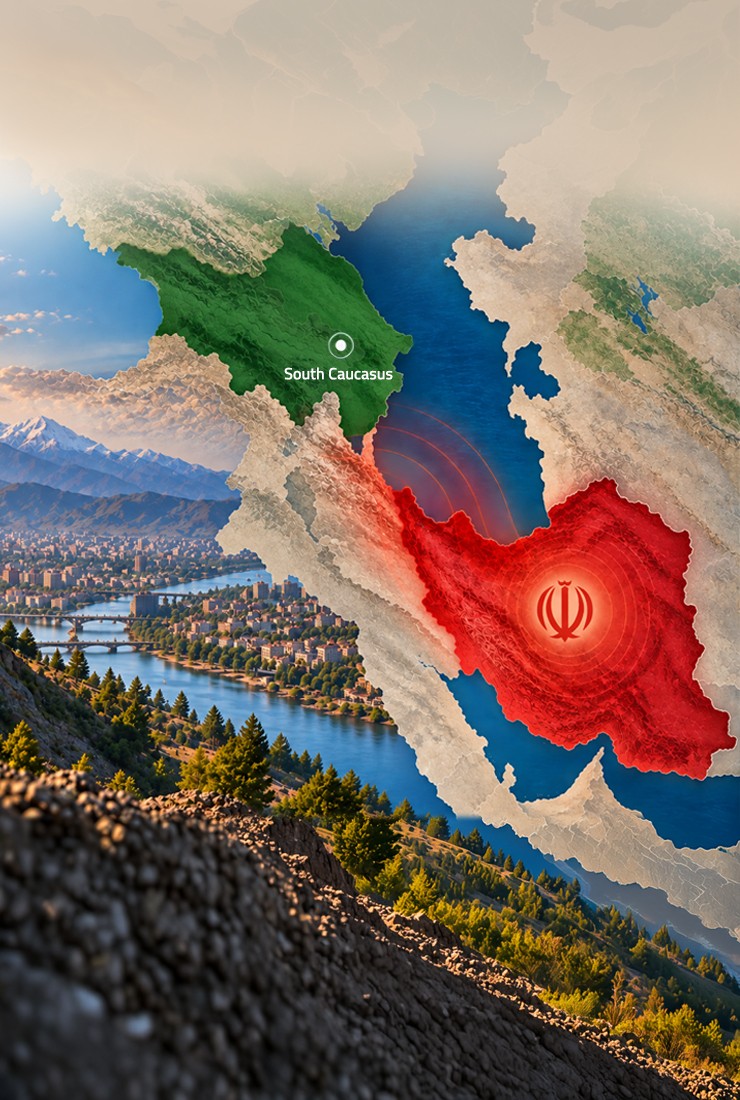
The beginning of a new phase of the conflict between Iran, on the one hand, and Israel and the United States, on the other, is a worrying development for two reasons: its length and its geographical scope. Having begun on 28 February 2026, the intermittent attacks show no signs of ending, despite diplomatic attempts to stop them, which have so far been unsuccessful. Furthermore, the attacks have not only affected the three countries but also almost all other regional actors, particularly the Arab Gulf states, which have borne the brunt of Iranian aggression as noted in the United Nations Security Council resolution 2817 (2026).[1] Beyond strictly military matters, the conflict has impacted other areas of regional and global security, including food and energy, trade flows, and investment. This insight analyzes the implications of the conflict for the South Caucasus region. A realignment is taking place as a result of the conflict in the Gulf, and the emerging order sees Russia and Iran play a smaller role than in the past, while Türkiye and Azerbaijan serve as a logistical bridge to strengthen their relations with Europe and Central Asia. Finally, the United States’ interest, as demonstrated by the Trump Route for International Peace and Prosperity (TRIPP) project, is a further driver of this change, even though its realization is still further down on the horizon. The central theme of this insight is to explore how the Iran–Israel/U.S. conflict reshapes the regional order, energy flows, and transport corridors of the South Caucasus.
Energy markets
An immediate consequence of the conflict is the disruption to international energy markets, particularly oil and gas prices, as well as damage to infrastructure such as wells, offshore platforms, refineries, and port terminals. The closure of the Strait of Hormuz has also caused disruption to the global economy. However, the effects of this volatility are to be felt in the long term. Consider the withdrawal of the United Arab Emirates (UAE), the group’s third-largest producer, from OPEC and the implications for the global oil market of a country with such vast production capacity being able to sell its oil without OPEC’s production quotas.[2]
In the case of the South Caucasus, Azerbaijan is a member of OPEC+, a group of eleven countries that coordinate their production quotas with OPEC members. The countries of the South Caucasus are affected by a higher-priced oil market in various ways. Producers benefit from increased international prices, while buyers require a constant and stable supply of oil and gas to ensure energy security. The Caspian Sea has not been directly affected, except for occasional military operations. Consequently, despite Iran being one of the five littoral states, exports from countries such as Kazakhstan to the coast of Azerbaijan and onward to Europe via the Southern Corridor have not experienced any sustained disruption.
In fact, the consistent flow of oil and gas from the region has heightened its significance compared to hydrocarbon exports that must cross the Gulf via the Strait of Hormuz or the Red Sea via the Suez Canal due to Houthi attacks. Pipelines crossing Azerbaijan, Georgia, and Türkiye are a vital link in the energy security of many countries, particularly European nations, which have been affected by the war in Ukraine since February 2022. The war in the Gulf has led European countries to pay closer attention to the Caspian region, and particularly the Central Asia–Caspian–Azerbaijan–Türkiye axis, in terms of energy security. These countries have benefited from the instability caused by Iran, as well as from the increase in international hydrocarbon prices. The ensuing developments have strengthened Azerbaijan’s ties with the Gulf Cooperation Council (GCC),[3] Türkiye, Central Asia, and Europe. Energy markets are one of the most important elements of multimodal transport corridors, which form the backbone of global trade links.
Transport corridors
The conflict in Iran has highlighted the importance of land, sea, and air transport corridors for international trade, as well as their impact on the global economy. The closure of the Strait of Hormuz, coupled with the inherent dangers and attacks in the Red Sea[4] attributed to Houthi forces and documented by IMO and UKMTO,[5] carried out by Houthi militias in the Red Sea, has had a significant international impact. This ranges from disruption to global value chains and higher freight rates and transport insurance to the search for new suppliers and securing new routes for diversification. Also, the closure of airspace by the Arab Gulf countries has made the Caucasus extremely important for routes between Asia and Europe. The importance of the Baku–Tbilisi–Ceyhan (BTC) oil pipeline and the Trans-Anatolian (TANAP) gas pipeline is now beyond dispute.
The same applies to the Trans-Caspian International Transport Route (TITR), also known as the ‘Middle Corridor’, which has become an invaluable trade corridor for China, Central Asian countries,[6] and Europe. Problems arising from the conflict in Iran have only served to reinforce the need to develop the necessary infrastructure to strengthen this route, which links the Eurasian continent via the South Caucasus. Other projects, such as the International North–South Transport Corridor (INSTC) and the India–Middle East–Europe Economic Corridor (IMEC), demonstrate that they depend not only on the interests of the states through which these multimodal infrastructure projects pass but also on the transport needs of suppliers and destination markets.
In the case of the INSTC, both Iran and Russia are seeking alternative routes to those already in place. However, the routes proposed by Moscow or Tehran do not reflect actual trade needs; rather, they are intended to circumvent sanctions and project an image of international engagement. Hence, these projects are more political than practical.[7] The Middle Corridor is a reality, and its importance has been further emphasized by disruptions arising from the conflict in the Gulf. The need to strengthen the resilience of international supply chains and to develop secure alternatives gives it an undeniable importance.[8] The possibility of reducing transport time for goods between China from six weeks to two-three weeks via trans-Caspian routes is highly attractive for international trade, particularly when combined with the resolution of territorial conflicts in the South Caucasus.[9]
Regional order
The developments resulting from the conflict in Iran have impacted the regional system in the South Caucasus. First, Iran’s relative decline as a regional power is inevitable. There are no appealing ideological or religious factors in Iran that could act as elements of ‘soft power’, nor any real economic capabilities that could generate expectations of opportunities for countries in the Caucasus. On the contrary, the large number of international sanctions imposed on Iran makes it an unattractive partner, as the risks posed by secondary sanctions outweigh any potential opportunities.
However, Iran’s influence and military capabilities, combined with nationalist policies, must be considered as they represent a disruptive force. The countries of the South Caucasus recognize that it is impossible to completely isolate a country of over 90 million people. This is why those countries try to find a way to coexist with Iran rather than engage in open confrontation.[10]
Secondly, Russia is also a power whose influence in the South Caucasus is in decline due to the current conflict, and particularly the war in Ukraine. Moscow intends not to accept this reality, that its influence has been waning. Consequently, this has on more than one occasion strained relations with countries in the South Caucasus, which are perceived as distancing themselves from Russia. Despite Russia’s historical significance and undeniable linguistic influence, these countries are seeking new global partners rather than the two states in the region with greater political ambitions: Iran and Russia.
Türkiye is emerging as an actor with aspirations to become a regional center of power. It has two clear advantages in this respect: the NATO membership and the fact that many of the oil and gas pipelines that reach Europe pass through its territory, forming an energy link between the Caspian region and Europe. Also, its cultural affinity with Turkic-speaking countries such as Azerbaijan and the four Turkic-speaking countries of Central Asia helped develop an extensive network of interregional partnerships, such as the Organization of Turkic States, as a result of this shared foundation.
The United States, particularly during Donald Trump’s second term, is seeking an active role in the region for the first time in decades. The TRIPP project aims to establish Washington as a mediator and guarantor of peace in the region. It goes without saying that this role has another geopolitical consequence, namely as a barrier to contain Russian and Iranian influence in the region. This is why both Moscow and Tehran are very clearly opposed to this project. For Azerbaijan and Armenia, however, the project would help stabilize the situation by providing guarantees from a state with a perceivably more benign history toward either country, unlike Russia or Iran.
For its part, the European Union supports any initiative that guarantees its energy security, ensures stability, and limits Russian and Iranian influence. Italian Prime Minister Giorgia Meloni highlighted the importance of Baku for European and Italian energy security during her visit to Azerbaijan in May 2026: “Gas and oil supplies to Italy have been decisive for the energy security of the nation I have the honour of representing, ever since Russia first began its war of aggression against Ukraine”.[11]
From this perspective, the interests of Armenia, Azerbaijan, Türkiye, the United States and Europe align. This is a rare geopolitical opportunity. Within the framework of the South Caucasus, beyond the need to implement foreign policies that do not lead to open confrontation or unqualified acceptance of Iran, relations between the three neighboring states demonstrate trends that reflect the impact of the conflict in question. Resolving the territorial conflict between Armenia and Azerbaijan requires a comprehensive peace agreement to mark the beginning of a new chapter in the regional configuration. Negotiations to this end are underway, and there is clearly political will in both states to bring them to fruition.
The sustained rise in hydrocarbon prices, coupled with the decline in the regional influence of Russia and Iran, prompts Armenia to adopt a more open stance toward a definitive agreement. This is to avoid a widening gap between its capabilities and those of other regional countries involved in energy pipeline projects, as well as to prevent greater isolation or dependence on Iran or Russia. This explains Armenia’s support for the TRIPP project.[12] Armenia’s significant dependence on Russia and Iran,[13] resulting from its closed borders with Türkiye and Azerbaijan, makes it difficult for Yerevan to adopt an openly confrontational policy towards Moscow and Tehran.[14] However, the relative decline in Russia’s and Iran’s power in the South Caucasus cannot be reversed in the short term.
Azerbaijan’s importance as a hydrocarbon producer, pipeline operator, and guarantor of part of Europe’s energy security undoubtedly increases its regional standing. Its strong ties with Türkiye and Israel, as well as with the United States, ensure that its international integration is not viewed with suspicion. While there are tensions in its foreign policy toward Iran, maintaining the status quo is a clear objective for Iran in its dealings with Baku. Amid rising levels of conflict in the Gulf region and with Arab countries, Tehran is keen to avoid opening up a new front, which explains the relative stability in their bilateral ties, despite Tehran’s great suspicion of relations between Baku and Tel Aviv, as well as pro-Azerbaijani sentiments among the Azerbaijani population in Iran’s northwestern provinces,[15] which could fuel secessionist tendencies. The 759km border between Azerbaijan and Iran[16] could be a major source of instability, which prompts both sides to prioritize reaching agreements. This explains why, despite Iran launching attacks in early March that reached Azerbaijani territory in Nakhchivan,[17] Baku has chosen to de-escalate tensions.
Georgia is the country least directly affected by the regional turmoil due to its distance from the conflict zone and the fact that its domestic and foreign policy agendas focus on other issues. However, the current government has failed to secure support from either the United States or Russia,[18] which places the country in a precarious position on the international stage.
The road ahead
The conflicts in Iran and Ukraine are having structural consequences in the South Caucasus. It is impossible to isolate the two regions from the rest of the Eurasian continent. The decline in the prestige and power of Russia and Iran means these two states have less capacity to exert power, in whatever form, despite still possessing disruptive capabilities. In this context, the alignment of interests among regional and extra-regional actors is increasing the importance of the South Caucasus and fostering a desire for stabilization. In this evolving scenario, the region must receive greater attention from policy circles to understand the dynamics and the opportunities ahead.
[1] Resolution 2817 (2026) / adopted by the Security Council at its 10119th meeting, on 11 March 2026.
[2] Loubna Madani, “Beyond Oil: The UAE’s OPEC Exit,” Arab Gulf States Institute, May 18, 2026, https://agsi.org/analysis/beyond-oil-the-uaes-opec-exit/.
[3] Paulo Botta, “Relations between Azerbaijan and the Arab Gulf Countries,” TRENDS Group, February 6 2026, https://trendsgroup.org/insight/relations-between-azerbaijan-and-the-arab-gulf-countries/.
[4] “Statement on recent attacks on ships in the Red Sea,” International Maritime Organization, July 23, 2026, https://www.imo.org/en/mediacentre/pressbriefings/pages/statement-on-recent-attacks-in-the-red-sea.aspx.
[5] “Update 091 to JMIC Advisory Note: 01 March – 30 August 2026: Regional Tension – Impact on Maritime Security,” Joint Maritime Information Center, https://www.ukmto.org/-/media/ukmto/products/update-091-jmic-advisory-note-30-august.pdf.
[6] Syed Fazl-e-Haider, “ Iran Conflict Disrupts Central Asian Trade Routes,” Eurasia Daily Monitor, March 24, 2026, available at https://jamestown.org/iran-conflict-disrupts-central-asian-trade-routes/.
[7] Sergei Melkonian, “Russia-Iran Strategic Partnership: Implications for the South Caucasus,” APRI, March 13, 2025, https://apri.institute/russia-iran-strategic-partnership-implications-for-the-south-caucasus/.
[8] Kadri Tastan, “Rethinking the Middle Corridor,” The German Marshall Fund of the United States (GMF), July 21, 2026, https://www.gmfus.org/news/rethinking-middle-corridor.
[9] Mikayil Jabbarov, “The Middle Corridor: a new China-Europe route for greater global trade resilience,” World Economic Forum, June 15, 2026, https://www.weforum.org/stories/trade-and-investment/understanding-middle-corridor-trade-china-europe/.
[10] Tokmajyan Armenak, “The Gulf Conflict and the South Caucasus,” Carnegie Middle East Center, March 18, 2026, https://carnegieendowment.org/middle-east/diwan/2026/03/the-gulf-conflict-and-the-south-caucasus.
[11] Italian Government, Presidency of the Council of Ministers, President Meloni’s press statement with President Aliyev of Azerbaijan, May 4, 2026, https://www.governo.it/en/articolo/president-meloni-s-press-statement-president-aliyev-azerbaijan/31742.
[12] “TRIPP takes step toward implementation,” Eurasianet, July 16, 2026, https://eurasianet.org/tripp-takes-step-toward-implementation.
[13] Joe Yans et al., “The South Caucasus. Collateral Damage of the Iran War,” Wyoming Star, May 6, 2026, https://wyomingstarnews.org/2026/05/06/exclusive-the-south-caucasus-collateral-damage-of-the-iran-war/.
[14] Irakli Laitadze, “South Caucasus Navigating Economic and Security Effects of Iran Conflict,” Eurasia Daily Monitor, May 19, 2026, https://jamestown.org/south-caucasus-navigating-economic-and-security-effects-of-iran-conflict/.
[15] It is estimated that there would be at least 15 million people.
[16] Lines of Power: Iran’s Borders and Border Policy, p. 6
[17] “Iranian drones strike Azerbaijan’s Nakhchivan international airport,” Euronews, March 5, 2026, https://www.euronews.com/2026/03/05/iranian-drones-strike-azerbaijans-razi-airport-in-nakhchivan.
[18] Giorgi Kandelaki and Luke Coffey, “Georgia’s Iranian Turn: Tehran’s Rapid Expansion of Influence in a Once-Committed US Ally,” Hudson Institute, March 3, 2026, https://www.hudson.org/foreign-policy/georgias-iranian-turn-tehrans-rapid-expansion-influence-once-committed-us-ally-luke-coffey.