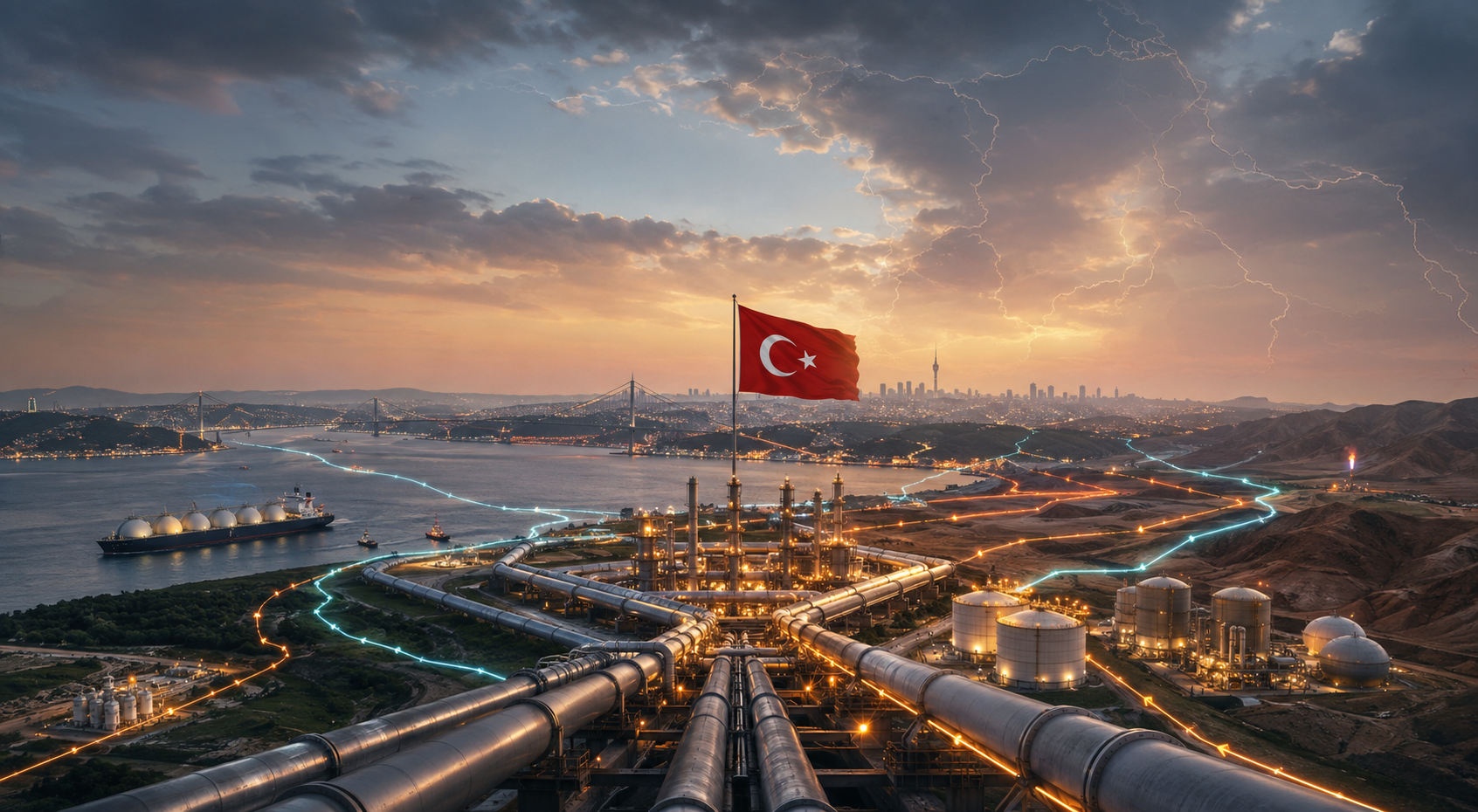
The Strait of Hormuz is frequently characterized as a chokepoint for global supply chains; however, this description is now insufficient. Recent disruptions have demonstrated that the world’s most critical supply chains depend on a limited number of narrow routes connecting energy, food, and industry. These connections influence both economic resilience and national security.
The recent conflict in Iran highlights the importance of Hormuz. In the first half of 2025, an average of 20.9 million barrels per day passed through the Strait. The Strait accounts for 20% of global petroleum liquids consumption and about one-quarter of global seaborne oil trade. [1] According to the International Energy Agency, LNG shipments through the Strait totaled just over 112 bcm in 2025, representing 20% of global LNG trade. [2] Any disruption in this corridor is not a local shock but a global crisis. Such events reveal hidden dependencies that affect Asian energy buyers, European market confidence, global shipping behavior, insurance pricing, industrial costs, and government security planning.
The main challenge is that governments and companies often identify supply chain risks only after disruptions have already begun. While many know their direct suppliers and main routes, few have the real-time intelligence needed to track disruptions across energy, logistics, industrial inputs, ports, and upstream suppliers. Tools like supply chain mapping, knowledge graphs, large language models, and agent-based AI are now essential for building national resilience, not just for improving business operations.
Hormuz as a Global System
The recent disruption showed that Hormuz is not simply a regional passage. It is a global system compressed into a narrow maritime corridor. Reuters reported on 29 June that Middle East oil and LNG producers continued loadings despite ship attacks and escalated tension, with LNG exports from Qatar and the UAE also continuing and vessels heading to Asian markets, including India and China. [3] Earlier in June, Reuters reported that oil product shipments exited Hormuz while an LNG tanker loaded cargo in the UAE, noting the relevance of these movements while traffic through the chokepoint remained limited. [4]
This is significant because the effects of a chokepoint begin well before any actual closure occurs. Uncertainty alters behavior throughout the system: ships reduce speed, cargo experiences delays, and routes are modified. Tracking shipments becomes increasingly complex, insurance costs escalate, and buyers incorporate risk into pricing. Energy markets react to the potential for disruption prior to any physical interruption. In contemporary supply chains, early warning indicators frequently emerge before the primary disruption.
Although energy is typically the first sector impacted, uncertainty regarding oil and LNG rapidly extends to electricity prices, transportation, aviation, chemicals, food delivery, industrial supplies, and consumer costs. For manufacturers, increased fuel prices, delivery delays, supplier risks, inventory challenges, and global tensions complicate planning and operations. An initial shipping issue can swiftly escalate into a production challenge or a national inflation concern, transforming a chokepoint into a broader national security issue.
The UAE’s Strategic Role in Resilience
The United Arab Emirates (UAE) plays a pivotal role in this system. Its proximity to one of the world’s most significant maritime corridors has prompted substantial investment in infrastructure, diplomacy, and operations to enhance regional resilience.
The clearest example is Fujairah. Unlike Gulf ports located inside the Strait, Fujairah sits on the Gulf of Oman, outside Hormuz. That gives it a strategic role as an export, storage, bunkering, and logistics hub. Reuters reported in May that the UAE would accelerate construction of a new oil pipeline to double export capacity through Fujairah by 2027. [5] Reuters also reported that the new UAE pipeline bypassing Hormuz was about 50 percent complete, according to ADNOC’s chief executive. [6] Reuters later assessed that Gulf exporters’ efforts to bypass Hormuz are able to reshape the region, highlighting the UAE’s ability to use its Fujairah route as part of a broader resilience strategy. [7]
The UAE’s strategy emphasizes preparedness over vulnerability. Through proactive investment in robust infrastructure prior to crises, the country ensures operational continuity, decreases dependence on a single route, and fosters market confidence. As global trade encounters emerging risks, such forward planning constitutes a significant national asset.
The UAE has also maintained a clear diplomatic line on freedom of navigation and regional stability. In May, the UAE Ministry of Foreign Affairs called for the immediate and unconditional reopening of the Strait of Hormuz and emphasized the importance of protecting international navigation. [8] In an earlier joint statement, the UAE and partners described freedom of navigation as a fundamental principle of international law under the United Nations Convention on the Law of the Sea. [9] The United Nations Security Council similarly stressed the need to restore freedom of navigation through the Strait. [10] This diplomatic framing matters. Supply-chain resilience is not only physical. It is also legal, diplomatic, and institutional.
The Missing Layer: Visibility Before Impact
The disruption at Hormuz highlighted a common challenge in global crises: many organizations do not have a complete picture of their dependencies. While they may know their direct suppliers and main routes, they often miss risks hidden in second-tier suppliers, raw materials, port connections, vessel movements, energy sources, and backup routes.
That missing layer is visibility.
Supply chains have historically prioritized efficiency, yielding benefits but also introducing concealed vulnerabilities. Highly optimized networks are susceptible to breakdown if a critical node, such as Hormuz, is disrupted. The solution is not to halt global trade, but to enhance intelligence and monitoring capabilities to manage risks proactively.
AI now plays a central role in supply-chain resilience. It enables real-time mapping of supply-chain connections. Knowledge graphs link companies, ports, ships, goods, facilities, products, routes, suppliers, and countries. Large language models gather information from news, company reports, shipping updates, customs data, sanctions, and policy statements. Agent-based AI systems help with monitoring, mapping, risk assessment, planning, and response.
Recent research on supply-chain visibility using knowledge graphs and large language models focused on exactly this challenge: how to extend visibility beyond direct suppliers by extracting supply-chain relationships from public sources and constructing structured maps of dependency. [11] The broader research direction is that supply-chain intelligence should not depend only on manual disclosure. In a crisis, decision-makers need to infer, connect, and update relationships from fragmented information.
This is especially relevant for Hormuz. Governments and companies must identify imports dependent on the corridor, exposed suppliers, delayed shipments, available alternative ports or pipelines, time-sensitive industries, partners with spare capacity, and how risks may spread across energy, food, manufacturing, aviation, and consumer prices.
In the absence of AI-enabled mapping, responses to these questions are frequently delayed or incomplete. AI-powered supply chain intelligence integrates these components into a cohesive system that supports national resilience.
From Monitoring to Action
The next step is to move beyond better visibility and achieve faster, more coordinated responses. Agent-based AI and multi-agent systems are essential for making this possible.
Managing supply-chain disruptions involves several steps: identifying problems, determining who is affected, mapping risks, estimating impacts, developing alternatives, sharing decisions, and monitoring outcomes. A single model or dashboard is rarely enough. Multi-agent systems are more effective because they assign tasks to specialized agents and keep the process coordinated.
Recent research on agentic AI for disruption monitoring has proposed a framework in which specialized agents detect disruption signals from unstructured news, map these signals to multi-tier supplier networks, evaluate exposure, and recommend mitigations such as alternative sourcing options. [12] Related studies on multi-agent systems and foundation models suggest that these technologies can support autonomous supply chains by enhancing adaptability and decision-making across evolving supply networks. [13] The objective is not to eliminate human judgment, but to provide decision-makers with faster, more structured, and more traceable intelligence.
The Hormuz event shows why rapid decision-making is essential, especially when information is incomplete, and risks span multiple sectors. Operational, diplomatic, financial, and security issues all come together. National resilience depends on having timely and accurate information.
AI systems support governments and companies in several key ways. Agent-based AI can monitor geopolitical and maritime signals in real time, link these signals to supply chains to identify at-risk sectors, track how disruptions spread across fuel, shipping, food, industry, and prices, recommend alternative routes, suppliers, or inventory buffers, and keep clear records of decisions to ensure crisis responses are both fast and transparent.
That last point is crucial. In national security, AI systems must not be a black box. The best setup combines knowledge graphs for clear structure, large language models for finding and understanding information, reliable tools for checking results, and human review for judgment. Research shows that mixing language models with knowledge graphs is powerful for supply-chain resilience because leaders need both. The Strait of Hormuz is a reminder for governments to rethink what resilience means. Today, supply chains are part of national security infrastructure, not just business systems.
This shift brings several important lessons. First, mapping critical supply chains is now a vital national skill. While energy is a leading example, the same approach is needed for food, medicine, semiconductors, defense materials, essential minerals, and industrial parts.
Second, resilience should be built into infrastructure, not treated as a separate issue. The UAE’s Fujairah plan shows the value of having backup capacity and alternative routes. Countries with multiple options and plans in place before a crisis are better prepared to keep operations running during disruptions.
Third, governments need to connect geopolitical monitoring of global disruptions with supply-chain intelligence. Events like shipping delays, sanctions, conflicts, or port issues should be quickly linked to the sectors, products, companies, imports, routes, and economic impacts they affect.
Fourth, companies must recognize that awareness of only their primary suppliers is insufficient. Significant risks frequently reside in materials, sub-suppliers, transport routes, and infrastructure connections. AI-enabled mapping assists businesses in transitioning from reactive problem-solving to proactive resilience-building.
Finally, national resilience depends on reliable AI. Speed is important, but confidence matters even more. Resilience systems should use transparent data, provide traceable results, show confidence levels, include human oversight, and ensure accountability. The aim is to support informed decisions, not to create panic.
Conclusion
The disruption at the Strait of Hormuz was a wake-up call, showing how issues can quietly move through complex supply chains and affect sectors far beyond the original problem. As a key maritime corridor, the UAE has invested in infrastructure and diplomacy to keep trade moving. Fujairah, bypass capacity, energy reliability, and a steady commitment to freedom of navigation are all part of a wider resilience strategy.
The main lesson is that national resilience now depends on spotting supply chain issues before they happen. AI cannot remove geopolitical risks or chokepoints, but it helps governments and companies detect risks sooner, find alternatives more quickly, and respond with greater confidence.
Hormuz showed that future national security needs more than ships, ports, pipelines, reserves, and alliances. It also requires intelligence systems that can map global dependencies in real time.
[1] U.S. Energy Information Administration, “World Oil Transit Chokepoints: Strait of Hormuz,” https://www.eia.gov/international/analysis/special-topics/world_oil_transit_Chokepoints. Accessed June 29, 2026.
[2] International Energy Agency, Strait of Hormuz, 2025, https://www.iea.org/about/oil-security-and-emergency-response/strait-of-hormuz. Accessed June 29, 2026.
[3] “Middle East producers push on with oil, LNG loadings despite ship attacks,” Reuters, June 29, 2026. https://www.reuters.com/business/energy/middle-east-producers-push-with-oil-lng-loadings-despite-ship-attacks-2026-06-29/. Accessed June 29, 2026.
[4] “Oil products shipments exit Hormuz, LNG tanker loads at UAE,” Reuters, June 2, 2026, https://www.reuters.com/world/middle-east/oil-products-shipments-exit-hormuz-lng-tanker-loads-uae-2026-06-02/. Accessed June 29, 2026.
[5] “UAE’s new oil pipeline push to double export capacity bypassing Hormuz,” Reuters, May 15, 2026, https://www.reuters.com/business/energy/uae-accelerate-oil-pipeline-project-help-bypass-hormuz-2026-05-15/. Accessed June 29, 2026.
[6] “New UAE pipeline bypassing Hormuz now 50% complete, ADNOC CEO says,” Reuters, May 20, 2026, https://www.reuters.com/world/middle-east/new-uae-pipeline-bypassing-hormuz-now-50-complete-adnoc-ceo-says-2026-05-20/. Accessed June 29, 2026.
[7] Ron Bousso, “Gulf exporters’ quest to bypass Hormuz will reshape the region,” Reuters, June 18, 2026, https://www.reuters.com/commentary/reuters-open-interest/gulf-exporters-quest-bypass-hormuz-will-reshape-region-2026-06-18/. Accessed June 29, 2026.
[8] UAE Ministry of Foreign Affairs, “UAE Calls for Immediate and Unconditional Reopening of Strait of Hormuz,” May 1, 2026, https://www.mofa.gov.ae/en/mediahub/news/2026/5/1/uae-strait-of-hormuz. Accessed June 29, 2026.
[9] UAE Ministry of Foreign Affairs, “Joint Statement on the Strait of Hormuz,” March 21, 2026, https://www.mofa.gov.ae/en/mediahub/news/2026/3/21/uae-strait-of-hormuz. Accessed June 29, 2026.
[10] United Nations Security Council, “Immediately Restore Freedom of Navigation through Strait of Hormuz,” April 27, 2026, https://press.un.org/en/2026/sc16349.doc.htm. Accessed June 29, 2026.
[11] Sara AlMahri, Liming Xu, and Alexandra Brintrup, “Enhancing supply chain visibility with knowledge graphs and large language models,” International Journal of Production Research 64, no. 6 (2026): 2178–2209, https://www.tandfonline.com/doi/full/10.1080/00207543.2025.2575841. Accessed June 29, 2026.
[12] Sara AlMahri, Liming Xu, and Alexandra Brintrup, “Automating Supply Chain Disruption Monitoring via an Agentic AI Approach,” arXiv, 2026, https://arxiv.org/abs/2601.09680. Accessed June 29, 2026.
[13] Liming Xu, Sara Almahri, Stephen Mak, and Alexandra Brintrup, “Multi-Agent Systems and Foundation Models Enable Autonomous Supply Chains: Opportunities and Challenges,” IFAC-PapersOnLine 58, no. 19 (2024): 795—800, DOI: 10.1016/j.ifacol.2024.09.200.