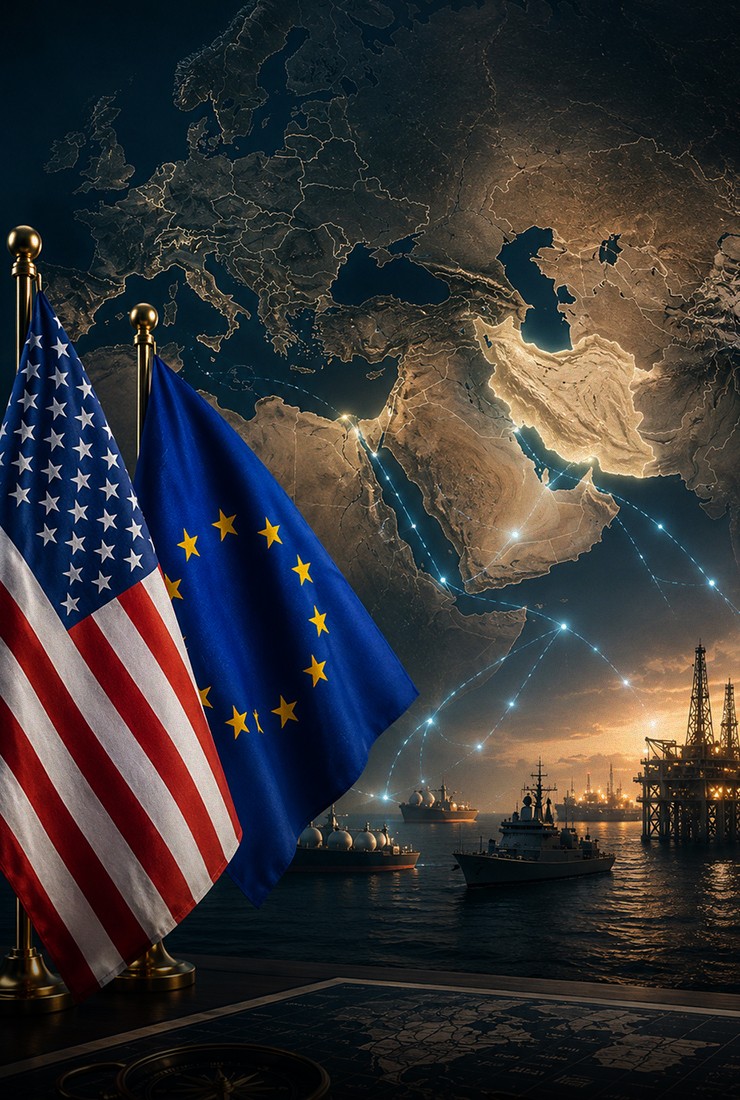
The future of U.S.-European relations is under significant scrutiny and debate. The Iran war has energized policy discourse on the state of U.S.-NATO relations. Many experts would argue that U.S.-European relations have hit rock bottom, and the Iran war is further exacerbating tensions.
In response to the Iran war, Europe has reportedly taken an unprecedented position by limiting military contributions to the United States. This initial decision was based on concerns over insufficient situational awareness and limited consultation from the U.S. prior to the preemptive strike in Iran. As a result, the U.S. has sharply criticized NATO for the lack of military support in the Iran war.[1]
The current administration has repeatedly threatened to withdraw from NATO and is reassessing U.S. military posture in Europe. The U.S. is also reducing its presence by delaying and scaling back troop deployments to Germany and Poland.[2]
What comes next for this relationship remains uncertain. The Iran war represents a pivotal moment in U.S.-European relations. European nations may need to reconsider their positions and engage more actively using the full range of foreign policy tools, including potential military contributions. The Iran war is entering a new phase and has passed 100 days. The costs associated with the war are increasingly affecting European security. It is inevitable that Europe will intervene. The big question is what European intervention looks like, given significant conditions: domestic politics, economic costs, and the Ukraine war.
Background
For more than seventy years, United States-NATO relations have traditionally been close. In 1949, the military alliance was formed to create a collective defense system that has successfully expanded its mission in Europe and among non-member states in different regions. Since its founding, the U.S. has been the most influential NATO member and has remained committed to Article 5 of NATO: an attack on one member is an attack on all members. The U.S. has participated in many NATO combat operations, initially aimed at countering regional threats, including Bosnia and Herzegovina (1992–1995) and the Kosovo War (1999). By the 2000s, NATO’s combat priorities shifted beyond Europe. U.S. historical commitments to NATO have included maintaining regional deterrence, security cooperation activities, counterterrorism operations, cybersecurity and intelligence sharing, crisis management, and peacekeeping missions. Also, the U.S. established military bases and ongoing joint military exercises conducted with NATO partners.[3]
To reiterate, U.S.-NATO relations are strong but imperfect. Through several administrations, there has been pressure from the United States, especially during the Trump administration, for NATO to contribute more. NATO members are expected to meet or exceed the two percent burden-sharing requirement involving military contributions. During the first and second Trump administrations, NATO countries increased their military expenditures. “In August 2025, NATO committed to a five percent defense spending increase. At the 2025 NATO Summit in The Hague, Allies agreed to invest 5% of Gross Domestic Product (GDP) annually in core defense requirements and defense- and security-related spending by 2035. They will allocate at least 3.5% of GDP annually based on the agreed definition of NATO defense expenditure to meet NATO Capability Targets.”[4]
NATO members have participated in multiple U.S.-led military campaigns in the Middle East. In fact, the transatlantic alliance suffered significant losses and spent substantial resources on U.S.-led military operations. After 9/11, NATO invoked Article 5 and participated in several U.S.-led military campaigns in the Middle East, including Operation Enduring Freedom and Combined Joint Task Force – Operation Inherent Resolve. During the initial phase of the Global War on Terrorism, NATO participated in combat operations in Afghanistan through the International Security Assistance Force. This became NATO’s largest and longest military operation. After the 2003 U.S. invasion of Iraq, several NATO members participated in the coalition and later focused on training missions. In 2011, during the no-fly zone in Libya, NATO commanded Operation Unified Protector, leading an air campaign. In 2014, many NATO members provided support, training, and capacity-building for the Combined Joint Task Force – Operation Inherent Resolve.[5]
Strong U.S.-NATO relations have generally complemented the European Union’s foreign policy interests. NATO’s mission prioritizes defense and security affairs, while the EU focuses on soft security issues such as political affairs, economic integration, technological cooperation, energy security, and environmental policy. The EU is also involved in defense and security matters but relies heavily on NATO’s military capabilities.[6] A clear example of this cooperation is Arctic security. The EU works closely with NATO on issues related to Greenland. Both organizations maintain separate but complementary roles in the Arctic region. The European Union focuses on climate policy, infrastructure investment, economic regulation, diplomacy and governance, and research and innovation. Meanwhile, NATO focuses on military defense, deterrence and exercises, operational security, force readiness, and collective defense.
NATO-EU relations regarding Arctic security were disrupted after the Trump administration expressed interest in seizing Greenland. For the first time in history, a NATO member threatened military action against another NATO country. The U.S.’s interest in taking control of another NATO member state reflected an imperial approach, raising concerns about international law and signaling strain in U.S.-NATO relations. However, U.S. interests in taking over Greenland ceased. U.S. lawmakers from both parties opposed this position and emphasized that such action would require congressional approval.[7] Besides, there is room for the U.S. to expand its security role in Greenland according to the 1951 Defense of Greenland Agreement.[8]
Another important note to take into account is the current administration’s strained relationship with President Zelensky. President Trump’s infamous key leadership engagement with the Ukrainian president in the Oval Office. President Trump wanted a peace deal. Prior to the proposed deal, President Zelensky was adamant about restoring Ukraine’s borders. Beyond this point, the EU decided to act as mediator between the United States, Ukraine, and Russia.[9]
Additionally, U.S. tariffs have strained U.S.-European relations. During Trump’s first presidency, the administration imposed 25 percent tariffs on steel and 10 percent tariffs on aluminum. The second administration further disrupted relations by imposing tariffs on similar goods. In response, the EU imposed retaliatory tariffs on U.S. goods, including motorcycles, alcohol and spirits, clothing and textiles, agricultural products, boats, and food products. The EU avoided imposing tariffs on certain sectors, especially aerospace.[10]
The 2026 Iran war exposed further fragility in U.S.-European relations. Washington’s criticism of NATO for not contributing signaled a turning point in the relationship. However, earlier developments made this situation more predictable. The administration had already criticized Europe’s security posture in official documents, including the 2025 White House National Security Strategy (NSS)[11] and the latest Annual Threat Assessment of the U.S. Intelligence Community.[12] More specifically, the NSS strategy argued that Europe faces challenges related to political cohesion, migration, censorship concerns, demographic decline, and weakening national identity.
Prior to the Iran war, the administration also threatened to withdraw from NATO. During the first presidency, Trump expressed frustration over NATO defense spending and repeatedly suggested withdrawal. In 2018, multiple news sources reported that the president was considering pulling out of NATO. The administration expressed this position at the 2018 Brussels NATO Summit.[13] More recently, President Trump again raised the possibility of withdrawal in response to NATO’s lack of involvement in the Iran war.[14]
Current Assessment on European Involvement
The United States did little in presenting its interests to its European allies and partners before the preemptive strikes. Historically, this move is incomparable to the Obama and Bush Jr. administrations. President Bush sought global consensus from the international community regarding the U.S. invasion of Iraq. He worked with former United Nations Secretary General Kofi Annan, seeking support from the UN Security Council.[15] Also, President Obama emulated a similar approach, working with key players and international organizations regarding the intervention in Libya. The Obama administration closely worked with the Arab League, NATO, and the United Nations.[16]
Currently, European nations appear to provide little to no contribution. In response, the U.S. has called out key players. The United States called out UK Prime Minister Keir Starmer for not supporting the U.S. blockade in the Strait of Hormuz. The UK Prime Minister publicly expressed his concerns about his country getting “dragged into another war.”[17] The UK also resisted allowing the United States to use its airspace and military bases. Germany even denied the U.S. direct military contributions, believing that the war generated major political, economic and security implications. The U.S. reacted to Germany’s stance by reducing the U.S. troop presence.[18] In addition, Spain publicly expressed the strongest opposition against the Iran war and characterized it as a reckless move. Spain showed no interest in involvement by denying the United States utilization of military bases and closed airspace.[19]
Europe did convene preliminary meetings discussing potential military contributions. The UK and France convened multinational talks focusing on the Strait of Hormuz. The EU’s immediate response recommended prioritizing diplomacy and stressed de-escalation efforts.[20] Since then, Europe has incrementally contributed, but only by using a soft approach. The European Union imposed sanctions on multiple stakeholders, including targeting Iranian authorities that are involved in human rights abuses and those individuals who threaten freedom of navigation in the Strait of Hormuz.[21] However, the contributions are viewed as inadequate by the Trump administration. The administration is under pressure because, in order to gain victory, the U.S. needs military contributions from European powers.
There are many factors why Europeans are contributing very little to the fight. Domestic politics appears to be the utmost reason why several European nations are willing to make little to no contribution. According to multiple polls, the Iran war is viewed as unfavorable by Europeans. Also, Iran is not considered an imminent threat to European security. Therefore, many Europeans are not favorable to military intervention. The second order of effect is that Europe’s involvement could generate more regional security challenges. European nations could end up being more vulnerable to homeland attacks, political violence, and cybersecurity threats.
Furthermore, the Ukraine war is another factor contributing to Europe’s reluctance to become more involved. If the war persists, this will put pressure on Europe to get more involved. This approach will be hard for Europe to balance participation in the Ukraine war and the Iran conflict. Some European nations are just starting to increase their military expenditures and contribute more to the Ukraine war.
Current Impacts from the Iran War
The Iran war is impacting European security. If the war continues, those effects will likely exacerbate, influencing multiple domains, including commercial activities, energy prices, and food security. Security challenges associated with the Strait of Hormuz generated higher energy prices. These economic shocks are even contributing to slower economic growth. Significant business industries such as transportation, manufacturing, chemical and steel have been impacted.
Recommendations
European nations’ refusal to contribute toward the Iran war, in support of the United States, is a game-changer for U.S.-European relations. It is also an opportunity for Europe to reshape what kind of forward-looking relationship they want to have with the United States. Europe can no longer assume that the United States will seek consultation prior to seeking war in the Middle East and other parts of the world, even with new leadership. Therefore, the European Union should consider several immediate recommendations on how to repair the relationship with the United States.
International Law and U.S. Congress: The core issue of Europeans’ decision to provide limited contributions stems from the role of international law. The UN Charter clearly advocates for the international community or sovereign states to pursue maximal diplomacy over defense, responding to a global crisis as we learned our lesson from World War II. The European Union should organize a multilateral agreement among different international organizations, creating a Memorandum of Understanding addressing the issue with its global allies and partners before going to war with another nation. Similar to the EU’s statement addressing the Middle East, the Memorandum of Understanding should promote the importance of the protection of civilians and full respect for international law, and underscore international humanitarian law. The EU should solicit this MoU’s key players and organizations even beyond its region, such as Canada, Mexico, India, Japan, Australia, the Gulf States, Colombia, and many more. International organizations should include NATO, the United Nations, the Organization of American States, the Organization of Islamic Cooperation, ASEAN, and the African Union.
The Memorandum of Understanding should be submitted to Congress. The European Union and NATO need to conduct subnational diplomacy with the U.S. Senate Committee on Foreign Relations (SCFR). SCFR includes enduring bipartisan support for NATO. The potential request for SCFR to be committed to providing situational awareness prior to entering war will likely gain enough support by focusing on NATO Affairs. There are several notable examples to cite. In January 2026, SCFR clearly believed that there was a need to establish a NATO Observer Group. The purpose of the NATO Observer Group is to address and advise on matters related to U.S.-NATO relations. In 2018, two senators initially launched the NATO Observer Group, which focused on “defense spending, military capabilities, counterterrorism efforts, enlargement, and the ability to address unconventional warfare threats.”[22]
In April, SCFR reassured that the U.S. is committed to remaining in NATO. U.S. Senate NATO Observer Group co-chairs, U.S. Senator Jeanne Shaheen and Senator Thom Tillis, further codified that the U.S. is not leaving NATO and the executive branch is not authorized to withdraw from NATO without Senate approval. In the press statement, both senators even acknowledged NATO’s historical contributions that supported U.S. National Security. [23]
According to the bill, SCFR’s NATO Observer Group is committed to subnational diplomacy or is willing to engage in diplomatic talks with European counterparts. The bill recommends foreign travel to meet with counterparts. SCFR NATO Observer Group members have been active in engaging with European counterparts through multilateral forums and bilateral meetings. SCFR should encourage the U.S. House of Representatives and select state and local officials to emulate a similar approach. These efforts should be cross-coordinated and managed by the SCFR NATO Observer Group.
Alternatively, the EU could also solicit a Memorandum of Understanding through the existing focused group, the NATO Parliamentary Assembly Delegation. The EU should gain the support of the MoU from lawmakers, which will likely influence the Senate decision.
Domestic Politics and Strategic Messaging: The EU needs to be very intentional in educating the region about historical contributions and critical developments on European involvement. The EU needs to go beyond publishing press statements and use both legacy and new media tools to amplify its strategic messages. Executing a strong strategic messaging campaign is crucial as we are in an era of widely spread misinformation and disinformation.
The European Union Should Recommend More Contributions: The current state of this war is further conditioning the security environment for Europe to be more precarious. At this point, Europe has no choice but to consider more involvement. Rising energy prices and additional costs associated with commercial activities will inflame significant political and economic insecurity. The Iran war will likely not involve the deployment of ground troops to Iran but will likely consider other security options. The EU and NATO should consider contributing military support by deploying an international interim security group to the Strait of Hormuz. The interim international security group would help facilitate the opening of the Strait of Hormuz. In doing so, the interim security group would coordinate demining operations, deploy naval forces, air-defense missiles, intelligence, surveillance, and reconnaissance (ISR) assets, logistical support, and cyber defense capabilities.
Similar to Pakistan, the EU could offer to lead in peace negotiations. Playing a major role in diplomatic efforts would be helpful in ensuring a strong ceasefire and effective negotiations. The EU is better positioned to do so since it has unique and long-term ties with both the United States and Middle East countries.
Recommend Transatlantic Caucus: Also, the EU should recommend to the United States to create a transatlantic caucus. Transitioning from an observer group to creating actually will deepen the relationship. In 2019, this author and Ashley Burrell recommended a similar approach by creating a NATO Caucus.[24] Based on the current dynamics with the significant changes in this critical relationship, the caucus should focus on the transatlantic alliance. The House should have a transatlantic alliance caucus that has a broader mission, working with the NATO Parliamentary Assembly delegation, and cut through the redundancy.
Conclusion
The current state of the Iran war will likely continue, with increasing costs for the global security environment, which will place pressure on European intervention. Europe needs to do more. The EU should lead the effort by promoting new rules and standards, working with key players and regional and international organizations, supporting diplomacy and defense contributions to the Iran war, engaging its domestic audiences through strategic messaging using both legacy and new media tools, and continuing to sanction individuals and entities that are supporting the war.
[1] Christian Edwards, “Europe didn’t want an Iran war, yet Trump is saddling it with the consequences,” CNN, April 2, 2026, https://www.cnn.com/2026/04/02/europe/europe-nato-iran-war-trump-consequences-intl.
[2] “Pentagon Halts Deployments To Poland and Germany To Cut Troop Numbers in Europe, AP Sources Say,” AP News, May 16, 2026, https://apnews.com/article/poland-us-troop-reduction-deployment-europe-34138e62c7afc0b83ab7c7cc8fa60071.
[3] NATO & OTAN, A Short History of NATO, https://www.nato.int/en/about-us/nato-history/a-short-history-of-nato.
[4] NATO & OTAN, The Hague Summit Declaration, June 25, 2025, https://www.nato.int/en/about-us/official-texts-and-resources/official-texts/2025/06/25/the-hague-summit-declaration.
[5] Ibid.
[6] NATO & OTAN, “Relations with the European Union,” June 20, 2025, https://www.nato.int/en/what-we-do/partnerships-and-cooperation/relations-with-the-european-union.
[7] Rep. Jimmy Gomez Introduces Bill to Block Any U.S. Effort to Invade, Annex or Purchase Greenland, January 13, 2026, Press Release, https://gomez.house.gov/news/documentsingle.aspx?DocumentID=5905.
[8] Defense of Greenland Agreement Between the United States and the Kingdom of Denmark, April 27, 1951, Avalon Project, https://avalon.law.yale.edu/20th_century/den001.asp.
[9] Constant Méheut, “Ukraine Turns to Europe as U.S. Steps Back As Mediator in Peace Talks,” The New York Times, June 7, 2026, https://www.nytimes.com/2026/06/07/world/europe/ukraine-europe-russia-us-peace-talks.html.
[10] “EU to begin retaliatory tariffs against US on Friday,” Business Standard, June 21, 2018, www.business-standard.com.
[11] The White House, National Security Strategy of the United States of America, November 2025, https://www.whitehouse.gov/wp-content/uploads/2025/12/2025-National-Security-Strategy.pdf.
[12] Office of the Directorate of National Intelligence, 2026 Annual Threat Assessment of US Intelligence Community. March 2026, https://www.dni.gov/files/ODNI/documents/assessments/ATA-2026-Unclassified-Report.pdf.
[13] “New York Times: Trump Raised Withdrawing the U.S. from NATO Several Times,” CNN, January 19, 2019. https://www.cnn.com/2019/01/15/politics/trump-nato-us-withdraw.
[14] “Trump Considering Pulling Us Out of NATO Amid Fallout Over the Iran War: Can He Legally Do That?,” Time, April 2, 2026, https://time.com/article/2026/04/01/trump-considering-pulling-us-out-of-nato-iran-war-legal-options/.
[15] “Bush Seeks Help in Iraq,“ September 23, 2003, https://www.cnn.com/2003/US/09/23/sprj.irq.un/index.html.
[16] The White House, Remarks by the President in Address to the Nation on Libya, March 28, 2011, https://obamawhitehouse.archives.gov/the-press-office/2011/03/28/remarks-president-address-nation-libya/.
[17] “Starmer says he’s ‘not going to yield’ to pressure from Trump on the Iran War,” BBC, April 15, 2026, https://www.bbc.com/news/articles/cdxdd7ddzgdo.
[18] “Germany’s Merz: We will not participate in the Iran War,” Reuters, March 16, 2026, https://www.reuters.com/world/middle-east/germanys-merz-we-will-not-participate-iran-war-2026-03-16/.
[19] “US Aircraft Leave Spain After Government Says Bases Cannot Be Used in Iran Attacks,” Reuters, March 2, 2026, https://www.reuters.com/world/middle-east/us-aircraft-leave-spain-after-government-says-bases-cannot-be-used-iran-attacks-2026-03-02/.
[20] “France and United Kingdom Convene 40-Nation Hormuz Talks, as Iran Standoffs Continue,” Yahoo News, May 12, 2026, https://www.yahoo.com/news/articles/france-uk-convene-40-nation-.
[21] “EU Sanctions Iranians Over Restricting Naval Traffic Hormuz,” June 8, 2026, https://www.reuters.com/world/middle-east/eu-sanctions-iranians-over-restricting-naval-traffic-hormuz-2026-06-08/.
[22] Thom Tillis, U.S. Senator for North Carolina, “Senate NATO Observer Group Announces Appointment of New Members,” July 17, 2018, https://www.tillis.senate.gov/2018/7/senate-nato-observer-group-announces-appointment-of-new-members.
[23] “Bipartisan Senate NATO Observer Group Co-Chairs Respond to President Trump’s Comments on NATO,” Foreign Relations Committee, April 2, 2026, https://www.foreign.senate.gov/press/dem/release/bipartisan-senate-nato-observer-group-co-chairs-respond-to-president-trumps-comments-on-nato.
[24] Asha Castleberry and Ashley Burrell, “U.S. Leadership on Foreign Policy: Establish A Caucus on NATO and Transatlantic Security,” The National Interest, June 9, 2019, https://nationalinterest.org/profile/asha-c-castleberry.