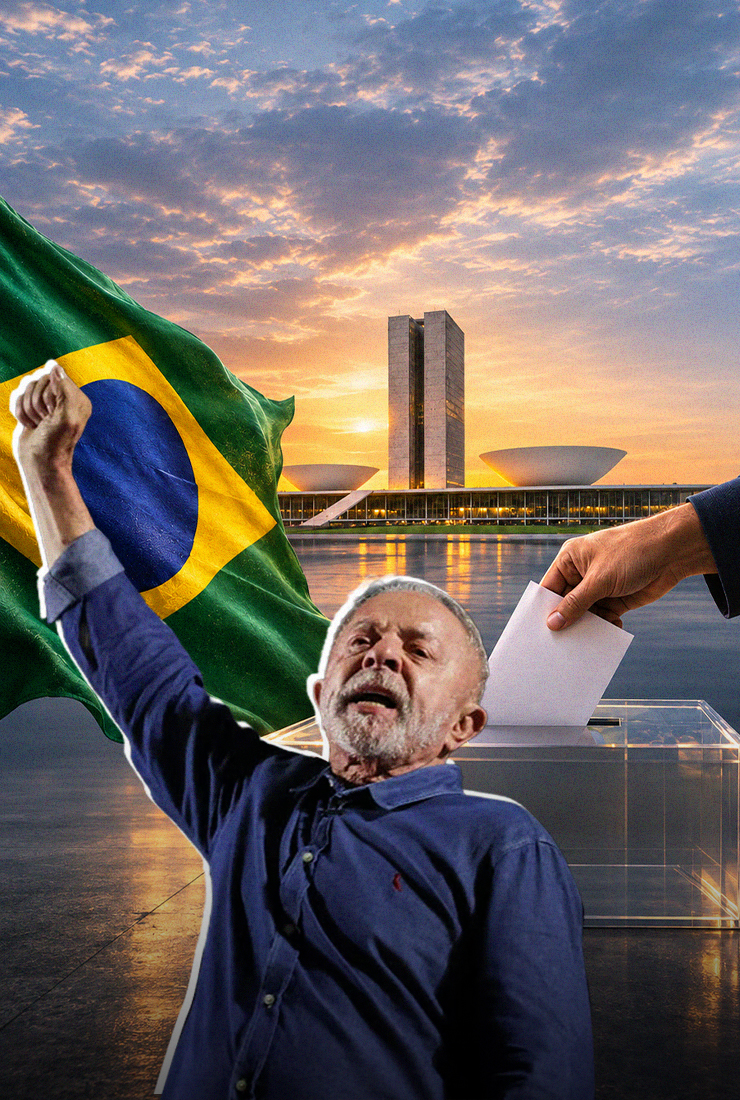
The second round of Brazil’s presidential election was held on 27 October. In the first round on 4 October, Flávio Bolsonaro (Liberal Party) won with 47.03% of the votes (56,104,503), while the incumbent President Luiz Inácio Lula da Silva (Workers’ Party) received 45.16% (53,879,538 votes).
Polls and analysts had predicted a victory for Bolsonaro, highlighting his lead of 2.2 million votes over Lula and the fact that most of the other presidential candidates who participated in the first round were ideologically closer to him than to the current president.
However, contrary to all predictions, Lula received 4.43 million more votes than Bolsonaro in the second round—something that had seemed impossible[1]—and will begin his fourth term as president of Brazil in January.
Beyond this unexpected result, Brazil’s domestic politics—and those of the wider Latin American region—were shaken by Flávio Bolsonaro’s departure from the country and his request for U.S. asylum with Argentina’s assistance—an event bound to alter both the domestic and international landscapes.
Furthermore, social and political polarization, Brazil’s structural problems and the governability of the political system will shape the domestic agenda far beyond the analysis of the election results.
Lula’s Not-So-Victorious Victory
As we pointed out in a previous article,[2] the polarization of Brazilian society is nothing new. Polls showed a virtual tie between the candidates in the first round, just as happened in the 2022 election and was expected for this election’s second round.
However, as mentioned, Lula managed to turn the tables and defeat Bolsonaro by more than four million votes, receiving almost 11 million more votes than in the first round. Official results show that Lula received 51.79% of valid votes (64,256,232), compared to 48.21% for his rival (59,826,041 votes).[3]
On election Sunday, the Liberal Party claimed to have noticed irregularities in the process as a result of the voting hours being extended by two hours beyond the original 5 p.m. finish time. However, the Superior Electoral Court (TSE) and the Federal Supreme Court of Brazil found no evidence to support this claim.
In the wake of these events, observers have sought to explain Lula’s ‘electoral resurgence’, who recently turned 81, by pointing to the greater mobilization of his electoral base, both on the streets and through increased social media activism. In this regard, the WhatsApp group called ‘Lula’s Army’, formed in April and growing exponentially after the first round to reach 10 million members before the second, is said to have played a crucial role in instantly spreading Lula’s views to every corner of Brazilian society.[4] He also shifted the focus of his discourse from his history and legacy to proposals for the future.
It is also noted that certain decisions made between 5 and 25 October (between the first and second rounds), which favored the less privileged classes, played a significant role.[5] This has earned Lula accusations of populism, as well as leading to higher voter turnout.
In the first round, voter abstention reached 21% of the electorate, or around 28 million people. In the second round, this figure fell to 19 percent, with around 25 million Brazilians not voting. There were 2.3 million blank ballots in the first round and 1.4 million in the second. In the first round, there were 3.6 million invalid ballots, and in the second, there were 2.7 million.
All of these factors would help to explain the outcome: higher voter turnout, fewer invalid votes and blank ballots, and an increase in Lula’s total vote—particularly in key states such as Minas Gerais and São Paulo, where he gained an additional 2.6 million votes between the first and second rounds.
While Bolsonaro received 3,721,538 more votes in the second round than in the first, Lula received 10,376,694 more.
Lula won in 13 of Brazil’s 27 states, while Bolsonaro won in 14. Beyond the presidential election results, the advantage of Bolsonaro’s party at the state level, as well as its victories in the Senate and Chamber of Deputies, foreshadow difficulties for Lula’s Workers’ Party in a country with strong federalism. Bolsonaro’s Liberal Party will hold 28 of the 81 Senate seats,[6] accounting for nearly one-third of the total.
In the Chamber of Deputies, there is much greater fragmentation among its 513 seats, but the Liberal Party will hold 98 of them.
The Liberal Party has secured victory in six of the 27 states, while the Workers’ Party has won four.
Another group of states will be led by governors belonging to the so-called “centrão”[7] in Brazil—that is, right-wing and center-right parties: Five governorships are held by the PSD (Social Democratic Party), four by the Progressive Party, four by the Republicans, and one by the MDB (Brazilian Democratic Movement).
In summary, although Lula won the presidential election somewhat unexpectedly, the presence of opposition forces among governors, state legislators and federal legislators (representatives and senators) means that the president’s Workers’ Party is far from dominant.
This will necessitate complex negotiations and compromises in a highly polarized society that must address urgent problems amid an uncertain international context.
Bolsonaro: From near-president to the United States
While polarization is one of the central characteristics of the Brazilian political system, it has taken a new turn following the events at the end of the second round of voting.
Flávio Bolsonaro did not acknowledge the election results in the hours that followed. On Monday, 26 October, he announced on social media that Brazilian authorities had asked him to hand in his passport and that the Brazilian Federal Police had revoked it to prevent him from leaving the country.[8] It is important to note that the current senator for Rio de Janeiro is under investigation for alleged money laundering and illegal foreign financing of his presidential campaign.
The Bolsonaro family faces several legal issues.
Former President Jair Bolsonaro, Flávio’s father, was sentenced to 27 years in prison in September 2025 for attempting to stage a coup and is currently serving his sentence under house arrest.
In 2025, Eduardo Bolsonaro, son of Jair and brother of Flávio, fled to the United States after being sentenced to four years in prison for obstruction of justice.
The Bolsonaro family maintains that this is a case of political persecution, since Alexandre de Moraes, a member of Brazil’s Federal Supreme Court and one of the key judges in cases involving Jair, Eduardo and Flávio, is accused by them of being close to Lula.
Hours after receiving the order barring him from leaving the country, Flávio Bolsonaro travelled incognito by land to Argentina with his wife and daughters. From there, they flew to the United States on a private plane registered in Argentina, making a stopover in Ecuador. Upon arriving in Miami, the U.S. government allowed him to enter the country.
He then met with his brother Eduardo and published a letter proclaiming himself “the leader of Brazil”, thanking Argentina and the United States for facilitating his departure, refusing to recognize the election results and declaring himself a victim of political persecution by Lula’s government.[9]
His departure from Brazil under these circumstances has significant domestic and international ramifications. This is a serious blow to both his party and Lula internally. For his party, which has a strong presence among governors, state legislatures and the federal legislature, the presidential candidate’s refusal to acknowledge the election results disregards part of that legitimacy. For Lula, who has announced his intention to work toward reducing internal tensions, this does not help either.
External consequences
Furthermore, the tensions that had been building between Brazil and the United States, and between Brazil and Argentina, will intensify following these two countries’ support for Flávio Bolsonaro—support that he himself has acknowledged. Lula’s fourth term in office begins without him having been able to improve bilateral relations with Washington and Buenos Aires.
The rift between Lula’s administration and Javier Milei’s in Argentina is not just bilateral but also extends to multilateral forums such as the Ibero-American Summit in Madrid on 4–5 November and, more significantly, to MERCOSUR.
MERCOSUR is already experiencing tensions among its members, but recent events threaten to paralyze the bloc politically. This could have significant ramifications for countries such as the United Arab Emirates, which are currently negotiating a free trade agreement with MERCOSUR.[10]
The future of Latin America appears to be one of greater division, with the region becoming increasingly polarized along two political axes. On the one hand, there are left-wing governments led by figures such as Lula in Brazil and Claudia Sheinbaum in Mexico. On the other hand, there are right-wing or center-right governments, including those of Javier Milei in Argentina, Santiago Peña in Paraguay, Daniel Noboa in Ecuador, José Antonio Kast in Chile, Keiko Fujimori in Peru, Rodrigo Paz in Bolivia, Abelardo de la Espriella in Colombia and Nayib Bukele in El Salvador.
Flávio Bolsonaro’s defeat has ended the winning streak of right-wing parties in Latin America, which began nearly three years ago.
The midterm elections in the United States are also being closely watched in the region. If President Trump’s party loses, this would mean a relatively weakened “lame duck” administration for the next two years, as well as the possibility of a U.S. government with a different political orientation that is less aligned with the right-wing governments of Latin America.
Conclusions: Challenges facing Lula’s fourth presidency
The start of Lula’s fourth term in office will be marked by a number of internal and external challenges.
Although the Brazilian economy grew at an annual rate of 2% to 3% between 2022 and 2025,[11] and unemployment fell to 5.4%, minimum wages remain low and social disparities remain wide.
The “Bolsa Família” subsidies, which provide approximately $130 (660 Brazilian reais) per month to families plus additional payments for children under six, benefit some 19 million families.[12]
However, these advantages have not been able to alter the situation of poverty in a structural way, and they put additional pressure on the country’s fiscal accounts. Public debt currently accounts for 83% of GDP, and the fiscal deficit is at 9.4% of GDP.[13]
Despite moderate inflation of around 5% annually and high levels of foreign direct investment,[14] the fiscal deficit, lack of infrastructure and the country’s overreliance on primary commodities remain structural problems.
Public perception of complex issues such as corruption and insecurity adds an urgent dimension that cannot be ignored.
All the necessary reforms—the country’s fiscal structure, long-term investments in infrastructure, education and healthcare—require political agreements that seem difficult to reach in times of tension and polarization. In addition to the tensions at the federal level, there are also tensions when the national government must negotiate with the states (of which there are 27 in Brazil).
These internal tensions are mirrored at the regional and global levels due to competition among major powers. Although Brazil lies within the United States’ primary sphere of interest (referred to in Washington as the ‘Western Hemisphere’), its main trading partner and investor is China.[15] Sino-American tensions force Brazil—and many other countries—to maintain a delicate balance.
Thus, Brazil’s challenges do not end with presidential elections, which reveal an undeniable degree of institutional instability. The losing candidate in the 2022 elections was convicted of attempting a coup, the losing candidate in the 2018 presidential elections was disqualified by the Electoral Court due to his conviction in the anti-corruption operation known as ‘Lava Jato’, and the losing candidate in these elections fled to the United States, citing political persecution.
Nevertheless, Brazil remains the largest economy in Latin America and the eighth-largest in the world. It is also a member of the G20 and a founding member of the BRICS. However, the country’s problems and contradictions prevent it from occupying the global position to which its significance and influence would otherwise entitle it.
[1] Martín Schapiro, “El amor y el espanto: Lula, presidente por cuarta vez contra todas las apuestas,” Cenital, October 26, 2026, https://cenital.com/el-amor-y-el-espanto-lula-presidente-por-cuarta-vez-contra-todas-las-apuestas/.
[2] Paulo Botta, “Upcoming Presidential Elections in Brazil,” TRENDS Group, August 28, 2026, https://trendsgroup.org/insight/upcoming-presidential-elections-in-brazil/.
[3] “Eleição Geral Ordinária 2026,” https://resultados.tse.jus.br/oficial/app/index.html#/eleicao/6258/uf/br/cargo/1/vis/nominal/resultados.
[4] María José Artuch, Mario Pérez Galindo, and VerificaRTVE, “’Lula’s Army’: the WhatsApp channel where his comeback in the Brazilian elections was forged,” VerificaRTVE, October 27, 2026, https://www.rtve.es/noticias/20261027/ejercito-lula-canal-whatsapp-remontada-elecciones-brasil/17285223.shtml.
[5] “Lula anunció un aumento del 15 por ciento para el programa Bolsa Familia,” Pagina|12, September 18, 2026, https://www.pagina12.com.ar/2026/09/17/lula-anuncio-un-aumento-del-15-por-ciento-para-el-programa-bolsa-familia/.
[6] Camila Vollenweider, “Brasil: informe postelectoral,” Celag Data, October 5, 2026, https://www.celag.org/resultados-elecciones-brasil-2026/.
[7] Elizabeth Yang, “Elecciones. Qué es el Centrão y cómo juega en la política brasileña,” La Izquierda Diario, September 29, 2026, https://www.laizquierdadiario.com/Que-es-el-Centrao-y-como-juega-en-la-politica-brasilena.
[8] “Cancelan el pasaporte a Flávio Bolsonaro, que podría haber huido,” DW, October 27, 2026, https://www.dw.com/es/brasil-cancela-el-pasaporte-a-fl%C3%A1vio-bolsonaro-que-podr%C3%ADa-haber-huido-del-pa%C3%ADs/a-79781434.
[9] Mauricio Torres, “Flávio Bolsonaro se asume como “líder de Brasil” y pide a sus seguidores mantener la “lucha por la democracia,” CNN Espanol, October 28, 2026, https://cnnespanol.cnn.com/2026/10/28/latinoamerica/brasil-flavio-bolsonaro-carta-lider-mensaje-seguidores-orix.
[10] https://bilaterals.org/mercosur-y-emiratos-arabes-unidos.
[11] “GDP (annual % growth),” World Bank Group, https://data360.worldbank.org/en/indicator/WB_WDI_NY_GDP_MKTP_KD_ZG?country=BRA&view=trend&minYear=1961&maxYear=2025.
[12] Banco Interamericano de Desarrollo, Síntesis del programa Bolsa Familia en Brasil, 2016, https://publications.iadb.org/es/publicacion/15580/sintesis-del-programa-bolsa-familia-en-brasil.
[13] Marcelo Izquierdo, “con Trump y Milei: los desafíos de Lula en su cuarto mandato,” TN, October 26, 2026, https://tn.com.ar/internacional/2026/10/26/el-deficit-fiscal-un-congreso-adverso-y-las-tensiones-con-trump-y-milei-los-desafios-de-lula-en-su-cuarto-mandato/.
[14] https://www.cepal.org/es/publicaciones/90154-la-inversion-extranjera-directa-america-latina-caribe-2026-navegando-nuevo.
[15] Marta Watanabe, “Chinese investment in Brazil jumps 45% to $6.1bn in 2025,” Valor International, May 7, 2026, https://valorinternational.globo.com/business/news/2026/05/07/chinese-investment-in-brazil-jumps-45percent-to-61bn-in-2025.ghtml.