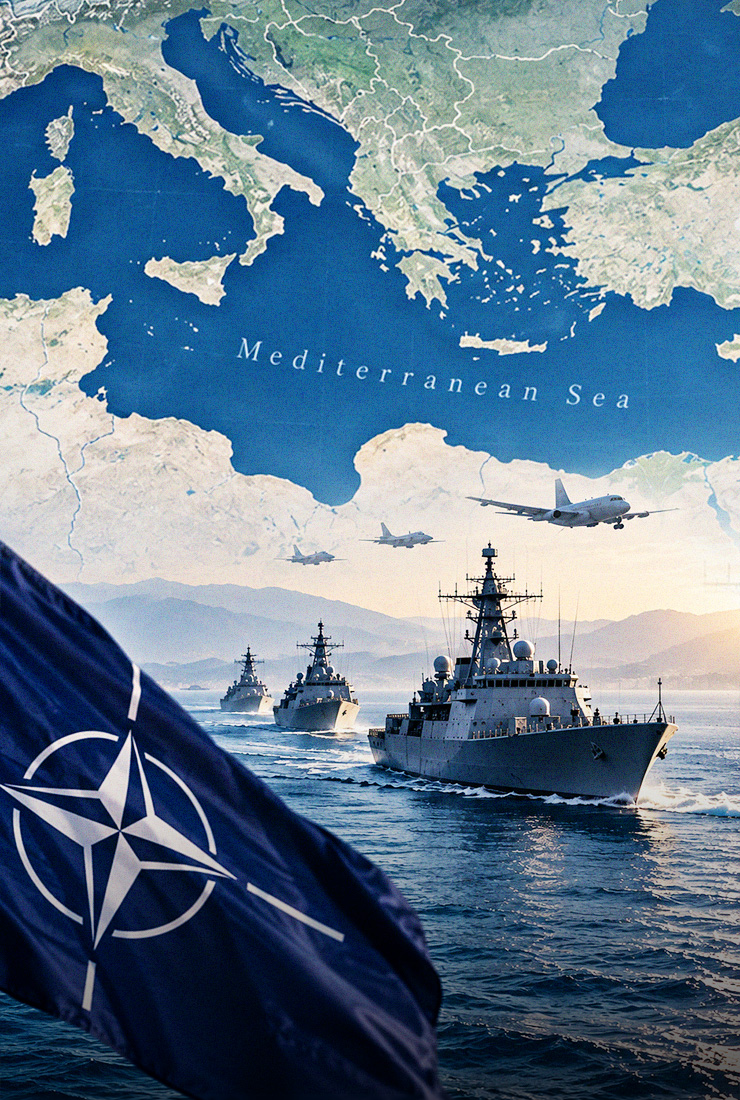
NATO is rethinking the role of maritime power. After decades in which naval forces largely supported expeditionary and land-centric operations, the Alliance now faces a security environment in which the maritime domain has again become central to collective defense. Russia’s renewed naval activity, China’s expanding maritime reach, threats to critical infrastructure, and growing competition at sea have exposed the limits of NATO’s previous approach. The 2025 Alliance Maritime Strategy (AMS) consequently places sea control, combat readiness, and high-end warfighting more prominently within NATO’s agenda. Along with the North and Baltic Seas, this transformation is visible in the Mediterranean, where deterrence, maritime security, and power projection increasingly converge.
The Alliance at Sea
As a political and military alliance covering the Euro-Atlantic area, NATO’s maritime component was initially conceived around the protection of the transatlantic sea lines of communication upon which the security and economic viability of its members depended. During the Cold War, this gave naval power a central role in Alliance defense planning, particularly in relation to sea control, reinforcement, and the protection of maritime approaches.[1] The end of the Cold War, however, substantially altered NATO’s strategic priorities. With the disappearance of the Soviet naval threat, maritime forces increasingly became enablers of an expeditionary Alliance whose operational focus shifted towards crisis management and out-of-area deployments.[2]
This transition was reflected in NATO’s post-Cold War operations. The campaigns in Kosovo and Afghanistan were predominantly air- and land-centric, with naval forces generally performing a supporting role. Maritime assets remained important operational enablers, providing capabilities ranging from strategic mobility and logistics to maritime security, surveillance and force protection.[3] The experience of these operations consequently did not eliminate the importance of sea power within NATO, but rather it temporarily repositioned it within a broader expeditionary model in which naval forces supported predominantly land-based campaigns.
By the early 2010s, however, the strategic environment was beginning to challenge this model, with piracy, terrorism, arms proliferation, and regional instability becoming more urgent threats compared to large-scale maritime confrontation between major powers. Largely unchanged since the mid-1980s, NATO’s maritime posture was ill-equipped to confront this composite array of menaces.[4] To this end, the Alliance published its new AMS in 2011, which placed much emphasis on how NATO maritime forces, especially its expeditionary capability, could contribute to collective security in this geopolitical landscape.[5]
However, gaps between the 2011 AMS’s vision and tools, on the one hand, and the fast-evolving global strategic environment, on the other, started to appear shortly after its adoption.[6] The major disruptive event was the resurgence of Moscow’s militarism, as showcased by the 2014 Russian war on Ukraine and the seizure of Crimea.[7] As Russia ramped up naval activism in the Black Sea and beyond, China’s growing geopolitical ambitions at sea also underscored to what extent the 2011 Strategy was ill-equipped to cope with a fast-changing geopolitical context.[8]
NATO’s adoption of a new AMS in 2025, therefore, represented more than a routine policy update. Fourteen years after the previous public strategy, the document placed maritime power much more explicitly within the Alliance’s collective-defense agenda. While retaining NATO’s 360-degree approach and its three core tasks (deterrence and defense; crisis prevention and management; cooperative security), the strategy places substantially greater emphasis on combat readiness, sea control, power projection, and the ability to prevail in high-end conflict.[9]
The shift is particularly significant because the strategy treats the maritime domain not simply as a space in which NATO conducts supporting activities, but as a distinct arena of strategic competition. The Alliance identifies Russia as its principal long-term threat, with its military build-up in the Baltic, Black, and Mediterranean seas explicitly highlighted. The strategy also points to Russia’s ability to disrupt Allied reinforcement, threaten freedom of navigation and conduct activities against critical maritime infrastructure. China is similarly identified as a growing maritime actor whose expanding naval capabilities and presence beyond the Indo-Pacific have implications for Alliance security.
Most importantly, the 2025 Strategy acknowledged that a changed strategic environment dominated by ramping great power competition requires a more assertive posture, recognizing that the seas have increasingly become a theater of contestation. Starting from a renewed sense of urgency about the broad array of threats menacing the Alliance, the document clearly outlined a hierarchy of security concerns: Russia, terrorism, and China, in this order. Notably, the Strategy goes a step forward by outlining concrete actions to bolster NATO’s capability at sea, largely by leveraging hard power, digital innovation, and integrated industrial development.[10]
The Mediterranean consequently acquires renewed importance within NATO’s maritime posture. The Alliance’s southern flank is simultaneously a strategic theater, an important transit space for Allied forces, and a maritime environment in which NATO must contend with a plurality of opponents, from Russia to terrorist groups.[11] The Mediterranean, therefore, illustrates the broader transformation of NATO’s maritime approach. Naval forces are no longer viewed principally through the lens of expeditionary support, but increasingly as instruments of deterrence, readiness, and collective defense at the core of the Euro-Atlantic security architecture.
The 2025 strategy also places greater emphasis on training and exercises. Rather than treating exercises primarily as instruments for maintaining interoperability, the Alliance explicitly links them to its ability to retain a warfighting edge and to prepare its forces to “fight tonight” and “fight tomorrow.”[12]
NATO’s Mediterranean Posture
NATO’s maritime posture in the Mediterranean rests on a combination of standing naval forces, rotational national deployments, and dedicated maritime-security activities. This mix allows the Alliance to maintain a degree of persistent maritime presence without permanently stationing a large, fixed naval formation in its southern flank.[13] This distinction is crucial as NATO’s Mediterranean posture is best understood not as a permanently deployed fleet but rather a sustained force-generation and command structure capable of concentrating Allied naval power when required.
At the command level, Allied Maritime Command (MARCOM), headquartered at Northwood in the United Kingdom, is NATO’s principal maritime headquarters and exercises command over the Alliance’s Standing Naval Forces (SNFs).[14] The Mediterranean falls within the wider area of responsibility of Joint Force Command Naples, headquartered in Italy.[15] This division reflects the distinction between the standing maritime command structure and NATO’s broader regional operational architecture.
Standing Naval Forces
At the core of this posture are the SNFs, which comprise two Standing NATO Maritime Groups (SNMGs) and two Standing NATO Mine Countermeasures Groups (SNMCMGs). These are multinational, integrated forces that remain continuously available to NATO, although their composition and geographic employment vary according to Alliance requirements and national contributions.[16] SNMGs generally comprise between two and five surface combatants, normally supported by a replenishment vessel.[17] SNMCMGs consist principally of minehunters and minesweepers, complemented by explosive-ordnance-disposal divers’ teams.[18]
The structure, therefore, provides NATO with something different from a permanently stationed squadron. The force is standing, but individual ships are not. Contributing navies rotate vessels, personnel and, periodically, command responsibilities, allowing NATO to sustain a continuous maritime capability while distributing the burden of deployment across the Allies. Six-month rotations are a common feature of the SNFs, although the precise duration and composition of individual contributions can vary according to operational requirements.
This rotational model has an important strategic consequence. It allows NATO to maintain a presence without committing permanently stationed forces, thereby combining political signaling with operational flexibility. At the same time, the multinational composition of the groups provides an institutional mechanism through which Allied navies routinely train together, standardize procedures and develop interoperability.
For the Mediterranean specifically, SNMG2 and SNMCMG2 are the most relevant of the four standing formations. SNMG2 traces its institutional origins to the Standing Naval Force Mediterranean, established in 1992, before being given its current designation in 2005. SNMCMG2 similarly evolved from a Mediterranean on-call force established in 1969 and adopted its present designation in 2006. Their historical continuity demonstrates that NATO’s Mediterranean naval presence predates the post-Cold War return to strategic competition by several decades.[19]
The standing groups serve three overlapping purposes in the Mediterranean. First, they provide persistent presence, ensuring that NATO has maritime forces already at sea rather than having to constitute a naval force from scratch during a crisis. Second, they provide a platform to cultivate operational readiness and interoperability, as ships from different national navies train and operate under a common command structure. Third, they provide a relatively low-cost mechanism for strategic signaling and naval diplomacy through port visits and interactions with regional partners.
This combination of functions is precisely what lies at the heart of the 2025 Strategy, with standing forces being simultaneously operational assets, instruments of deterrence, and platforms for experimentation and force development.
Regional partnerships
The Alliance’s Mediterranean posture, however, is not limited to the deployment of NATO naval assets. It also relies on a wider network of political and military relationships with non-NATO states. The principal framework for this engagement on the southern flank is the Mediterranean Dialogue (MD). Launched in 1994, the Dialogue is a partnership forum regrouping seven non-NATO states of the Mediterranean region, with Egypt, Israel, Mauritania, Morocco, Tunisia, and Jordan joining it in 1995, followed by Algeria in 2000. Its objective is threefold: first, to contribute to security and stability at sea; second, to improve relations between NATO and participating states; and finally, to develop a better understanding of NATO’s strategy and activities in the Mediterranean.[20]
To this end, the initiative combines two key instruments, political dialogue and practical cooperation.
On the one hand, NATO and MD states regularly convene meetings, which could be held in a bilateral (NATO+1) and multilateral (NATO+7) format. These engagements vary significantly in terms of participation, spanning from staff-level discussions to senior government official encounters. Notably, a seven-principles compass informs dialogue between NATO Allies and MD partners,[21] ensuring that the forum serves as a conduit for meaningful two-way engagements rather than a top-down, NATO-dominated approach.[22]
On the other hand, the menu of training modules available to MD partners has significantly broadened since 1994. Military education and training encompass over 30 areas of practical cooperation, including missile defense, maritime security, counterterrorism, critical energy infrastructure protection, and cybersecurity. NATO-MD’s Partnership Cooperation Menu (PCM) totals over 1,000 available activities.[23]
Since 2021, the Alliance has significantly overhauled its cooperation approach with non-NATO members by launching the “One Partner, One Plan” concept, a framework to streamline and modernize how it conducts engagements. The centerpiece of this effort is the Individually Tailored Partnership Programme (ITPP). Rather than managing multiple partnership instruments separately, the latter brings different civilian and military initiatives together within a single strategic framework. Most importantly, inclusiveness and shared ownership drive the ITPP approach. This model represents a highly flexible and structured cooperation tool as it combines goal-oriented activities tailored to meet the mutual interests of participants with a detailed four-year implementation plan, complemented by mid-term and end-of-cycle assessments.[24]
For maritime security, however, the practical significance of the Mediterranean Dialogue is often most visible below the strategic level, often taking the form of port visits and passage exercises (PASSEX). While the latter do not by themselves create the operational integration, they nevertheless provide opportunities for navies to familiarize themselves with one another’s operational procedures and threat perceptions.
Taken individually, such activities are modest. For instance, a PASSEX generally involves relatively limited maneuvering and communications training rather than the integrated combat operations associated with major NATO exercises. Still, its cumulative value lies in its regularity and geographic distribution. Repeated interactions create familiarity between Allied and partner navies and provide opportunities to practice basic maritime capabilities in a non-combat setting. The focus is on gradually reducing operational distance between NATO and regional navies rather than generating combined combat power.
This distinction is important when assessing the MD’s security value. The framework’s true contribution is less about creating a unified regional maritime force than building the institutional and operational conditions for cooperation. Low-intensity engagements, therefore, provide NATO with alternative tools to communicate its priorities and maintain visibility without relying exclusively on large-scale exercises or permanent deployments.
Table 1: NATO engagements with MD partners
| Activity | NATO asset | non-NATO asset | ||
| April 16, 2026 | SNMG2 | PASSEX | Italian frigate Virginio Fasan | Egyptian frigate Bernees |
| April 24, 2026 | SNMG2 | PASSEX | Italian frigate Virginio Fasan | Algerian corvette El Moutassadi |
| June 4, 2026 | SNMG2 | PASSEX | Italian frigate Virginio Fasan | Moroccan frigate Sultan Moulay Ismail |
| July 23, 2026 | OSG | PASSEX | Greek frigate Nikiforos Fokas | Egyptian frigate El Fateh |
| August 17, 2026 | SNMCMG2 | Port visit + PASSEX | Italian minehunter Chioggia Dutch minehunter Willemstad | Alexandria, Egypt Egyptian minehunter Al Seddiq |
| September 7-10, 2026 | SNMG2 | Port visit + PASSEX | Greek frigate Kountouriotis Italian offshore patrol vessel Raimondo Montecuccoli | Oran, Algeria Algerian Adhafer-class corvette |
Source: MARCOM, data elaborated by the author.
At the same time, however, the effectiveness of this model depends on the political willingness of individual partners to sustain engagement. The Mediterranean security environment is increasingly fragmented, and regional governments do not necessarily share identical threat perceptions or strategic priorities.[25] This creates structural limitations for a multilateral framework with an extended membership, such as the Dialogue, where participating states have different security relationships with NATO, divergent views of regional conflicts and, in some cases, competing foreign-policy priorities.[26] While Allies sought to revitalize NATO’s engagement with its southern flank at the 2024 Washington NATO Summit by adopting an action plan for a result-oriented approach and agreeing on establishing a result-oriented approach,[27] institutional and political progress has been moderate.
The Alliance’s southern flank is neither simply a secondary theater nor a permanently contested naval battlespace. Instead, it is an arena in which demands to address deterrence, maritime security, naval diplomacy, and interoperability coexist. For NATO, consequently, the challenge is not merely to maintain warships in the Mediterranean but to ensure that its sustained naval presence can translate into operational access, partner interoperability, and, if required, the rapid concentration of credible maritime combat power.
Operation Sea Guardian
Operation Sea Guardian (OSG) is NATO’s standing maritime security operation in the Mediterranean. Launched in November 2016, OSG’s core mandate revolves around three maritime security tasks. First, it supports maritime situational awareness (MSA) through information-sharing among Allies and with civilian agencies. Second, it supports maritime counter-terrorism by helping deter, disrupt, and contain efforts by terrorist groups to exploit the sea for hostile activities. Finally, it contributes to maritime security capacity-building among military and civilian personnel, including in non-NATO partner countries.[28]
Sea Guardian is the successor to Operation Active Endeavour, a NATO Article 5 operation activated in response to the 9/11 terrorist attacks to counter maritime terrorism in the Mediterranean.[29] While the two operations share the same broad geographic focus, they differ qualitatively in both mandate and political character. Sea Guardian was indeed established as a non-Article 5 operation and therefore does not constitute a collective-defense response to an armed attack that the North Atlantic Council has determined to fall under Article 5.
Within OSG, MARCOM generally conducts five to six focused operations each year across the Mediterranean. These deployments concentrate NATO’s maritime capabilities in specific areas of interest, allowing the Alliance to develop a more granular understanding of maritime activity, while also sustaining a visible presence and improving interoperability among contributing forces.[30]
Focused operations are deliberately scalable, combining surface, air, and sub-surface assets from different Allied nations, leveraging primarily intelligence, surveillance, and recognition (ISR) capabilities. Through sustained patrols and surveillance, they contribute to the development of an accurate image of ongoing maritime activities in sensitive sectors of the Mediterranean to identify anomalous or potentially threatening activity.
To this end, OSG closely cooperates with NATO ISR Force (NISRF), whose aviation assets can provide operational support through Airborne Early Warning (AEW) and Maritime Patrol Aircraft (MPA). The resulting integration of naval and airborne sensors extends OSG beyond the presence of individual warships, allowing NATO to combine information from multiple platforms and contributing nations into a broader operational picture.[31]
Table 2: OSG’s focused operations in 2026
| Iteration | When | Area | NATO participants | Non-NATO participants |
| 26-1 | January – February | Eastern Mediterranean | Turkish warship Turkish, Greek, and Italian submarines Greek, Turkish, and U.S. air assets (AEW & MPA) | Georgian Coast Guard team |
| 26-2 | Not known | Not known | Not known | Not known |
| 26-3 | June | Central Mediterranean | Italian, Croatian, Albanian warships Belgian air assets (MQ-9B) | None |
| 26-4 | September | Mediterranean | Romanian and Croatian warships | None |
Source: NATO’s X account, data elaborated by the author.
Beyond surveillance, focused operations provide a practical mechanism for developing and testing critical maritime capabilities, ranging from small-arms firing drills to ship-boarding and helicopter deck-landing training. The occasional inclusion of non-NATO partner forces further extends this function beyond the Alliance, as occurred last February when a Georgian Coast Guard team embarked on the Turkish frigate Gaziantep, training alongside Turkish personnel.[32] Such activities allow NATO to translate presence at sea into practical interoperability, familiarizing partner personnel with Allied operational procedures, equipment, and standards while strengthening their ability to operate alongside NATO forces.
NATO’s Exercises Ecosystem
To sustain maritime readiness and interoperability, NATO operates a complex ecosystem of naval exercises, combining long-established drills with newer activities designed to adapt Allied forces to an evolving maritime security environment. Collectively, these exercises cover a broad spectrum of maritime warfare. Their cumulative value lies both in testing individual capabilities and integrating them across multinational formations and operational domains.
Dynamic Manta is NATO’s principal anti-submarine warfare (ASW) exercise in the Mediterranean. Previously conducted under the name Proud Manta,[33] the exercise in its current form has been planned annually since 2013. Through successive iterations, it has provided a demanding platform in which Allied surface, subsurface, and air forces refine ASW tactics and develop the ability to coordinate across different platforms and national procedures.
Its 2026 edition brought together a massive naval build-up, with submarines from Türkiye, Greece, and Italy taking part alongside maritime patrol aircraft, helicopters, and surface combatants. The ASW exercise required participating forces to operate in complex subsurface scenarios, with submarines alternating between hunting and evasion roles while surface and aerial assets coordinated their detection and tracking.[34] This “hunting the hunters” approach allows NATO forces to train against a moving and adaptive underwater threat rather than against a static training objective, placing a premium on coordination between otherwise distinct ASW capabilities.
Beyond traditional ASW training, Dynamic Manta 2026 also highlighted two broader developments in NATO’s maritime posture.
First, the exercise demonstrated the growing integration of unmanned technologies into NATO’s sub-surface operations. During the exercise, Allied forces live-tested a ship-launched USV for sprint-and-dip sonar operations. Manufactured by the French company Thales, the drone boat features a dipping sonar, known as Compact FLASH, which is lowered into the water column to detect ultra-quiet targets, such as divers, midget submarines, and uncrewed underwater vehicles.[35] While still under trials, the integration of USV into Dynamic Manta provides a mechanism for testing how autonomous and crewed systems can operate within the same tactical architecture.
Second, Dynamic Manta continued to expand interoperability between surface, subsurface, and special operations forces in the littoral domain. For the third consecutive year, and the fourth time since Dynamic Manta kicked off in 2014, the exercise also included submarine infiltration and extraction training involving Allied Special Operations Forces (SOFs) teams. During the 2026 edition, a Greek frogmen team, in close coordination with an Italian submarine, conducted disembarking and beach landing operations, demonstrating how submarines can support missions beyond conventional ASW.[36] This broadens the Dynamic Manta’s utility from submarine hunting to the integration of undersea platforms into wider maritime and littoral operations, while allowing Allied forces to test procedures for coordinating highly specialized capabilities.
Table 3: NATO’s maritime exercises in the Mediterranean
| Exercise | Recurrence | Focus | Lead | Duration | Location | Participants (last iteration) | Assets (last iteration) |
| Dynamic Manta | Once yearly | ASW | MARCOM | 2 weeks | Central Mediterranean | SNMG2 | (2026) 3 submarines, 7 surface ships, 12 aircraft, 1,600 sailors, |
| Neptune Strike | 4 iterations per year | Multi-domain strike capabilities | STRIKECOM | 5-7 days | Western and Central Mediterranean | Change across iterations | Change across iterations |
| Dynamic Guard | Twice yearly | EW, AShM, Counter-UAV | MARCOM | 5-7 days | Central Mediterranean | SNMG2 + JEWCS | (2026) 4-5 ships 1,000 |
| Dynamic Mariner | Once yearly | Full spectrum naval warfare | MARCOM | 2 weeks | Mediterranean | SNMG2 + SNMCMG2 | (2025) 30 ships 2 Submarines 5-6,000 troops Air units |
| Dynamic Move | Twice yearly | MCM and CPX/CAX | MARCOM | 10 days | Central Mediterranean | SNMCMG2 | (2025) 15 nations |
Source: NATO, data elaborated by the author.
Contrary to Dynamic Manta, Neptune Strike is not a single, Mediterranean-dedicated naval drill, but rather a series of four military exercises carried out throughout the year across different theaters in NATO’s area of operations. Launched in 2020, the Neptune Strike format aims to harmonize the command-and-control capabilities of Allied states in conducting high-end maritime strike operations. Led by Naval Striking and Support Forces NATO (STRIKFORNATO), headquartered in Oeiras, Portugal, Neptune Strike provides a framework for integrating naval, air, and amphibious assets in high-intensity combat training.[37] Neptune Strike is part of NATO’s enhanced Vigilance Activities (eVA), which is a series of day-to-day initiatives to bolster multi-domain force readiness among Allied states.[38]
Neptune Strike’s first 2026 iteration saw a massive deployment of Allied naval assets in the western and central Mediterranean Sea, comprising the Spanish Juan Carlos I expeditionary strike group, and the Italian and French carrier strike groups (CSGs) Cavour and Charles de Gaulle. The air component included a mixed complement, with embarked carrier wings spanning from fourth and fifth-generation fighter jets, such as Rafale M fighters and F-35B Lightning IIs, to second-generation ones, like AV-8B Harrier II fighters.[39] NATO’s long-range strike capabilities were tested through engagement of targets on firing ranges in Bulgaria, Poland, and Romania.[40] This demonstrated NATO’s ability to use maritime forces as launch platforms for effects extending well beyond the immediate maritime theater.
During its second iteration this year, held in late April across NATO’s southern and south-eastern flanks, Allied forces carried out conventional long-range air strike operations, such as engaging targets on firing ranges in Latvia, but also trained on auxiliary tasks, including simulating combat-zone personnel recovery missions. The French Navy’s Charles de Gaulle CSG, supported by Italian, Dutch, and Spanish frigates, served as the core platform for coordinating operations spanning from the Mediterranean Sea to continental Europe and the Black Sea region.[41] While Neptune Strike’s third iteration focused on NATO’s northern flank,[42] the final of the series, according to a NATO exercise calendar, is scheduled for mid-October in the North Atlantic and Mediterranean Sea.[43]
Dynamic Guard, instead, is NATO’s flagship electronic warfare and anti-ship missile defense exercise.[44] The drill’s core aim is to strengthen the tactical capabilities of the SNMGs and NATO Allied Reaction Force (ARF), the Alliance’s high-readiness, multinational, emergency-response force launched in 2024 to replace the NATO Response Force.[45] The exercise is held twice annually, with iterations alternating between NATO’s northern and southern flanks. Led by MARCOM, it benefits from contributions of NATO’s Joint Electronic Warfare Core Staff (JEWCS), generally through embarked personnel.
Its purpose is to expose Allied forces to contested electromagnetic conditions in which jamming, spoofing, and other electronic-warfare effects can degrade communications, sensors, and command-and-control systems.[46] During its latest edition in the Mediterranean in September 2026 under Greek command, SNMG2 forces trained across the full electromagnetic spectrum, from early detection to coordinated neutralization of hostile targets, including through soft-kill and hard-kill counter-UAV techniques.[47]
In this respect, Dynamic Guard complements exercises such as Dynamic Manta and Neptune Strike by testing a less visible but increasingly important layer of maritime combat power as the ability to preserve operational effectiveness when the electromagnetic environment itself becomes contested.
Among NATO’s largest naval drills, Dynamic Mariner is a multi-domain exercise specialized in crisis response and maritime expeditionary capabilities. Most importantly, it also serves as a certification venue for Allied states keen on assuming command of NATO ARF’s maritime component. Its combination of both SNMG2 and SNMCMG2, supported by air assets, allows participating forces to train across a broad range of maritime missions, from anti-submarine warfare and anti-air warfare to mine countermeasures and amphibious operations. Consequently, its principal contribution to NATO’s maritime posture is the integration of capabilities that are often exercised separately, while simultaneously testing the command arrangements required to employ them as a coherent force.
Dynamic Move closes the cycle by focusing on sea mine warfare. It is a biannual mine-countermeasure (MCM) exercise comprising tactical-level command-post and computer-assisted training strands. Like Dynamic Mariner, it also supports the preparation and certification of the SNMCMGs for the Alliance’s high-readiness force, while providing a multinational setting in which participants can refine common procedures and tactics.[48]
Dynamic Move covers the MCM process from the detection and identification of mines through their neutralization, using both conventional divers teams and increasingly unmanned systems. The exercise alternates between mine-warfare-specialized hubs in Oostende, Belgium, and in La Spezia, Italy, providing a complementary setting for high-end training.[49] Together, these activities allow NATO to sustain a specialized capability that is less visible than carrier or ASW operations but remains essential to maintaining freedom of maneuver in mined or contested waters.
Russia, an evolving maritime challenge
As outlined in the 2025 Strategy, NATO’s assessment of Russia’s role in its southern flank is one of growing strategic uncertainty for the Alliance. A revival of Russian naval activity, particularly in the central and easter Mediterranean, could pose a broad array of conventional and asymmetrical challenges to NATO forces.
The beginning of the 2022 war on Ukraine, coupled with Russia’s loss of its military foothold in Syria, has pushed it to diversify the geography through which it projects its power and contests NATO’s security architecture in the broader Mediterranean region. Following the fall of Bashar Al-Assad in December 2024, Russia began pivoting from Syria to North Africa, relocating personnel and military equipment from the Syrian Khmeimim air base and Tartus naval facility toward eastern Libya.[50] To this end, Moscow’s long-lasting relationships with local leadership proved instrumental in securing access to logistics facilities around Tobruk and Benghazi.[51]
So far, Russia appears to have been making inroads to gain and expand its foothold in Libyan airfields.[52] Similarly, there has been an increase in seaborne cargo movements from Russia to Libya. In mid-September, a Russian convoy including the Ropucha-class landing ship Aleksandr Shabalin and two cargo ships, the Anastasia and Yuriy Arshenevskiy, docked at Tobruk. The convoy reportedly transported Ural supply trucks and armored personnel carriers, alongside other logistics supplies.[53] These developments point to Libya becoming an increasingly important logistics hub for Moscow’s presence across the Mediterranean.
Russia’s growing foothold in Libya matters for NATO because it potentially gives Moscow a more dispersed maritime and military footprint along the Alliance’s southern flank. Rather than reproducing the concentrated presence previously sustained from Tartus and Khmeimim, Russia appears more inclined to use Libyan facilities as a forward logistics platform and stopping-off point for supporting its overseas deployments while retaining the ability to operate in the Mediterranean. The result appears to be a less predictable Russia presence, linking Mediterranean maritime activity with Russia’s transregional military and logistics networks.
A second dimension is the growing security relevance of Russia’s so-called shadow fleet. Primarily developed to sustain Russian oil exports despite Western sanctions, this network of tankers and other merchant vessels operates through opaque ownership structures, flags of convenience, and other mechanisms that complicate attribution and enforcement.[54]
Although publicly available evidence does not establish that the shadow fleet has been systematically employed for such purposes in the Mediterranean, Russia’s pattern of suspicious activities in the Baltic and North Sea region has long concerned the Alliance,[55] which looks at the Mediterranean theater with increased vigilance.
Indeed, NATO has increasingly treated the fleet as a wider maritime-security concern, with the Alliance organizing a symposium in March 2026 for member state delegates to exchange experience and best practice on legal and operational responses by senior officials, subject-matter experts, and practitioners.[56]
Notably, the shadow fleet’s strategic value to Moscow appears to extend beyond sanctions evasion. As per the CIA’s security assessments, Russian commercial vessels operating with limited transparency could provide platforms for surveillance, intelligence collection, or other forms of asymmetric activity, including sabotage and disruption on critical underwater infrastructure.[57] Yet, there is a lack of available evidence of Moscow using commercial vessels by Moscow for such purposes in the Mediterranean, while the extent to which these capabilities could be operationalized along NATO’s southern flank remains uncertain.
More immediately, the increasing use of Russian warships to escort military cargoes and tankers illustrates the potential convergence between Russia’s commercial and military maritime networks. Most recently, SNMG2 forces closely monitored a Russian naval convoy, including the Udaloy-class anti-submarine destroyer Admiral Levchenko, the tanker General Skobelev, the support vessel Akademik Pashin, and the cargo ship Sparta.[58] The Russian flotilla transited eastward through the Gibraltar Strait in late August 2026, heading for the Syrian port of Tartus before leaving the Mediterranean about a month later.[59] What makes these transits particularly notable is the continued use of escorted sealift operations at a time when Russian military shipping patterns in the Mediterranean remain under increased scrutiny.
Such escorts potentially serve several purposes simultaneously, from protecting sensitive logistics to deterring interference and signaling Moscow’s willingness to employ naval assets in defense of maritime shipping and military logistics. For the Alliance, this creates a more complicated operating environment in which distinguishing between Russia’s military, logistics, and quasi-commercial maritime activity becomes increasingly important.
Constraints on NATO
NATO’s Mediterranean maritime posture provides substantial tools for strengthening naval presence, interoperability, and crisis response. However, these instruments do not automatically translate into sustained high-end combat power, presenting the Alliance with three main challenges.
First, the SNFs are continuously available, but their composition depends on national contributions and operational requirements. Besides, the measured number of forward-deployed assets also limits the extent to which NATO can maintain a significant concentration of combat-capable vessels in the Mediterranean at any given time. The Alliance, therefore, retains the ability to generate and concentrate naval forces, but this capacity should be distinguished from maintaining a permanently deployed high-end fleet.
A second constraint is the breadth of tasks assigned to maritime posture. On the one hand, SNFs, OSGs, and regional partnerships support maritime awareness, counterterrorism, and naval diplomacy. On the other hand, the 2025 Strategy places greater emphasis on collective defense and high-end conflict. These functions are complementary, but they also place different demands on limited naval resources, creating a gap between sustained maritime presence and the forces available for a major contingency.
Political fragmentation among Mediterranean partners adds another layer of complexity. NATO’s MD provides an established framework for political and military cooperation, but participating states increasingly differ in threat perceptions and foreign-policy priorities, thereby limiting the Alliance’s capacity to generate a unified response from its regional partners during a major maritime crisis.
Finally, the changing character of Russian maritime activity increasingly blurs the boundary between military and commercial operations. Moscow’s expanding presence and activism in the Mediterranean create an operating environment in which military, logistical and quasi-commercial activity increasingly overlap, complicating NATO’s surveillance and attribution. While there is no clear evidence of systematic Russian use of the shadow fleet for asymmetric operations, such vessels could create additional challenges for monitoring shipping and protecting critical infrastructure. NATO’s challenge is, therefore, to turn a broad and increasingly sophisticated maritime architecture into persistent surveillance, operational access, and rapidly deployable combat power required by a more contested Mediterranean.
Conclusion
NATO’s Mediterranean maritime posture has evolved significantly, reflecting the Alliance’s broader return to collective defense and high-end maritime competition. SNFs, OSG, regional partnerships, and an increasingly sophisticated exercise portfolio provide NATO with mechanisms for maintaining presence, improving interoperability, and developing readiness. However, these instruments should not be treated as interchangeable. Rotational deployments, competing maritime-security requirements, fragmented regional partnerships and the changing character of the Russian maritime challenge all constrain the extent to which persistent activity can translate into sustained combat power. The Mediterranean, therefore, illustrates both the progress and the limits of NATO’s maritime adaptation. The Alliance has strengthened the architecture through which it can respond to a more contested maritime environment, but its effectiveness will ultimately depend on its ability to concentrate credible forces, maintain maritime awareness, and sustain high-end operations when required.
[1] Eric Grove, “NATO as a maritime alliance in the Cold War” in The Sea in History – The Modern World, edited by N. A. M. Rodger and Christian Buchet (Boydell and Brewer: Boydell and Brewer, 2017), pp. 574-583, https://doi.org/10.1515/9781782049111-060.
[2] Ivo H. Daalder, “NATO in the 21st Century: What Purpose? What Missions?,” Brookings, April 1, 1999, https://www.brookings.edu/articles/nato-in-the-21st-century-what-purpose-what-missions/.
[3] Jo G. Gade and Paal Sigurd Hilde, “NATO and the Maritime Domain,” in International Order at Sea: How it is challenged. How it is maintained, edited by Jo Inge Bekkevold and Geoffrey Till (Springer, 2016), pp. 115-139.
[4] Jason Alderwick and Bastian Giegerich, “Navigating Troubled Waters: NATO’s Maritime Strategy,” Survival 52, no. 4 (2010): pp. 13-20, https://doi.org/10.1080/00396338.2010.506814.
[5] NATO, “Maritime security: Protecting vital sea lines,” August 17, 2011, https://www.nato.int/en/news-and-events/articles/news/2011/08/17/maritime-security-protecting-vital-sea-lines.
[6] Felix F. Seidler, “Slowing Alliance – NATO’s New Maritime Strategy and the Need for Reform,” RUSI, March 25, 2011, https://www.rusi.org/explore-our-research/publications/commentary/slowing-alliance-natos-new-maritime-strategy-and-need-reform.
[7] Kirk Wolff, “Lessons from Crimea: The Way Forward for NATO,” Center for International Maritime Security, July 25, 2017, https://cimsec.org/lessons-crimea-way-forward-nato/.
[8] Peter Hudson, “The Renaissance at Sea: A New Era for Maritime NATO,” The RUSI Journal 159, no. 3 (2014): pp. 24-28, https://doi.org/10.1080/03071847.2014.927994.; Steven Horrell, Magnus Nordenman, and Walter B. Slocombe, “Updating NATO’s Maritime Strategy,” Atlantic Council, July 5, 2016, https://www.atlanticcouncil.org/in-depth-research-reports/issue-brief/updating-nato-s-maritime-strategy/.; Steven Horrell, “NATO’s Maritime Strategy Is Badly Outdated,” Center for European Policy Analysis, July 10, 2023, https://cepa.org/article/natos-maritime-strategy-is-badly-outdated/.
[9] NATO, “Alliance Maritime Strategy,” October 29, 2025, https://www.nato.int/en/about-us/official-texts-and-resources/official-texts/2025/10/29/alliance-maritime-strategy. (accessed September 11, 2026).
[10] Emma Salisbury, “Collective Seapower: NATO’s New Maritime Strategy,” Foreign Policy Research Institute, November 10, 2025, https://www.fpri.org/article/2025/11/collective-seapower-natos-new-maritime-strategy/.
[11] NATO, “Alliance Maritime Strategy.”
[12] Ibid.
[13] Sarah Tarry and Kaspar Pajos, “The Alliance’s Reinforced Maritime Posture: Strengthening NATO’s Deterrence and Defence at Sea,” in From the North Atlantic to the South China Sea: Allied Maritime Strategy in the 21st Century, edited by Julian Pawlak and Johannes Peters (Institute for Security Policy Kiel University, 2021), pp. 257-271, https://doi.org/10.5771/9783748921011-255.
[14] MARCOM, “Mission,” https://mc.nato.int/about-marcom/mission-.aspx. (accessed September 11, 2026).
[15] JFC Naples, “What Is JFC Naples?,” https://jfcnaples.nato.int/page5714813.aspx. (accessed September 11, 2026).
[16] NATO, “NATO’s maritime activities,” (updated: 10 March 2025), https://www.nato.int/en/what-we-do/operations-and-missions/natos-maritime-activities. (accessed September 11, 2026).
[17] MARCOM, “NATO Standing Naval Forces,” https://mc.nato.int/missions/NATO-standing-naval-forces.aspx. (accessed September 11, 2026).
[18] Ibid.
[19] NATO, “NATO’s maritime activities.”
[20] NATO, “Mediterranean Dialogue,” (Updated: 18 September 2025) (accessed September 11, 2026), https://www.nato.int/en/what-we-do/partnerships-and-cooperation/mediterranean-dialogue.
[21] The seven principles at the core of the MD are as follows: non-discrimination, self-differentiation, two-way engagement, non-imposition, diversity, and complementarity.
[22] NATO, “Mediterranean Dialogue.”
[23] Ibid.
[24] NATO, “Individually Tailored Partnership Programmes,” https://www.nato.int/en/what-we-do/partnerships-and-cooperation/individually-tailored-partnership-programmes. (Updated: 21 October 2024) (accessed September 11, 2026).
[25] Alessandro Marrone, “The Mediterranean Dialogue,” in James Sperling and Mark Webber (eds), The Oxford Handbook of NATO (Oxford, Oxford University Press: 2025), pp. 814-826.
[26] Costanza Musu, “NATO’s Mediterranean Dialogue: More than Just an Empty Shell?,” Mediterranean Politics 11, no. 3 (2006): pp. 419–424, https://doi.org/10.1080/13629390600914070.
[27] NATO, “Washington Summit Declaration,” July 10, 2024, https://www.nato.int/en/about-us/official-texts-and-resources/official-texts/2024/07/10/washington-summit-declaration. (accessed September 11, 2026).
[28] NATO, “Operation Sea Guardian,” Updated: 26 May 2023, https://www.nato.int/en/what-we-do/operations-and-missions/operation-sea-guardian. (accessed on September 11, 2026).
[29] NATO, “Operation Active Endeavour (2001-2016),” Updated: 01 September 2022, https://www.nato.int/en/what-we-do/operations-and-missions/operation-active-endeavour-2001-2016. (accessed on September 11, 2026).
[30] NATO, “Operation Sea Guardian.”
[31] Ibid.
[32] MARCOM, “NATO Operation Sea Guardian Focused Operation strengthens maritime security in the Eastern Mediterranean,” February 12, 2026, https://mc.nato.int/media-centre/news/2026/nato-operation-sea-guardian-focused-operation-strengthens-maritime-security-in-the-eastern-mediterranean.
[33] Naval Technologies, “Nato nations conduct exercise Proud Manta 2013,” Match 10, 2013, https://www.naval-technology.com/news/newsnato-nations-conduct-exercise-proud-manta-2013/.
[34] MARCOM, “NATO Enhances Readiness Above and Below the Waves During Dynamic Manta Exercise in the Mediterranean Sea,” March 5, 2026, https://mc.nato.int/media-centre/news/2026/nato-enhances-readiness-above-and-below-the-waves-during-dynamic-manta-exercise-in-the-mediterranean-sea.
[35] Cem Devrim Yaylali, “NATO’s Dynamic Manta exercise demonstrates unmanned ASW integration,” Janes, March 4, 2026, https://www.janes.com/defence-intelligence-insights/defence-news/sea/natos-dynamic-manta-exercise-demonstrates-unmanned-asw-integration.
[36] “NATO Allies Test ASW Skills On Exercise Dynamic Manta 26,” Navy Leaders, March 6, 2026, https://navyleaders.com/news/nato-allies-test-asw-skills-on-exercise-dynamic-manta-26/.
[37] STRIKEFORNATO, “Neptune Strike,” https://sfn.nato.int/activities/current-and-future/exercises/neptune-strike-nest. (accessed September 14, 2026).
[38] SHAPE, “Enhanced Vigilance Activities,” https://shape.nato.int/eva. (accessed September 14, 2026).
[39] JFC Naples, “NATO Concludes First Iteration of Neptune Strike 26,” April 2, 2026, https://jfcnaples.nato.int/newsroom/news/news-archive/2026/nato-concludes-first-iteration-of-neptune-strike-26.
[40] Dzirhan Mahadzir, “French, Italian Carrier Strike Groups Wrap NATO’s Neptune Strike Drills,” USNI News, April 2, 2026, https://news.usni.org/2026/04/02/french-italian-carrier-strike-groups-wrap-natos-neptune-strike-drills.
[41] JFC Naples, “NATO Concludes Second Iteration of Neptune Strike 2026,” May 5, 2026, https://jfcnaples.nato.int/newsroom/news/news-archive/2026/nato-concludes-second-iteration-of-neptune-strike-2026.
[42] JFCNF, “Neptune Strike 26-3 validates NATO’s ability to command and integrate Allied forces,” July 28, 2026, https://jfcnorfolk.nato.int/activity/neptune-strike-263-validates-natos-ability-to-command-and-integrate-allied-forces.
[43] SHAPE, “NATO Exercises and Activities,” https://shape.nato.int/nato-exercises. (accessed September 14, 2026).
[44] MARCOM, “DYNAMIC GUARD,” https://mc.nato.int/missions/exercises/dynamic-guard-. (accessed September 14, 2026).
[45] NATO, “Allied Reaction Force (ARF),” https://www.nato.int/en/what-we-do/deterrence-and-defence/allied-reaction-force-arf. (accessed September 14, 2026).
[46] MARCOM, “NATO sharpens Allied electronic warfare readiness during Exercise Dynamic Guard,” September 9, 2025, https://mc.nato.int/media-centre/news/2025/nato-sharpens-allied-electronic-warfare-readiness-during-exercise-dynamic-guard.
[47] MARCOM, “NATO staying ahead in the electromagnetic battlespace during Exercise Dynamic Guard,” September 28, 2026, https://mc.nato.int/media-centre/news/2026/nato-staying-ahead-in-the-electromagnetic-battlespace-during-exercise-dynamic-guard.aspx.
[48] MARCOM, “Dynamic Move.” https://mc.nato.int/missions/exercises/dynamic-move.aspx. (accessed September 14, 2026). MARCOM, “NATO Maritime Personnel Shine during Dynamic Move 2025,” September 9, 2025, https://mc.nato.int/media-centre/news/2025/nato-maritime-units-shine-during-dynamic-move-2025-.
[49] Ibid.
[50] IISS, “Libya’s continuing instability as Russia pivots from Syria to North Africa,” Strategic Comments 31, no. 1 (2025): xii–xiv, https://doi.org/10.1080/13567888.2025.2480478.
[51] Frank Talbot, “Russia’s most important Middle East base is not where you think,” Atlantic Council, December 18, 2025, https://www.atlanticcouncil.org/blogs/menasource/russias-most-important-middle-east-base-is-not-where-you-think/.
[52] Claudio Antonelli, “Farewell, Syria: Russia secures six air bases in Libya,” Il Sole 24 Ore, August 18, 2026, https://en.ilsole24ore.com/art/farewell-syria-russia-takes-six-airbases-in-libya-AJwIvMo.
[53] The Maritime Executive, “Russian Military Cargo Ship Heads for Turkey from Tobruk,” September 25, 2026, https://maritime-executive.com/article/russian-military-cargo-ship-heads-for-turkey-from-tobruk.
[54] Nick Childs, “Russia’s ‘Shadow Fleet’ and Sanctions Evasion: What Is To Be Done?,” IISS, January 9, 2025, https://www.iiss.org/globalassets/media-library—content–migration/files/research-papers/2025/01/russias_shadow-fleet_and-sanctions-evasion/iiss_russias_shadow-fleet_and-sanctions-evasion_31012025.pdf.
[55] ACLED, “Russia’s shadow fleet presents a sustained hybrid war threat at sea,” May 22, 2025, https://acleddata.com/report/russias-shadow-fleet-presents-sustained-hybrid-war-threat-sea.
[56] NATO, “NATO Headquarters hosts discussions about Russia’s Shadow Fleet,” March 17, 2026, https://www.nato.int/en/news-and-events/articles/news/2026/03/17/nato-headquarters-hosts-discussions-about-russias-shadow-fleet.
[57] Linus Höller, “Report: CIA warned Europe of Russian drone attack from vessels in the Mediterranean,” Defense News, September 24, 2026, https://www.defensenews.com/global/europe/2026/09/24/report-cia-warned-europe-of-russian-drone-attack-from-vessels-in-the-mediterranean/.
[58] NATO Maritime Command (@NATO_MARCOM), “We. Are. Watching. From the #BalticSea to the #Mediterranean, #NATO maintains constant vigilance at sea. #SNMG2 contributes to this maritime picture, monitoring Russian vessels transiting through the Med. We’re keeping a close watch across the Euro-Atlantic. From north to south, NATO’s maritime forces remain alert 24/7 #WeAreNATO,” X’s Post, September 4, 2026, https://x.com/NATO_MARCOM/status/2095819821841530889?s=20.
[59] “Russian Convoy Leaves Mediterranean Sea and Heads Back to Russia,” Italmilradar, September 23, 2026, https://www.itamilradar.com/2026/09/23/russian-convoy-leaves-mediterranean-sea-and-heads-back-to-russia/.