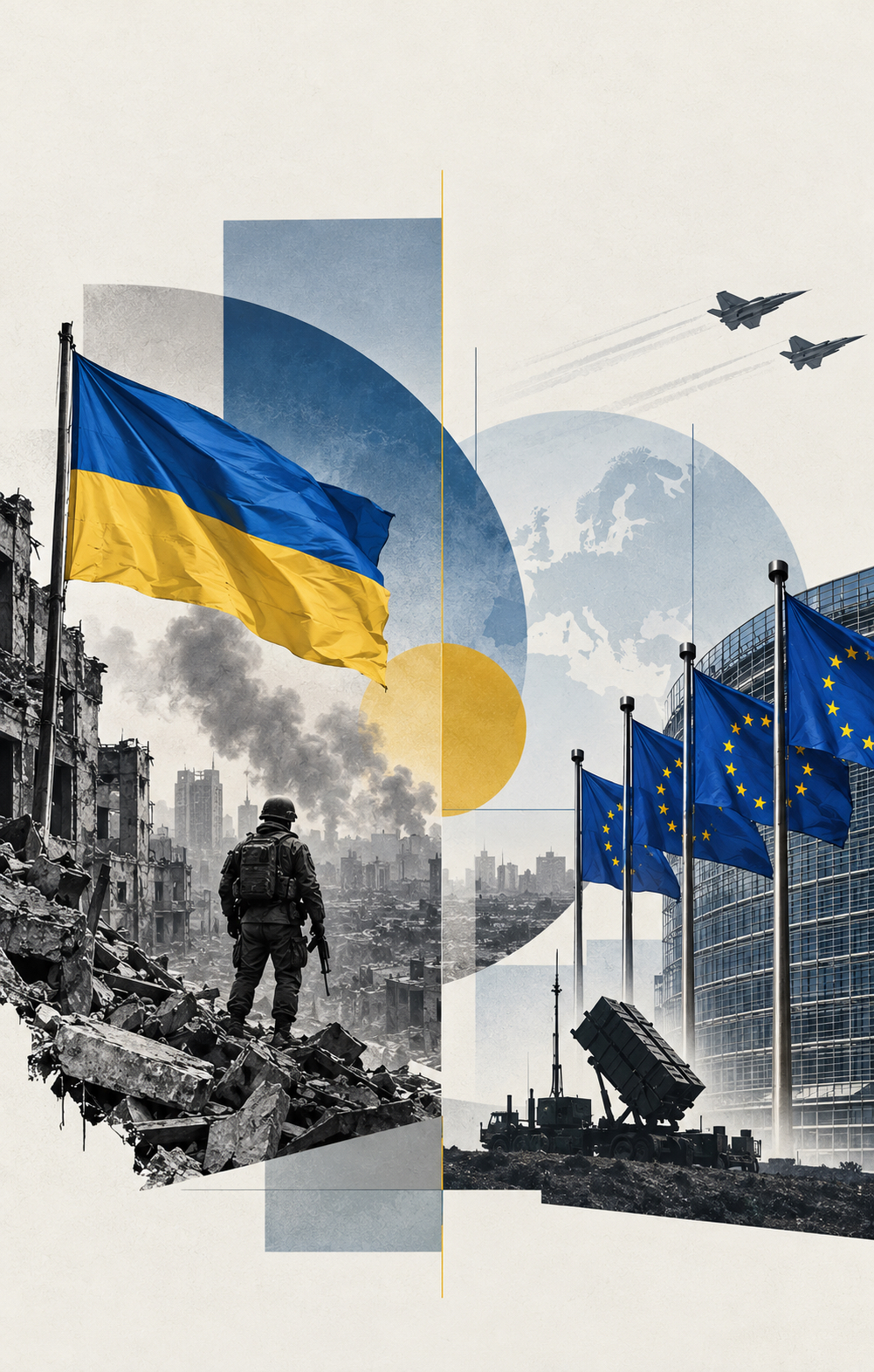
Moscow is intensifying its strategic bombing campaign against Ukraine while stepping up hybrid operations against Kyiv’s European supporters. Senior politicians and military officials across NATO warn that Russia could go further, launching a limited territorial incursion or a more destructive hybrid attack against the Alliance. The aim would be to weaken support for Ukraine, divide European societies and fuel claims that Europe’s rearmament is “provoking” Russia.
Europe has yet to give Moscow sufficient reason to stop. Deterring a conventional attack is a familiar task for NATO. However, agreeing on a credible response to hostile acts below the threshold of armed aggression is far harder. Unless Europeans can make further escalation carry significant costs, the Kremlin may conclude that it can keep pushing.
Battlefield attrition and the prospect of renewed Russian mobilization
Russia still pursues its maximalist objectives in Ukraine by trying to deny Kyiv its statehood, territorial integrity and political independence. Moscow sees European backers of Ukraine as obstacles to these aims.
On the battlefield, the war of attrition continues with little movement of the frontline. Ukrainian forces, however, appear to have gained the tactical initiative in some sectors. They are expanding the areas in which drones can detect and strike Russian forces (also known as the kill zone) and are disrupting supply lines and logistics as far as 150 kilometers behind the front.[1] As part of Operation Vivaldi, aimed at stabilizing the frontline in northern Donbas, Ukrainian forces have liberated several villages around Lyman.[2] Contrary to the prevailing narrative of a static front and the impossibility of advancing on a fully transparent battlefield, these recent territorial gains suggest that Ukrainian forces can mount successful counteroffensive operations within brief windows by temporarily disrupting or overwhelming Russian surveillance and targeting systems.
As Ukrainian forces strengthen and expand their kill zone, Russian forces continue to suffer heavy casualties. Estimates put Russia’s losses at more than 1,000 killed or wounded each day, with monthly losses exceeding recruitment by roughly 6,000 personnel.[3] Despite these losses, Putin continues to claim that the battlefield situation favors Russia[4] and avoided a major mobilization ahead of the tightly controlled federal elections, which delivered him a carefully orchestrated political victory.[5]
Some observers predicted another round of mobilization immediately after the elections. However, this has not materialized yet. One possible explanation, put forward by some Western analysts, is that Moscow may seek to intensify its hybrid campaign against NATO, hoping to provoke a more muscular response by the Alliance, which it could use to justify further mobilization at home.[6]
Escalating aerial strikes and the threat of another harsh winter
Russia is intensifying its strikes on Ukraine’s energy infrastructure and defense industry, seeking to exploit gaps in the country’s slowly depleting air defenses. Ballistic missiles and jet-powered drones enable Moscow to strike targets deep inside Ukraine, including civilian objects.[7] From a military perspective, this tactic can be described as a strategic bombing campaign aimed at undermining public morale and pressuring Ukraine’s political leadership into accepting Russia’s maximalist demands.
Russia’s strikes extend beyond power generation to railway stations, locomotives, warehouses, bridges, border crossings and ports. These strikes aim to disrupt transport, trade and the movement of supplies, including through Ukraine’s vital links with Poland and Romania. By targeting the systems that keep Ukraine functioning, Russia seeks to weaken the country’s ability to sustain the war.
In contrast to Russia, Ukraine is pursuing a more targeted campaign against Moscow’s war effort. It focuses its strikes on oil refineries as well as radar, air defense and electronic warfare sites, seeking to open routes for strikes deeper into Russia-controlled territory. It is also putting sustained pressure on Russian forces in Crimea and the routes that supply them to make the illegally occupied peninsula a strategic liability for Moscow.
Ukraine has adapted to Russia’s aerial strikes by spreading defense production across multiple sites and building backup capacity. It has also worked to decentralize energy production.[8] These measures make it harder for Russia to cripple essential infrastructure and industries with a limited number of strikes. Nonetheless, the growing use of jet-powered drones by Moscow presents a challenge to Ukraine. While Kyiv has developed interceptors that can successfully counter Russia’s jet-powered drones,[9] scaling up their production to the necessary levels will take time.
Ukrainians and their European backers fear a repeat of last winter, when Russian strikes on energy infrastructure left millions without reliable electricity and heating during severe cold. This tactic of war has caused a high number of cold-related deaths and injuries.
Europe’s support for Ukraine: Political will meets production constraints
Strengthening Ukraine’s air defenses remains essential to countering Russia’s ongoing aerial attacks. PAC-3 interceptors for Patriot systems are particularly important, having proved highly effective against Russian ballistic missiles. However, the situation in the Gulf has added to global demand for these interceptors, further constraining the already tight supply chains.
European governments have granted Ukraine an exemption from the EU loan’s procurement rules, allowing it to purchase critical American equipment under a €6.1 billion defense package that includes Patriot interceptors and other urgently needed capabilities.[10] However, funding alone cannot resolve production bottlenecks, as the capacity to increase output on both sides of the Atlantic remains limited.
Given this pressure on supply chains, European partners are also helping Ukraine develop alternatives and expand domestic production of air defense systems. In July, France and Italy authorized licensed production of Aster 30 interceptor missiles for SAMP/T air defense systems in Ukraine, while France also authorized production of SCALP cruise missiles and AASM guided bombs.[11] These capabilities would strengthen both Ukraine’s air defenses and its ability to strike targets deep inside Russia. Also in July, Ukraine and nine other European countries launched the FREYJA coalition to develop a European ballistic missile defense capability and reduce dependence on American Patriot missiles.[12]
Despite these initiatives, establishing production lines and building entirely new supply chains cannot be done overnight. Ukraine’s defense industry has demonstrated a strong capacity for innovation, rapidly developing and fielding even complex weapon systems. However, the challenge now is to scale up production quickly and robustly enough to achieve the so-called affordable mass. These are capabilities that are relatively inexpensive, available in large numbers and capable of delivering substantial military effects.
Ukraine is also seeking expanded Starlink access to support strikes against missile launchers inside Russia, aiming to reduce attacks at their source and ease pressure on its depleted air defenses.[13] Such access has not been granted by Washington so far. The prospects remain low due to the reported opposition from Elon Musk, CEO of SpaceX, which owns the system[14] and unresolved discussions with the U.S. administration over the potential risks of further escalation.
Limited prospects for a negotiated peace
There is little hope that the war will be resolved at the negotiating table at this stage. Both Russia and Ukraine still believe that continued fighting can secure a better outcome than a negotiated settlement. Moscow’s theory of victory rests on the conviction that attacks on Ukrainian civilian infrastructure will wear down the population and persuade Ukraine’s international backers to pressure Kyiv into accepting Russian terms. Ukraine’s theory of victory, meanwhile, centers on conducting targeted strikes against Russia’s economy and war production to make the conflict as costly as possible for Moscow.
The initial ambition of securing a ceasefire at the Alaska summit between Trump and Putin failed to materialize amid Russia’s maximalist demands. Moscow’s proposed “3+2” formula envisaged recognition of Russian sovereignty over Crimea and the entire Donetsk and Luhansk regions, including territory still controlled by Ukraine, as well as the occupied parts of Kherson and Zaporizhzhia.[15] Combined with demands restricting Ukraine’s sovereignty, these terms were unacceptable to Kyiv. Subsequent engagement led by U.S. representatives Steve Witkoff and Jared Kushner has so far produced little progress.
While it is true that diplomacy must proceed alongside military operations to be successful, it requires more than meetings between leaders. A sustained process involving regular contacts at lower levels could help build trust, clarify positions and secure agreements on narrower issues before attempting a comprehensive settlement. High-level summits risk granting Putin political recognition without securing meaningful concessions. Neither the Alaska meeting nor the subsequent U.S.-led engagement has yet demonstrated a convincing path toward an agreement acceptable to Ukraine.
One urgent priority for diplomacy is restoring safe passage for Ukrainian agricultural exports through the Black Sea, where Russian attacks threaten commercial shipping and port infrastructure. Renewing an arrangement along the lines of the grain initiative brokered by Türkiye and the UN, from which Russia withdrew in 2023, could offer a practical starting point. However, Moscow’s resistance to renewed commitments on safe shipping underscores the difficulty of securing even a limited agreement.
Russia’s widening hybrid campaign against Europe
Moscow’s strategy of wearing down Ukraine also extends to its European supporters. By targeting the infrastructure, companies and transport networks that sustain assistance to Kyiv, Russia seeks to disrupt supplies and raise the political costs of continued support. Its hybrid campaign, therefore, complements its military operations in Ukraine, while testing how far it can go without provoking a decisive collective response. Moscow may also calculate that fear of a wider confrontation will strengthen political forces advocating reduced support for Ukraine.
The attempted attack with explosive-laden drones at Leipzig/Halle Airport in August, which Germany publicly attributed to Russia in September, illustrates the increasingly dangerous nature of these operations.[16] Estonia has also attributed the August arson attack against Milrem Robotics, a supplier of unmanned ground vehicles to Ukraine, to Russian security services.[17] In April, British, Norwegian and American forces disrupted a Russian operation near Svalbard involving preparations to sabotage undersea cables.[18] In Poland, authorities described the September fire at a Starlink ground station as suspected sabotage, although Russian responsibility had not been firmly established.[19] These incidents suggest that companies and facilities supporting Ukraine face a growing threat of physical sabotage, with consequences that could extend well beyond damage to equipment.
Warnings about further escalation have become more explicit. Danish defense intelligence has assessed that Russia is likely to intensify its hybrid campaign through more frequent attacks with potentially greater consequences, alongside a low but growing risk of limited military action against NATO countries bordering Russia.[20] The threat also extends beyond NATO’s Eastern Flank. According to recent reporting, U.S. intelligence has warned France, Spain and Italy about possible Russian drone operations using commercial vessels as launch platforms in the Mediterranean.[21]
NATO’s increasingly assertive response
In response to these threats, European governments are moving slowly but steadily toward a more muscular posture toward Moscow. Estonia is building a military base in Narva,[22] a border city whose Russian-speaking population, despite its loyalty to Estonia, has led analysts to identify it as a potential target for a limited Russian military escalation.[23] The concern is that Moscow could attempt to repeat the Crimea scenario, using unmarked troops, or “little green men”, to seize a small piece of NATO territory while hoping to avoid an allied military response. Establishing a military presence in Narva strengthens deterrence by making it harder for Russia to secure a foothold.
Poland has announced changes allowing pilots to engage positively identified hostile aerial targets without first obtaining visual confirmation.[24] This does not amount to automatic authorization to engage any aircraft approaching from Russia. It does, however, represent a step up the escalation ladder and a warning to Moscow about the risks of further provocations involving military assets. Recent incidents, including the incursion of a Russian military helicopter into Polish airspace[25] and a Russian ship firing flares near a Danish military helicopter,[26] underline the relevance of this shift.
Despite the Trump administration’s distancing from Europe, recent U.S. actions suggest that Washington remains engaged in European security and continues to play a central role in strengthening NATO’s deterrence. CIA Director John Ratcliffe’s visit to Moscow, allegedly to warn against further challenges to NATO,[27] followed an unannounced NATO exercise near Kaliningrad earlier in August. The drill, led by the United States and involving advanced American electronic warfare capabilities, also conveyed a strong deterrent message.[28]
NATO’s Supreme Allied Commander Europe (SACEUR), General Alexus Grynkewich, has also issued warnings about Russia’s escalation. Addressing the European Parliament’s Security and Defense Committee (SEDE), he warned that sabotage directed by states was becoming increasingly brazen, with incidents growing in both number and severity.[29] To strengthen the alliance’s ability to establish responsibility for hybrid incidents, he also explained that Supreme Headquarters Allied Powers Europe (SHAPE), NATO’s strategic military headquarters, was building a network connecting national capitals, military commands, law enforcement bodies and intelligence agencies. In his view, clearer attribution can support a more decisive response, making it harder for Moscow to exploit uncertainty and divisions among allies.
Strengthening the EU’s deterrence by punishment
While NATO is central to conventional and nuclear deterrence against Russia, Moscow’s hostile activity against EU and NATO countries takes place below the threshold of armed aggression. Strengthening deterrence in the hybrid domain, therefore, also requires an active EU role. The Union has powers in areas such as international trade, technology and financial regulation, air transport and energy, giving it tools that can complement NATO’s response.
In her most recent State of the European Union address, European Commission President Ursula von der Leyen proposed two initiatives to strengthen European preparedness and readiness to face hybrid threats. The first was an emergency security protocol, with packages of measures agreed in advance that could be activated by member states swiftly following a hybrid attack against one or multiple members of the EU.[30] The second was a European Security Council, bringing together EU member states and key partners such as the United Kingdom, Canada and Norway.[31] While the protocol offers a practical way to accelerate responses, the council’s added value is less clear. Without changes to the unanimity requirement governing most EU foreign and security policy decisions, such a body risks becoming another discussion forum without the authority to translate agreement into action.
A new European Security Strategy, expected to be prepared jointly by the European Commission and the European External Action Service, could offer another opportunity to address these weaknesses. Although the document has yet to be released, the key question is whether it will move beyond Europe’s longstanding emphasis on resilience, the ability of the EU and its member states to absorb shocks and mitigate their consequences. Even though strengthening this capacity is necessary, it does not in itself deter Russia from escalating further. The EU and NATO should therefore explore closer coordination of more assertive and targeted national responses to Russian provocations. In this regard, Germany’s proposed reform of its intelligence legislation, which would allow its intelligence services to conduct offensive operations abroad,[32] offers a possible model for other European countries to consider.
The central challenge remains how to deter Russia’s hybrid operations. Preventing every hostile act is unrealistic. However, Europeans need to signal, through credible warnings and proportionate action, that particularly dangerous attacks will carry significant costs. Without such signaling, Moscow may continue escalating toward an incident causing substantial loss of life or material damage, potentially paralyzing European decision-making and sowing divisions within the EU and NATO. Deterring such attacks before they reach that point requires clear thresholds, credible response options and the political willingness to use them.
Conclusion: Political polarization–Europe’s biggest vulnerability
It is often said that deterrence equals capabilities multiplied by political will. Europe can, despite considerable difficulties, develop the military capabilities needed to deter Russian aggression in the conventional, hybrid and nuclear domains. Preserving the political will to sustain these efforts may prove harder. Strengthening national armed forces and security services, deepening cooperation within NATO and advancing EU defense integration all require lasting political commitment.
France and Germany are central to these efforts, making their domestic political trajectories particularly consequential. In France, a possible Rassemblement National (RN) victory in the next presidential election raises concerns about the future of European deterrence. The party’s past ties to Moscow and Marine Le Pen’s positions on Russia cast doubt on its willingness to sustain a firm response to Russian actions. In Germany, the growing popularity of the Alternative for Germany (AfD) presents a similar challenge. Its calls to restore relations with Moscow and revive the model of peace through trade persist despite Russian hybrid operations targeting Germany, including suspected sabotage and reported assassination plots against defense industry executives. Arguments that German support for Ukraine provokes Russia, and that restoring former ties would bring security, overlook Moscow’s own objectives and conduct.
These political trends may encourage the Kremlin to believe that European resolve will weaken over time. Building stronger capabilities is, therefore, only part of the task. Europeans must also sustain public support for using them when necessary. What is at stake extends beyond support for Ukraine. It concerns Europe’s ability to protect its citizens, preserve its freedom and defend its way of life.
[1] Andril Tymoshchenkov, “Ukraine is building a new “kill zone” for Russia – how middle-range strike drones could change the course of the war,” UNN, June 1, 2026, https://unn.ua/en/news/ukraine-is-building-a-new-kill-zone-for-russia-how-middle-range-strike-drones-could-change-the-course-of-the-war.
[2] “Russian Offensive Campaign Assessment, September 15, 2026,” Institute for the Study of War, September 15, 2026, https://understandingwar.org/research/russia-ukraine/russian-offensive-campaign-assessment-september-15-2026/.
[3] Peter Walker, “Russia ‘losing 6,000 more troops in Ukraine each month than it can recruit’,” The Guardian, August 28, 2026, https://www.theguardian.com/world/2026/aug/28/russia-losing-6000-more-troops-than-it-can-recruit-each-month-in-ukraine-says-west.
[4] Steve Rosenberg, “Putin shows no sign of stopping the war as Russia doubles down on Ukraine,” BBC News, September 30, 2026, https://www.bbc.com/news/articles/cqx2ze420kpyo.
[5] Benjamin Quénelle, “Kremlin orchestrates Russian elections by manipulating votes and barring observers,” Le Monde, September 12, 2026, https://www.lemonde.fr/en/international/article/2026/09/21/kremlin-orchestrates-russian-elections-by-manipulating-votes-and-barring-observers_6757755_4.html.
[6] Ewan Jones, “Could Russia provoke a conflict to justify mobilization?” TVP World, September 25, 2026, https://tvpworld.com/95591407/putin-wants-mobilization-europe-prepares-for-escalation tvpworld.com.
[7] UN Human Rights Monitoring Mission in Ukraine, UN report details increase in civilian deaths amid systematic strikes on energy facilities, June 29, 2026, https://ukraine.ohchr.org/en/UN-report-details-increase-in-civilian-deaths-amid-systematic-strikes-on-energy-facilities.
[8] Jason Eden, “Ukraine builds out decentralized power amid Russian attacks,” Energy Intelligence, August 5, 2026, https://www.energyintel.com/0000019f-a87a-d15b-a5bf-e97b8ab40000.
[9] Jake Epstein, “Ukraine’s growing fleet of new high-speed interceptors is downing Russia’s fastest attack drones,” Business Insider, September 21, 2026, https://www.businessinsider.com/new-ukrainian-interceptors-downing-fastest-russian-jet-powered-drones-2026-9 currently.att.yahoo.com.
[10] European Commission, “Commission approves €6.1 billion to support Ukraine’s air and missile defence and other defence needs,” [Press release], September 11, 2026, https://ec.europa.eu/commission/presscorner/detail/en/ip_26_1829.
[11] Presidential Office of Ukraine, Joint declaration by the President of Ukraine and the President of the French Republic, July 14, 2026, https://www.president.gov.ua/en/news/spilna-deklaraciya-prezidenta-ukrayini-ta-prezidenta-francuz-105425.
[12] Presidential Office of Ukraine, “First meeting on implementing the FREYJA anti-ballistic missile program took place in Paris,” July 13, 2026, https://www.president.gov.ua/en/news/u-parizhi-vidbulasya-persha-zustrich-prisvyachena-realizaciy-105405.
[13] Oleksandra Bashchenko, “Ukraine seeks expanded Starlink capabilities to counter Russian missiles,” RBC-Ukraine, September 27, 2026, https://newsukraine.rbc.ua/news/ukraine-seeks-expanded-starlink-capabilities-1790510800.html.
[14] Simon Shuster, “Elon Musk moves against the Russians in Ukraine,” The Atlantic, February 27, 2026, https://www.theatlantic.com/national-security/2026/02/elon-musk-ukraine-russia-starlink/686155/.
[15] “Ukraine’s troops helped push Putin’s ‘Anchorage’ demands off peace talks agenda, Zelensky says,” Kyiv Post, September 25, 2026, https://www.kyivpost.com/post/85395 kyivpost.com.
[16] James Gregory and Jessica Parker, “Germany says Russia behind Leipzig airport drone attack,” BBC News, September 1, 2026, https://www.bbc.com/news/articles/c5ylm3m67n2o.
[17] LRT.lt, & AFP, “Estonia attributes attack on defence firm to Russia,” LRT, September 29, 2026, https://www.lrt.lt/en/news-in-english/19/3067270/estonia-attributes-attack-on-defence-firm-to-russia.
[18] Sarah McFarlane and Gram Slattery, “NATO allies foil Russian subsea cable sabotage plot,” Reuters, September 10, 2026, https://www.reuters.com/world/europe/nato-allies-foil-russian-subsea-cable-sabotage-plot-2026-09-10/.
[19] Alys Davies and Paul Adams, “Poland says fire at Starlink station is sabotage as Denmark warns of rising Russian threat,” BBC News, September 24, 2026, https://www.bbc.com/news/articles/cmp30r1klk37o.
[20] Danish Defence Intelligence Service, “Assessment of the threat from Russia,” September 24, 2026, https://www.fe-ddis.dk/globalassets/fe/dokumenter/2026/trusselsvurderinger/-assessment-of-the-threat-from-russia-.pdf.
[21] Maria Muñoz Morillo, “What we know about CIA warning of Russian drone threat to southern Europe,” Euronews, September 24, 2026, https://www.euronews.com/2026/09/24/what-we-know-about-cia-warning-of-russian-drone-threat-to-southern-europe.
[22] Johannes Voltri, “Estonian Defense Forces to build new base in Narva,” ERR, April 23, 2025, https://news.err.ee/1609672526/estonian-defense-forces-to-build-new-base-in-narva.
[23] Institute for the Study of War, Narva, Estonia map for a notional scenario, September 21, 2026, https://understandingwar.org/map/narva-estonia/.
[24] “Poland changes rules for military aircraft to shoot down targets,” Ukrinform, September 30, 2026, https://www.ukrinform.net/rubric-polytics/4169243-poland-changes-rules-for-military-aircraft-to-shoot-down-targets.html.
[25] Anna Wlodarczak-Semczuk and Pawel Florkiewicz, “Russian military helicopter entered Polish airspace briefly, Polish army says,” Reuters, September 23, 2026, https://www.reuters.com/business/aerospace-defense/russian-military-helicopter-entered-polish-airspace-briefly-polish-army-says-2026-09-23/.
[26] Ritzau, “Russia summons Danish ambassador after helicopter incident near Russian frigate,” The Copenhagen Post, October 1, 2026, https://cphpost.dk/2026-10-01/global/russia-summons-danish-ambassador-after-helicopter-incident-near-russian-frigate/.
[27] Kevin Liptak, Zachary Cohen, and Katie Bo Lillis, “CIA chief was in Moscow to warn Russia against attacking NATO and encourage cutting off Iran,” CNN, August 27, 2026, https://edition.cnn.com/2026/08/27/politics/john-ratcliffe-cia-moscow-visit.
[28] Şeyma Erkul Dayanç,“NATO holds air exercise near Russia’s Kaliningrad region,” Anadolu Agency, August 20, 2026, https://www.aa.com.tr/en/world/nato-holds-air-exercise-near-russias-kaliningrad-region/4032236.
[29] Kjeld Neubert, “NATO top general urges allies to share intelligence on hybrid attacks,” Rapporteur, September 29, 2026, https://www.rapporteur.com/news/nato-top-general-urges-allies-to-share-intelligence-on-hybrid-attacks/.
[30] European Commission, “State of the Union 2026: Main initiatives,” 2026, https://commission.europa.eu/strategy-and-policy/state-union/main-initiatives-2026_en.
[31] Anupriya Datta, Nicoletta Ionta, and Eddy Wax, “Exclusive: Von der Leyen to call for ‘European Security Council,’” Rapporteur, September 15, 2026, https://www.rapporteur.com/news/exclusive-von-der-leyen-calls-for-european-security-council-in-soteu-text/.
[32] Federal Government of Germany, “Intelligence services legislation to be reformed,” August 12, 2026, https://www.bundesregierung.de/breg-en/news/cabinet-intelligence-services-reform-2449552.