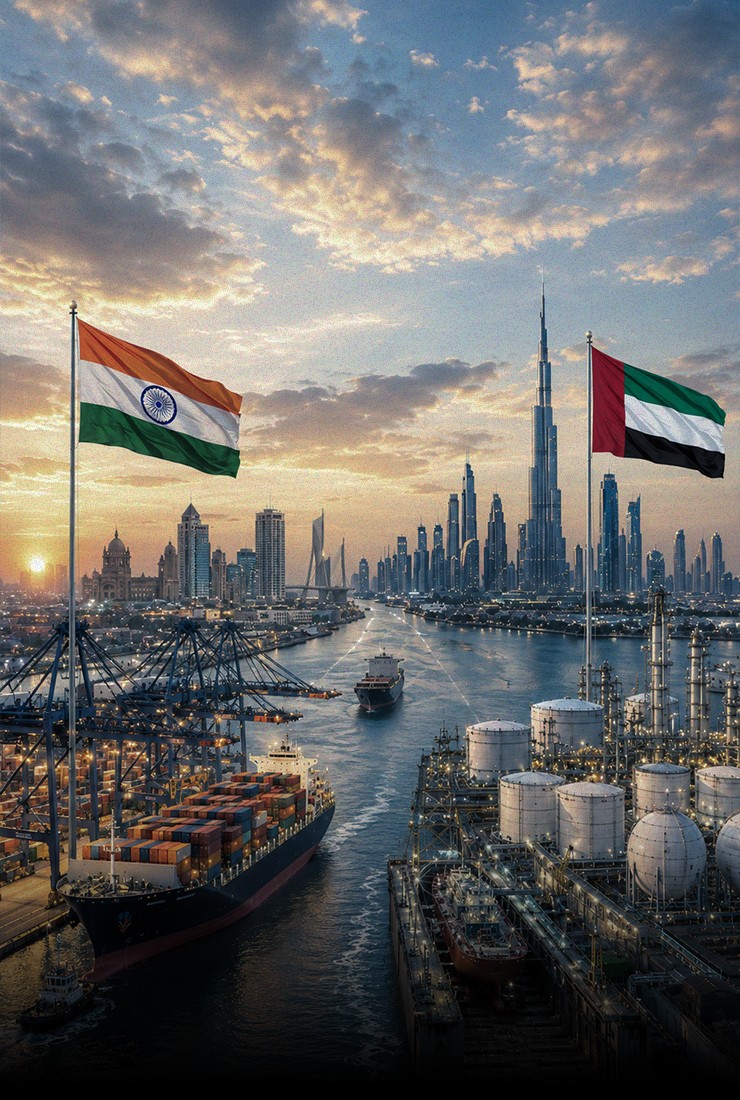
Even as the world economy struggles to deal with the repercussions of the Iran war, and more specifically the closure of the Strait of Hormuz, many countries are moving ahead in terms of economic agreements. The recent visit of Indian Prime Minister Narendra Modi to the United Arab Emirates (UAE) is one such example. The visit and the subsequent signing of various agreements between the two sides highlighted continuity in an unstable world and an emphasis on mutual growth.
India and the UAE already share a robust economic partnership. The India-UAE Free Trade Agreement, which came into force in May 2022, has already resulted in bilateral trade surpassing $100 billion.[i] The agreements signed during the Indian prime minister’s recent visit include a Strategic Defence Partnership, energy memorandums covering petroleum reserves and LPG supplies, and a Ship Repair Cluster agreement. The visit also saw a commitment for $5 billion in UAE investment into Indian markets.[ii]
India and Its Energy Needs
India is today among the world’s fastest-growing economies, despite the shocks of the ongoing tensions in the Middle East.[iii] It is home to 18% of the world’s population. The nation is experiencing rapid urbanization as people move from their native villages to big cities in search of jobs. Even as India embarks on this ambitious plan to grow economically, the energy sector is one area where it remains largely dependent on imports. The Middle East conflict has affected India enormously. From cooking gas to petrol to fertilizers to gold, prices of almost all commodities have increased. This is also primarily because the cost of oil has gone up globally.
India imports roughly 90% of its crude oil and 50% of its gas needs,[iv] and most of this comes from the Gulf via the Strait of Hormuz. The de facto closure of the Strait of Hormuz has already seen inflation set in and growth slow down. Airfares have gone up, and the government has raised import duties on gold and silver to 15%. There has also been an austerity appeal by the Indian prime minister to the people, urging them not to buy gold for one year and to avoid international travel. But despite all the measures, India’s demands for energy need to be met, and that is where the UAE is seen as a natural partner to offset that demand.
The UAE is one of India’s top five crude oil suppliers.[v] In 2025, the UAE supplied roughly 11% of India’s crude imports, and New Delhi also imported $5 billion-worth, about 25% of its natural gas requirement, from the UAE.[vi]
The UAE’s decision to opt out of the Organization of the Petroleum Exporting Countries (OPEC) and OPEC+ again works in favor of both India and the UAE. India can now look to get a greater quota of its crude oil from the UAE, which is free to pump more oil, as it is no longer constrained by OPEC quotas on oil production. The UAE’s crude oil production capacity stands at 4.85 million barrels per day, though actual production is around 3.4 million barrels per day.[vii] Following its exit from OPEC, the country intends to raise its output. India consumes around 5.5 million barrels of oil daily.
While this definitely provides an economic impetus to the relationship, it invariably also lends strength to the bilateral ties in political terms where both countries are now looking to move beyond a transactional relationship to a more institutionalized and diversified one.
During the visit of the Indian prime minister to the UAE, the leaders of the two countries also welcomed the operationalization of the Virtual Trade Corridor using MAITRI (Master Application for International Trade and Regulatory Interface). This digital framework, linking Customs and port authorities in both countries, is expected to streamline cargo movement, reduce logistics costs and transit time, and improve trade flows.
Strong Political Foundation
India-UAE ties have grown in strength over the last decade. There have been various high-level political visits from both sides. UAE President H.H. Sheikh Mohamed bin Zayed Al Nahyan visited India in January 2026. It was a brief but highly productive visit that saw the signing of the Letter of Intent (LOI) on comprehensive Strategic Defence Partnership. Energy security was another area where MoUs were exchanged.
In April 2025, India’s Foreign Minister Dr. S. Jaishankar visited the UAE. This was followed in late April by a visit of India’s National Security Advisor Ajit Doval, while India’s Foreign Secretary Vikram Misri visited the UAE in early May. The purpose of these high-level visits from India was twofold. One, to discuss the tensions in the Middle East since the conflict began on 28 February, and two, to lay the groundwork for the visit of Prime Minister Modi, which took place on 15 May 2026.
It is also significant to point out here that Prime Minister Modi has visited the UAE eight times since taking office in 2014. It is an indication of a relationship that has grown consistently over time. In 2022, the signing of the Comprehensive Economic Partnership Agreement (CEPA) between the two countries was a major landmark. Today, both countries share a common goal of achieving $200 billion in bilateral trade by 2032.[viii] It is noteworthy that despite the regional and global tensions, trade in the non-oil sector between the two countries has increased by 17%. CEPA also opened access to global markets for India. Africa is another place where both India and the UAE can look to cooperate in various sectors like supply chains, investments and building railway lines. Both India and the UAE enjoy tremendous goodwill in the African continent, and that can help them do collaborative projects there.
Recent MoUs and Their Mutual Benefits
The Indian prime minister’s visit to the UAE on 15 May has yielded tangible outcomes across energy, defense, infrastructure, and maritime domains.[ix] A total of six agreements were inked during the visit. A closer look at some of the Memorandums of Understanding (MoUs) highlights how this has resulted in a positive trajectory going forward for both countries.
Strategic Petroleum Reserves and LPG Supplies: A landmark Strategic Collaboration Agreement between India’s Strategic Petroleum Reserves Limited (ISPRL) and Abu Dhabi National Oil Company (ADNOC) will see the UAE store up to 30 million barrels of crude in Indian reserves. An accompanying long-term agreement ensures reliable LPG supplies to India. For India, this markedly strengthens energy security and provides a buffer against global supply shocks. For the UAE, it secures a major, stable buyer and deepens its role as a critical energy partner to one of the world’s fastest-growing economies.
Framework for Strategic Defence Partnership: This agreement institutionalized growing defense ties, covering manufacturing, technology collaboration, and industrial cooperation. It moves the relationship beyond buyer-seller dynamics toward joint development and co-production—beneficial for India’s push toward Atmanirbhar Bharat in defense and for the UAE’s ambitions in high-tech security capabilities.
The two sides agreed to deepen defense industrial collaboration and cooperation in innovation and advanced technology, training, military exercises, and maritime security.
Maritime and Investment Pacts: An MoU for a ship repair cluster at Vadinar in the Indian state of Gujarat promises to boost the country’s maritime infrastructure and generate jobs. For India, job creation for a growing youth population is a major challenge that needs to be addressed in the days ahead.
Further, the announcement that the UAE will invest $5 billion in Indian infrastructure,[x] RBL Bank, and Sammaan Capital will provide a major boost to the Indian economy. These inflows will support capital[xi] formation in India while offering the UAE sovereign wealth funds and entities attractive returns in a high-growth market.
It is also worth noting that there is a change in the pattern of investments by UAE-linked sovereign and strategic capital. The move is now toward controlling-equity partnerships in Indian financial institutions, rather than the passive FPI stakes that Gulf money has traditionally held in Indian equities. This also indicates that the UAE views India as a stable investment market over the long term.
Additional understandings in areas such as agricultural research, Medium and Small Enterprises (MSME) promotion, digital payments, and even Artificial Intelligence (AI) supercomputing hint at a broadening canvas that extends well beyond traditional hydrocarbons. It is also a clear indication that the India-UAE relationship is well on its way to a diversification mode.
These MoUs should also be viewed as logical extensions of the 2022 Comprehensive Economic Partnership Agreement (CEPA) signed between India and the UAE. The CEPA has already dismantled tariffs on over 80% of goods and streamlined procedures, catalyzing rapid trade growth.
Challenges as Global Tensions Continue
Since 28 February, the world and especially the Middle East have been in a state of heightened tensions. For countries like India, which are hugely dependent on the Gulf for their energy demands, this is a challenging time. Not to mention the nearly 10 million-strong Indian diaspora that works and lives in the region. But with time, it seems the region and the global economy and its major players have decided to go for a reset. We are likely to witness this reset in the coming months, as states try out new alliances and structures.
For India and the UAE, a closer defense and strategic partnership promises to build a safer region and a more stable ecosystem for future investments. Both countries are also committed to various multilateral forums like the India-France-UAE Trilateral forum, and to more ambitious initiatives like the India-Middle East-Europe Economic Corridor (IMEC). Progress on the IMEC has slowed down because of the ongoing Iran war and the tensions in the region. Indian, UAE and European leaders, however, remain committed to the project, which is a good sign, but it nevertheless is a challenge as to how to get the initiative to move forward. I2U2 (India, Israel, the U.S. and the UAE) is another initiative that will help integrate these economies more, providing an economic boost to all. But again, as with IMEC, I2U2 will also need a bit of an extra push and maybe a rethink as the world order changes and many countries look to diversify their economic partners.
Way Forward
The India-UAE relationship is highly positive, both from an economic and a political viewpoint. With the CEPA delivering results, new investments, and energy pacts (signed during the visit of the Indian PM to the UAE in May), bilateral ties are poised for sustained double-digit growth. The relationship today also serves as a model of South-South cooperation, hedging against global shocks. Despite the hits that the global and Indian economies have taken since the Iran war began on 28 February, this is one relationship that has maintained an upward trajectory. The UAE is the seventh largest investor in India, with cumulative FDI inflows of $25.19 billion from April 2000 to September 2025.[xii] Indian investments in the UAE are also growing.
One can expect to see deeper integration, with trade heading toward $200 billion and diversified investments enhancing resilience on both sides.
Going forward, what we are also witnessing is a growing sense of solidarity between India and the UAE. The ongoing Middle East conflict (which has not yet been resolved) has pointed out the vulnerabilities of a globalized world. The closure of the Strait of Hormuz has been a major shock to the global economy. As a result, supply chains have been disrupted, stock markets have crashed, inflation has risen, and growth has slowed down. Most of the world’s economies have already started planning their next economic steps, keeping this ‘hard lesson’ in mind. Alternative supply routes are being put in place, security arrangements are undergoing a change, and partnerships are being sought where countries can provide a buffer to one another for energy shocks.
India is an attractive investment destination for the UAE. The recent approval by India’s Reserve Bank of India (RBI) for Emirates NBD to acquire a majority stake in the Indian private RBL Bank is an important development. The investment is roughly around Dh11 billion ($2.99 billion) and represents the largest equity fund raise in the Indian banking sector. It is also a milestone acquisition of a majority interest in a profitable Indian bank by a foreign banking institution.[xiii] More than being a mere financial agreement, this is an instance of political goodwill getting translated into mutual economic benefits.
A strategic report released in May 2026 by the UAE India Business Council-UAE Chapter (UIBC-UC) and Arthur D. Little (ADL) makes the observation that the India-UAE economic relationship is evolving from a traditional trade corridor into an integrated consumer and retail ecosystem. The report also points out that India provides scale, diversity, and long-term growth potential with a retail sector that is expected to exceed $1.5 trillion by 2030. This is further supported by a rapidly expanding middle class and increasing digital adoption. On the other hand, the UAE offers “a premium, globally benchmarked retail environment characterized by high purchasing power, advanced infrastructure, and a diverse, internationally influenced consumer base.”[xiv]
Conclusion
India-UAE ties today are one of the strongest examples of a mutually beneficial relationship. What adds impetus is that this today covers areas as diverse as energy, defense, people-to-people contacts, and political alignments. In the last few months, as the world has adjusted to disruptions, the consistency in the India-UAE ties points to a new strength in this relationship. Both India and the UAE, in their own spheres, have had to deal with the economic fallouts of the Middle East conflict. Yet trade agreements and investments continue to move forward. It would then be a fair assessment to make at this point that one can see greater economic cooperation going forward. The ambitious target of hitting $200 billion in non-oil bilateral trade by 2032 seems well within reach, and that sets out the future trajectory too.
[i] PTI, “India UAE trade pact helps boost bilateral trade to cross $ 100 billion: Goyal,” The Hindu, May 1, 2026, https://www.thehindu.com/news/national/india-uae-trade-pact-helps-boost-bilateral-trade-to-cross-100-billion-goyal/article70928036.ece.
[ii] Dhanusha Gokulan, “PM Modi’s UAE visit seen as vital boost for India-UAE ties,” Gulf News, May 16, 2026, https://gulfnews.com/business/pm-modis-uae-visit-seen-as-vital-boost-for-india-uae-business-ties-1.500542830.
[iii] “India remains among the fastest-growing economies even as growth slows amid Middle East conflict; outlook vulnerable to risks and uncertainty,” World Bank Group, April 9, 2026, https://www.worldbank.org/en/news/press-release/2026/04/09/india-remains-among-the-fastest-growing-economies.
[iv] Soutik Biswas and Nikhil Inamdar, “Why Modi wants Indians to buy less gold and take fewer foreign holidays,” BBC, May 15, 2026, https://www.bbc.com/news/articles/c775v7dlndyo.
[v] Smriti Jain, “PM Modi’s UAE visit: How India will benefit from agreements on strategic petroleum reserves, LPG explained,” Times of India, May 15, 2026, https://timesofindia.indiatimes.com/business/india-business/pm-modis-uae-visit-how-india-energy-security-will-benefit-from-agreements-on-strategic-petroleum-reserves-lpg-explained/articleshow/131122104.cms.
[vi] Ninad D Sheth, “India deepens its multidimensional ties with UAE,” Deccan Herald, May 18, 2026, https://www.deccanherald.com/opinion/india-deepens-its-multi-dimensional-ties-with-uae-4006990.
[vii] Archis Mohan and Sudheer Pal Singh, “India, UAE sign six agreements on LPG and strategic oil reserves,” Business Standard, May 16, 2026, https://www.business-standard.com/economy/news/uae-to-invest-5-bn-in-india-as-two-nations-deepen-energy-defence-ties-126051501219_1.html.
[viii] News on AIR, “UAE, India reaffirm growing strength of bilateral economic ties,” All India Radio, May 19, 2026, https://www.newsonair.gov.in/uae-india-reaffirm-growing-strength-of-bilateral-economic-ties/.
[ix] WAM, “UAE President, Indian PM oversee major agreements and MoUs: All you need to know,” Gulf News, May 15, 2026, UAE President and Indian PM Narendra Modi Seal Major Strategic Agreements to Boost UAE–India Partnership.
[x] “India, UAE ink major pacts on energy, defence, AI: Abu Dhabi commits $5billion investment,” DD News, May 15, 2026, https://ddnews.gov.in/en/india-uae-ink-major-pacts-on-energy-defence-ai-abu-dhabi-commits-5-billion-investment/.
[xi] Sankunni K, “UAE deepens India bet with $5 billion investment push; Modi visit seals energy, defence pacts,” Fortune, May 15, 2026, https://www.fortuneindia.com/india/uae-deepens-india-bet-with-5-billion-investment-push-modi-visit-seals-energy-defence-pacts/137925.
[xii] “India UAE trade,” India Brand Equity Foundation (IBEF), April 2026, https://www.ibef.org/indian-exports/india-uae-trade.
[xiii] Hind Aldah, “UAE’s Emirates NBD bank gets nod for majority stake in India’s RBL bank,” Khaleej Times, May 17, 2026, https://www.khaleejtimes.com/business/uaes-emirates-nbd-bank-gets-nod-for-majority-stake-in-indias-rbl-bank.
[xiv] “India-UAE economic relationship: Recommendations for businesses and policymakers to accelerate cross-border retail and consumer trade,” NRIFocus.com, May 2026, https://nrifocus.com/NRI-Focus/india-uae-economic-relationship-recommendations-for-businesses-and-policymakers-to-accelerate-cross-border-retail-and-consumer-trade/.