Commissioning Fujian: A Milestone in China’s Naval Rise
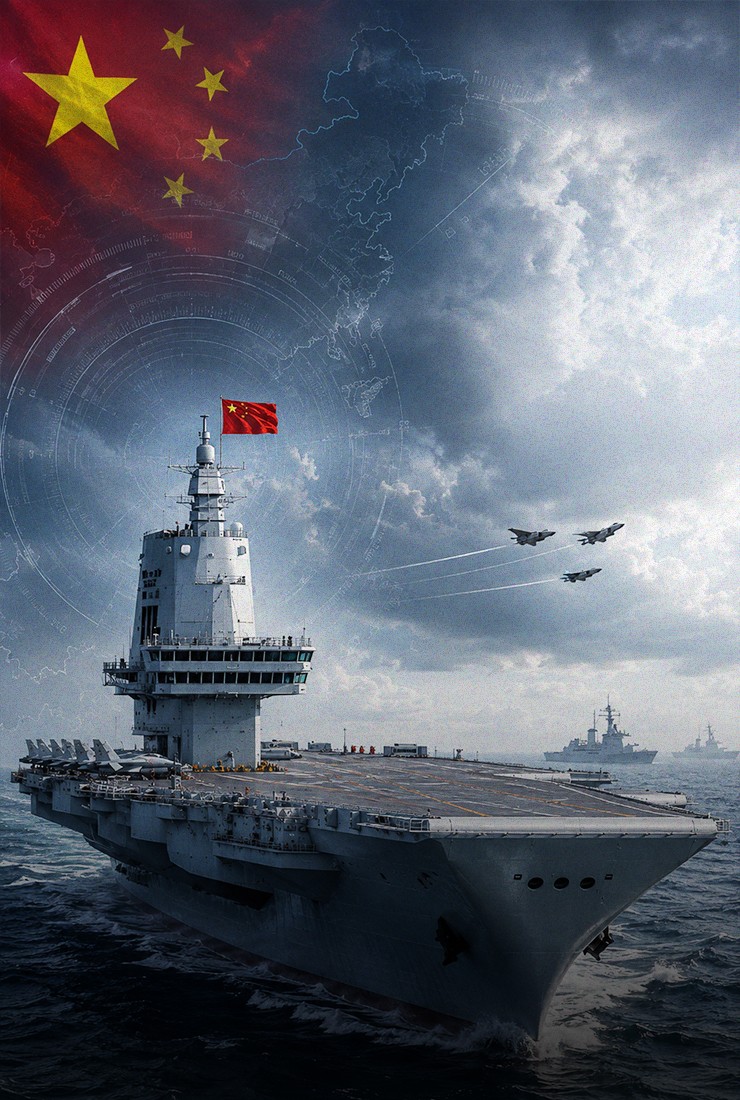
On 5 November 2025, China commissioned its third aircraft carrier, the Fujian, at the Yulin naval base in Hainan Province. Chinese President Xi Jinping presided over the ceremony, reflecting the significance of the event. Before the Fujian was commissioned, the People’s Liberation Army Navy (PLAN) operated two carriers, the Liaoning and the Shandong. The latest addition, the Fujian, is fully domestically built, featuring advanced capabilities such as Electromagnetic Aircraft Launch System (EMALS) catapults and integration with China’s latest aircraft. While China remains far behind the U.S., which operates eleven nuclear-powered carriers, commissioning a domestically built, EMALS-equipped carrier marks a major leap in China’s naval aviation and shipbuilding capability.
Maritime power is a crucial component for any state that aspires to great-power status. Alfred Thayer Mahan, the influential American historian and strategist, theorized that whoever controls the oceans controls the world’s commerce and, by extension, its destiny.[1] State-of-the-art vessels are a critical part of a powerful maritime force. Among various types of warships, aircraft carriers are considered important platforms for naval power projection in distant waters. China is one of the elite group of nine countries with aircraft carriers (for details, see Table 1). Since commissioning its first carrier in 2012, China has built/equipped three carriers in 13 years, with its third, the Fujian, entirely domestically designed and constructed. Beijing aims to double its carrier fleet to six by 2035.[2] China is already the world’s largest navy by the number of ships and a leading navy by personnel. According to media reports based on satellite imagery, China has begun work on its fourth carrier, which many analysts believe will be nuclear-powered. If current assessments are accurate, this carrier would be comparable in size to the largest vessels in the U.S. fleet.[3]
China’s commissioning of the Fujian comes amid heightening U.S.-China rivalry, rising cross-Strait tensions, and growing disputes in the South China Sea, especially between China and the Philippines. In this context, this study analyzes Fujian’s key features, the geopolitical implications of its induction, and the outlook of China’s maritime strategy. It begins by tracing the evolution of China’s maritime strategy, with a specific focus on the development of its aircraft carriers.
From Coastal Defense to Blue‑Water Ambitions
Despite its size, vast population, and a coastline stretching thousands of kilometers, China paid little attention to developing a blue-water maritime force from its independence in 1949 until the late 20th century. The Chinese leadership prioritized the People’s Liberation Army (PLA), ground forces, as the central pillar of national security and state survival. The PLAN was “clearly subordinate” to the Army with a limited role to “coastal defense” or “near-coast defense.”[4] It mainly consisted of a fleet of frigates, destroyers, and submarines, operating as a near-seas navy in the East and South China Seas and the Yellow Sea.
A gradual change in China’s maritime strategy started during the 1980s, with the third Taiwan Strait crisis in 1995-96 proving a wake-up call.[5] As tension heightened, the United States swiftly deployed its two aircraft carriers and other naval assets to the region, leaving China with no effective countermeasures and feeling humiliated. This prompted China to build a strong navy centered on developing aircraft carriers.[6]
Following this, at the 15th “National Congress,” the five-yearly gathering of the Communist Party of China held in 1997, the Chinese leadership set maritime interests as a key policy priority. The economic growth resulting from earlier reforms and the opening-up policy, which China had started in the late 1970s, provided the necessary funding and resources for future naval modernization.
During the 2000s, China’s doctrinal clarity regarding the importance of a naval force matured, and the PLAN began participating in joint maritime exercises with other countries and engaging in multilateral anti-piracy missions for the first time since 1949.[7] President Hu Jintao’s “New Historic Missions” policy, which he announced in December 2004, emphasized protecting China’s growing overseas interests and sea lines of communication as core objectives. These changes revised defense priorities, which led to increased funding and faster modernization of the PLAN.[8] Beijing also decided to gain international experience by deploying the PLAN in distant waters. In December 2008, for the first time, the PLAN deployed a task force to participate in anti-piracy operations in the Gulf of Aden under a UN-authorized mission—a practice it has continued since then. At the policy level, China’s emphasis on naval modernization persisted, as evidenced by the maritime-focused 18th National Congress in 2012, the Defense White Paper of 2013, the 19th National Congress in 2017, the 20th National Congress in 2022, and the 2025 White Paper.[9]
Table 1: Global aircraft carrier operators, platforms, and key technical characteristics
| No | Country | Total carriers | Propulsion | Flight deck type | Aircraft launch system | Estimated displacement (tons) |
| 1 | United States | 11 | Nuclear (all) | Flat | Steam (Nimitz) / EMALS (Ford) | ~100,000 |
| 2 | China | 3 | Conventional | Ski-jump (2), Flat (1) | STOBAR (2) / EMALS (1) | ~60,000–90,000 |
| 3 | UK | 2 | Conventional | Ski-jump | STOVL | ~65,000 |
| 4 | France | 1 | Nuclear | Flat | Steam catapults | ~42,500 |
| 5 | India | 2 | Conventional | Ski-jump | STOBAR | ~45,000–47,000 |
| 6 | Russia | 1 | Conventional | Ski-jump | STOBAR | ~58,600 |
| 7 | Italy | 2 | Conventional | Ski-jump | STOVL | ~27,000 / ~32,000 |
| 8 | Spain | 1 | Conventional | Ski-jump | STOVL | ~27,000 |
| 9 | Türkiye | 1 | Conventional | Ski-jump | STOVL | ~27,000 |
| 10 | Japan[10] | 2 | Conventional | Flat | STOVL | ~27,000–28,000 |
Sources: Author’s compilation from manufacturer data and defense reporting; displacement figures are approximate and vary by measurement standard (standard vs full load). EMALS – Electromagnetic Aircraft Launch System; STOBAR – Short Take-Off But Arrested Recovery; STOVL – Short Take-Off and Vertical Landing.
Carrier Development: From Liaoning to Shandong and Beyond
Initial references to China’s intentions for an aircraft carrier began in the 1980s. Key indicators of China’s carrier ambitions included statements from Chinese naval commander Liu Huaqing, the establishment of a research institute in Shanghai, and the purchase of HMS Melbourne in 1985, a light aircraft carrier from the Royal Australian Navy, by Chinese shipbreakers to study its design and technology before dismantling.
The story of China’s first aircraft carrier, the Liaoning, is revealing. The carrier was originally named Riga and was begun at the Nikolayev South Shipyard (now Mykolaiv, Ukraine) by the former Soviet Union in the mid-1980s. It was later renamed Varyag in 1990. After the disintegration of the Soviet Union in 1991, ownership was transferred to Ukraine, which halted construction due to a lack of funding. In 1998, the unfinished carrier was auctioned to a Macau-based Chinese company for US$20 million. The company claimed it would build a floating casino and a theme park. According to several accounts, this was a strategic deception and a clever use of commercial cover to facilitate a military acquisition and circumvent export restrictions on military equipment.[11] After a long journey full of challenges, the ship arrived at the Dalian shipyard in China in 2002, where it underwent comprehensive refurbishment and was commissioned as Liaoning in 2012.[12]
China’s second aircraft carrier, the Shandong, was designed based on the Liaoning but was constructed in China, from hull to completion. Construction began with steel cutting and official keel-laying in early 2015 at Dalian Shipbuilding Industry, Liaoning Province, and commissioned into the PLAN in 2019. Apart from the design, since it was built in China, some Chinese accounts, including military ones, boasted that it was the first home-made aircraft carrier.[13] However, its design, engineering lineage, and architectural features, including the ski-jump ramp and propulsion system, were derived from the original Soviet design.
Both Liaoning and Shandong have “ski-jump” decks with an upward curve to allow aircraft to take off. These decks cannot support the installation of EMALS. Aircraft taking off from ski-jump decks must rely on their own power, a long deck run, and the ramp for extra lift. This limits the types and weights of aircraft that can be launched. Heavier and slower fixed-wing planes, such as advanced airborne early warning aircraft and fully-loaded fighters, cannot operate from ski-jump decks. This also results in a low sortie rate, meaning the number of combat missions is kept to a minimum.
As China rose to great-power status, its conflict with the United States intensified, its commitment to Taiwan unification strengthened, its stance on South China Sea disputes hardened, and its expansive Belt and Road Initiative (BRI) required a role beyond traditional waters, together reinforcing the perceived need to construct advanced carriers equipped with EMALS.
Fujian’s Capabilities: EMALS, Air Wing, and Design Advances
China’s leadership made final approval of the Fujian in around 2016, and the construction began in March 2017 at Jiangnan Shipyard in Shanghai, which is China’s largest and most technologically advanced shipbuilding complex, specializing in large-scale naval and commercial vessels. The Fujian was launched in June 2022, began its sea trials in May 2024, and was handed over to the PLAN in November 2025. It is a Type 03-class aircraft carrier, measuring approximately 316 meters in length, with a displacement exceeding 80,000 tons. The flat flight deck features three EMALS catapults, an angled landing area, two deck-edge elevators, and a carrier air wing of 40-60 aircraft of various types. The carrier is powered by a combination of conventional steam turbines and diesel generators with a reported maximum speed of 31 knots.
Some of Fujian’s features make it distinctive from Liaoning and Shandong. The Fujian is a flat deck and equipped with EMALS catapults. Previously, only the U.S. Navy’s newest carrier, the USS Gerald R. Ford, utilized this technology. As a result, the Fujian became the world’s second carrier with EMALS catapults, marking a significant advancement in China’s naval aviation capabilities.
EMALS are advanced launch systems that use powerful electromagnetic fields and linear induction motors to rapidly accelerate aircraft, providing the thrust needed to launch jets from a short flight deck. This technology replaces the conventional steam-powered catapults. Prior to the Fujian, only the 11th U.S. aircraft carrier, the USS Gerald R. Ford, was equipped with EMALS. In the future, however, the U.S. might revert to steam catapults, as President Trump described EMALS as complex and prone to failure, requiring specialized off-ship technical support, whereas steam-propelled catapults were, in his view, simpler, more reliable, and easier to repair.[14] China, on the other hand, is moving ahead with EMALS as used in its Type 076 amphibious assault ship Sichuan, widely described as the world’s first drone carrier, which is expected to be commissioned by the end of 2026. Aircraft launching from the Fujian can, therefore, carry heavier payloads, with full fuel and munitions.[15] Chinese media reported that the EMALS installed on the Fujian is highly efficient, with precise control over launch force and the ability to support a wide range of aircraft, from heavy fighter jets weighing up to 30 tons to lightweight drones of just a few hundred kilograms. It accelerates them to the required take-off speed.[16] Official media credited Xi Jinping for personally instructing the incorporation of the EMALS during the carrier’s final approval.[17]
Most commentaries described this technology as a breakthrough in China’s aircraft carrier advancement. A report by Japan’s National Institute for Defense Studies commented that “The successful EMALS launches and arrested landings of the J-35, J-15T, and KJ-600 aircraft on the aircraft carrier Fujian this time demonstrates that China has reached a new stage in its carrier aviation capabilities.” “In particular,” the report added, “the KJ-600’s capability to operate from aircraft carriers represents a significant achievement for the PLA Navy, greatly advancing improvements in its maritime combat environment.”[18]
The rollout of the Fujian also demonstrated closer coordination within China’s defense industrial complex. The near-simultaneous rollout of the Fujian aircraft carrier, the J-35 carrier-borne stealth fighter, and the KJ-600 airborne early-warning aircraft, platforms that are fundamentally different in role and technology, reflected a meticulously synchronized development program. China’s carrier-capable J‑35 began flight testing in late October 2021, when a naval-configured prototype with folding wings, reinforced gear, and an arrestor hook made its first flight. This twin-engine stealth fighter is intended for both carrier-based and land-based roles, with a carrier variant commonly referred to as the J‑35 or J‑35N, and a land-based J‑35A version. During Fujian’s sea trial phase from May 2024 to September 2025 and its first post-commissioning exercise in October 2025, Chinese media released footage of the J-35’s repeated takeoffs and landings. Open sources indicate that small-scale initial production of both the carrier and land-based variants is underway.
The KJ-600 is designed for short takeoff and landing operations and made its debut during the 2025 Beijing military parade. Analysts describe it as China’s answer to the U.S. E-2 Hawkeye. Locally referred to as the “brain in the sky,” the KJ-600’s extended radar range is double that of the helicopters China used on older carriers and will significantly enhance the PLAN’s far-seas combat capability. Resultantly, the Fujian could operate as a “floating command center and airbase” without reliance on land-based reconnaissance aircraft to detect threats.[19]
Within just two weeks of its commissioning, the Fujian completed its first live-force maritime multi-task training exercise alongside its carrier strike group escorts. During these exercises, in addition to the J-35 and KJ-600, other aircraft such as the J-15, J-15T, and J-15D performed repeated EMALS catapult-assisted take-offs and arrested landings. The carrier also conducted tasks such as formation navigation, joint ship-aircraft search and rescue operations, and other integrated strike-group drills, reflecting the initial training and integration of the carrier.[20]
Limits and Learning Curves: Propulsion, Deck Cycles, and Training
While the induction of the Fujian is seen as a leap forward in China’s aircraft carrier capabilities, technical and operational challenges should not be overlooked. Multiple expert analyses have identified a flaw in its flight deck design. The positions of the three catapults interfere with one another.[21] This configuration impedes simultaneous takeoffs and landings and is projected to reduce the sortie generation rate to about 60 percent of that of U.S. Nimitz-class carriers. The ability to conduct such simultaneous take-off and landing is considered a fundamental requirement for a modern, high-tempo carrier.[22]
Moreover, the Fujian is effectively a prototype, with the PLAN using many of its features for the first time. The EMALS catapults are highly skill‑demanding for the launch and recovery of airplanes. The settings of these systems require adjustments according to aircraft type, fuel quantity, and the payloads they carry. Mastering the hardware, software, and pilot training will take time.[23] This challenge is compounded by ongoing manpower shortages; China has already shortened the training period for fighter pilots twice in recent years to expand the number of trained pilots more quickly.[24]
The Fujian employs a conventional propulsion system powered by steam turbines and diesel generators, rather than a nuclear reactor, which limits its operational range on a full load of fuel to about 8,000-10,000 nautical miles. In contrast, all U.S. carriers are powered by nuclear reactors, providing them with virtually unlimited range and the ability to operate overseas for extended periods without refueling.[25] As China does not have overseas bases except in Djibouti, the Fujian’s distant operational effectiveness will require frequent replenishment. This logistical constraint, along with a lack of overseas deployment experience as elaborated below, cautions against viewing the PLAN as a full-fledged blue-water navy at this stage.
The PLAN lacks real-world experience in deploying a full carrier battle group in distant international waters on long-term missions. As open-source research indicates, since the induction of the first carrier in 2012, no Chinese aircraft carrier has made a port visit to any foreign country to date (Hong Kong is regarded as a domestic port), let alone conducted long-term overseas deployment. Its carrier experience consists of round-trip training cruises to the Philippine Sea, which occurred only recently and involved only a few missions.[26] That experience can be described as “far-seas training missions” rather than true deployments. Furthermore, a carrier is escorted by a large array of support vessels and requires complex coordination of air defense, anti-submarine warfare, and logistics. Given the PLAN’s lack of deployment experience and the fact that the Fujian is a prototype introducing many new systems, China has a long way to go to become a blue-water power. Apart from these few challenges, the Fujian’s induction into the PLAN has several implications.
Strategic Implications: Regional Balance and Global Ambitions
Indigenous Innovation: Moving Beyond Western Templates
The development of the Fujian aircraft carrier shatters China’s image as a mere imitator of Western military technology. As mentioned before, China designed, engineered, built, and rolled out the carrier completely domestically. The carrier is only the second, after the USS Gerald R. Ford, to be equipped with advanced EMALS, which has already been used to test a range of carrier-based aircraft. Moreover, the United States incorporated this technology only with its eleventh aircraft carrier, whereas China incorporated it into its third. Achieving this technological leap on its third carrier, and within 13 years of commissioning its first, highlights China’s capability to execute complex, cutting-edge naval projects without relying on foreign models.
The Three‑Carrier Threshold: Asserting Regional Influence
With the Fujian, China has gained a three-carrier force ability, which is considered the minimum for a country to sustain continuous operations—one carrier at sea while the other two undergo maintenance or training.[27]
The PLAN based the Fujian at the Sanya Yulin naval base in Hainan Province, under the Southern Theater Command. The base is at the doorstep of the South China Sea and overlooks the Paracel Islands, which have been under China’s control since 1974 but are contested by Vietnam and Taiwan. The port is over 600 nautical miles from Taiwan and the Bashi Channel, nearly a day’s steaming distance. The Bashi Channel is a narrow waterway between southern Taiwan and the northernmost islands of the Philippines, connecting the South China Sea/Taiwan Strait with the Western Pacific. It is one of the main routes for ships and submarines moving between the first and the second island chains or from the South China Sea into the Western Pacific. The PLAN often used this route to encircle Taiwan and to enter the Western Pacific and the second island chain.
Operating from its homeport at Yulin Naval Base, the Fujian could pose challenges to Taiwan, the United States, and other regional maritime claimants. From this strategic position, the carrier could reach Taiwan’s southern and eastern approaches more quickly than ships deployed from other ports. At the same time, from this naval base, the Fujian could operate under a dense shield of air, missile, and submarine forces. As a result, the Fujian could help enforce a full or partial maritime blockade or quarantine, cutting off many of Taiwan’s sea routes. For example, during the Joint Sword 2025B exercise in April 2025, China conducted multi-axis drills that simulated surrounding the island in response to political developments in Taiwan. According to Taiwan’s defense analysts, the KJ-600 airborne early warning and control aircraft, which reportedly has a detection range of 600 km, would render Taiwan’s air defense system within the reach of the Fujian carrier strike group’s combat air patrol and air defense systems.[28]
While the United States would remain the dominant maritime power with eleven nuclear-powered carriers, the Fujian would create challenges for it, at least in the South China Sea, as well as for Washington’s commitments to Taiwan. The U.S. Seventh Fleet, with its headquarters in Yokosuka, Japan, is responsible for the Western Pacific. Despite its decades-old deployment, for the United States, the Western Pacific is a distant theater, whereas for China, it is a regional sea. Given the geographic constraint, in the event of conflict, the United States would need to move additional carriers from other regions, which would take weeks and create vulnerability elsewhere.[29] For China, this is a near-sea area where its three carriers are all home-ported and can sortie immediately, supported by an overwhelming land-based missile, air, and sensor network.
The Fujian would further tilt the naval balance in the South China Sea against smaller claimants such as Vietnam, the Philippines, Malaysia, Indonesia, and Brunei, increasing the risks and costs of direct confrontations between these nations and China. Considering China’s overall military rise, particularly in the maritime sector, some of these claimant states might enhance their defense capabilities and seek external security partnerships. Manila has already upgraded defense ties with Washington through the expansion of the Enhanced Defense Cooperation Agreement (EDCA) sites and closer operational coordination. The Fujian’s reach to the Western Pacific will increase pressure on Japan’s southwestern islands, sea lanes, and the forward posture of the Japan-U.S. alliance. Tokyo is likely to respond by further strengthening its maritime defense (it has already converted two ships into small carriers; see Table 1) and by deepening operational integration with the United States under the existing U.S.-Japan alliance framework.
Although India is not a claimant state in the South China Sea disputes, it has a long-standing boundary dispute with China in the Himalayas. The bilateral relationship between the two giant neighbors is marred by ongoing competition and a cold peace. Beijing’s strong defense partnership with Islamabad further strains Sino-Indian ties. Against this backdrop of strategic rivalry, China’s naval modernization, in the form of the induction of the Fujian, naturally concerns India. New Delhi has already announced plans to begin construction of its third aircraft carrier, projected to be nuclear-powered,[30] and to enhance naval and air defense assets in the Andaman and Nicobar Islands, near the strategic Strait of Malacca, through which a significant portion of Chinese trade and oil imports passes.[31]
Outreach to the Pacific Island nations
The Fujian’s commissioning will strengthen the PLAN’s power-projection capacity into the wider Indo-Pacific. This is particularly significant in the context of China’s growing diplomatic, economic, and geopolitical interests in the small Pacific Island nations. In the past six years, China has succeeded in switching the recognition of three countries, namely Solomon Islands (2019), Kiribati (2019), and Nauru (2024), from Taipei to Beijing. China also signed a security agreement with the Solomon Islands in 2022, and in mid-February 2025, signed the “Action Plan 2025-2030 for the Comprehensive Strategic Partnership” with the Cook Islands. Beijing’s Pacific foray has provoked strong reactions from New Zealand and Australia, particularly following China’s live-fire naval drills in international waters off the coasts of Australia and New Zealand in February 2025. To counter China’s growing footprint in its backyard, Australia signed a Mutual Defense Treaty with Papua New Guinea in October 2025.[32] Canberra and Wellington are likely to further expand cooperation with Washington, and Australia might deepen its commitments under the Australia-United Kingdom-United States (AUKUS) security partnership.
Search for Overseas Bases
With the commissioning of the third carrier and more to come, China might seek new maritime support points around the world. Aircraft carriers, especially large ones with advanced features such as the Fujian, are not designed for coastal operations alone; their main purpose is power projection in distant waters. As mentioned before, China’s carriers have recently started operating in the second island chain. The induction of the Fujian will further strengthen the PLAN’s operational reach in this area and beyond.
As the number of China’s carriers increases, it faces two major challenges in sustaining overseas deployments: first, all three commissioned carriers are conventionally powered, which limits their range and necessitates more frequent at-sea replenishment; second, aside from its naval base in Djibouti and limited access to Cambodia’s Ream Naval Base, China lacks established overseas military bases. Furthermore, long-term carrier deployment depends on securing reliable port access and basing arrangements in host states, including rights for regular port calls, logistics support, and broader host-nation support. Given this, as China’s naval power grows, Beijing is likely to seek additional ports for dual-use access in addition to more fully leveraging the existing leased and administered ports such as Gwadar, Hambantota, and Kyaukphyu.
Maritime Power for Territorial, Geopolitical and Economic Interests
The nature of China’s territorial claims, geopolitical contest, and economic interests demands a strong maritime force. Under this realization, China began to prioritize the development of maritime power over other branches of its military in the past. This policy will continue with the expansion of blue-water capabilities through a larger, more advanced fleet and improved far-seas logistics. For example, except for the contested border with India, most of China’s territorial disputes are maritime in nature, primarily in the South China Sea and East China Sea, and involve at least six countries, namely Brunei, Indonesia, Malaysia, the Philippines, Vietnam, and Japan. Similarly, the key geopolitical challenges China faces from its principal challenger, the United States, are concentrated in the maritime and air-maritime domain, such as the U.S. aircraft carrier strike groups, forward-deployed naval forces, and major maritime-oriented bases in South Korea, Japan, the Philippines, and Guam, rather than in large U.S. ground formations along China’s land borders.
A large portion of China’s energy imports and trade is seaborne, navigating vulnerable maritime routes like the South China Sea and the Strait of Malacca.[33] The launch of the BRI has further expanded China’s economic interests beyond its immediate region. An uninterrupted energy supply and sustained economic growth are directly linked to political stability and regime security in China. Moreover, the United States and its allies have long criticized China for “free-riding” on the security provided by U.S. naval forces, especially in conflict-prone regions such as the Gulf and the Red Sea. Therefore, a strong maritime power will secure China’s maritime interests, ensure the safety of the sea lines of communication (SLOCs) that support its trade and energy flows, and reduce dependence on Western-led security arrangements.
In the context of China’s expanding maritime interests, more carriers and varied forms of maritime platforms are expected to roll out in the future. China’s Dalian and Jiangnan shipyards have the capacity to build more than one carrier at a time. This, coupled with China’s massive experience in shipbuilding, producing roughly half of global shipyard output in recent years, indicates production of more carriers. China started working on the fourth Type 004-class carrier, assessed to be nuclear-powered and significantly larger, rolled out the Type 076 amphibious assault ship, the Sichuan, the world’s first “drone carrier” equipped with EMALS,[34] and progressed on a fleet of Type 903A replenishment oilers, Type 055 large destroyers, Type 054B frigates, and long-range anti-ship and land-attack missiles. These developments are a clear testimony to its aspirations for blue-water power projection.
Conclusion
China’s commissioning of the Fujian is both a technological breakthrough and a geopolitical step toward becoming a stronger maritime power. Building the carrier domestically, incorporating EMALS—a feat achieved only by the United States before—and integrating fifth-generation fighter jets and heavier aircraft like the KJ-600 demonstrate advances in China’s naval engineering and indicate that the country is not merely a copier of Western defense technology. The three-carrier force, backed by land-based support, will enable China to assert its territorial claims more credibly and put greater pressure on regional claimants in the South China Sea. In particular, the carrier could help enforce a blockade of Taiwan, raising the cost of the self-governing island’s defense even higher. The carrier will expand China’s outreach to the second island chain and the Pacific Island nations, where Beijing’s diplomatic and economic interests are rapidly growing. The Fujian also reflects China’s gradual shift from continental to maritime power, a change that underscores China’s deepening economic and trade interests and the vulnerability of its SLOCs. This prioritization is likely to persist. While the Fujian will enhance China’s maritime capabilities, its impact should not be overstated. For the PLAN to conduct sustained carrier deployments in distant waters will take time. It must acquire new carriers to close the gap with the United States, master operating advanced carriers, and gradually learn from overseas deployments. At this stage, China can be considered a regional maritime power. However, the Fujian represents a milestone, not the endpoint, of China’s naval modernization. The fact that China has already started building its fourth carrier, which is reported to be far larger and widely assessed as nuclear-powered, as well as other maritime platforms, suggests that China is on the path to becoming a blue-water maritime power.
[1] A. T. Mahan, The Influence of Sea Power upon History, 1660-1783 (Cambridge: Cambridge University Press, 2010)
[2] Peter Suciu, “How China’s Navy Just Got Closer to Its 2035 Naval Plan,” The National Interest, June 19, 2025, https://nationalinterest.org/blog/buzz/how-chinas-navy-just-got-closer-to-its-2035-naval-plan.
[3] Matthew Bodner and Keir Simmons, “China is working on an enormous aircraft carrier that rivals the biggest in the U.S. fleet, analysts say,” NBC News, March 2, 2025, https://tinyurl.com/5e6tc5sc.
[4] China Power Team, “How is China Modernizing its Navy?,” Center for Strategic and International Studies (CSIS), December 17, 2018, https://chinapower.csis.org/china-naval-modernization/.
[5] The third Taiwan Strait crisis started when the U.S., in a rare gesture, granted a visa to the sitting Taiwanese President Lee Teng-hui to attend a reunion at his alma mater, Cornell University. During his speech, Lee Teng-hui referred to Taiwan as an ‘independent country.’ China reacted by launching missile tests and military exercises near Taiwan, which prompted the U.S. to intervene by sending aircraft carrier groups.
[6] Minnie Chan, “‘Unforgettable humiliation’ led to development of GPS equivalent,” South China Morning Post, November 13, 2009, https://tinyurl.com/25a8wy4y.
[7] Ghulam Ali, “China–Pakistan Maritime Cooperation in the Indian Ocean,” Issues & Studies 55, no. 3 (2019): 1940005, https://doi.org/10.1142/s1013251119400058.
[8] Ian Burns McCaslin and Andrew S. Erickson, “The Impacts of Xi-Era Reforms on the Chinese Navy,” In P. C. Saunders, A. S. Ding, A. Scobell, A. N. D. Yang, & J. Wuthnow (Eds.), Chairman Xi Remakes the PLA: Assessing Chinese Military Reforms (National Defense University Press, 2019).
[9] Ziya Guo, “What China’s 2025 White Paper Says About Its Maritime Strategy,” CSIS, August 19, 2025, https://tinyurl.com/3mr2649u.
[10] Japan does not have an indigenously designed, conventionally labeled aircraft carrier, but it has converted two of its multipurpose helicopter carriers into de facto aircraft carriers and has successfully conducted F-35B short take-off/vertical landing (STOVL) operations from the modified decks.
[11] James R. Holmes, “The Long, Strange Trip of China’s First Aircraft Carrier And what it says about Beijing’s naval ambitions,” Foreign Policy, February 3, 2015, https://tinyurl.com/y7puwwrj; IANS, “How deceit was built into China’s first aircraft carrier,” Hindu Post, July 21, 2021, https://hindupost.in/world/how-deceit-was-built-into-chinas-first-aircraft-carrier/.
[12] “Liaoning Varyag Aircraft Carrier, China,” Naval Technology, September 24, 2012, https://www.naval-technology.com/projects/varyag-aircraft-carrier-china/.
[13] Li Jiayao, “A Milestone in History: Birth of First China-made Aircraft Carrier Shandong,” China Military Online, 2021, Retrieved from http://eng.chinamil.com.cn/CHINA_209163/TopStories_209189/10018387.html.
[14] Joseph Trevithick, “Executive Order To Go Back To Steam Catapults On New Aircraft Carriers Coming: Trump,” TWZ, October 28, 2025, https://tinyurl.com/wy9wc53b.
[15] Editorial, “New Fujian carrier shows China’s tech prowess, commitment to peace,” South China Morning Post, November 12, 2025, https://bit.ly/3WRCwjG.
[16] Zhang Tong, “How China’s Fujian aircraft carrier deceived US military experts at launch,” South China Morning Post, November 16, 2025, https://tinyurl.com/3mc83f32.
[17] Liu Xuanzun, Liang Rui, and Guo Yuandan, “China commissions first electromagnetic catapults-equipped aircraft carrier, Fujian,” Global Times, November 7, 2025, https://www.globaltimes.cn/page/202511/1347603.shtml.
[18] AITA Moriki, China’s Aircraft Carrier Fujian: Milestone Achieved, Challenges Ahead in Carrier Aviation, NIDS Commentary, no. 200 (2025), https://www.nids.mod.go.jp/english/publication/commentary/index.html#.
[19] Christian Shepherd and Álvaro Valiño, “China’s new aircraft supercarrier challenges U.S. dominance in Pacific,” The Washington Post, November 14, 2025, https://tinyurl.com/52d53c5h.
[20] Berk Kutay Gokmen, “China’s newly-commissioned Aircraft Carrier Fujian conducts 1st naval drill,” Anadolu Ajansı, November 18, 2025, https://tinyurl.com/3uebxr2a; Liu Xuanzun and Liang Rui, “PLA Navy announces Fujian carrier formation’s 1st live-force training; warship becoming combat-ready fast, experts say,” The Global Times, November 18, 2025, https://tinyurl.com/2nyh764p.
[21] Brad Lendon and Wayne Chang, “China’s newest aircraft carrier not as capable as 50-year-old US ship in one key respect, former US officers say,” CNN, October 26, 2025, https://edition.cnn.com/2025/10/25/asia/us-china-aircraft-carrier-comparision-intl-hnk-ml; Nitin J. Ticku, “Critical Design” Flaws In China’s Fujian Aircraft Carrier; Less Capable Than Decades-Old U.S. Flattop: Reports,” The EurAsian Times, October 28, 2025, https://www.eurasiantimes.com/critical-design-flaws-in-chinas-fujian-aircraft-carrier/; Choi Yoo-sik, “Fujian Carrier’s Flight Deck Flaws Limit Simultaneous Operations,” The Chosun, October 6, 2025, https://tinyurl.com/mvs464m3.
[22] Nitin J. Ticku, “Critical Design” Flaws In China’s Fujian Aircraft Carrier; Less Capable Than Decades-Old U.S. Flattop: Reports,” The EurAsian Times, October 28, 2025, https://www.eurasiantimes.com/critical-design-flaws-in-chinas-fujian-aircraft-carrier/.
[23] Moriki, China’s Aircraft Carrier Fujian: Milestone Achieved, Challenges Ahead in Carrier Aviation.
[24] Amber Wang, “China cuts fighter pilot training by 1 year, on track for full overhaul ‘by early 2030s,’” South China Morning Post, December 5, 2025, https://tinyurl.com/ydeemhsm.
[25] Mithil Aggarwal, “China aims to expand its power in the Pacific with its new Fujian aircraft carrier,” NBC News, November 7, 2025, https://tinyurl.com/3z76xd4v.
[26] Dzirhan Mahadzir, “China Deploys 2 Aircraft Carriers to Western Pacific for the First Time,” United States Naval Institute, June 10, 2025, https://tinyurl.com/mrxbuj3p; Brent Sadler and Allen Zhang, China’s Carriers Cruised Past the Second Island Chain. What Now?,” Breaking Defense, August 20, 2025, https://breakingdefense.com/2025/08/chinas-carriers-cruised-past-the-second-island-chain-what-now/.
[27] Gabriel Dominguez, “China delivers warning to U.S. and Japan with third aircraft carrier,” The Japan Times, November 11, 2025, https://www.japantimes.co.jp/news/2025/11/11/japan/china-new-aircraft-carrier-japan/.
[28] Wu Che-yu and Jonathan Chin, “‘Fujian’ carrier to pose steep defense challenge,” Taipei Times, September 13, 2025, https://www.taipeitimes.com/News/taiwan/archives/2025/09/13/2003843720.
[29] Sophie Wushuang Yi, “South China Sea: how third PLA Navy aircraft carrier changes dynamics for US,” South China Morning Post, November 16, 2025, https://tinyurl.com/mwcttrxs.
[30] “India eyes nuclear-powered carrier, home-built navy jets in 15-year defence plan,” Reuters, September 5, 2025, https://bit.ly/4oEZzKH.
[31] Amit Kumar, “Development of Andaman and Nicobar Islands: Strategic comfort for India, anxiety for her adversaries,” The Times of India, September 22, 2025, https://bit.ly/4qZueE3.
[32] Prime Minister of Australia, Australia and Papua New Guinea sign Mutual Defence Treaty, Media release, October 6, 2025, Retrieved from https://www.pm.gov.au/media/australia-and-papua-new-guinea-sign-mutual-defence-treaty.
[33] China Power Team, How Robust Is China’s Energy Security? Economic Security Series, https://chinapower.csis.org/china-energy-security/.
[34] Seong Hyeon Choi, “China’s first 076 ‘drone carrier’ amphibious assault ship Sichuan starts sea trials,” South China Morning Post, November 14, 2025, https://tinyurl.com/yvyvz3df.