This insight examines the role of artificial intelligence (AI) and big data analytics in predicting conflicts and managing regional crises, with a particular focus on the Middle East and Africa. It argues that the past two decades have witnessed a qualitative shift in regional crises, moving from wars between states with clearly defined front lines to complex, multi-party conflicts and proxy wars rooted in war economies and transnational networks. This has weakened the effectiveness of traditional expert- and intelligence-based early warning systems.
In this context, AI-powered models and large-scale data analytics offer promising potential for faster risk pattern detection, expanded surveillance, and more systematic scenario simulations, as demonstrated by recent international initiatives such as UN early warning projects and regional predictive platforms. The article also talks about structural problems that can make data bias, model ambiguity, and “automation bias” worse. These problems can make existing inequalities in global knowledge production worse and make it harder to make responsible decisions.
The study uses a qualitative analytical approach, combining a systematic literature review with a comparative case study of Africa and the Middle East, including a high-risk escalation scenario involving Iran, Israel, and the United States, and its implications for Gulf security.
The findings show that AI significantly improves the speed and comprehensiveness of early warning systems, but it is still limited in complex political environments, where secretive decisions, disinformation, and the dynamics of proxy wars make it hard to make accurate predictions and warnings. The article states that AI should be seen as a tool that helps, not replaces, human governance. It also states that to use AI effectively, we need strong data governance, clear and understandable models, and institutional frameworks that make sure that technological outputs are used in ethical and context-aware decision-making processes.
1.1 Introduction
Over the last few decades, the international and regional systems have seen dramatic changes in the character of conflicts and security crises. Traditional interstate warfare is no longer the predominant trend. Instead, increasingly complex forms have arisen, such as proxy wars, identity-based conflicts, non-state armed players, cross-border networks, and the growing overlap of physical and digital domains in conflict resolution. [1] This trend has increased the complexity of crisis contexts and expedited escalation dynamics, offering substantial difficulties to traditional conflict anticipation and risk management models based on human interpretation, diplomatic reports, and intelligence assessments. [2]
Considering the digital revolution and the rapid growth of artificial intelligence models and big data analytics, new techniques have developed that seek to use algorithms and machine learning to support early warning systems and political and security risk assessment. [3] International and regional institutions, such as the United Nations and the African Union, are increasingly using anticipatory models and “smart early warning” systems to monitor indicators of political violence and instability. These systems analyze massive amounts of information gathered from news sources, social media, satellite images, and economic and security indices. [4]
The usefulness of artificial intelligence in these subjects stems from its capacity to digest data quickly, find hidden patterns, and uncover intricate correlations between political and security issues. This allows us to produce probabilistic estimations of the likelihood of conflict escalation or outbreak before it occurs. [5] These technologies also enable the creation of quantitative scenarios that can assist decision-makers in crisis management, resource allocation, and preventive measures more effectively than traditional techniques.
The expanding application of artificial intelligence in security and strategic sectors creates numerous theoretical, practical, and moral concerns. Critical evaluations demonstrate that anticipatory models are not totally unbiased; they may contain structural biases resulting from data sources and global knowledge generation procedures. [6] This is especially true because Western sources are more abundant, but certain areas and populations are underrepresented in training databases. Furthermore, complicated political situations, such as the Middle East, include aspects that cannot be reduced to quantitative models, such as covert strategic calculations, identity and religion influences, cyber warfare, and media deception. All these factors make it difficult for algorithmic models to reliably foresee significant catastrophes. [7]
Additionally, the efficacy of early warning systems is determined not just by technological advancements but also by political and institutional capacity to translate early warnings into actions and preventive measures. Even the most advanced models cannot prevent conflicts or manage crises on their own unless they are embedded in clear. responsible institutional and organizational frameworks that address the ethical concerns of utilizing artificial intelligence in security and peace-related domains. [8]
1.2 Problem Statement
In the last few decades, regional crises and conflicts have changed a lot in terms of their nature and structure. This has had a direct effect on the types of security threats and how they are managed. Conflicts are no longer just wars between states; they are more complex, involve many actors, and occur at multiple levels, including political, military, media, and digital. [9] This change has led to more proxy wars, a bigger role for non-state armed groups, and new types of conflict that use transnational networks, media influence, and cyberspace. This makes it harder to predict and manage crises using traditional methods. [10]
Table 1: Evolution of the Nature of Regional Crises Across Historical Phases
| Historical Phase | Main Characteristics of Crises | Brief Examples |
| Pre-1990 | Interstate wars, regular armies, and clearly defined frontlines. | Iran-Iraq War |
| 1990–2010 | Civil wars, international interventions, and identity conflicts. | Bosnia, Rwanda |
| Post-2011 | Proxy wars, armed groups, multiple actors, war economies. | Syria, Yemen, Libya |
Table 1 shows how crises have changed from traditional conflicts with clear lines of battles to more complicated, multi-layered conflicts where political, sectarian, economic, and media factors all play a role. This change has made conflict environments more dynamic and less predictable. As a result, traditional monitoring and analysis tools like diplomatic and intelligence reports and expert assessments have become less effective at keeping up with the rapid escalation and complicated dynamics of conflict. [11]
In response to this growing complexity, artificial intelligence (AI) and big data analytics have become popular modern tools for creating early warning systems and analyzing security and political risks. This is accomplished through the application of machine learning techniques and extensive data processing to identify patterns and indicators linked to violence and instability. [12]
International and regional organizations, including the United Nations and the African Union, have implemented initiatives founded on anticipation models and data analysis to enhance crisis management and facilitate preventive decision-making. [13] Notwithstanding the swift advancement of these technologies, the utilization of AI in conflict anticipation continues to encounter significant challenges pertaining to data quality, algorithmic biases, and the disproportionate representation of various political and cultural contexts within the databases employed for model training. [14]
Moreover, regional crises, especially in the Middle East, exhibit a considerable level of complexity due to the involvement of variables that are challenging to quantify, such as covert strategic decisions, undisclosed political calculations, and identity and symbolic factors. This limits the ability of algorithmic models to accurately anticipate escalation paths or the timing of crises. [15] Recent literature shows that the effectiveness of early warning systems depends not only on the technical capabilities of anticipation models, but also on the ability of political and security institutions to use these outputs in ways that are transparent, accountable, and political. [16]
The study’s problem is to look at how artificial intelligence might help with conflict anticipation and regional crisis management compared to traditional methods, while also looking at the political, technical, and ethical limits that make these models less effective, and showing how artificial intelligence and human judgment can work together to help with strategic decision-making.
This study seeks to answer the main questions:
To what extent does artificial intelligence improve conflict anticipation and regional crisis management compared with traditional methods, and what are the practical limits of its role in supporting strategic decision-making without replacing human judgment?
1.3 Significance of the Study
The study bridges the gap between conflict studies and artificial intelligence research by offering an analytical framework that integrates crisis management, machine learning, and big data analytics, while critically examining the assumption of data and algorithm neutrality. It contributes to the emerging literature addressing artificial intelligence as both a technological innovation and a socio-political construct, intertwined with power relations and cognitive inequalities.
The study conducts a critical evaluation of AI-driven early warning systems through a comparative case study of Africa and the Middle East, concentrating on a potential escalation scenario involving Iran, Israel, and the United States, and its ramifications for Gulf security. This approach enriches the regional perspective rooted in local realities, contests prevailing Western narratives on AI and security, and enhances the Arab academic discourse in this domain.
The research provides national security institutions, foreign ministries, and crisis management centers with a conceptual framework for comprehending the capabilities and limitations of AI-based predictive models in analyzing intricate regional dynamics. It also suggests ways to integrate these tools into existing institutional mechanisms to improve the speed and accuracy of risk assessments without compromising human oversight.
Furthermore, the article provides practical recommendations on how to design and integrate “AI crisis units” within decision-making structures under strong governance frameworks that limit bias, ensure transparency and accountability, and prevent misuse or diversion of these tools into offensive or covert activities beyond their original objectives.
1.4 Research Methodology
The study relies on a qualitative analytical methodology based on a systematic review of academic and policy literature, combined with an examination of applied projects on AI-supported early warning systems. It also employs a comparative case study method, focusing on two primary cases: Africa, as a region that has witnessed relatively early experiences in data-driven early warning, and the Middle East, with special emphasis on a hypothetical yet plausible high-risk escalation scenario involving Iran, Israel, and the United States and its implications for Gulf security.
2. Theoretical Framework and Literature Review
Artificial intelligence refers to a set of computational methods and algorithms that enable digital systems to perform tasks that typically require a degree of “human intelligence,” such as learning from data, anticipating outcomes, recognizing patterns, and making decisions under uncertainty. [17] The study focuses on applications of Narrow AI in the fields of Anticipating and pattern recognition, rather than on general or comprehensive artificial intelligence.
2.1 Machine Learning Theory:
Machine Learning refers to algorithms that learn patterns from historical data and then use these learned representations to generate predictions or classifications for new cases. During regional crises, machine learning models can integrate political, economic, security, and media variables into predictive frameworks. These frameworks give probabilistic estimates of how likely it is that conflict starts or gets worse in a certain country within a certain time frame. [18] There are two types of these models: Supervised Learning, which uses pre-labeled data like past conflict events, and Unsupervised Learning, which finds clusters and unusual patterns without needing prior classification. [19]
2.2 Big Data Analytics
Big data analytics refers to the processing and analysis of massive, diverse, and rapid flows of data, including news reports, social media posts, satellite imagery, and economic indicators, to extract early warning indicators and broader trends related to social mood and regional security. [20] In crisis environments, this analytics is of particular importance because it enables continuous monitoring across multiple geographic areas and spaces, reducing reliance on a single source of information and improving awareness of the security situation. [21]
3. Crisis Management: Traditional Models versus AI-Supported Models
3.1 Traditional Models of Crisis Management
Traditional models of crisis management rely primarily on expert assessments, diplomatic and intelligence reports, and direct field information. Analytical tools are mostly qualitative, with limited use of quantitative risk assessment models, especially in politically sensitive or data-scarce environments. These models excel in incorporating historical contexts, local narratives, and symbolic and identity-based dynamics. However, they face difficulties in processing the massive and rapidly changing data flows generated by digital media and global information environments. [22]
3.2 AI-Supported Models in Crisis Management
AI-supported models add a digital layer capable of ingesting and analyzing vast datasets in near real-time, detecting hidden patterns and anomalies, and generating quantitative scenarios to support decision-making. [23] In principle, these models can expand the temporal and geographical scope of monitoring systems and provide continuous risk updates as new data flows in. However, their performance depends critically on data quality, representativeness, and model design. Their output remains dependent on decision-makers’ willingness and ability to interpret and act upon them. [24]
It is important to emphasize that the comparison between traditional and AI-supported approaches is not a zero-sum game; the two can be complementary. The most effective structure is a hybrid model in which human experts provide deep contextual understanding and value-based judgment, while AI systems offer speed, scale, and the ability to detect patterns across large-scale datasets. This integration underscores that artificial intelligence should be viewed as a tool to support decision-making, not a replacement for human agency and ethical responsibility. [25]
Table 2: Comparison Between Traditional and AI-Supported Crisis Management Models
| Measurement | Traditional Crisis Management Model | AI-Supported Crisis Management Model |
| Type of Data | Expert reports and qualitative information | Big data, real-time, and multi-source data |
| Rate of Analysis | Relatively slow | High |
| Depth of Contextual Understanding | Deep understanding of history, culture, and symbols | Limited; depends on available data |
| Ability to Identify Patterns | Effective in familiar contexts | Strong in identifying hidden patterns |
| Bias | Expert-related bias | Data and algorithmic bias |
| Transparency | Apparent and accountable (experts can be questioned) | Sometimes operates as a “black box.” |
Table 2 shows that effective crisis management depends on integrating human expertise with AI capacities rather than changing one methodology for another.
3.3 Data Flow from Sources to Anticipation
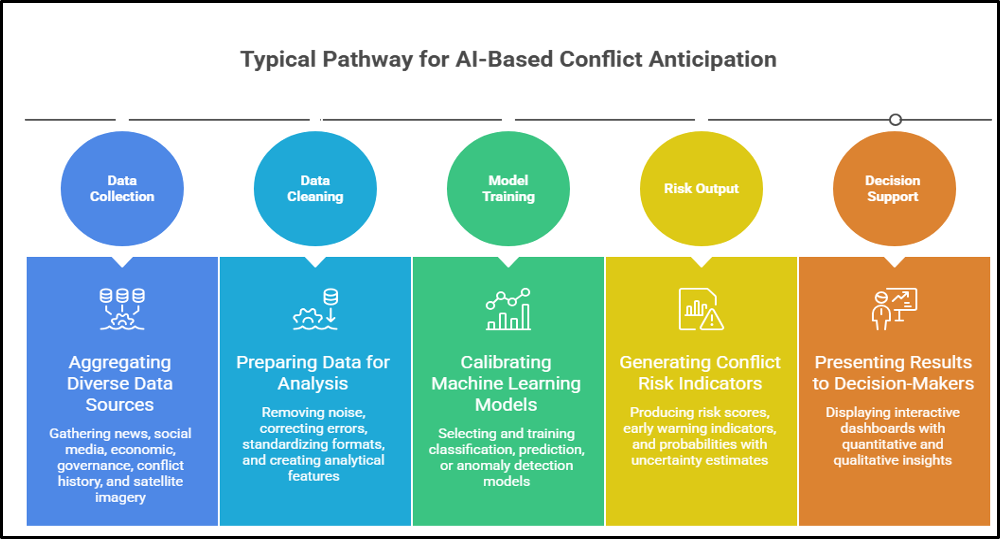
Typical pathway for AI-based conflict anticipation that might be summarized as follows:
Figure 1: Typical pathway for AI-based conflict anticipation, illustrating the stages from data collection and cleaning to model training, risk prediction, and decision support
4. Are Data Neutral or Biased?
Technical discourse often assumes that data is “neutral” and that artificial intelligence produces objective knowledge. However, critical research shows that the datasets used to train predictive models can contain structural biases that reflect existing inequalities in information production and representation. [26] These biases manifest in the dominance of Western news sources, the over-representation of certain regions or types of conflicts, linguistic and cultural biases, and the possibility of deliberate manipulation by actors seeking to mislead or overwhelm monitoring systems with disinformation. [27]
Consequently, AI-based conflict-anticipating models may underestimate risks in politically or media-marginalized regions, while overestimating risks in areas that receive intense media coverage and political attention. Without strong data governance, including source diversification, dataset auditing, and mechanisms for verification and correction, artificial intelligence may unintentionally reproduce and deepen existing blind spots and biases rather than reduce them. [28]
5. AI-Based Conflict Anticipating Mechanisms
Figure 2: Synergy between AI-driven data sources and analytics to anticipate conflict and assess crises
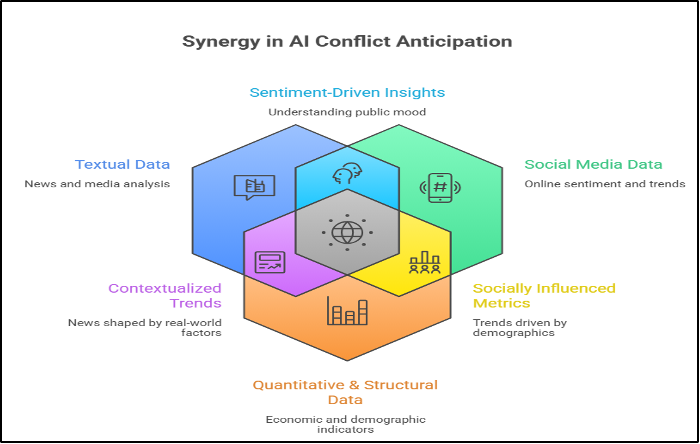
Figure 2 shows that AI-based conflict-anticipating systems typically rely on three main categories of data, often integrated within unified analytical frameworks:
A. Textual Data from News and Media
Natural Language Processing (NLP) is used to analyze shifts in political discourse, monitor the rise of hate speech and incitement, and track references to armed actors and military threats. This enables the development of quantitative indicators to measure rhetorical escalation in both official and unofficial channels. [29]
B. Social Media Data
Sentiment analysis and social network analysis are employed to detect waves of anger, protest, and digital mobilization, including calls for demonstrations or support for violence. This allows the construction of “social tension indicators” that can serve as early warning signals for potential outbreaks of unrest. [30]
C. Quantitative and Structural Data
This category includes macroeconomic indicators, governance metrics, historical conflict event data, and military movements monitored through satellite imagery. These variables are integrated into statistical or machine learning models to estimate the probability of instability or conflict outbreak within a specific time frame, such as the next six to twelve months. When national, regional, and United Nations systems successfully integrate these diverse data sources—as seen in some emerging early warning platforms they can enhance the ability to detect early signals of political instability and violence, thereby supporting preventive diplomacy and humanitarian preparedness.
6. Empirical Applications
Applied studies and experimental projects have shown that machine learning models can, in some cases, identify high-risk countries or regions before large-scale violence erupts, particularly in parts of Africa and Asia where organized conflict databases and governance indicators are available. [31]
The United Nations and its partners have also begun employing advanced data analytics within broader initiatives for early warning and crisis anticipation, as reflected in recent policy papers on “Predictive Peacebuilding” and “Technology for Peace.” [32]
Nevertheless, these applications remain uneven and incomplete. They do not cover all types of conflicts with equal accuracy and often show relatively high rates of false positives and false negatives in complex political environments. Limitations in data coverage, quality, and timeliness, along with the opacity of some proprietary closed models, restrict the possibility of full reliance on these tools for high-stakes decisions. Moreover, even when early warning signals are accurate, they do not automatically translate into preventive actions, as political will and institutional mandates remain decisive factors.
7. Artificial Intelligence and Decision Support in Crises
Figure 3: AI framework for crisis management integrating risk analysis, simulation, and decision support
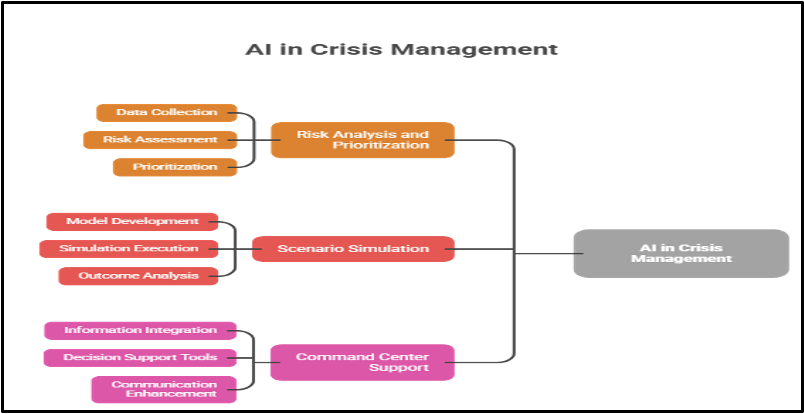
Figure 3 shows that artificial intelligence plays an increasingly important role in supporting command and control centers across various stages of crisis management. Three main areas might be highlighted in this context:
A. Risk Analysis and Prioritization
Artificial intelligence models are used to build risk matrices that clarify the probability and impact of different scenarios. This helps decision-makers identify priorities and allocate resources more efficiently.
B. Scenario Simulation
Digital tools enable the simulation of hypothetical scenarios based on changes in political, military, and economic variables. This allows decision-makers to assess the potential outcomes of alternative strategic options before implementation.
C. Command Center Support
Interactive dashboards integrate early warning data, risk maps, and escalation pathways into visually accessible formats. This enhances situational awareness during critical phases of a crisis and supports rapid, well-informed responses.
8. The Role of Big Technology Companies
Cloud platforms provided by major technology companies such as Microsoft and Google offer advanced tools for data storage, processing, analysis, and visualization. These can be leveraged to build sophisticated early warning and crisis management systems. When integrated within appropriate governance frameworks, they help states and international organizations expand their analytical capabilities and experiment with the latest artificial intelligence solutions. However, reliance on commercial platforms in sensitive security applications raises serious concerns regarding data sovereignty, control over infrastructure, access rights, and the risk of repurposing crisis management tools for offensive military or intelligence purposes.
These concerns underscore the need for clear regulatory frameworks and international standards to govern the use of artificial intelligence by states and technology companies in high-risk domains. [33]
9. Achieving Balance Between Human and Machine
This study adopts a realistic critical position that views artificial intelligence as a high-value analytical tool. Its benefits are directly linked to its integration within transparent and accountable institutional frameworks that maintain the centrality of human judgment. Artificial intelligence is not a self-sufficient decision-maker, nor can it independently balance the human, political, and ethical considerations inherent in decisions of war and peace. [34]
Several factors support this orientation. Factor one, Inherent absence of ethics and law: AI models lack an internal ethical or legal framework and cannot independently weigh conflicting values, such as protecting civilians versus achieving military gains. Factor two, Information asymmetry: Many critical pieces of information during crises remain secret or confined to informal political channels, falling outside the scope of open data or even the classified data used to train models, and the last factor is Automation Bias, which is over-reliance on AI outputs may grant uncertain statistical predictions excessive authority or lead to the selective use of model results to justify pre-existing political preferences. [35]
Accordingly, the most realistic approach is to build a human-machine partnership, in which artificial intelligence enhances human analytical capabilities without replacing human responsibility or political accountability.
10. Data Analysis and Results
In Africa, numerous regional early warning initiatives have been tested that combine quantitative and qualitative data, including models that employ artificial intelligence and advanced statistics to predict political violence. In several cases, these systems successfully signaled elevated risk levels before the outbreak of violence, thereby contributing to improved humanitarian preparedness, even though their influence on political and security decision-making remained relatively limited.
In the Middle East, a large-scale escalation scenario between Iran, Israel, and the United States would place the Gulf states at the center of the risk equation. This could involve threats to energy infrastructure, maritime security in the Gulf and the Strait of Hormuz, and the expansion of proxy wars across Yemen, Iraq, Syria, and Lebanon. In such a scenario, artificial intelligence models can detect early indicators of escalation through:
- Escalation of hostile rhetoric and media mobilization.
- Unusual military and logistical movements are monitored via satellite imagery and open-source intelligence.
- Sudden surges in conflict-related discourse and public sentiment on social media across multiple languages.
- Nevertheless, the capacity of these models to predict the precise timing and scale of escalation remains limited due to secret strategic decisions, disinformation campaigns, cyber operations, and the interconnected nature of proxy war theaters. Consequently, temporal anticipating accuracy tends to be relatively higher in cases of low-intensity political violence that escalates gradually, and lower in major military crises driven by sudden political decisions. Moreover, the impact of early warning on public policy depends less on advances in artificial intelligence itself and more on political will and institutional capacity to respond to early signals.
11. Discussion of Results
The study demonstrated that applications of artificial intelligence in early warning and crisis management have undergone notable development in several regional settings, especially in Africa, which ranks among the earliest regions to test data-driven early warning systems. Several regional and international initiatives have integrated economic, political, and security indicators into analytical models that utilize machine learning and advanced statistics to forecast political violence and instability. [8]
The findings indicate that these systems have succeeded, in certain cases, in detecting escalation indicators before the outbreak of violence, thereby enhancing humanitarian readiness and enabling more efficient resource allocation. However, their influence on political and security decisions has remained limited owing to weak political will or insufficient institutional capacity to convert early warnings into effective preventive responses.
In the Middle East, the study revealed that the regional environment is considerably more complex in terms of political and security structures. This complexity arises from overlapping proxy wars, high levels of secrecy in strategic decision-making, and the entanglement of military, economic, sectarian, and media dimensions. In the plausible escalation scenario between Iran, Israel, and the United States, artificial intelligence proves capable of detecting certain early indicators, such as:
- Escalation of hostile rhetoric and media discourse.
- Unusual military movements.
- Digital activity linked to political and military mobilization.
- Sudden shifts in economic and security risk indicators.
Nevertheless, the study showed that the predictive models’ ability to determine the precise timing or scale of escalation remains constrained. Major crises are often driven by secret political decisions and complex deterrence calculations that are difficult to convert into quantifiable variables suitable for modeling.
However, the study’s results indicate that artificial intelligence represents a qualitative advancement in early warning systems compared with traditional models—particularly in terms of speed, expanded monitoring scope, and the near-real-time processing of multi-source data. This finding aligns with the literature on the role of machine learning and big data analytics in enhancing the detection of political escalation and violence indicators before they materialize.
The study further demonstrated that AI-supported models can improve the analysis of complex patterns and the integration of political, security, and media variables within comprehensive predictive frameworks. This provides decision-makers with a higher level of risk awareness than traditional methods relying solely on human analysis. However, the results also clarified that the effectiveness of these models varies according to the political environment and the nature of the conflict.
In highly complex environments such as the Middle East, the accuracy of predictive models declines due to the presence of non-quantifiable variables — including secret decisions, undeclared alliances, cyber warfare, and symbolic or identity-based calculations. This outcome is consistent with critical studies that emphasize that artificial intelligence cannot fully capture all political and social dimensions of conflicts and that its predictive power remains tied to data quality and the inherent limits of algorithmic modeling.
The study also confirms the theoretical argument regarding data and algorithmic bias. Predictive models may reproduce global knowledge imbalances because of the dominance of Western sources and the under-representation of local communities in training datasets. This supports the literature indicating that artificial intelligence is not a completely neutral tool but is shaped by the political and epistemic structures that produce the data. [4]
On the other hand, the study revealed that the primary gap lies not only in the technical capacity to predict but also in the ability of political institutions to respond effectively to early warnings. In many cases, the absence of information was not the main problem; rather, it was the lack of political will or limited institutional capacity to take preventive action. This finding is consistent with the literature, which stresses that crisis management remains fundamentally a political and institutional process, and that technology alone cannot prevent or resolve conflicts. [5], [11]
Accordingly, the study affirms that the most realistic and effective model is an integrative human-machine partnership in which artificial intelligence enhances human analytical capabilities without replacing political expertise or ethical responsibility in decision-making.
12. Conclusion
The study concluded that artificial intelligence constitutes a significant strategic addition to the field of conflict anticipation and regional crisis management, particularly in its ability to analyze big data and detect early patterns that human analysts may struggle to identify at the same speed. It showed that AI-supported early warning systems can enhance response speed, expand monitoring coverage, and provide quantitative scenarios to support decision-making.
However, the study clarified that the effectiveness of these systems remains limited in complex political environments characterized by secret decisions, proxy wars, media disinformation campaigns, and cyber operations, as is the case in the Middle East. It also demonstrated that artificial intelligence cannot serve as a substitute for human expertise or a deep understanding of local, cultural, and political contexts.
The research further emphasized that the main challenges associated with the use of artificial intelligence in crisis management extend beyond technical aspects to include issues of governance, transparency, accountability, data bias, and power imbalances in global knowledge production. Therefore, the success of predictive models depends on data quality, the existence of clear regulatory and ethical frameworks, and the capacity of political institutions to integrate AI outputs into rational and responsible decision-making processes.
On this basis, the study argues that the most realistic path forward is the adoption of an integrative model that combines the analytical capabilities of artificial intelligence with human expertise. This approach ensures the benefits of computational speed and accuracy while preserving the political and ethical judgment that remains a decisive element in the management of crises and international conflicts.
13. Recommendations
13.1 Institutional and Governmental Recommendations
- Establish specialized artificial intelligence units within crisis management centers and security institutions that operate in an integrated manner with political, diplomatic, and intelligence teams.
- Develop national strategies to regulate the use of artificial intelligence in security and early warning domains, ensuring a balance between technical efficiency and legal and ethical considerations.
- Strengthen the capacities of national personnel in data analysis, machine learning, and cybersecurity to support the use of modern technologies in risk assessment.
13.2 International and Regional Recommendations
- Support the creation of shared regional and international conflict and crisis indicator databases, while ensuring balanced representation of states and local communities.
- Strengthen cooperation among states and international organizations to develop ethical and legal standards governing the use of artificial intelligence in security and peace-related fields.
- Support open research initiatives that allow for the auditing of predictive models, improve their transparency, and reduce risks of monopoly and politicization.
13.3 Technical and Methodological Recommendations
- Improve the quality of data used to train predictive models by diversifying information sources and strengthening verification and reviewing mechanisms.
- Adopt explainable artificial intelligence (Explainable AI) models to increase output transparency and enhance decision-makers’ confidence in them.
- Develop specialized tools for detecting and correcting algorithmic biases before deploying models in sensitive security environments.
- Strengthen the integration of quantitative and qualitative analysis so that algorithmic models are used as decision-support tools rather than as replacements for human expertise.
- Faruk Deniz, ”The Impact of AI and Machine Learning on Conflict Prevention,” TRENDS Research & Advisory, May 2, 2025, https://trendsresearch.org/insight/the-impact-of-ai-and-machine-learning-on-conflict-prevention/.
- “Identifying crisis and war signals: How AI provides early warnings for global disruptions,” Riskify, June 2, 2025, https://www.riskify.net/blog/identifying-crisis-and-war-signals-how-ai-provides-early-warnings-for-global-disruptions
- “AI-Powered Conflict Early Warning Systems: Leveraging Natural Language Processing and Satellite Data for Sustainable Peace and Diplomacy in Fragile Regions,” Institute of Internal Peace Leaders, May 6, 2025, https://internship.internationalpeaceleaders.com/listing/ai-powered-conflict-early-warning-systems-leveraging-natural-language-processing-and-satellite-data-for-sustainable-peace-and-diplomacy-in-fragile-regions/.
- Ibid.
- International Panel on the Information Environment, C. Zelizer, F. Ogenga, L. Schirch, E. Tauchnitz, P.N. Howard, S. Valenzuela, (eds.) “Artificial intelligence and peacebuilding: opportunities and challenges,” IPIE, 2025,https://doi.org/10.61452/rngw7145.
- Klara Ismail, “Artificial intelligence in military conflict: Critical Reflections,” Next Century Foundation, November 19, 2024, https://www.nextcenturyfoundation.org/artificial-intelligence-in-military-conflict-critical-reflections/.
- Avi Goldfarb and Jon R. Lindsay, “Prediction and Judgment: Why artificial intelligence increases the importance of humans in war,”International Security 46, no. 3 (2022): 7–50, https://doi.org/10.1162/isec_a_00425.
- Leonardo De Agostini and Michele Giovanardi, AI and global security: From early warning to AI-assisted diplomacy, Think7, April 2025, https://www.think7.org/documents/3316/TF4_De_Agostini_Giovanardi.pdf.
- Abdul Rahman Bin Yaacob, “The changing character of war: What it means for small states,” Rabdan Security and Defence Institute, March 11, 2026, https://rsdi.ae/en/publications/the-changing-character-of-war-what-it-means-for-small-states.
- Hafizd Alharomain, Mohammad Izdiyan Muttaqin, and Nurwahidin Nurwahidin, “The cyber proxy war: Non-state actors’ role in global geopolitical competition,”Journal Research of Social Science, Economics and Management 4, no. 6 (2025): 815-828, https://doi.org/10.59141/jrssem.v4i6.773.
- United Nations Office for Disaster Risk Reduction, “Global AI-powered early warning systems under the Early Warnings for All (EW4All) initiative,” July 18, 2025, https://www.undrr.org/resource/case-study/global-ai-powered-early-warning-systems-under-early-warnings-all-ew4all.
- Mike Boni Bazza, Kanu Ikechukwu, and Michael Paul Pilani, “The African Union and conflict resolution initiatives: Leadership, regional cooperation, and peacebuilding,” Veritas University, December 2025, https://www.researchgate.net/publication/399084901_THE_AFRICAN_UNION_AND_CONFLICT_RESOLUTION_INITIATIVES_LEADERSHIP_REGIONAL_COOPERATION_AND_PEACEBUILDING
- Shakir Mohamed, Marie-Therese Png, and William Isaac, “Decolonial AI: Decolonial theory as sociotechnical foresight in artificial intelligence,” Philosophy & Technology 33, no. 4 (2020): 659–684, https://doi.org/10.1007/s13347-020-00405-8.
- Max Tretter, “Opportunities and challenges of AI-systems in political decision-making,” Frontiers in Political Science 7 (2025), https://doi.org/10.3389/fpos.2025.1504520.
- Christian Chidi Okeke, Peter Luke Oyigebe, and Cosmas Maduagwu, “Analysis of early warning system and failure of preventive diplomacy in 2022 Russia-Ukraine invasion,”Social Science Reports, 10, no. 1 (2025): 48–54, https://doi.org/10.51470/ssr.2026.10.01.48.
- Yogesh K. Dwivedi, Nir Kshetri, Laurie Hughes, Emma Louise Slade et al., Opinion Paper: “So what if ChatGPT wrote it?” Multidisciplinary perspectives on opportunities, challenges and implications of generative conversational AI for research, practice and policy.International Journal of Information Management 71 (2023): 102642 https://doi.org/10.1016/j.ijinfomgt.2023.102642.
- Sharmin Sultana, Mukhter Uddin, Md Asikur Rahman Chy, Syed Nazmul Hasan et al., “AI-Augmented big Data analytics for Real-Time cyber attack detection and proactive threat mitigation,”International Journal of Computational and Experimental Science and Engineering 11, no. 3 (2025), https://doi.org/10.22399/ijcesen.3564.
- Masike Malatji, “Augmented Intelligence Framework for Human–Artificial Intelligence teaming in Cybersecurity,”Human-Centric Intelligent Systems 5, no. 2 (2025): 151–180, https://doi.org/10.1007/s44230-025-00103-8.
- Okeke, Oyigebe, and Maduagwu, “Analysis of early warning system and failure of preventive diplomacy in 2022 Russia-Ukraine invasion.”
- Sharmin Sultana, Mukhter Uddin, Md Asikur Rahman Chy, Syed Nazmul Hasan et al., “AI-augmented big data analytics for real-time cyber attack detection and proactive threat mitigation.”
- Anca Florentina Vatamanu and Mihaela Tofan, “Integrating Artificial Intelligence into Public Administration: Challenges and Vulnerabilities,”Administrative Sciences 15, no. 4 (2025): 149, https://doi.org/10.3390/admsci15040149.
- Mariarosaria Taddeo, Tom McCutcheon, and Luciano Floridi, “Trusting artificial intelligence in cybersecurity is a double-edged sword.Nature Machine Intelligence 1 (2019): 557–560. https://doi.org/10.1038/s42256-019-0109-1.
- Malatji, “Augmented intelligence framework for human–artificial intelligence teaming in cybersecurity.”
- Shankar Subramanian Iyer, Raman Subramanian, Brinitha Raji, and Rajesh Arora, “The ethical implications of artificial intelligence in decision-making: Balancing innovation with accountability and integrity,”Journal of Economics & Management Research 6, no. 10 (2025): 1–11, https://doi.org/10.47363/JESMR/2025(6)305.
- Elif Kartal, “A comprehensive study on bias in artificial intelligence systems: Biased or unbiased AI, that’s the question!,”International Journal of Intelligent Information Technologies 18, no. 1 (2022): 1–23, https://doi.org/10.4018/IJIIT.309582.
- Ahmad Hamad Kareem and Yaseen Mahmood Najm, “A critical discourse analysis of the biased role of Western media in the Israeli-Palestinian conflict,”Journal of Language Studies, 8, no. 6 (2024), https://doi.org/10.25130/Lang.8.6.12.
- Amar Ahmad, Yvonne Vallès, and Youssef Idaghdour, “Bias in AI systems: Integrating formal and socio-technical approaches,”Frontiers in Big Data 8 (2026): 1686452, https://doi.org/10.3389/fdata.2025.1686452
- Mehedi Hasan Shohan, Kazi Rifat Ahmed, N.F. Kahar, and Nusrat Jahan, “Use of natural language processing for the detection of hate speech on social media,” Journal of Advanced Research in Applied Sciences and Engineering Technology 51, no. 2 (2024): 86–96, https://doi.org/10.37934/araset.51.2.8696.
- Soroush Vosoughi, Deb Roy, and Sinan Aral, “The spread of true and false news online,” Science 359, no. 6380 (2018): 1146–1151, https://doi.org/10.1126/science.aap9559.
- Samuel Bazzi, Robert A. Blair, Christopher Blattman, Oeindrila Dube et al., “The promise and pitfalls of conflict prediction: Evidence from Colombia and Indonesia,” Review of Economics and Statistics 104, no. 4 (2022): 1–45, https://doi.org/10.1162/rest_a_01016.
- John Heilprin, “Radar Spotlight: Peering into the future of conflict prevention with predictive peacebuilding,” Geneva Science and Diplomacy Anticipator, January 22, 2025, https://www.gesda.global/22-01-2025-radar-spotlight-predictive-peacebuilding/.
- Anca Florentina Vatamanu and Mihaela Tofan, “Integrating artificial intelligence into public administration: Challenges and vulnerabilities,” Administrative Sciences 15, no. 4 (2025): 149, https://doi.org/10.3390/admsci15040149.
- Forrest E. Morgan, Benjamin Boudreaux, Andrew J. Lohn, Mark Ashby et al., Military applications of artificial intelligence: Ethical concerns in an uncertain world, RAND Corporation, 2020, https://doi.org/10.7249/RR3139-1.
- Uwe Peters, “Algorithmic political bias in artificial intelligence systems,” Philosophy & Technolog, 35, no. 2 (2022): 25, https://doi.org/10.1007/s13347-022-00512-8.