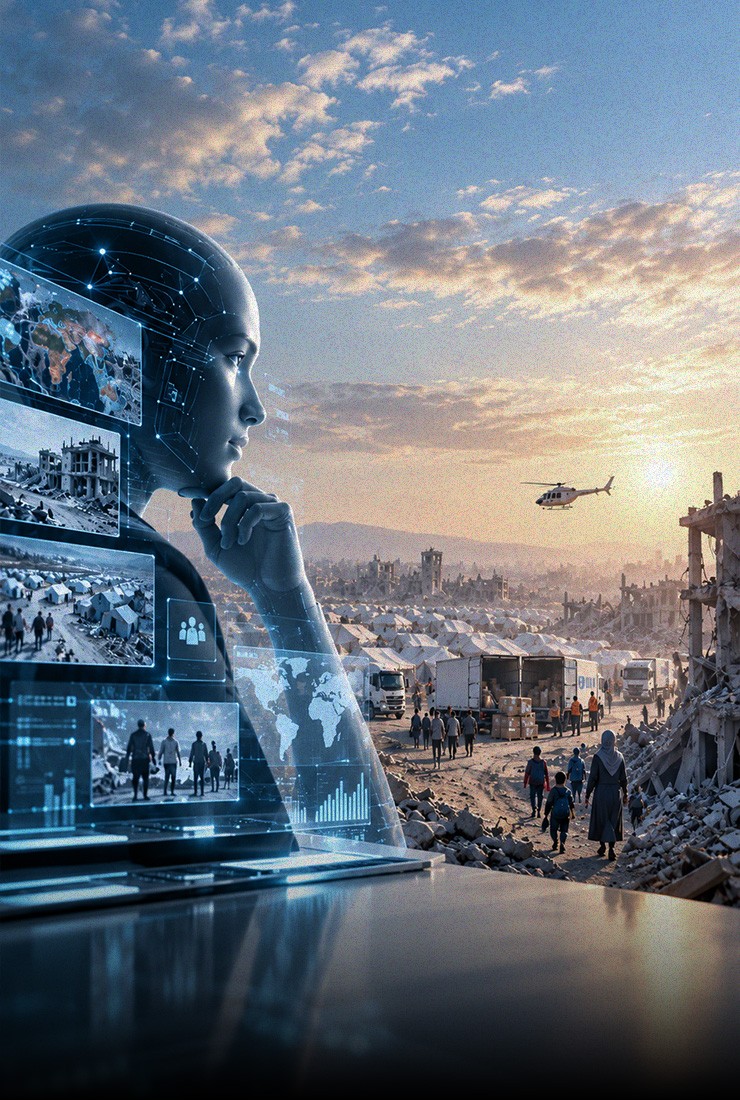
The integration of artificial intelligence (AI) across disciplines is rapidly outpacing governance, as private and public entities alike are automating decisions that were once manual. Recent attention to the use of AI in warfare in the U.S.-Iran war has raised questions about what it means to delegate lethal authority to algorithms.[1] More broadly, this debate highlights the tension between the pursuit of efficiency and the need for accountability and oversight, particularly when these decisions have tangible consequences for people’s lives.
The humanitarian sector presents a similar challenge. As AI tools are increasingly employed in humanitarian crises to inform who receives aid, when, and how, similar concerns arise: opaque decision-making, limited accountability, the deployment of private technologies in contexts for which they were not designed, and communities being subjected to systems they had little role in shaping. If the mission of humanitarian work is to serve people, the logic of AI systems often produces different priorities.
AI nonetheless offers the opportunity for real benefits for humanitarian preparedness, response, and recovery. Anticipatory cash transfer systems can reach vulnerable populations before crises. Satellite imagery analysis can rapidly assess post-disaster damage to direct aid. In the context of declining budgets and persistent need, AI’s capabilities can relieve some of the pressure on humanitarian actors. However, adoption is progressing quickly, faster than comprehensive frameworks for accountability and governance in the sector. Thus far, as with AI more generally, governance attempts are fragmented.
This insight examines how AI tools are reshaping authority and accountability in humanitarian crisis response, and what governance would need to look like to address that shift. It outlines the key challenges AI integration in the humanitarian sector presents and argues that filling this governance gap requires sector-wide coordination, community participation, and accountability mechanisms that extend to private technology companies. This coordination is critical to abiding by the humanitarian obligation to Do No Harm.
Governing AI in humanitarian contexts
The humanitarian context introduces distinct challenges to AI governance that necessitate sector-specific frameworks.
- Accountability
Accountability mechanisms are vital in humanitarian contexts, where civilians can take steps to seek redress in the event of harm. As organizations contract with private technology providers to utilize existing AI programs rather than creating their own, the chain of actors in a single deployment expands: international organizations, private companies, local partners, and funders. Thus, when a model misses a group underrepresented in a dataset or exposes individuals to risk, responsibility is distributed across this chain, making attribution and redress difficult.[2] Not only may the developer be removed from the application of its tool, but organizations also may lack the technical capacity to audit it. Funders can additionally affect which tool is deployed and how.
At the end of the chain, the communities, whom the tool is deployed to serve, are affected by the AI-powered outcome. This accountability challenge is inherent to partnerships that distribute responsibility between humanitarian actors and other entities, but it is heightened with the integration of AI. Often, even if accountability mechanisms exist, the opacity of algorithmic decision-making prevents tracing how a decision was made or what went wrong. This opacity poses a particular challenge to humanitarian organizations that bear the responsibility for the tools they deploy but are frequently removed from the processes behind the tools.[3]
Jordan’s Takaful cash transfer program reflects the ambiguity of accountability in decisions powered by algorithms.[4] Takaful, launched in 2019 with World Bank support and managed by the National Aid Fund, uses an algorithm with 57 socioeconomic indicators to determine eligibility for cash transfers, targeting the population under the poverty line. An investigation found that the algorithm’s reliance on these indicators produces a rigid conception of poverty.[5] For example, the algorithm assumes that less vulnerable families have higher electricity and water consumption, yet in reality, poorer households have higher consumption in many cases due to poor insulation. While applicants fill out a questionnaire to determine eligibility, the weight given to the indicators is not disclosed. Individuals denied support often cannot find out why or contest the outcome. Responsibility for the denial of aid is distributed across the government, the World Bank, and the developers; it could be an algorithmic error or the policy itself. Thus, the accountability issue in algorithmic aid distribution is both technical and structural.
- Private sector dominance
Similarly, the dominance of private sector companies in supplying technologies complicates AI integration in humanitarian contexts. Humanitarian actors and private companies are governed by different principles and incentives. The increasing popularity of corporate social responsibility programming and public-private partnerships has pulled technology companies into humanitarian response, but they fundamentally remain commercial actors, driven first and foremost by commercial interests.[6] These programs allow companies to pursue their own objectives and repurpose political or social issues in line with their own business agendas.
A five-year partnership between the World Food Programme (WFP) and private software company Palantir was met with significant global criticism.[7] While WFP argued that better data analysis and integration supported by Palantir would make its operations more efficient, criticism focused on protection issues from linking a relief agency to a company tied to intelligence, defense, and immigration enforcement. Opposition centered on the discrepancy of incentives between the partners, as Palantir’s commercial interests and ties to other clients operated alongside WFP’s humanitarian mandate.
While the expertise of these private companies can significantly expand the capabilities of humanitarian actors, with each new technology, it must be examined whether a technological solution is best to address the issue at hand. In an article on AI in humanitarian action by the International Committee of the Red Cross (ICRC), the author warns of techno-solutionism, defined as the “faith in technologies to solve most societal problems”, and points out that this phenomenon has yielded mixed results in humanitarian response.[8] The article cites studies after the Ebola pandemic in West Africa that found that investing in public health and social infrastructure proved to be more effective than predictive machine learning tools in preventing outbreaks, suggesting that technological sophistication does not always translate to better outcomes. In addition, these technologies are often designed in the Global North and deployed in the Global South without the involvement of local communities. In some instances, this disconnect is structural to how the tools are built. Humanitarian tech hackathons, cited as an example of techno-solutionism, take place without community input, prioritizing innovation over an understanding of what populations actually need.[9]
An AI chatbot deployed to provide psychotherapy support to Syrian refugees in Lebanon demonstrates these dynamics concretely. The chatbot, called Karim, was created by Silicon Valley start-up X2AI and uses natural language processing to analyze the individual’s SMS and Messenger messages and return comments and recommendations.[10] X2AI partnered with an organization called the Field Innovation Team (FIT), which focuses on tech-enabled humanitarian response. Karim’s pilot revealed significant linguistic and logistical obstacles, and experts found that the chatbot risked increasing subjects’ sense of alienation in the long term. Humanitarian chatbots reflect a broader trend toward efficiency and novelty rather than genuine engagement, as their capacity for meaningful conversation is limited.[11] Programs like Karim also raise ethical concerns about treating populations in need as subjects for technological experimentation. Karim’s mixed success highlights the importance of assessing whether an AI tool brings real benefit to affected populations and is not adopted for the sake of innovation.
- The data problem
AI systems are trained on data sets. Their efficacy, therefore, relies on high-quality data that may not exist, particularly in fragile state contexts, where conflict, displacement, and infrastructural collapse weaken the data infrastructure that would accurately represent affected communities.[12] Existing data may not reflect the entirety of a population, excluding those less digitally connected, more isolated, or left out of formal systems. Populations that are most at risk are systematically underrepresented in data on which AI models are trained.
Weak data quality threatens the humanitarian principle of impartiality if biases are encoded into AI models. Geospatial data from conflict or disaster zones, like satellite-imagery, can lead models to associate urgency with visibility and connectivity. Research on widely used open datasets, ImageNet and Open Images, found that they had insufficient geo-diversity for applicability across the developing world and labels for images that did not translate across cultural contexts.[13] Thus, AI systems that rely on these incomplete datasets risk reinforcing existing inequalities or misinterpreting context.
Facial recognition software used in humanitarian biometric registration has proven to be significantly less effective in recognizing darker faces, particularly women. A study by MIT and Microsoft researchers found that facial recognition software may misidentify the sex of darker-skinned women as frequently as one-third of the time.[14] The errors reflect gaps in training data that perpetuate inequalities and weaken the software’s efficacy in many contexts.
An example from the 2025 cholera outbreak in Chad reflects the reality of AI-generated analysis and what may be at risk.[15] The AI system flagged that distance to water sources produced “additional concerns regarding protection” but could not specify further. A humanitarian analyst reviewed the output and recognized that women and girls walking excessive distances for water in a displacement context face a higher risk of gender-based violence. In addition, the time needed for the route prevents children from attending school, disproportionately affecting girls. With AI analysis alone, this issue is a water, sanitation, and hygiene (WASH) gap rather than a protection and education risk. While the system flagged the right category of concern, there is a limit to which context and lived realities can be learned through data.
Weak or insufficient data cannot be solved by simply collecting more data.[16] AI systems learn patterns from what has been documented in the past, and humanitarian response is built on an understanding of lived experiences. To best serve humanitarian aims, the systems themselves must have humanitarian principles embedded within them from the outset.
- Manufactured consent
As discussed, the increased AI integration into the humanitarian sphere necessitates comprehensive datasets to ensure the efficacy and fairness of AI systems. Yet, this demand for data creates a tension between the operational needs of humanitarian actors and the agency of the populations they serve. Biometric registration for refugees, widely used across UNHCR projects, demonstrates this clearly: if access to aid requires an individual’s data for iris scanning, facial recognition, or fingerprinting, informed consent becomes challenging.[17] In these cases, individuals face the choice of providing data or refusing aid. In addition, the collection of biometric and personal data risks “function creep”, where the data is used for other purposes beyond its initial scope, including training future AI systems for humanitarian response.[18] Populations are likely not informed when this happens, and humanitarian actors may not have full control over the data in the hands of others.
In 2018, the UNHCR conducted joint registration with the government of Bangladesh; they collected both biographic and biometric data from Rohingya refugees as a condition of receiving identity cards required to access aid.[19] Bangladesh then shared this data with Myanmar to assess the refugees’ eligibility for repatriation. Refugees received registration receipts in English that indicated whether their data would be shared, which most of them could not read. Many felt that they could not decline sharing their data as they needed the identity card. Ultimately, over 830,000 names were submitted to Myanmar. This case not only serves as an example of “function creep”, as data collected for services was repurposed for repatriation, but it also reveals how data collection that is intended to help the most vulnerable can bring harm. This is what critics have called “surveillance humanitarianism”, where data collection by humanitarian organizations inadvertently increases individuals’ vulnerability.[20]
Current governance frameworks
The humanitarian sector has long been governed by ethical and accountability standards. The Core Humanitarian Standard (CHS), the sector’s primary accountability framework, outlines nine commitments that aim to describe what people and communities can expect from humanitarian actors that support them during and after a crisis.[21] These commitments include the right to participate meaningfully in decisions that affect them, access to timely and effective support, protection from harm, and the ability to report concerns safely and seek redress. The Sphere Handbook, created by a group of humanitarian NGOs and the Red Cross and Red Crescent Movement, complements the CHS with a Code of Conduct and Protection Principles.[22] The Protection Principles specifically include the imperative of care in how humanitarian actors record and share information and the importance of informed consent. These frameworks are clear that humanitarian action must be needs-based, accountable, participatory, and protective of the populations it serves.
International human rights law (IHRL) provides a baseline for governing AI in humanitarian contexts, but its reach is limited.[23] If states use AI to inform humanitarian response, human rights obligations remain relevant; however, IHRL does not bind international non-governmental organizations (INGOs) or private companies. INGOs’ fragmented governance frameworks are unenforceable, and private companies are largely only governed by their internal policies. Thus, while IHRL can provide guiding principles for AI integration, it can go little beyond that.
AI integration is testing the existing governance frameworks in the humanitarian sector, as the challenges posed by AI are unique and pressing. The Sphere Code of Conduct dictates that aid priorities must be calculated on the basis of need alone and that humanitarian actors are accountable to populations they serve and to funders and companies that provide resources. Both of these commitments are at risk when private technology providers can shape how aid is delivered and to whom, and when other incentives drive how AI systems are evaluated. The CHS commitment to meaningful participation requires that AI systems are designed and deployed with the input of the affected populations, which is made challenging by the chain of actors involved in an AI deployment. The protection principle from Sphere on information sharing is directly violated by cases like UNHCR Rohingya registration, where data collected under one purpose was used for another without informed consent. The opacity of machine learning systems complicates the obligation to Do No Harm and the principle of impartiality, due to the ambiguity of the processes behind AI-driven outcomes.
Several organizations within the humanitarian sector have sought to address this governance gap, creating guidelines specific to AI use. NetHope, a consortium of INGOs and technology companies, created a Humanitarian AI Code of Conduct that commits organizations to human review of AI-generated content and decisions, bias mitigation, and collective due diligence and assessment of providers.[24] The Code of Conduct is rooted in the values of fairness, inclusivity, accessibility, transparency, and explainability. Individual organizations like Mercy Corps, Signpost, and the IRC have developed their own ethics frameworks and quality assurance mechanisms. At the global level, the UN’s 2024 Global Digital Compact reflects a test of whether AI governance can move beyond fragmented national approaches toward a more coordinated effort.[25] The many attempts to govern AI as it evolves and is adopted at a high rate show a desire to engage with the challenges AI brings to the sector, but together they do not formulate a governance system.
NetHope’s Code of Conduct sought to address the “missing middle”—broader intergovernmental principles above, organization-specific policies below, and little between them to ensure consistency and enforce accountability across organizations.[26] Organizational frameworks apply only within the institution that created them in line with their own principles and incentives. Sector-wide frameworks like NetHope’s are entirely voluntary, although they offer the most promise for collaboration and collective progress. UN compacts lack enforceability but have the benefit of visibility. None of these governance frameworks extend to private technology providers who are increasingly integral to the deployment of AI in humanitarian contexts. The governance space is at once crowded and insufficient.
Toward a governance architecture for humanitarian AI
As long as AI adoption outpaces governance, populations will continue to act as subjects of technological experimentation, and cases like Jordan’s Takaful, UNHCR’s Rohingya registration, and X2AI’s Karim will increase, where AI-powered outcomes lead to inadvertent harm without paths for recourse. While AI has the capacity to assist humanitarian operations, the vulnerable contexts in which humanitarian organizations operate amplify the consequences of its failures, making strong governance essential. Coordination is needed at three levels: the sector, donors and funders, and private technology providers.
Recommendation 1: The humanitarian sector must commit to sector-wide coordination and shared standards on AI integration into its operations.
The “missing middle” gap between intergovernmental principles and organization-specific guidelines must be filled by a coalition of actors rather than a single organization. These shared standards must cover AI procurement, vendor due diligence, and algorithmic auditing across the organizations. The coalition should also provide opportunities for learning between the organizations and sharing both positive and negative outcomes of integrating AI into their work. A shared repository of AI incidents accessible to practitioners would allow the sector to minimize repeated errors and work with the most compatible providers.
Prior to the deployment of an AI system, organizations should undergo a data protection assessment, evaluating whether training data adequately represents the intended population and establishing efficient audit mechanisms. During this period, material detailing the process and function of the system should be prepared in collaboration with the technology companies and made publicly available to maximize transparency throughout the process. In addition, human oversight should be a baseline requirement; as demonstrated by the Chad cholera case, AI analysis can miss critical conclusions that inform humanitarian interventions. Oversight can also support documentation outlining precisely how decisions were reached.
Recommendation 2: Donors and funders must realign incentives to support responsible AI integration.
The current funding landscape incentivizes AI adoption and not the processes that slow adoption down. Humanitarian organizations face declining budgets, while donors and funders view innovation and efficiency as primary metrics of impact, creating an incentive to deploy tools quickly. This pressure risks inadequate investment in governance, auditing, and participation mechanisms required for responsible humanitarian interventions.
To combat this, donors should therefore condition support on sufficient community consultation, data protection, and human oversight. Funding structures can also contribute through multi-phase financing that covers maintenance, retraining, and auditing in addition to the initial deployment. Donors must acknowledge that AI systems are not static and require continued investment to remain accurate and representative. More fundamentally, the metrics of success for humanitarian programs should reflect the context in which they operate, beyond efficiency gains to real impact.
Recommendation 3: Accountability mechanisms must extend to private technology companies.
Current governance frameworks bind humanitarian actors but not the private technology companies that provide the technical infrastructure for AI systems. These companies have the most power in determining how the systems are built and trained. Contracts between organizations and technology providers, therefore, must include data protection requirements, prohibitions on repurposing data for non-humanitarian uses, and transparency obligations. Companies must also disclose the other purposes for this technology; in the event that a company’s core business involves defense, law enforcement, or border security, organizations may reassess the risk of a data-sharing agreement.
The sector more broadly should develop a vendor assessment framework to be applied when procuring tools. Private technology companies wishing to operate in humanitarian contexts should take steps to meet the necessary standards as a condition of their access. This adaptation may include creating a separate department dedicated to humanitarian partnerships with independent data storage. Extending humanitarian principles to these private actors should thus be a precondition for responsible AI integration.
Conclusion
With the integration of AI, the humanitarian sector must navigate a difficult tension. The new tools that make aid delivery more efficient also fundamentally change who holds power in humanitarian decisions. Without adequate safeguards, these systems can prevent affected populations from understanding or influencing decisions intended to serve them.
The humanitarian sector operates in a governance framework that can guide responsible AI adoption. Clear expectations for protecting people in crisis are outlined in the Core Humanitarian Standard and the Sphere Handbook, among others. However, these commitments were designed prior to the proliferation of AI in humanitarian operations. Governance frameworks now must adapt to keep innovation in line with humanitarian principles.
Humanitarian action ultimately seeks to support people in moments of vulnerability. If AI is to strengthen this work, the responsibility to Do No Harm must not only apply to the organizations using these systems but also to the technologies themselves and their designers and funders.
[1] Charles Fitchew, “How AI Is Rewriting the Rules of Modern Warfare,” Vision of Humanity, April 22, 2026, https://www.visionofhumanity.org/how-ai-is-rewriting-the-rules-of-modern-warfare/.
[2] NetHope, “Harnessing AI for Humanitarian Impact: Lessons and Insights from 11 Case Studies,” https://nethope.org/toolkits/harnessing-ai-for-humanitarian-impact-lessons-and-insights-from-11-case-studies/. Accessed July 9, 2026.
[3] Ana Beduschi, “Harnessing the Potential of Artificial Intelligence for Humanitarian Action,” International Review of the Red Cross, https://international-review.icrc.org/articles/harnessing-the-potential-of-artificial-intelligence-for-humanitarian-action-919. Accessed July 9, 2026.
[4] Rebecca Kahn, “Transformer States: Jordan,” Center for Human Rights and Global Justice, February 19, 2024, https://chrgj.org/2024-02-19-transformer-states-jordan/.
[5] Tate Ryan-Mosley, “An algorithm intended to reduce poverty might disqualify people in need,” MIT Technology Review, June 13, 2023, https://www.technologyreview.com/2023/06/13/1074551/an-algorithm-intended-to-reduce-poverty-in-jordan-disqualifies-people-in-need/.
[6] Mirca Madianou, “Technocolonialism: Digital Innovation and Data Practices in the Humanitarian Response to Refugee Crises,” Social Media + Society 5, no. 3 (2019), https://doi.org/10.1177/2056305119863146.
[7] Purvi Patel and Nicole Bennett, “The Humanitarian Halo: When Tech Companies Sell the Same Stack for Aid and War,” Tech Policy Press, https://www.techpolicy.press/the-humanitarian-halo-when-tech-companies-sell-the-same-stack-for-aid-and-war/. Accessed July 9, 2026.
[8] Beduschi, “Harnessing the Potential of Artificial Intelligence for Humanitarian Action.”
[9] Mirca Madianou, “Nonhuman Humanitarianism: When ‘AI for Good’ Can Be Harmful,” Information, Communication & Society 24, no. 6 (2021): 850–868, https://doi.org/10.1080/1369118X.2021.1909100.
[10] Olivia Solon, “Karim the AI Delivers Psychological Support to Syrian Refugees,” The Guardian, March 22, 2016, https://www.theguardian.com/technology/2016/mar/22/karim-the-ai-delivers-psychological-support-to-syrian-refugees.
[11] Madianou, “Nonhuman Humanitarianism.”
[12] Maria Haas, “How AI Learns and What It Misses: Why Data Selection Matters in Humanitarian Action,” ICRC Humanitarian Law & Policy Blog, August 14, 2025,.https://blogs.icrc.org/law-and-policy/2025/08/14/how-ai-learns-and-what-it-misses-why-data-selection-matters-in-humanitarian-action/.
[13] Shreya Shankar, Yoni Halpern, Eric Breck, James Atwood, Jimbo Wilson, and D. Sculley, “No Classification without Representation: Assessing Geodiversity Issues in Open Data Sets for the Developing World,” arXiv, November 22, 2017, https://doi.org/10.48550/arXiv.1711.08536.
[14] MIT Media Lab, “If You’re a Darker-Skinned Woman, This Is How Often Facial Recognition Software Decides You’re a Man,” https://www.media.mit.edu/articles/if-you-re-a-darker-skinned-woman-this-is-how-often-facial-recognition-software-decides-you-re-a-man/. Accessed July 9, 2026.
[15] “The Human in the Loop: How Oversight Turns AI into a Humanitarian Ally,” ReliefWeb, https://reliefweb.int/report/world/human-loop-how-oversight-turns-ai-humanitarian-ally. Accessed July 9, 2026.
[16] Haas, “How AI Learns and What It Misses.”
[17] Madianou, “Technocolonialism.”
[18] Madianou, “Technocolonialism.”
[19] Human Rights Watch, “UN Shared Rohingya Data Without Informed Consent,” June 15, 2021, https://www.hrw.org/news/2021/06/15/un-shared-rohingya-data-without-informed-consent.
[20] Michael Pizzi, Mila Romanoff, and Tim Engelhardt, “AI in Humanitarian Action: Human Rights and Ethical Considerations,” International Review of the Red Cross, March 2021, https://international-review.icrc.org/articles/ai-humanitarian-action-human-rights-ethics-913.
[21] “Core Humanitarian Standard on Quality and Accountability,” Core Humanitarian Standard, https://www.corehumanitarianstandard.org/. Accessed July 9, 2026.
[22] The Sphere Handbook: Humanitarian Charter and Minimum Standards in Humanitarian Response, Sphere, https://spherestandards.org/handbook/. Accessed July 9, 2026.
[23] Pizzi, Romanoff, and Engelhardt, “AI in Humanitarian Action.”
[24] NetHope, “Humanitarian AI Code of Conduct,” https://nethope.org/toolkits/humanitarian-ai-code-of-conduct/. Accessed July 9, 2026.
[25] Tony Oweke, “The World Is Trying to Govern AI. The UN Wants In,” Council on Foreign Relations, May 29, 2026, https://www.cfr.org/articles/the-world-is-trying-to-govern-ai-the-un-wants-in.
[26] NetHope, “AI Governance and the Nonprofit Sector: Mapping the Missing Middle,” https://nethope.org/toolkits/ai-governance-and-the-nonprofit-sector-mapping-the-missing-middle/. Accessed July 9, 2026.