As competition between the U.S. and China builds up, Europe is compelled to choose between two systems. EU-China relations have not been at their best in recent years, a product of economic, political, and security challenges. While some matters in the bilateral relationship can be managed, most of these issues are structural, directly impacting the national interest of either party. As the United States revisits its foreign policy priorities, however, Europe is concerned about its future security, pushing the old continent into a race for defense spending and economic competitiveness.
What Does China Mean for the European Experiment?
The European Union was born to reject the idea that major countries were destined for conflict, but now it must face it. In 1952, when Robert Schumann and other European leaders were laying the foundation for the EU, they did so over the ashes of two deadly World Wars. Their premise was that a united Europe through a common market, then limited to steel and aluminum, would not only prevent future wars but also interlink the growth of former rivals. The presumption of the experiment, as argued then, was that country-to-country conflict was inherently dangerous and should be eliminated. However, in this quest, European capitals created a gigantic Single Market and trade bloc capable of competing on the global stage.
And while the narrative that Europe has not known geopolitics since 1945 is prevalent, it might not be accurate. At the end of the day, the original six European countries also united in response to the rising threat from the Soviet Union, with the support of the United States. The famous phrase by Benjamin Franklin, “We must all hang together, or most assuredly we will all hang separately,” was understood to be Europe’s reality.
Many in Europe have sought to equate the challenge posed by China today to that of the Soviet Union, and while strategic competition does exist, it is a flawed comparison. It is true that both are contenders for global leadership, seeking to access the premier role in the global arena, but while the Soviet Union had an expansive character, forcing aligned governments in Eastern Europe, China has sought to build partnerships throughout the world, and unlike the Soviet Union, it makes no threats to European territorial sovereignty. One should also notice that China’s GDP is 10 times the Soviet Union’s at its peak.
The table below outlines two lists of priorities for Brussels vis-a-vis China: one of issues where the capitals must compete and another where they must cooperate.
| Competition | Cooperation |
| Critical Minerals | AI Safety |
| Pharmaceuticals | Climate Change |
| Semiconductors | Disease Prevention |
| AI Innovation | Terrorist Groups in the Sahel |
| Electric Vehicles | Russia in the Arctic |
| Russia vs Ukraine | |
| Taiwan & South China Sea | |
| Africa |
Scenarios of Strategic Competition
The EU was founded on the notion that economic unity can lead to political peace, yet it has only recently understood the strategic implications posed by China’s fusion of politics and business. Up until the year 2022, European capitals perceived China as any Western country, where the interests of business and the political elite may not only differ but also often be at odds. Europe did not realize that in China, the interests of the business are the interests of the party and the government, as the three of them coordinate over which industries must be prioritized for the sake of national prosperity and which companies are best positioned to succeed.
This model poses a challenge to Europe’s economic prosperity, but it has lifted billions from extreme levels of poverty. China has risen from being the world’s ninth-largest GDP to being the second in just under 40 years and is now the world’s leading exporter of electric vehicles thanks to a model that aligns government objectives with corporate interests. This model, however, does not just create jobs; it is an intentional push to control entire strategic supply chains for the modern economy.
Critical Minerals: Europe at China’s Mercy
Critical minerals are the essential components powering the defense industrial base and the battery components needed for the modern economy. They are used in everything from radars, missile tips, and car batteries to night vision goggles—our modern economy relies on them being subjected to harsh chemical and electrical treatments to perform as it does. Within the list of 34 minerals deemed “critical”1 due to their economic importance and supply risk, 17 of them are “rare earths,” which have similar chemical structures.
The European Union imports 95%2 of these rare earths from a single source: China, giving Beijing great leverage over a supply chain needed for the most basic levels of industry and defense. The London Metal Exchange plays3 a key role—like a normal stock exchange, it is a place where willing traders buy and sell minerals, with the exception that prices are dropped or raised frequently by specific traders in instances that favor Chinese exports. Beijing is able to influence global prices because, in some cases, it refines up to 95%4 of the world’s supply of refined rare earths, gaining effective control.
In the past, China felt it had to limit other countries’ ability to obtain specific minerals due to political escalations. In 2010, it limited5 the export of rare earths to Japan due to a territorial dispute over the Senkaku Islands, doing so again6 earlier this year when Japan linked higher defense expenditure to Chinese naval activity. Excessive tariffs threatened by the U.S. in 2025 pushed Beijing to do the same thing7 to Washington, forcing the U.S. administration to relax tariffs. While supply to Europe has not yet been limited, it raises a question: should Brussels decide to oppose Beijing on a politically sensitive issue (the Nine-Dash Line, etc.), would the old continent receive the same punishment? The answer is likely yes.
This control is a policy choice, not a competitive advantage. While China has considerable mineral reserves, so do Russia, Brazil, the DRC, Zambia, and other countries, but none of them holds Beijing’s horizontal grasp across mining, refining, processing, and trading. This position has been the result of consistent strategies and Five-Year Plans seeking to turn China into the world’s foremost economy. A policy choice can only be met with another policy choice.
Currently, Europe only mines 8%8 of the critical minerals it needs, and countries have long abnegated building mineral stockpiles for potential military conflicts. The dependency is as vast as it is concerning, prompting the European Commission to launch a Critical Raw Materials Act.9 The bill, passed in 2024, seeks to bring the EU’s domestic critical mineral mining levels to 10% and refining to 40% by 2030 through a set of policies aimed at cutting red tape, cutting taxes for miners, and providing other incentives for refineries and processing facilities. On the upside, Europe has already designated 60 strategic projects10 and introduced the RESourceEU Action Plan to accelerate mineral excavation and refinery in Europe.
Implementation of the CRMA, however, has been irregular so far. While the political courage to plan and pass it has been remarkable, all EU regulations are ultimately implemented by national and regional governments, giving them huge sway over their results. The governments do so while balancing it with local environmental, labor, and land use rules, slowing it down to the point of becoming ineffective. A single legal regime for critical minerals is needed at the European level, akin to the proposed 28th Regime11 for technology.
Semiconductors: Europe’s Only Hope
If minerals are the foundation of the modern economy, chips are the columns ensuring the building stays up. The COVID-19 pandemic brought to light a number of enormous problems in the chip supply chain, namely, that over 90% of the world’s production took place in Taiwan under the supervision of semiconductor giant TSMC. And while Western capitals were right to pass their respective Chips Acts to incentivize domestic production, the efforts ignored the multiple stages of this supply chain.
While the finalized, integrated chip is vital, so are its predecessors, including the motherboard, the perfectly flat silicon wafers, and the supply chains that ensure advanced technology can work with a nanometer of precision. Europe’s ASML, based in the Netherlands, plays a huge role in the supply chain, as it is the only company that can make a machine that concentrates EUV light into a single nanometer, and Germany’s ZEISS is the only company making the glasswork needed for these machines to work the way they do. This is a process where a single bit of dust can disrupt billions of dollars in investment, which has brought technology to perfection, making it too hard to replicate elsewhere. This process, while simplified in this essay, has given Europe an indispensable role in this vital supply chain.
But Beijing wants to reduce external dependencies. Huawei has been at the forefront12 of chip manufacturing and design in China, forced to innovate in part by a set of export controls13 on advanced chip technology from the Biden administration. The idea was that if Beijing were unable to get the most advanced chips and lithography machines, its semiconductor innovation would stop, leading its AI development to advance more slowly than the U.S.’s. Under that theory, President Joe Biden coordinated14 with allies, including Japan, the Netherlands, and South Korea, to create an export shield for everything from AI models to the export of chips themselves. For Europe, it was a challenging time, as Brussels sought to coordinate export controls while the Netherlands claimed that only they could limit or cede access to ASML as export controls were a national security issue—the debate struck at the very core of the European project. More so, Washington and European capitals agreed to divest Chinese capital from semiconductor ventures in their countries, seeking to “de-risk.”
The export controls only reinforced Beijing’s deep concerns about relying on foreign partners for technology. The few stages of the supply chain that they did not yet control became weaponized, proving the hawks in the CCP right. Since then, Huawei and other technology firms have stated15 they have made significant16 breakthroughs in developing their own EUV lithography machines and established plans17 to develop sub-3-nanometer chips. Experts in the West have cast doubt on the progress, pointing out that building these technologies requires a decades-long buildup of an industry-specific innovation ecosystem, and China has not had so much time. Perhaps it has been copyright vulnerabilities, perhaps China relies on an extremely bright network of innovators, or perhaps they have been able to evade export controls through parallel importing. The answer likely lies in a combination of all three, but Europe should not allow its only piece of leverage in the modern AI ecosystem to be displaced or replicated.
The Cutting Edge of AI Innovation
China is not just part of the AI innovation ecosystem; it is vying for global leadership. While most European countries are focused18 on regulating seemingly unfair uses of the technology, Beijing has placed massive funds in AI research, innovation, and governance. Experts so far have depicted AI development as a race between Europe, China, and the U.S. to develop the most advanced models—this is also a race to set the rules for the new economy.
Similar to the great industrial revolutions of the 19th and 20th centuries, AI innovators are positioning the technology to be an accelerator for economic growth and productivity in the decades ahead. Like the development of a global financial system or the trade of oil and gas, a new industrial revolution is governed not by the entities with the best technology but by those able to diffuse19 it to the most users and control the supply chain. Developing the best AI models will be nowhere near as important as adopting the technology throughout the entire economy and its different sectors: from banking to insurance, through to medical research and geology.
So far, Europe has been focused on ensuring this new technology will not replicate humanity’s worst behaviors, passing comprehensive legislation on its ethical use, the type of data it can access, and creating a risk-based regulation over its usage. The effort is noble and representative of a humanist tradition, but it contrasts with the nature of technology. The hard truth that Europe struggles to recognize is that the Old Continent lacks an ecosystem to support the defense of an “ethical AI” in the first place. EU-based startups spend upwards of 15%20 of their budget on legal compliance costs, and even if they scale, capital pools21 are limited by national restrictions. The challenges only grow when considering Europe’s higher taxes and considerable costs of labor. The U.S. and China already have such ecosystems, but their focus is not on legislation; rather, they are leading in both AI innovation and adoption. U.S. private AI investment reached22 over $109 billion, compared to China’s $9.3 billion, leaving the EU and UK fighting for single-digit fractions.
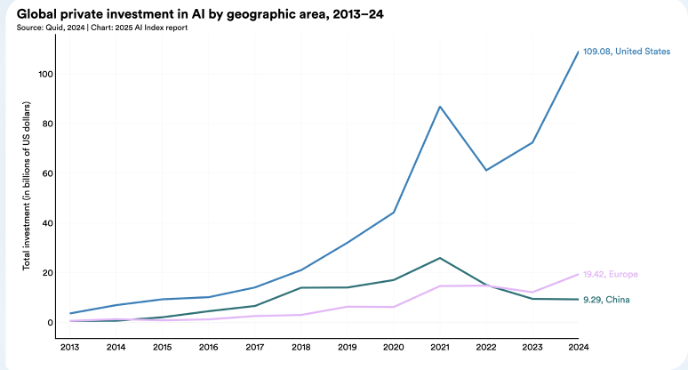
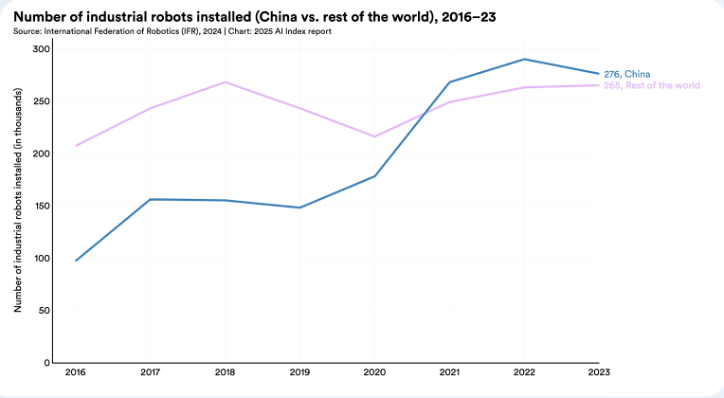
Source: AI Index Report 2025: Economy, HAI,23
But it’s not too late yet for Europe to catch up. Creating a new AI ecosystem is not done quickly, but it can still have enormous positive spillovers for the continent: the pooling of Capital Markets and Banks at the European level, combined with an effort to cut red tape and reduce regulatory compliance for technology start-ups, can be good first steps to mimic the successful conditions of other markets. More importantly, the European Union and national governments can still focus on AI adoption to reactivate growth.
While doing so, Brussels should act as a bridge between the U.S., China, the private sector, and other stakeholders. AI governance cannot be done by any country or institution alone; otherwise, we risk the creation of geopolitical “techno-spheres” where AI models in one part of the world operate under radically different expectations and rules than in another, unable to communicate with each other or operate on the same platforms. Europe can be an honest broker in ensuring dialogue can continue even in tense times.
Competing for the Electric Vehicle Space
Since the advent of the combustion engine, Europe has led innovation in the global automotive industry, with German and French manufacturers as emblems of modernity, reliability, and household names. China, however, is not just equal to Europe in electric vehicle production now; it has advanced new forms of technology and has become a market leader. The mainstream narrative says that when China opened up to the world in the 1980s, these European manufacturers moved part of their supply chain to the new market, hoping to reap the benefits of lower labor costs, but that over the years, Chinese firms learned how to do it better and cheaper, putting the European manufacturers at a competitive disadvantage.
So far, Western academics have regarded China’s rise in the Electric Vehicle (EV) industry through the Ricardian lens, stating that China has developed a comparative advantage in the production of cars. Riccardo’s economic model is the mainstream thinking in the West, and through the example of British cloth and Portuguese alcoholic beverage, he explains that some countries are naturally better positioned to produce certain goods. The long story, however, is much more nuanced than alcoholic beverage and cloth, as Riccardo wrote. China didn’t stumble into a comparative advantage; it created one through deliberate, decades-long vertical integration and policy action. The EV supply chain is not just an assembly line; it requires a network of mineral refineries, software developers, heavy metallurgy, electric assembly, and other factories just to support the creation of the first car.
However, few have explained why the development of such a competitive EV industry is such an issue for Europe. To answer that, one must realize that cars, unlike clothes or alcoholic beverage, are not recurrent purchases—a consumer will realistically change26 their car every 10 years at best, so losing market share now is not fixable tomorrow. A car that BYD sells is a car that Mercedes-Benz does not. As China rolls out top-quality electric vehicles for half the price of most European companies, consumers are logically choosing the more affordable option, but that puts European manufacturers out of the game, sometimes in their own market. Spain, for instance, recently awarded27 its system for public buses to Chinese EV-maker BYD. The concern is that as European manufacturers struggle to compete, entire regions dependent on these companies could end up with enormous unemployment, contributing to Europe’s competitiveness crisis.
And while one could be open to accepting the situation were it fair, critics point out that Chinese EVs only have these prices due to decades’ worth of state subsidies. To counter this support, the EU voted and imposed28 tariffs of up to 35.3% on Chinese EVs (over a flat 10% tariff for all firms), seeking to cancel out the effect of the subsidy. But the hard truth is that a tariff won’t cut it; energy, labor, and manufacturing costs in China are significantly lower, and more than that, Chinese EV producers have created massive economies of scale domestically already.
As electric vehicles continue to become technologically advanced, however, there are security concerns29 about these cars sending back sensitive data to China. Argued during concerns about TikTok and Huawei, all Chinese firms are required to cooperate with security authorities if they request data. However, privacy concerns are rising as these vehicles connect to Bluetooth and integrate with the phones and computers of users, leading to calls to ban Chinese EVs altogether.
To be fair, China is not entirely to blame for this situation. European leaders have been voicing these concerns for decades, only to find now that the margin for maneuver is rather small. The last two German governments and the French Elysée have not thought of new ways to support their business giants in maintaining their leadership positions, and similarly, the automakers have been advancing in the same direction despite the repeated warnings. A European auto renaissance will be very hard to come by, but it will only be possible if governments and businesses understand that their fates are tied. China’s EV prowess is not natural but industrial policy, and it must be met with more policy from Europe.
Conclusion
Europe and China may not have opposing interests in every single domain, but the economic and technological structure of the relationship is heading the capitals on a collision course. As Europe struggles to reactivate its industry and regain its competitiveness, China’s growth model of massive output in exports and restricting key materials threatens the EU’s very goals and economic resilience. Similarly, as China’s concerns over supply chain security increase, Europe risks losing one of its only economic assets with a global reach. In an increasingly unpredictable world of giants, diplomacy will be vital to collaborate when possible and compete on issues of national interest.
Endnotes
- U.S. Geological Survey, Mineral Commodity Summaries 2026, U.S. Department of the Interior, 2026, https://pubs.usgs.gov/periodicals/mcs2026/mcs2026.pdf. Accessed June 16, 2026.
- Eurostat, International Trade in Critical Raw Materials, European Commission, https://ec.europa.eu/eurostat/statistics-explained/index.php?title=International_trade_in_critical_raw_materials. Accessed June 16, 2026.
- Voltrush, Voltrush (Substack), https://voltrush.substack.com/. Accessed June 16, 2026.
- European Court of Auditors, Special Report 04/2026 (Luxembourg: European Court of Auditors, 2026), accessed June 16, 2026, https://www.eca.europa.eu/en/publications?ref=SR-2026-04.
- Keith Bradsher, “Amid Tension, China Blocks Vital Exports to Japan,” The New York Times, September 22, 2010, https://www.nytimes.com/2010/09/23/business/global/23rare.html. Accessed June 16, 2026.
- “China’s Rare Earth Exports to Japan Drop 80%, Sending Companies Scrambling,” Nikkei Asia, https://asia.nikkei.com/business/materials/china-s-rare-earth-exports-to-japan-drop-80-sending-companies-scrambling. Accessed June 16, 2026.
- Gracelin Baskaran and Meredith Schwartz, “Rare Earth Export Restrictions, One Year Later,” Center for Strategic and International Studies, April 27, 2026, https://www.csis.org/analysis/rare-earth-export-restrictions-one-year-later. Accessed June 16, 2026.
- European Court of Auditors, Special Report 04/2026, https://www.eca.europa.eu/en/publications?ref=SR-2026-04. Accessed June 16, 2026.
- European Commission, European Critical Raw Materials Act, https://commission.europa.eu/topics/competitiveness/green-deal-industrial-plan/european-critical-raw-materials-act_en. Accessed June 16, 2026.
- Eduardo Castellet Nogués, “Critical Supply: Europe’s Path to “Dig, Baby, Dig”” Critical Supply, December 3, 2025, https://criticalsupply.substack.com/p/critical-supply-europes-path-to-dig. Accessed June 16, 2026.
- European Parliament, “EU Inc: What Is the 28th Regime?,” May 6, 2026, https://www.europarl.europa.eu/topics/en/article/20260506STO42807/eu-inc-what-is-the-28th-regime. Accessed June 16, 2026.
- Michael Scott Sobolik, Countering China’s Great Game: A Strategy for American Dominance (Naval Institute Press, 2024), https://www.amazon.com/Countering-Chinas-Great-Game-Dominance/dp/1682479501. Accessed June 16, 2026.
- Christopher Cytera, Elly Rostoum, Matthew Eitel, William Echikson, and Jack Galloway, “Chip Challenge: Goodbye Export Controls?,” Center for European Policy Analysis, August 19, 2025, https://cepa.org/article/chip-challenge-goodbye-export-controls/. Accessed June 16, 2026.
- Matthew Eitel, “Export Controls — The Keys to Forging a Transatlantic Tech Shield,” Center for European Policy Analysis, July 20, 2023, https://cepa.org/comprehensive-reports/export-controls-the-keys-to-forging-a-transatlantic-tech-shield/. Accessed June 16, 2026.
- “How China Built Its Manhattan Project to Rival the West on AI Chips,” Reuters, December 18, 2025, https://www.reuters.com/world/china/how-china-built-its-manhattan-project-rival-west-ai-chips-2025-12-17/. Accessed June 16, 2026.
- Stefano Lovati, “China Invests €37 Billion to Develop Domestic EUV Lithography Systems,” Power Electronics News, February 11, 2025, https://www.powerelectronicsnews.com/china-invests-e37-billion-to-develop-domestic-euv-lithography-systems/. Accessed June 16, 2026.
- Frank Chen, “China’s Zhejiang Targets 3.7-Nanometre AI Chip Breakthroughs to Counter US Chokehold,” South China Morning Post, January 16, 2026, https://www.scmp.com/economy/china-economy/article/3340050/chinas-zhejiang-targets-3-7-nanometre-ai-chip-breakthroughs-counter-us-chokehold. Accessed June 16, 2026.
- “The EU Artificial Intelligence Act,” EU Artificial Intelligence Act, https://artificialintelligenceact.eu/. Accessed June 16, 2026.
- Policy Arena, https://www.policyarena.org/. Accessed June 16, 2026.
- Robert Kilian, Linda Jäck and Dominik Ebel, European AI Standards, March 2025, KI Bundesverband, https://ki-verband.de/wp-content/uploads/2025/05/Study_European-AI-Standards_FINAL_20250325.pdf. Accessed June 16, 2026.
- Council of the European Union, “Capital Markets Union Explained,” https://www.consilium.europa.eu/en/policies/capital-markets-union-explained/. Accessed June 16, 2026.
- AI Index Report 2025: Economy, HAI, Stanford University, https://hai.stanford.edu/ai-index/2025-ai-index-report/economy. Accessed June 16, 2026.
- Ibid.
- EV Market Graphic, Datawrapper, https://datawrapper.dwcdn.net/uRWhl/4/. Accessed June 16, 2026.
- EV Market Graphic, Datawrapper, https://datawrapper.dwcdn.net/GVb1J/3/. Accessed June 16, 2026.
- “The Ideal Length of Time to Own a Car Is Not Forever,” Financial Samurai, September 18, 2025, https://www.financialsamurai.com/the-ideal-length-of-time-to-own-a-car/. Accessed June 16, 2026.
- “BYD Delivers 23 New Electric Buses to Mallorca,” Electrive, May 22, 2026, https://www.electrive.com/2026/05/22/byd-delivers-23-new-electric-buses-to-mallorca/. Accessed June 16, 2026.
- Ryan Featherston, “Slamming the Brakes: EU Votes to Impose Tariffs on Chinese EVs,” CSIS, December 16, 2024, https://www.csis.org/blogs/trustee-china-hand/slamming-brakes-eu-votes-impose-tariffs-chinese-evs. Accessed June 16, 2026.
- Chris Miller and Caroline Nowak, “Connected and Autonomous Cars: Security Risks from Chinese Components,” AEI, May 15, 2026, https://www.aei.org/research-products/report/connected-and-autonomous-cars-security-risks-from-chinese-components/. Accessed June 16, 2026.