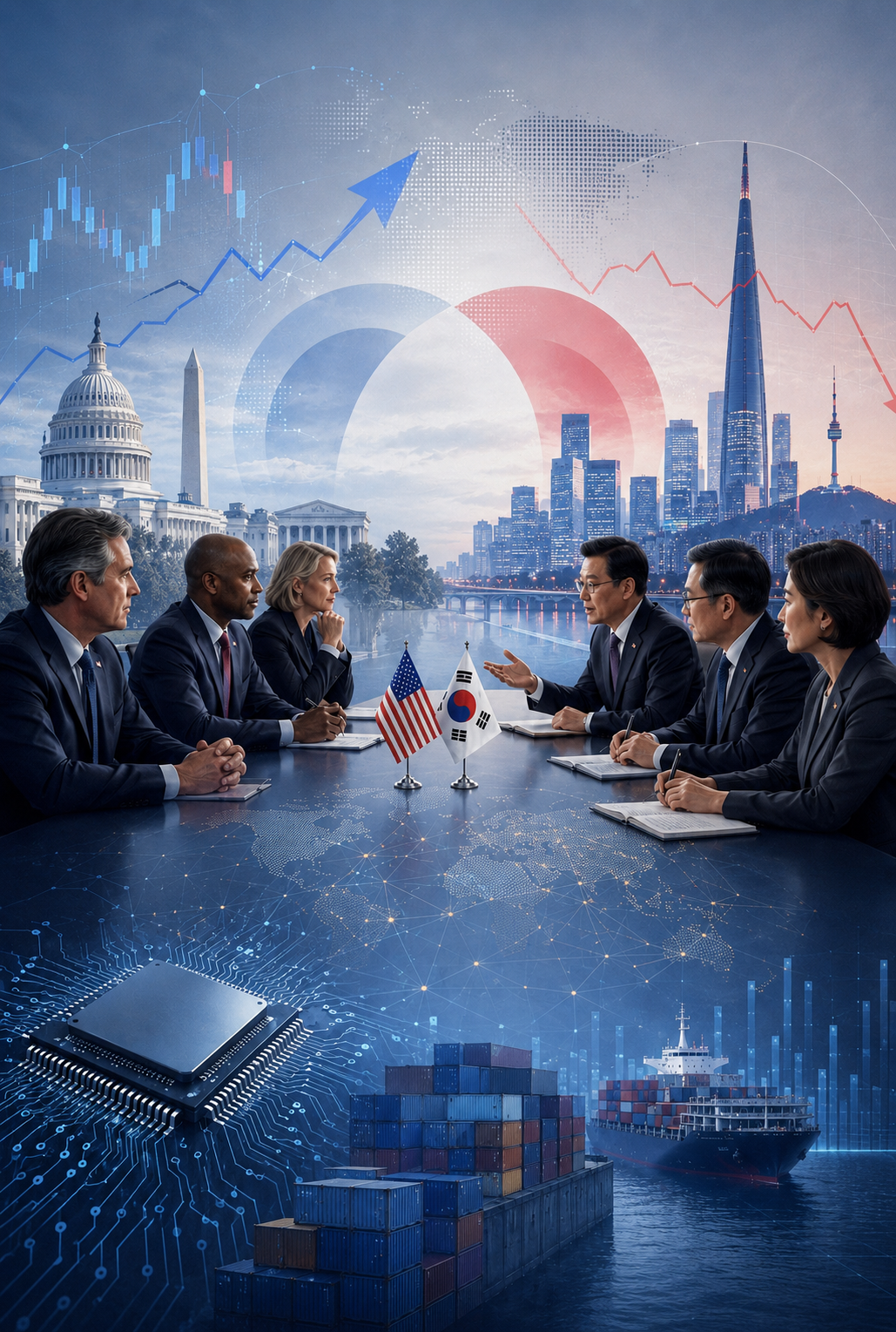
U.S.-South Korea trade ties represent a unique historical track record. South Korea is identified as one of the few Asia-Pacific states with a comprehensive trade pact with the United States, offering pathways to weather tariffs and supporting potential for an expanded U.S. trade footprint in the heart of Asia.[i] By October last year, that track record witnessed a new addition: Seoul’s pledge to invest $350 billion in high-value U.S. industries in exchange for capping tariffs at 15 percent.[ii]
The Trump administration has long argued that a trade surplus in favor of Seoul was counterproductive to its own ambitions of balancing out the volume. This has led to protracted spells of bilateral negotiations, efforts to prioritize certain sectors of choice to both capitals, and raised new questions about how South Korea and the United States can strike even without risking enduring damage to their multisector trade ties. The United States continues to represent South Korea’s second-largest export destination, and accounted for nearly $123 billion in total outbound shipments last year.[iii] For Washington, South Korea is an important factor in furthering artificial intelligence (AI), energy, technology and defense cooperation to back American jobs, making it critical to assess how either side is starting to negotiate relative economic gains at a time when U.S. tariff pressure assumes greater frequency.[iv]
The Emerging Logic of Relative Gains
Washington’s push to insulate its top-tier technology firms from market restrictions in South Korea points to an emerging logic of relative gains within South Korea-U.S. trade negotiations. In early 2026, the U.S. stepped up efforts to protect its e-commerce company Coupang, which conducts almost all business operations in South Korea. The measure became a defining element of Washington’s effort to move beyond tariff pressure and ensure that U.S. technology firms enjoy uninterrupted market access and limited regulatory bottlenecks.[v] But the nature of these negotiations is telling: the Trump administration indicated that it could raise tariffs on South Korea in the absence of sufficient cooperation on implementing the South Korea-U.S. trade agreement. And yet, the proposed U.S. tariff spike—from 15% to 25%—on Seoul’s automotives, pharmaceuticals and other sectors struggled to come through as anticipated, underlining a conscious U.S. approach of opening up multiple negotiation tracks with Seoul without eliminating the tariff threat altogether.[vi]
This “pressure point” diplomacy from the Trump administration ends up compelling Seoul to ramp up compliance on U.S. trade pact terms that Washington deems favorable to its end of the bargain. This includes stronger policy support against any discrimination of U.S. tech firms in the country, a key element of the 2025 trade pact that the U.S. seeks to enforce.[vii] Compared to earlier years, the instruments of South Korea-U.S. trade enforcement have also evolved: they provide limited space to bargain tariffs, despite considerable pressure from some of Seoul’s exporters to take a tougher stand.[viii] Part of their constraints stems from the assessments of South Korea’s central bank, which warned last year that U.S. tariffs could lay the groundwork for downward price pressure, challenging competitive exports without discounting the market appeal of the United States, despite the recurring levies.[ix]
A closer reading of Seoul’s diplomatic tact suggests it has secured a method to attract relative gains from the Trump administration. Consider the technology aspect of tense diplomatic negotiations. U.S. Vice President JD Vance met with South Korean Prime Minister Kim Min-seok in late January 2026, underlining the imperative for Seoul—still facing a 25 percent tariff spike risk—to deliver on technology concessions for U.S. firms.[x] This included a stated bid to sidestep U.S. tech giants from the country’s artificial intelligence regulations, including Meta Platforms and Google. Part of Washington’s reservations were that U.S. technology firms—eyeing market expansion in South Korea’s enabling AI ecosystem—could ultimately emerge at an operational disadvantage through these regulations.[xi]
Seoul’s response has endured without giving way to outsized concessions on U.S. AI demands. A closer look at the AI laws suggests that companies with the potential to comply with safety regulations alone can acquire a head start in an economy open to expanding by nearly 13 percent through accelerated AI adoption.[xii] South Korea has succeeded in bargaining with the Trump administration on the pace of the $350 billion investments in U.S. sectors, rather than opening up competitive space for U.S. tech giants to gain an edge over its own AI giants at home. The fact that billions in U.S. corporate investments in South Korea’s cloud infrastructure, and a dedicated U.S.-South Korea Technology Prosperity Deal are embedded into their October 2025 trade pact, Seoul succeeds in testing U.S. enforcement on tariffs with the knowledge that the U.S. cannot delink itself from shared technology commitments in a pact that it wants Seoul to uphold as well.[xiii]
The result is an “equilibrium of compromise” between Washington and Seoul on economic negotiations—one where reservations on technological access, tariffs and multisector contributions persist, but not enough to eclipse hard-set guarantees in the October 2025 pact, which the U.S. has shown few signs of sidestepping altogether.[xiv] By reading the temperature on the Trump administration’s recurring tariff threats (to ramp up the rate from 15 percent to 25 percent), Seoul also maintains its leverage in ratifying the trade deal in line with its domestic priorities. This includes enacting the deal through a bill in parliament that would likely factor feedback from various constituencies, including those representing Seoul’s export interests in strategic sectors, culminating into a final approval that meets U.S. demands on enactment—but without overlooking South Korea’s own domestic priorities on technology guardrails, auto sector growth, and the limiting of U.S. tariffs as a condition for sustained South Korean investments in the United States.[xv]
South Korea: Strategic Accommodation
One standout feature of South Korea’s trade negotiations is its strategic accommodation of “second-tier” U.S. demands. These include sufficient guarantees of investment flows to the U.S. when Washington judges limited inflows from other Asian partners that are home to similar competitive exports. Semiconductor investments are a proof point: as of January 2026, South Korea is engaged with over $41 billion in indigenous semiconductor investments in the U.S., underlining the steady fulfillment of one of the investment streams sought by the U.S.[xvi] This is a “second-tier” accommodation strategy because Seoul recognizes that Taiwan—a major giant in the semiconductor investment space—is already leading the charge with a $500 billion investment portfolio.[xvii] With the U.S. already subject to sizeable Taiwanese investments in one of these streams, there are limits to how much pressure the U.S. can exert on Seoul to ramp up its investments in line with foreign partners. For this reason, billions in ongoing South Korean semiconductor investments succeed in meeting sufficient progress goals under the broader $350 billion trade agreement, even before its formal enactment in parliament.[xviii] At the same time, South Korea can make the case that investment flows are already targeted toward the U.S., but their growth depends on the level of concessions U.S. affords to its Asian partner by means of scaling up domestic industrial growth, allowing greater chip capacity-building support from U.S. companies, and ultimately, doing away with some of the long-term tariff threats that risk compounding investment impact on U.S. shores.
Thus, South Korea’s success in entertaining the contours of the $350 billion investment agreement—ahead of its formal enactment—gives it a head start in navigating future tariff talks constraints, providing a proof point of its early engagement in one of the core investment streams sought by the U.S. However, South Korea also ends up affording enough space to other priority sectors that could envision scaled-up investments in the U.S. once Washington reciprocates on accommodating South Korea’s concerns.[xix] These include sufficient timeframes to debate the agreement in its entirety through parliament, give priority to domestic manufacturers’ feedback on its execution, and successfully tailor the agreement’s execution to South Korea’s domestic constraints and growth outlooks.[xx]
This includes increased political polarization over maintaining South Korea’s overseas spending leverage (given that $350 billion in investment outflows to the U.S. is a mammoth target), and ensuring that South Korea’s economy ends up drawing on a semblance of stability that limits prospects of domestic unease and industrial displeasure.[xxi] The latter two targets are central to the political fortunes and rule continuity of South Korean President Lee Jae-myung, whose promises on sweeping economic reforms and large-scale financial stability are yet to gain widespread traction with the population.[xxii]
United States: Cautious Assertion
Despite the Trump administration employing a heavy-handed approach to tariffs on South Korean sectors of late, the U.S. position is also marked by an element of “cautious assertion.” Momentum shows in the White House’s approach to dealing with South Korea and Japan on the issue of tariffs: a viable trade-off on long-term investment was reached with Sanae Takaichi recently, with part of the understanding driven by increased Japanese defense spending, shared threat perceptions on security challenges in East Asia, and deeper alignment between strategic technology and manufacturing sectors in Japan and the United States.[xxiii] The latter understanding was underpinned by a $550 billion outward, U.S.-bound investment push—an agreement reached as Japan convinced the U.S. of stepping up its defense spending to acceptable levels.[xxiv] These optics and additional defense considerations have not accompanied U.S.-South Korea negotiations on trade since late 2025. The driving factor behind Washington’s cautious assertion is that stressing security could open up broader South Korean limitations on securitizing the Korean Peninsula.[xxv]
This poses a two-fold challenge: first, security on the Korean Peninsula involves a concerted effort to promote fraught denuclearization talks with North Korea, a process that has yielded limited gains for both South Korea and the U.S., and is not driven by Seoul’s personal military leverage. Second, drastic defense spending increases could prove difficult for South Korea in the long run, having indicated that last year’s sum—about $37.5 billion—was already very high.[xxvi] There is also concern about how outsized defense spending could risk meaningful gains in the country’s fast-expanding economy.[xxvii]
Unlike negotiations with Japan, the Trump administration understands that Seoul’s vantage point in chip supplies, existing toehold in strategically lucrative U.S. sectors, and forward-looking economy on automotive exports and high-end manufacturing are too big an interest to be undermined by an outsized U.S. influence on defense.[xxviii] Thus, successive U.S. tariff talks with Seoul have featured defense pressure as a less prominent instrument of leverage, instead prompting the U.S. to cautiously assert Seoul’s status as a major multisector partner that should expand market access for U.S. companies at home.[xxix] But the U.S. has been largely aware not to undermine these multibillion-dollar investments and corporate priorities through an outsized influence on defense, which the administration has been keen to compartmentalize and present as a recurring influence on South Korea-U.S. diplomacy under Trump rather than a dominant feature, as seen with Japan.[xxx]
Lessons in Trade-Offs for Asian Countries
For close U.S. allies such as Japan, there are several lessons in tactful diplomatic negotiations with the Trump administration in its second term. First, Tokyo could use a “sequential” approach to weighing U.S. tariffs across strategic sectors—including automotives, equipment parts, steel, and aluminum—and their relative profit cuts.[xxxi] An in-depth assessment of the margin of perceived loss will better enable Japan to seek priority concessions on the most exposed sectors.[xxxii] As a fallback option, Japan can contemplate options to cede space for expensive exports in sectors where the profit risk is marginal.
By relatively insulating the least exposed sectors from tariff concessions, Japan acquires two distinct advantages. First, it can acquire much-needed time in negotiations. This was a major shortcoming of Japan’s openness to expand its sectors for largely unilateral trade advantages for the U.S. in October last year.[xxxiii] It saw the Japanese premier, Takaichi, agree to high-end investments in the U.S. by viewing her high-level negotiations with the Trump administration as a “single shot” opportunity for concessions, rather than taking a sector-by-sector approach, which could demand that the tariff negotiation process be stretched across multiple iterations, potentially limiting long-term tariff exposure for some of Japan’s most prized export sectors.[xxxiv]
The second advantage is that Japan can negotiate with the U.S. while being aware of its future employment generation needs and the constraints that come with it. Evidence this year has shown that Japan’s unemployment rate stands at about 2.5 percent, underlining continuity in its tight job market.[xxxv] Meanwhile, Japan’s foreign workforce has expanded, making it critical for Tokyo to balance these priorities in the interests of its long-term economic stability goals.[xxxvi] Accommodating the interests of each employment sector could give Tokyo a better sense of which sectors need immediate tariff concessions and others that can afford delayed facilitation. This contingency planning broadens Japan’s bargaining options with the U.S., which is likely to present more opportunities for tariff talks as the $550 billion investment effort demands sustained feedback and progress assessment from both sides.
Recent months have shown that this has been easier said than done. South Korea’s new leadership has taken pains to assess the trajectory of U.S. negotiation tactics, particularly as U.S. chip flows to the Middle East and rising “national security” concerns around envisioned multisector investments take center stage.[xxxvii] For Japan, the dilemma of negotiation has been more pronounced: as a trusted U.S. ally in Asia, widely seen as a core source of multisector investment and defense deterrence in the Pacific, maintaining amicable ties across varied administrations was a fundamental U.S. priority in past American administrations.[xxxviii] President Trump’s outsized influence on balancing out U.S.-Japan trade volume in Washington’s favor has made it difficult to put a floor beneath those long-standing strategic understandings.[xxxix] The resulting negotiations, including a stated U.S. bid to ensure that over $500 billion in Japanese investments saw profits flow disproportionately to the U.S., have proven less advantageous to Tokyo.
However, as South Korea’s case study suggests, the art of navigating constraints finds a potent match when a country takes a “sector-to-sector” approach to tariff concessions. Relative advantages derived from each sector—whether in the automotives or high-stakes semiconductor spaces—can help better factor manufacturers’ motivations and future constraints.[xl] The resulting target list of sectors can help stretch high-level U.S. negotiations across multiple phases, allowing all sides to contemplate a “mix and match” of domestic sectors that are subject to tariffs or remain vulnerable to them in the future. Both Tokyo and Seoul are better positioned to argue this way that the sectors in which the U.S. wants to scale up investments in the country are set to deliver results. But in the event that these sectors, for instance, semiconductors, face domestic growth and revenue headwinds, both Tokyo and Seoul can contemplate ways to make up for the U.S.-bound investment shortfall by pressing ahead with other sectors—effectively satisfying U.S. apprehensions on sustained, meaningful investment progress.[xli]
With U.S. and South Korean trade negotiations set to stretch long-term, and limited space to overlook external pressures—including volatile global growth and competing corporate investment interests—the need to understand South Korea’s “strategic accommodation” approach is vital to expanding future bargaining options with the Trump administration.
What makes it a major point of consideration is that even when the prospects for favorable trade-offs with Washington remain bleak, South Korea’s case shows that the logic of relative gains can prove effective.
[i] “U.S. and South Korea had ‘very successful’ trade talks, Bessent says,” Reuters, April 25, 2025, https://www.reuters.com/business/autos-transportation/south-korea-target-lower-tariffs-opening-round-us-trade-talks-2025-04-24/.
[ii] “Explainer: Why has President Trump threatened to raise US tariffs on South Korea again?,” Reuters, January 27, 2026, https://www.reuters.com/world/asia-pacific/why-has-president-trump-threatened-raise-us-tariffs-south-korea-again-2026-01-27/.
[iii] Jennifer A Dlouhy and Heesu Lee, “Trump Vows to Raise Tariffs to 25% on South Korean Goods,” Bloomberg, January 27, 2026, https://www.bloomberg.com/news/articles/2026-01-26/trump-threatens-to-raise-tariffs-to-25-on-south-korean-goods.
[iv] “Fact Sheet: President Donald J. Trump Brings Home More Billion Dollar Deals During State Visit to the Republic of Korea,” White House, October 29, 2025, https://www.whitehouse.gov/fact-sheets/2025/10/fact-sheet-president-donald-j-trump-brings-home-more-billion-dollar-deals-during-state-visit-to-the-republic-of-korea/.
[v] “US Trade Spat With South Korea Driven by Tech Laws, Gridlock,” Bloomberg, January 27, 2026, https://www.bloomberg.com/news/articles/2026-01-27/us-trade-spat-with-south-korea-driven-by-tech-rules-gridlock.
[vi] “U.S. Warns Korea Against Targeting American Tech Firms Amid Trade Escalation,” The Wall Street Journal, January 27, 2026, https://www.wsj.com/world/asia/u-s-warns-korea-against-targeting-american-tech-firms-amid-trade-escalation-7a8a5a3a.
[vii] “Joint Fact Sheet on President Donald J. Trump’s Meeting with President Lee Jae Myung,” The White House, November 13, 2025, whitehouse.gov/fact-sheets/2025/11/joint-fact-sheet-on-president-donald-j-trumps-meeting-with-president-lee-jae-myung/.
[viii] “South Korea factory activity shrinks for 7th month on higher US tariffs, PMI shows,” Reuters, September 1, 2025, https://www.reuters.com/world/asia-pacific/south-korea-factory-activity-shrinks-7th-month-higher-us-tariffs-pmi-shows-2025-09-01/.
[ix] “S.Korea central bank says US tariffs may exert downward price pressure,” Reuters, June 18, 2025, https://www.reuters.com/world/asia-pacific/skorea-central-bank-says-us-tariffs-may-exert-downward-price-pressure-2025-06-18/.
[x] “U.S. Vice President JD Vance Warns South Korea Against Targeting American Tech Companies,” The Chosun Daily, January 28, 2026, https://www.chosun.com/english/world-en/2026/01/28/J4UMAST7HVAUPA7WIJECRFZOCA/.
[xi] Gavin Bade and Amrith Ramkumar, “U.S. Warns Korea Against Targeting American Tech Firms Amid Trade Escalation,” The Wall Street Journal, January 27, 2026, https://www.wsj.com/world/asia/u-s-warns-korea-against-targeting-american-tech-firms-amid-trade-escalation-7a8a5a3a.
[xii] “Korea maps 30 AI, deep tech projects to reignite economy,” The Korea Herald, August 22, 2025, https://www.koreaherald.com/article/10559725.
[xiii] “Fact Sheet: President Donald J. Trump Brings Home More Billion Dollar Deals During State Visit to the Republic of Korea,” The White House, October 29, 2025, https://www.whitehouse.gov/fact-sheets/2025/10/fact-sheet-president-donald-j-trump-brings-home-more-billion-dollar-deals-during-state-visit-to-the-republic-of-korea/.
[xiv] “US govt. weighing whether to formalize threatened S. Korea tariff hike in Federal Register: Seoul official,” The Korea Herald, February 4, 2026, https://www.koreaherald.com/article/10669257.
[xv] “US and South Korea need more discussion on trade deal, Seoul says,” Reuters, January 30, 2026, https://www.reuters.com/world/asia-pacific/us-south-korea-need-more-discussion-trade-deal-seoul-says-2026-01-30/.
[xvi] Choi Eun-kyung and Yoo Ji-han, “U.S. Pressures South Korea to Match Taiwan’s Semiconductor Investments,” The Chosun Daily, January 19, 2026, https://www.chosun.com/english/industry-en/2026/01/17/LZ72X5ENTZG77CRFODHQF5WI5Y/.
[xvii] “Taiwan chip deal is worth a total of $500 billion, US Commerce Secretary Lutnick says,” Reuters, January 16, 2026, https://www.reuters.com/world/asia-pacific/taiwan-chip-deal-is-worth-total-500-billion-us-commerce-secretary-lutnick-says-2026-01-15/.
[xviii] Choi Eun-kyung and Yoo Ji-han, “U.S. Pressures South Korea to Match Taiwan’s Semiconductor Investments,” The Chosun Daily, January 19, 2026, https://www.chosun.com/english/industry-en/2026/01/17/LZ72X5ENTZG77CRFODHQF5WI5Y/.
[xix] “South Korea vows support for biopharmaceutical, auto sectors over US tariffs,” CNBC, May 20, 2025, https://www.cnbc.com/2025/05/21/south-korea-vows-support-for-biopharmaceutical-auto-sectors-over-us-tariffs.html.
[xx] “US and South Korea need more discussion on trade deal, Seoul says,” Reuters, January 30, 2026, https://www.reuters.com/world/asia-pacific/us-south-korea-need-more-discussion-trade-deal-seoul-says-2026-01-30/.
[xxi] “South Korea’s President Lee says economy has turned a corner,” Reuters, November 4, 2025, https://www.reuters.com/world/asia-pacific/south-koreas-president-lee-says-economy-has-turned-corner-2025-11-04/.
[xxii] Ibid.
[xxiii] “Donald Trump and Sanae Takaichi promise ‘golden age’ for US-Japan alliance,” Financial Times, October 27, 2025, https://www.ft.com/content/84e962b4-c8b1-43b6-9fc1-c040808fd703.
[xxiv] “Donald Trump to direct Japan’s $550bn investment in US after deal with Tokyo,” Financial Times, September 5, 2025, https://www.ft.com/content/ba944ada-608d-4265-abef-48939dd56197.
[xxv] “Korea, US yet to finalize talks over Seoul’s defense spending hike: defense official,” The Korea Times, September 2, 2025, https://www.koreatimes.co.kr/southkorea/defense/20250902/korea-us-yet-to-finalize-talks-over-seouls-defense-spending-hike-defense-official.
[xxvi] “South Korea says defense spending against GDP already ‘very high’,” The Korea Herald, June 20, 2025, https://www.koreaherald.com/article/10514213.
[xxvii] “South Korea Eyes 8.1% Budget Increase to Aid Growth Amid Tariffs,” Bloomberg, August 29, 2025, https://www.bloomberg.com/news/articles/2025-08-29/south-korea-eyes-8-1-budget-increase-to-aid-growth-amid-tariffs.
[xxviii] “South Korea says Samsung, SK Hynix will not be subject to 100% US chip tariffs,” Reuters, August 7, 2025, https://www.reuters.com/world/asia-pacific/south-korea-says-samsung-sk-hynix-will-not-be-subject-100-us-chip-tariffs-2025-08-07/.
[xxix] “Explainer: Why has President Trump threatened to raise US tariffs on South Korea again?,” Reuters, January 27, 2026, https://www.reuters.com/world/asia-pacific/why-has-president-trump-threatened-raise-us-tariffs-south-korea-again-2026-01-27/.
[xxx] “US, ROK diplomats discuss North Korean denuclearization, peace efforts,” NK News, February 4, 2026, https://www.nknews.org/2026/02/us-rok-diplomats-discuss-north-korean-denuclearization-peace-efforts/.
[xxxi] “U.S. Tariffs and the 2025 U.S.-Japan Framework Agreement,” Congressional Research Service, January 30, 2026. P. 2, https://www.congress.gov/crs_external_products/IN/PDF/IN12608/IN12608.3.pdf.
[xxxii] “Trump national security tariffs threaten $621bn in trade with Asia,” Nikkei Asia, January 26, 2026, https://asia.nikkei.com/economy/trade-war/trump-tariffs/trump-national-security-tariffs-threaten-621bn-in-trade-with-asia.
[xxxiii] “Donald Trump to direct Japan’s $550bn investment in US after deal with Tokyo,” Financial Times, September 5, 2025, https://www.ft.com/content/ba944ada-608d-4265-abef-48939dd56197.
[xxxiv] “Fact Sheet: President Donald J. Trump Drives Forward Billions in Investments from Japan,” White House, October 28, 2025, https://www.whitehouse.gov/fact-sheets/2025/10/28195/.
[xxxv] “Japan’s jobless rate in 2025 stays at 2.5% as tight job market continues,” Japan Today, January 31, 2026, https://japantoday.com/category/business/update1-japan%27s-jobless-rate-in-2025-stays-at-2.5-as-tight-job-market-continues.
[xxxvi] “Japan’s foreign workforce surpasses 2.5 million for the first time, with Vietnam leading the market,” Nation Thailand, January 31, 2026, https://www.nationthailand.com/category/the-opinion/commentary.
[xxxvii] “US Trade Spat With South Korea Driven by Tech Laws, Gridlock,” Bloomberg, January 28, 2026, https://www.bloomberg.com/news/articles/2026-01-27/us-trade-spat-with-south-korea-driven-by-tech-rules-gridlock.
[xxxviii] “U.S., Japan Military-to-Military Relationship Reaches ‘New Heights’,” U.S. Department of War, April 11, 2024, https://www.war.gov/News/News-Stories/Article/Article/3739131/us-japan-military-to-military-relationship-reaches-new-heights/.
[xxxix] Sarah Shamim, “US-Japan trade deal – will this one be too tricky for Trump?,” Al Jazeera, July 3, 2025, https://www.aljazeera.com/economy/2025/7/3/us-japan-trade-deal-will-this-one-be-too-tricky-for-trump.
[xl] “Korea pins hopes on US pledge of ‘no less favorable’ chip tariffs,” The Korea Times, January 18, 2026, https://www.koreatimes.co.kr/business/companies/20260118/korea-pins-hopes-on-us-pledge-of-no-less-favorable-chip-tariffs.
[xli] Robert Ward, “Japan and the US – tariffs, gaiatsu and options,” International Institute for Strategic Studies, April 16, 2025, https://www.iiss.org/online-analysis/online-analysis/2025/04/japan-and-the-us-tariffs-gaiatsu-and-options/.