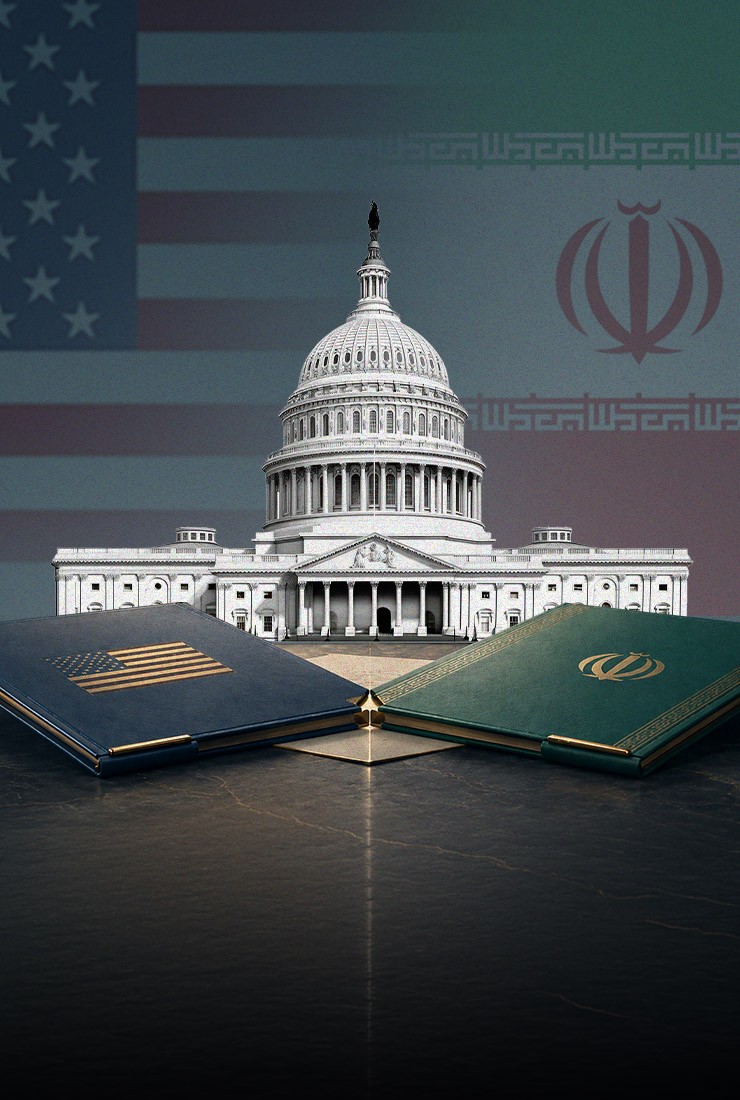
The U.S.-Iranian memorandum of understanding, signed in France on 17 June concerning the war that broke out in February between the United States and Israel on the one hand and Iran on the other, and whose repercussions were not confined to its direct parties after Iran directly targeted the Gulf states, acquires a particular symbolic significance in terms of both the place and timing of its signing. It was announced that U.S. President Donald Trump had signed the memorandum with Iran at the Palace of Versailles, coinciding with the conclusion of the G7 Summit in France.[1] The choice of Versailles is not a neutral protocol detail;[2] rather, it carries a clear historical and political charge, as this site is associated in modern political memory with major settlements and attempts to re-engineer the international order after wars. Moreover, the timing of the signing alongside the G7 Summit gives the agreement a dimension that goes beyond the bilateral relationship between Washington and Tehran, placing it within a broader attempt to rearrange regional and international balances under the umbrella of the major powers.[3] Hence, the question of why this location and timing were chosen cannot be separated from the essence of the agreement itself: are we merely facing the end of a war, or are we witnessing a political moment aimed at redefining Iran’s position, regime, and role without moving toward the option of its immediate collapse?
Through an initial reading of the agreement’s provisions, it does not appear to be merely a technical understanding to end the war or reopen the Strait of Hormuz. Rather, it represents a broader political and strategic framework for restructuring the relationship between the United States and Iran and recalibrating the balance of power in the Middle East. The language used in the text reveals an attempt to move from the logic of open military confrontation to that of conditional settlement, where questions of security, the nuclear program, sanctions, maritime navigation, reconstruction, and the role of regional allies intersect.
This study proceeds from the central idea that the agreement, despite the apparent gains it grants Iran, such as ending the war, lifting the blockade, easing sanctions, and releasing funds, contains a set of strategic constraints and risks that may affect Iran’s regional position, the image of its allies, and the narrative of the independence of its political decision-making. Accordingly, the importance of studying this agreement lies not only in analyzing its direct provisions but also in deconstructing the transformations in the balance of power that it conceals, as well as the long-term consequences it may entail for Iran and its axis of influence in the region.
Therefore, this study seeks to examine the disadvantages and risks that this agreement may impose on Iran, on the grounds that these disadvantages reveal not only the limits of Iran’s apparent gains but also, indirectly, the nature of the actual victor in the war. The agreement should not be read only through what it grants Iran, but also through what it extracts from it, and through the strategic, political, and supervisory constraints it imposes, which may reshape Iran’s position and role in the region.
What the Agreement Extracts from Iran: A Reading of the Limits of Apparent Gains and the Nature of the Actual Victor
Although the agreement appears, on the surface, to serve Iran’s interests—since it includes an end to the war, the lifting of sanctions, the removal of the blockade, the release of frozen funds, and a commitment to reconstruction—a closer reading between the lines reveals profound risks for Iran. Indeed, it may be argued that while the agreement provides Iran with immediate economic gains, it also places it inside a long-term negotiating, supervisory, and sovereign cage.
The first danger is that the agreement transforms Iran from a party resisting pressure into a party formally seeking survival through an understanding sponsored by Washington. The mere signing of a memorandum of understanding of this kind means that Iran effectively accepts the United States as a decisive actor in its security, economy, nuclear file, and even reconstruction. This strikes at the core of the Iranian narrative built on independence, rejection of hegemony, and refusal to submit to American dictates.
Second, the agreement ties Iran’s major gains to subsequent negotiations. The lifting of sanctions, the mechanism for handling enriched materials, the future of enrichment, the release of funds, and the USD 300 billion reconstruction plan are not immediately and definitively achieved; rather, they are placed within the framework of a final agreement to be reached within 60 days. This means that Iran is entering a new phase of pressure: it receives major promises but is required to offer strategic concessions before these promises can become reality.
Third, although the text does not explicitly call for dismantling Iran’s nuclear program, it gradually opens the door to such an outcome. The phrase “down-blending on site under the supervision of the IAEA” means placing the core of Iran’s nuclear capability under direct supervision. Likewise, the reference to discussing the issue of enrichment and Iran’s nuclear needs within a satisfactory framework in the final agreement means that Iran’s right to enrichment is no longer treated as a fixed sovereign right but has become a subject of negotiation and bargaining.
Fourth, the agreement imposes on Iran a freeze of its current nuclear status, while granting the United States valuable time to reorganize its tools of pressure. Paragraph nine states that Iran will maintain the current status quo of its nuclear program, which prevents it from escalating on the nuclear front or using the program as an additional bargaining card. By contrast, the U.S. commitment not to deploy additional forces does not mean that Washington is abandoning sanctions, intelligence tools, political influence, or regional alliances.
Fifth, the agreement undermines the legitimacy of the Iranian regime. Iran’s acceptance of a major settlement after a war, accompanied by nuclear supervision, involvement in the management of maritime chokepoints, and conditional financial and economic arrangements, may be read domestically as an implicit admission that the cost of confrontation has exceeded the regime’s capacity. This could weaken the regime’s image before its ideological base, especially among hardline currents that may regard the agreement as a concession rather than a victory.
Sixth, the USD 300 billion provision appears to be a major gain, but in reality, it means tying the Iranian economy to external conditions. The reconstruction of Iran and the financing of its development through a plan led by the United States and its regional partners could open the door to financial, supervisory, institutional, and perhaps political influence within Iran’s economic structure. In other words, Iran may emerge from the blockade only to enter into a form of conditional economic dependence.
Seventh, the agreement effectively places the Strait of Hormuz on the table of soft internationalization. The text does not merely address the passage of vessels; it also refers to dialogue with the Sultanate of Oman and the Gulf states regarding the future administration and maritime services of Hormuz. This is an extremely sensitive point, as it could weaken Iran’s ability to use Hormuz as a strategic deterrence card. In doing so, Tehran would lose one of its most important geopolitical assets.
Eighth, the agreement distinguishes between what Iran must do quickly and what it will obtain later. Iran is immediately required to ensure the safe passage of vessels, maintain the current nuclear status quo, and enter into a monitoring mechanism, whereas the major gains—such as the full lifting of sanctions, access to funds, and reconstruction—remain tied to the final agreement and its implementation mechanisms. This represents a serious imbalance in the temporal structure of the agreement: Iranian obligations begin early, while full benefits come later and remain conditional.
Ninth, the agreement does not protect Iran from the future reactivation of pressure. If negotiations over the final agreement falter, Washington could argue that Iran has failed to comply with the spirit of the understanding, or that the nuclear issues have not been resolved satisfactorily. At that point, sanctions or threats could return, while Iran would already have frozen its escalation cards, loosened its grip over maritime navigation, and submitted to broader oversight.
Tenth, the deeper danger of the agreement may lie in its impact on the mental image of Iran’s regional allies. When the text refers to the cessation of military operations on all fronts, including Lebanon, it reinforces the impression that these fronts are not autonomous actors in their own right so much as cards within Iran’s strategic calculations. When Tehran decides to move from escalation to settlement, these fronts are expected to de-escalate according to the rhythm of Iranian interests, rather than according to their own local priorities or narratives. This reinforces, among adversaries and perhaps within the environments of the allies themselves, the idea that Iran uses its allies as instruments of negotiating pressure, opening or closing fronts according to what serves its security and bargaining position. Thus, the agreement not only threatens the cohesion of Iran’s axis of influence; it also damages its symbolic image because it reveals that the “unity of arenas” is not necessarily a unity of destiny but may, at the moment of settlement, be subordinated to the logic of Iranian interests first.
Conclusion
Ultimately, the agreement reveals a profound strategic paradox: it grants Iran immediate economic and political gains, represented by the end of the war, the lifting of the blockade, the easing of sanctions, and the release of part of its assets. Yet, at the same time, it confronts Iran with a long-term strategic cost that may outweigh the gains of the moment. The real value of the agreement is not measured only by what Tehran obtains immediately, but also by what it may gradually lose of the instruments of power it has accumulated over decades.
If the agreement leads to the restriction of Iran’s nuclear program, subjects it to stricter oversight, neutralizes the Strait of Hormuz as a geopolitical deterrence card, or ties the Iranian economy to external mechanisms of financing and reconstruction, then exiting the war will become an entry point for recalibrating Iranian power from the outside. Moreover, obliging regional fronts to de-escalate may weaken Iran’s image among its allies and reinforce the perception that it employs them according to the logic of Iranian interests first, rather than within a genuine unity of destiny.
From this perspective, Iran may succeed in exiting the war, but it may lose what remains of the very conditions of resilience that originally enabled it to negotiate. The question of who emerged victorious from the war, therefore, becomes more complex: the victor is not necessarily the party that secured immediate gains, but rather the one that managed to impose on the other party a redefinition of its power, a narrowing of its margin of decision-making, and the transformation of its instruments of influence into matters subject to negotiation, oversight, and settlement.
[1] Ségolène Forgar, Laurent Picat et al., “Guerre au Moyen-Orient : Donald Trump a signé l’accord avec l’Iran au château de Versailles,” Le Figaro, juin 18, 2026, https://www.lefigaro.fr/international/en-direct-guerre-au-moyen-orient-donald-trump-a-signe-l-accord-avec-l-iran-au-chateau-de-versailles-20260618.
[2] Alayna Treene and Kevin Liptak, “US officials downplay text of the Iran agreement, saying it doesn’t account for back-channel commitments,” CNN, June 17, 2026, https://edition.cnn.com/2026/06/16/politics/iran-agreement-text-trump.
[3] Isabelle Labeyrie and Marie-Pierre Vérot, “Les États-Unis et l’Iran signent à distance le protocole d’accord pour mettre fin à la guerre au Moyen-Orient,” Radio France, juin 18, 2026, https://www.radiofrance.fr/franceinter/podcasts/l-info-de-france-inter/les-etats-unis-et-l-iran-signent-a-distance-le-protocole-d-accord-pour-mettre-fin-a-la-guerre-au-moyen-orient-8392308.