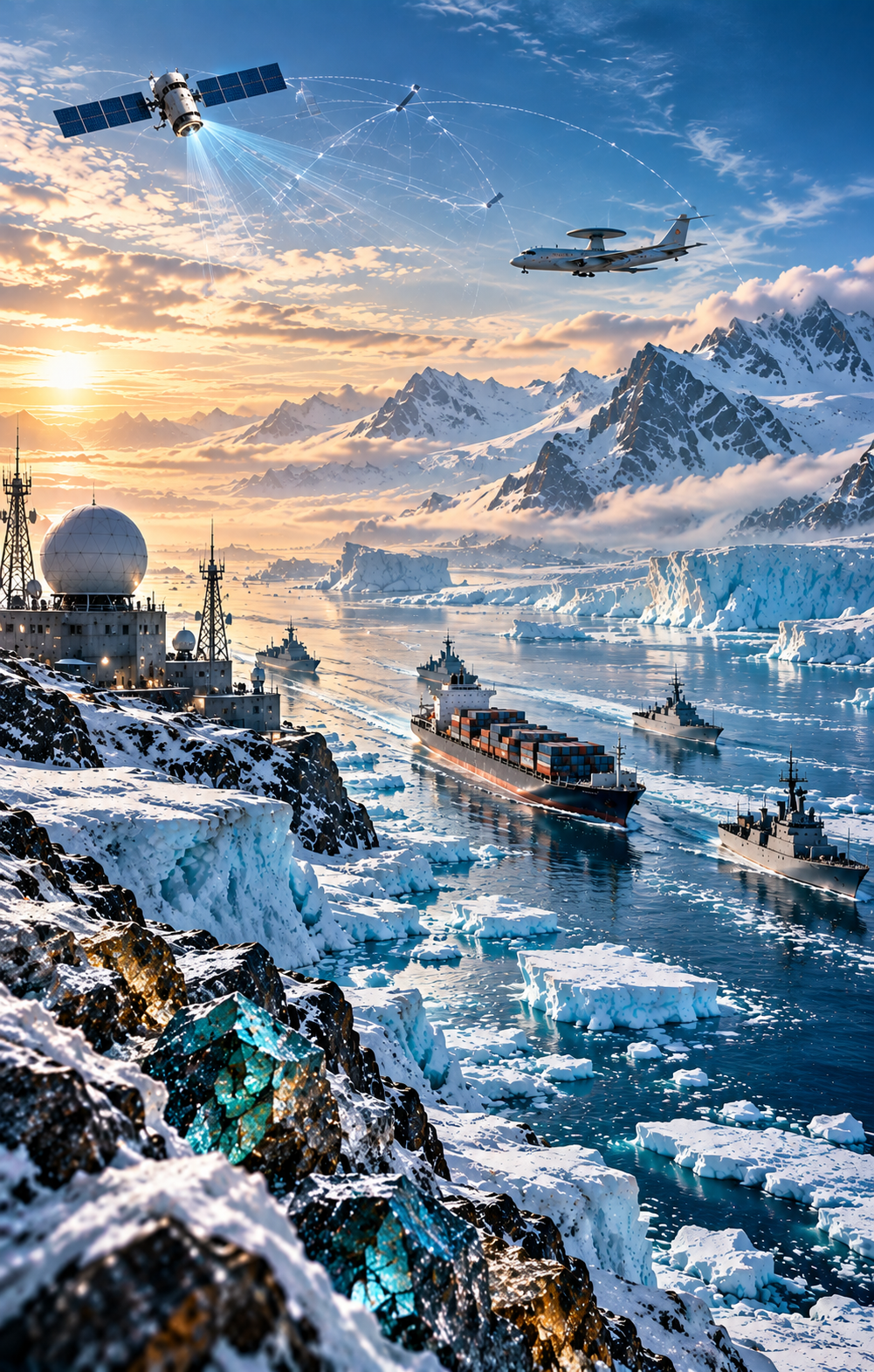
For much of the twentieth century, Greenland occupied the margins of international politics, despite its enduring military importance as an autonomous territory within the Kingdom of Denmark and home to a population of approximately 57,000.[1] Its geographic position has long made it central to North American early-warning systems, transatlantic reinforcement routes, surveillance across the Greenland–Iceland–United Kingdom (GIUK) Gap, and the wider defense of the Arctic during and after the Cold War. Since 2019 and with renewed intensity following Donald Trump’s return to the White House in 2025, Greenland has moved from the strategic periphery to the center of an increasingly consequential international contest. This takes place over Arctic shipping routes made more accessible by a warming climate, the critical minerals underpinning the energy transition and advanced defense industries, and the cohesion of the Western alliance system itself.
That transformation entered a new phase on 22 September 2026, when U.S. President Donald Trump, Danish Prime Minister Mette Frederiksen, and Greenlandic Prime Minister Jens-Frederik Nielsen signed a trilateral security agreement on the sidelines of the 81st United Nations General Assembly in New York. Amending the legal framework established by the 1951 U.S.–Danish defense agreement, the accord permits a substantially expanded American military presence in Greenland, including the development of additional defense sites and Greenland’s integration into Washington’s emerging missile-defense architecture. At the same time, it stops short of Trump’s earlier demand that the United States acquire the island and formally reaffirms Greenlanders’ right to self-determination. The agreement, therefore, represents neither annexation nor a simple return to the Cold War status quo. Rather, it institutionalizes a new strategic bargain, which is expanded American security access in exchange for the preservation of Greenland’s constitutional status and a more explicit Greenlandic role in decisions concerning the island’s future. It also raises unresolved questions about the boundary between collective defense and external control, particularly where military access, critical infrastructure, and foreign investment intersect.
Drawing on the background of Greenland issue, field interviews conducted in Nuuk, Ilulissat, and Copenhagen with Greenlandic and Danish officials and experts, Arctic diplomats, fisheries and mining stakeholders, defense researchers, a Canadian former North American Aerospace Defense Command (NORAD) General, and the European Union’s Commissioner for International Partnerships, this insight examines how climate change, resource politics, sovereignty, and great-power competition have converged on a single Arctic island. It places these interviews alongside open-source reporting on the July 2026 NATO Summit in Ankara, the May 2026 Future Greenland Conference in Nuuk, and the newly concluded U.S.–Denmark–Greenland security agreement. In doing so, it asks whether the September accord has resolved the dispute over Greenland or merely transformed it, from an overt contest over ownership into a longer-term struggle over military authority, investment control, and political agency and considers what role, if any, Türkiye might plausibly play in this emerging Arctic order.
The physical enabler: climate change and Arctic accessibility
The premise behind much contemporary interest in Greenland is that melting ice is opening the Arctic to shipping and resource extraction. Practitioners on the ground offer a more cautious picture than the popular narrative suggests. A Danish Arctic policy researcher, Jon Rahbek Clemmensen, argued in an interview that the Northern Sea Route’s impact “has thus far been very marginal”, noting that only a small fraction of vessels use the route compared with the roughly 20,000 ships transiting the Suez Canal annually, and that Greenland itself lies largely outside the routes ships would actually take.[2] A former Danish Arctic Council diplomat who did not wish to be named distinguished between the two theoretical Arctic corridors: the Northeast Passage, north of Russia, where “slow growth” of genuinely commercial shipping is already underway, and the Northwest Passage, past Canada’s Arctic islands, which remains “more theoretical”, constrained by heavier ice.[3] A captain with the Royal Arctic Line, who also did not prefer to be named due to his company policy, offered a similar assessment from the deck: ice remains “very unpredictable”, requiring reinforced hulls and constant lookout for “black ice”, refrozen ice nearly invisible in open water; he estimated a genuinely viable Transpolar route was “maybe 20 years” away.[4]
Karl Aakatak Sandgreen, director of Ilulissat’s Icefjord Center, added an ecological dimension often missing from shipping-route debates: the glacier feeding Disko Bay is the second-most productive ice-generating glacier in the world after Antarctica, and its retreating icebergs, which currently trap krill-rich currents inside the fjord’s food chain, are shrinking toward a point where the fjord could open into unobstructed water, thinning the krill population sustaining local fish, seabirds, and whales.[5] Its conversion into reliable shipping infrastructure, then, remains a matter of decades rather than years.
Resource geopolitics: rare earths and critical minerals
Greenland’s mineral wealth is frequently cited as the material logic behind renewed great-power interest, but the view from Nuuk complicates this narrative. Clemmensen noted that a University of Copenhagen study concluded Greenland would need “several very, very large mining projects” merely to offset the roughly US$750 million to US$1 billion the Danish state annually transfers to sustain Greenland’s economy, judging full mineral self-sufficiency “completely unrealistic”.[6] He pointed to the stalled Kvanefjeld (Kuannersuit) rare earth project in southern Greenland, owned by the Australian firm Greenland Minerals, which was effectively halted after the Inuit Ataqatigiit party won the 2021 “mining election” and parliament passed legislation banning the extraction of any deposit with uranium content above 100 parts per million, a threshold the site’s ore exceeds, given its uranium co-mingled with the rare earths.[6a] A Greenlandic foreign ministry official confirmed mining today remains small in scale; a rare-earth operation near Qaqortoq employs around 25 workers processing roughly 87 tons of ore per hour, while a much larger prospective iron project in northern Greenland remains constrained less by ore volume than by logistics, since extraction would need to cross seasonal drift ice, pushing Greenland toward a shipping partnership with Iceland.[7]
Washington’s bid: from purchase offer to “51st state”
The recurring American interest in acquiring Greenland has been, in the assessment of several interviewees, poorly explained by conventional strategic logic. Clemmensen observed that the United States “already” has enjoyed extensive military access under its 1951 defense agreement with Denmark,[8] and that Denmark and Greenland have historically been “very open to help enhance American security”. This is a pattern traceable to the Cold War, when Denmark quietly allowed the U.S. to station nuclear weapons in Greenland despite Danish policy formally prohibiting them elsewhere in the kingdom, precisely to avoid ceding the island outright.[9] He characterized the current push as driven substantially by domestic political motive: as Donald Trump wants to secure a legacy as part of his “Make America Great Again” policy. According to the expert, layered atop is an anxiety, not fully supported by current evidence, that an independent Greenland might one day open itself to Chinese investment. A Greenlandic diplomat put the puzzle more bluntly: under existing agreements, the United States can already conduct surveillance, basing, and operations across Greenlandic territory, so “there must be something else behind” the pressure for outright control, since the economic case does not hold up. Denmark already spends roughly a billion dollars annually administering Greenland, a floor any American offer would have to clear.[10]
Nuuk and Copenhagen: sovereignty and self-determination
Greenlandic and Danish are emphatic that the territory’s constitutional trajectory, from Home Rule in 1979 to Self-Government in 2009, which recognized Greenlanders as a people under international law, made Greenlandic the official language, and transferred authority over mineral resources,[11] is a story about a small indigenous nation’s project of self-determination, not a resource negotiation. A Greenlandic diplomat stated that American overtures framed around investment and prosperity misread the situation, underlying that it is not about money but the struggle of the people.[12] Ulrik Pram Gad, a Danish Arctic scholar, put it in comparative terms: “If you listen to Trump, and if you listen to a lot of geopolitical analysis, it’s just like a piece of territory, a piece of ice that needs to be managed”, when the more important fact is “there is a community living in Greenland that sees itself as a nation like any other nation”.[13] Sandgreen, speaking from Ilulissat, described the toll as emotional reactions of people because of the fear and the fury, stressing this situation was driven less by minerals than by the prospect of new Arctic shipping routes once the ice opens.[14]
This dynamic was echoed at the July 2026 NATO Summit in Ankara, where Danish Prime Minister Mette Frederiksen reiterated that Greenland is not for sale and pledged Denmark was “ready to defend every inch of NATO, including its own territory”.[15] The EU’s spokesperson likewise affirmed that decisions about Greenland’s future belong to Greenlanders and Danes, invoking territorial integrity and sovereignty as foundational principles of international law.[16]
Denmark’s strategic pivot and the three costs of Washington’s Greenland push
Previously, Russia was not seen as a threat, and Arctic security was a low priority for Arctic states. Arctic security was funded incrementally, rather than as Norway had done since 2005. Danish security policy was historically anchored in the Middle East and North Africa; Denmark’s contribution to the Afghanistan campaign imposed a substantial human cost relative to the country’s population. Forty-three Danish soldiers were killed, an absolute total exceeded by only a small number of NATO allies. For a country of approximately six million people, this represented a particularly high per-capita fatality rate: more than six times that of Germany and over three times that of France, placing Denmark’s losses on a level comparable to, or higher than, those of several much larger allies with considerably greater military and economic resources.[17]
After President Trump’s first attempt to purchase Greenland, Denmark committed in December 2019 to a roughly DKK 1.5 billion (about US$200 million) Arctic capacity package, but implementation lagged for years.[18] Only after renewed American pressure in 2025 did Copenhagen reverse course decisively: it unveiled a further DKK 14.6 billion (about US$2.05 billion) Arctic and North Atlantic defense package in January 2025,[19] followed by an additional DKK 27.4 billion (about US$4.26 billion) package in October 2025 covering new Arctic vessels, an Arctic command headquarters, a North Atlantic undersea cable, and maritime patrol aircraft.[20] Danish defense spending overall has climbed from roughly 1.1 percent of GDP in 2017 to about 3 percent in 2025 and 2026, with Copenhagen bringing forward its target of reaching 3.5 percent, the core-defense component of NATO’s broader 5-percent-by-2035 commitment agreed at the 2025 Hague Summit, to 2030.[21]
Clemmensen offered a sharply argued critique of the American approach, directly relevant to Ankara’s substance. He identified three costs of Washington’s Greenland push: first, it “sucks out all the energy” from the security challenge that actually matters, namely Russia’s ability to project submarines from the Kola Peninsula into the Atlantic, a corridor that is not ice-covered and therefore has little to do with climate change at all; second, it undermines the West’s strategic narrative against Russian aggression, since a U.S. campaign to annex a neighboring democracy’s territory “is following Vladimir Putin’s playbook”; and third, it carries a tangible risk of fracturing NATO’s Article 5 guarantee altogether.[16] He noted European allies had, in early 2026, sent and then symbolically withdrawn a small number of troops to Greenland. This was, in his reading, materially trivial but important in signaling that any American use of force would risk killing allied personnel.[22]
This is precisely the tension that played out in Ankara. President Trump used the NATO 2026 Summit, held in Türkiye for the second time after Istanbul in 2004, to revive his call for the U.S. acquisition of Greenland, describing the island as something that “should be controlled by the United States” and threatening to withdraw American forces from Europe over allied resistance.[23] The final Ankara Declaration reaffirmed unity and collective defense but did not reflect Trump’s Greenland ambitions.[24] Secretary General Mark Rutte sought to bridge the divide, conceding Trump “has a point” about Chinese and Russian Arctic ambitions, while insisting the appropriate response was collective Alliance action. This was reflected in NATO’s Arctic Sentry mission, launched in February 2026 to coordinate allied exercises, including Denmark’s Arctic Endurance and Norway’s Cold Response drills, which by March had grown to roughly 25,000 troops from 14 nations.[25] Ankara’s parallel Defense Industry Forum advanced Nordic and Allied defense-industrial cooperation tied to NATO’s 5-percent GDP target, with European allies and Canada having already increased core defense investment by more than US$139 billion since 2025.[26]
Scott Clancy, a former North American Aerospace Defense Command (NORAD) general from Canada, drew an explicit parallel between Greenland and Canada’s own experience of American pressure, describing both as “an absolute breach of trust of someone that you thought was a friend”, and predicting the relationship would become permanently “transactional” regardless of who controls the White House next; he characterized this as “a silent crisis within NATO” that may ultimately push Europeans toward “a new security alliance”.[27] Gad offered a more measured operational lesson: rather than chasing “his most outrageous” statements in real time, governments and media alike are “getting better” at stepping back and declining to be provoked into reactive diplomacy.[28]
Four suitors: the U.S., UK, Canada, and France in Nuuk
The competitive dynamic among Western partners was on full display at the May 2026 “Future Greenland” conference in Nuuk, where the ambassadors of the United States, United Kingdom, Canada, and France shared a single panel. Washington’s pitch, delivered by Ambassador Kenneth Howery, centered on opportunity: critical minerals, emerging shipping routes, tourism, and future data-center investment, alongside the fact that operations at the Pituffik Space Base are carried out by a Greenlandic company. The British ambassador emphasized connectivity: maritime security, British mining investment, and new scholarships for Greenlandic students. France’s ambassador, Christophe Parisot, delivered arguably the conference’s sharpest line: “Only Greenlanders can decide Greenland’s future”, adding that Greenland’s lands are not for sale, a message reinforced by President Macron’s earlier visit, the first by a head of state amid the crisis. Canada’s ambassador, Carolyn Bennett, reframed the discussion around Indigenous partnership, warning that “economic activity that does not generate meaningful benefits for Greenlanders is ultimately not sustainable”.[29]
The visible friction inside the American delegation was instructive: several protocol seats reserved for U.S. officials sat conspicuously empty, and Trump’s special envoy to Greenland left before the new consulate’s opening ceremony, outside which Inuit demonstrators held banners reading “U.S. OUT, NATO IN”.[30] Managing this daily friction has fallen to a working triangle of career diplomats: Greenland’s Washington representative Jacob Isbosethsen, Danish Ambassador Jesper Moller Sorensen, and Howery himself, described as turning “political controversy into practical cooperation” largely beneath the headlines.[30]
Investment landscape
Greenland’s investment regime has become more restrictive since the intensification of the U.S.-Greenland dispute, and frictions extend beyond formal rules. A Nuuk-based legal practitioner described a new law barring foreign nationals from owning real estate absent two years’ residence and tax payment, alongside a longstanding rule limiting non-Danish, non-Greenlandic ownership of tourism companies to one-third of equity, both carrying exemptions for capital-intensive sectors such as mining.[31] Christian Keldsen, Director of the Greenland Business Association, confirmed that there is active foreign capital in tourism (Icelandic, Spanish, French) and mining exploration (Australian, five Czech licenses), while noting that Turkish, Gulf, and Central Asian capital remain largely absent, and that Russia and China are currently the only explicit “no-goes”.[32]
The European Union (EU) as an institutional counterweight
Where Washington’s approach has been transactional, the European Union has positioned itself as a patient, long-term partner for Greenland. According to Josef Sikela, the EU’s Commissioner for International Partnerships, “Greenland’s sovereignty is not up for negotiation”, and confirmed a Commission proposal to raise the EU’s financial envelope for Greenland from roughly 225 million Euros to 530 million Euros for the coming budget period, alongside a further 50 million Euro package.[33] He framed the EU’s offer around “de-risking” private investment through grants, blended finance, and guarantees, with subsea cable connectivity linking Europe, Greenland, and Asia, and price-stability arrangements for critical minerals modeled on long-term energy contracts. When Keldsen bluntly asked the Commissioner how a 27-member bloc could compete for Greenland’s favor against faster-moving rivals, Sikela pointed to the EU’s speed in supporting Greenland from “the very beginning” of the crisis and its record of transforming post-Soviet Central Europe after EU accession as evidence that patient, collective investment outlasts rapid, transactional promises.[34]
This commitment was reinforced at the political level in late August and early September 2026. From 25 to 28 August, a cross-party delegation from the European Parliament’s Committee on Constitutional Affairs, comprising representatives of the EPP, S&D, Greens/EFA, and ECR, met Greenland’s parliament and government, the Inuit Circumpolar Council, Ilisimatusarfik, and representatives of the U.S. mission to discuss self-government, constitutional development, climate governance, sustainable Arctic development, and transatlantic relations.[35] This was followed on 6–7 September by European Commission President Ursula von der Leyen’s visit to Nuuk, accompanied by Síkela and the Commission’s special adviser for EU–Arctic relations, Jyrki Katainen. The program combined high-level political symbolism with practical measures: a renewed EU–Greenland–Denmark declaration, the launch of an enhanced satellite-connectivity project, and planned investments in critical minerals, renewable energy, and communications infrastructure.[36] Describing the forthcoming investment package as “substantial”, von der Leyen warned that, as Greenland’s ice melts, “a new reality is taking shape”.[37] Together, the visits indicate that Brussels is institutionalizing its Greenland engagement across political groups and converting its assurances on sovereignty into concrete, long-term economic and infrastructural commitments.
Beneath the surface of Western solidarity, competitive friction persists, most visibly in fisheries. Following Brexit, the UK sought a quota arrangement with Greenland comparable to its former EU-derived rights. Bent Sorensen, a Greenlandic fisheries representative, firmly rejected this, alleging UK negotiators represented the same commercial interests Greenland already dealt with through the EU.[38]
Canada’s sovereignty anxieties and the Greenland parallel
Canada’s perspective on the Greenland question reflects a different, yet closely related, strategic concern. While Canadian officials have consistently emphasized respect for Greenlandic self-determination and Danish sovereignty, the debate has been shaped by domestic anxieties arising from similar rhetoric directed at Canada itself. Retired Major General Scott Clancy, former Director of Operations for NORAD, drew an explicit parallel between U.S. discussions of acquiring Greenland and repeated suggestions by President Donald Trump that Canada should become the “51st state” of the United States. From a Canadian security perspective, both narratives represent challenges to the sovereignty of close allies rather than isolated political statements. The comparison illustrates how revisionist rhetoric directed toward one North American partner inevitably resonates with another, reinforcing concerns that territorial ambitions, whether framed in strategic, economic, or security terms, can erode trust within NATO and the broader transatlantic alliance. This perception has contributed to Canada’s more active diplomatic engagement with Greenland, including the opening of a consulate in Nuuk and high-level visits emphasizing Arctic cooperation, Indigenous ties, and the principle that sovereignty in the Arctic must be respected.[39]
From Ankara to New York: from annexation rhetoric to a security bargain
The agreement [40] was signed on 22 September 2026, on the sidelines of the 81st United Nations General Assembly in New York, following President Trump’s address to the Assembly, by Trump, Danish Prime Minister Mette Frederiksen, and Greenlandic Prime Minister Jens-Frederik Nielsen. Its diplomatic and legal language marked a significant contrast with the discourse surrounding the July 2026 NATO Summit in Ankara. In Ankara, Trump had revived his demand for the United States to acquire Greenland, argued that the island “should be controlled by the United States”, and threatened to withdraw American forces from Europe in response to allied resistance.
The confrontation consequently presented Greenland as a potential fault line within NATO itself. At the UN General Assembly, Trump continued to describe the outcome in expansive terms, claiming that Washington had obtained “permanent control” over Greenland’s security requirements. The text signed in New York, however, reflected a negotiated allied compromise rather than the transfer of territory or sovereignty. It explicitly reaffirmed the sovereignty and territorial integrity of the Kingdom of Denmark and recognized the Greenlandic people’s right to self-determination. At the same time, it granted Washington substantial operational gains. These are the modernization and expansion of Pituffik Space Base; new defense areas at Narsarsuaq and Mestersvig; the possibility of further mutually agreed sites; Greenland’s integration into the Golden Dome missile-defense architecture; and extensive American military movement by land, air, sea, and beneath Greenlandic territorial waters. It also excludes non-NATO states from maintaining a persistent military presence and places foreign involvement in critical infrastructure, natural resources, and other sensitive sectors under coordinated security screening.
The shift from Ankara to New York, therefore, constituted a legal retreat from annexation, but not a strategic retreat by Washington. Trump secured most of the military-access and economic-denial objectives associated with his Greenland campaign without acquiring the island; Denmark preserved the Kingdom’s territorial integrity; and Greenland participated as a named party whose consent and right to self-determination were formally recognized.
Nevertheless, the agreement’s indefinite duration and its provision that a future independent Greenland assume its obligations and remain within NATO pre-structures the island’s future strategic alignment. The accord does not give the United States sovereignty or the unilateral authority suggested by Trump’s UN address, and it will enter into force only after the necessary Danish and Greenlandic parliamentary procedures are completed. Yet it institutionalizes American strategic primacy in Greenland and makes the exclusion of rival military and investment influence principally that of Russia and China, a defining element of the island’s emerging security order.
Russia, China, and the Arctic Council’s institutional memory
There has recently been a lack of institutional context, often missing from great-power framing. A former Arctic diplomat who works for the Arctic Council and did not want to be named recounted that the Council originated in a 1987 speech by Mikhail Gorbachev in Murmansk proposing environmental cooperation among Arctic states, carried forward by Finland through the 1991 Rovaniemi process into the Council’s formal establishment in 1996, a Russian-initiated forum now central to managing Russian isolation.[41] Since the invasion of Ukraine, political-level Council cooperation with Moscow has been paused, while its six scientific working groups continue functioning with Russian participation at a virtual level, because the studies are not only for the non-Russian Arctic’s sake but rather for the whole world, given the Arctic’s influence on global climate data. Denmark’s current chairmanship functions as “the glue” holding the arrangement together. On China, the same source recalled that Beijing’s 2013 admission as a full Council observer generated quiet unease among some members, contributing to a broader freeze on new observer states that persists today, including the observer membership application of the Republic of Türkiye.
Türkiye’s emerging Arctic vector: recommendations from on-site research
Türkiye’s Arctic engagement, including a newly announced embassy in Reykjavik, scientific expeditions, and a Polar Research Council under the Turkish Presidency, drew genuinely divergent assessments, offering a useful academic corrective to any single narrative. Türkiye’s prospects for observer status depend on demonstrated scientific investment and engagement with the Inuit Circumpolar Council, rather than declaratory ambition, citing South Korea and Poland as models Ankara could emulate.
Türkiye can adopt a gradual, trust-based strategy for expanding its engagement in the Arctic. Ankara should first establish its legitimacy as a constructive regional partner through science diplomacy. This could include increasing participation in polar expeditions, supporting joint research projects, strengthening institutional cooperation with Arctic universities and scientific centers, and contributing Turkish technological capabilities to climate observation, ice monitoring, maritime safety, environmental protection, and search-and-rescue research. Science diplomacy would allow Türkiye to demonstrate that its interest in the Arctic is based not only on emerging economic and geopolitical opportunities but also on a genuine willingness to contribute to the production of knowledge and the protection of a highly vulnerable region.
The second stage should involve carefully selected and responsible investments developed in consultation with Arctic governments, local authorities, indigenous institutions, and business organizations. Türkiye could explore cooperation in areas where it already possesses relevant expertise, including renewable energy, sustainable construction, maritime transport, tourism, digital infrastructure, communications, unmanned technologies, and cold-weather logistics. Such investments should respond to locally identified needs and produce tangible benefits for Arctic communities. Türkiye should avoid an extractive model in which external actors enter the region primarily to access strategic resources. Its economic engagement should instead be based on partnership, local participation, skills development, technology transfer, and long-term value creation. This would help distinguish Türkiye from actors perceived as approaching the Arctic primarily through strategic competition or resource acquisition.
Only after developing a credible record of scientific cooperation and responsible investment should Türkiye consider a more active role in Arctic security. As a longstanding NATO member with substantial military, technological, and operational capabilities, Türkiye could contribute to NATO cold-weather exercises and tasks, particularly in areas such as search and rescue, maritime domain awareness, disaster response, logistical resilience, surveillance, communications, and the protection of critical infrastructure. Participation through NATO would offer Türkiye the most legitimate institutional framework for security engagement in the High North, because it would embed any Turkish contribution within an established multilateral alliance and in coordination with Arctic allies. This would be preferable to pursuing an independent military profile, which could generate unnecessary political sensitivities or be interpreted as an attempt to enter an already contested strategic environment.
Türkiye may therefore follow a sequential model: science diplomacy, responsible investment, and NATO-based security participation only after sufficient trust has been established. This approach would enable Türkiye to demonstrate patience, respect for Arctic governance arrangements, and sensitivity to the priorities of local and indigenous communities. It would also allow Ankara to build enduring relationships before seeking a more visible strategic role. Should Türkiye decide to deepen its Arctic engagement, participation in NATO cold-weather tasks could eventually strengthen both regional security and Türkiye’s position as a capable, allied contributor. However, such participation would be most effective and credible when it emerges as the result of sustained cooperation and accumulated trust rather than as the starting point of Türkiye’s Arctic policy.
On the ground in Greenland, awareness of Türkiye remains limited but not unwelcoming: Keldsen noted Greenland currently has no formal strategy excluding Turkish capital and would likely be open to discussion depending on the project,[42] while a Greenlandic foreign ministry official identified nursing, medical training, and tourism know-how as areas of genuine interest, distinct from the mineral and security competition dominating the Washington-Nuuk-Copenhagen triangle.[43] Türkiye’s position as 2026 NATO host highlighted a convening role Ankara could build upon: not as a claimant to Arctic resources, but as a scientific, technological and diplomatic entrant pursuing the same patient, credibility-building path other non-Arctic observer states have taken.
A practical opportunity to advance this gradual engagement strategy already exists. In October 2026, Türkiye will participate in the Arctic Circle Assembly in Reykjavík for the first time at the governmental level, with high-level representatives from the Ministry of Industry and Technology and the Ministry of Foreign Affairs, as well as The Scientific and Technological Research Council of Türkiye (TÜBİTAK). This marks an important milestone in Türkiye’s evolving Arctic policy, signaling that Ankara is moving beyond academic interest toward coordinated institutional engagement. Rather than viewing participation solely as attendance at a major Arctic conference, Türkiye seems to be going to treat the assembly as a diplomatic platform for building long-term relationships with Arctic governments, indigenous organizations, scientific institutions, businesses, and regional organizations.
The Arctic Circle Assembly also provides the most appropriate environment to begin discussions on expanding Türkiye’s role in the Arctic. It offers a neutral, multistakeholder forum in which Türkiye can demonstrate its commitment to science diplomacy, sustainable development, and responsible international cooperation before seeking a larger strategic role. In this context, the Assembly could serve as the starting point for diplomatic consultations regarding Türkiye’s long-term objective of obtaining Observer status in the Arctic Council once the Council resumes consideration of new observer applications. By first establishing credibility through scientific cooperation and sustained dialogue within Arctic institutions such as the Arctic Circle Assembly, Türkiye would strengthen the legitimacy of any future application while demonstrating that its Arctic engagement is based on partnership, contribution, and respect for existing governance arrangements rather than geopolitical competition. Besides, the Nordic Baltic Institute Association based in Istanbul will be the first think tank from Türkiye to host a session in the Arctic Circle Assembly, as epistemic and civil networks carry an important role for developing cross-regional contact and cooperation.
Conclusion
Greenland functions as a stress test for two propositions: whether climate change is converting Arctic geography into an economically transformative asset, and whether the Western alliance system can absorb unilateral pressure from its most powerful member without fracturing. On the first, practitioners closest to Greenland’s ice, fisheries, shipping routes, and mineral deposits counsel patience over hype. Climate change is increasing Greenland’s strategic importance, but formidable environmental, logistical, financial, and social constraints continue to separate geopolitical expectations from commercial reality. On the second, the progression from the July NATO Summit in Ankara to the September agreement signed in New York revealed both the vulnerability and adaptability of the transatlantic alliance. Ankara exposed a genuine fault line between an American approach centered on ownership, control, and leverage and a NATO institutional response expressed through Arctic Sentry, joint exercises, greater Danish defense investment, defense-industrial cooperation, and an expanded EU partnership based on the premise that Arctic security and prosperity should be pursued collectively.
The U.S.–Denmark–Greenland agreement has reduced the immediate danger of annexation and prevented the dispute from becoming an open rupture within NATO. It did so, however, by converting a confrontation over sovereignty into a long-term bargain over access, alignment, and strategic influence. Washington obtained an expanded and potentially permanent military role, together with mechanisms restricting rival military activity and sensitive investment; Denmark preserved the Kingdom’s territorial integrity; and Greenland secured formal recognition as a party whose people possess the right to self-determination. The outcome, therefore, demonstrates that the alliance can absorb unilateral pressure, but not without redistributing practical authority. Greenland retains its constitutional right to determine its future, while the agreement substantially pre-structures the security framework within which that future will unfold. The central question has consequently shifted from whether the United States will acquire Greenland to how Greenlandic self-determination can be exercised within an increasingly institutionalized American and NATO security architecture.
As Greenland marked seventeen years of expanded self-government in June 2026, the wider lesson for outside actors, including Türkiye, is that meaningful Arctic engagement cannot be built through declaratory ambition or a narrow competition for minerals. It requires patient, science-led cooperation, respect for Indigenous agency, and sustained investment in local relationships and institutions. Türkiye’s most credible path is therefore not to imitate the transactional approaches of larger powers, but to contribute where it possesses relevant capabilities in polar research, climate observation, maritime technology, responsible business cooperation, and multilateral diplomacy. In an Arctic increasingly shaped by both strategic rivalry and institutional interdependence, sovereignty, local consent, scientific credibility, and alliance cohesion, not resource potential alone, will determine who ultimately gains a legitimate seat at the table.
[1] Population figure per Türkiye Today’s 2026 profile of Greenland’s demographics; see Esra Ozturk, “Arctic Ball in Greenland: Who Can Make the Girl Dance?” Türkiye Today, June 4, 2026, https://www.turkiyetoday.com/region/arctic-ball-in-greenland-who-can-make-the-girl-dance-3221225.
[2] Jon Rahbek Clemmensen, Danish Arctic policy researcher, interview by the author, Copenhagen, May 2026.
[3] An Arctic diplomat who did not want to be named, interviewed by the author, Nuuk, May 2026.
[4] A captain from Royal Arctic Line who did not want to be named, interviewed by the author, Ilulissat, 2026.
[5] Karl Aakatak Sandgreen, Director of the Ilulissat Icefjord Center, interviewed by the author, Ilulissat, May 26, 2026 (published with interviewee’s consent).
[6] Clemmensen, interview, May 2026. See also “Greenland Bans Uranium Mining, Blocks Rare Earths Project,” MINING.COM, November 10, 2021, https://www.mining.com/greenland-bans-uranium-mining-blocking-vast-rare-earths-project/; “Greenland, Rare Earths, and Arctic Security,” Center for Strategic and International Studies, https://www.csis.org/analysis/greenland-rare-earths-and-arctic-security.
[7] Greenlandic Ministry of Foreign Affairs official, who did not want to be named, interviewed by the author, Nuuk, May 2026.
[8] Denmark-United States Defense of Greenland Agreement, 1951.
https://www.worldlii.org/int/other/treaties/UNTSer/1951/327.pdf?utm_source=chatgpt.com.
[9] Clemmensen, interview, May 2026; see also Clemmensen’s remarks reported in Esra Ozturk, “Annexing Greenland Would Seriously Undermine NATO, Danish Expert Warns,” Türkiye Today, https://www.turkiyetoday.com/world/annexing-greenland-would-seriously-undermine-nato-danish-expert-warns-3212620.
[10] Greenlandic diplomat, who did not want to be named, interviewed by the author, Nuuk, May 2026.
[11] Greenland Self-Government Act, 2009, https://english.stm.dk/media/4vgewyoh/gl-selvstyrelov-uk.pdf; see also Esra Öztürk, “Greenland’s National Day: Half a Century of Growing Self-Rule,” Türkiye Today, June 21, 2026, https://www.turkiyetoday.com/region/greenlands-national-day-half-a-century-of-growing-self-rule-3222271.
[12] Greenlandic diplomat, who did not want to be named, interviewed by the author, Nuuk, May 2026.
[13] Ulrik Pram Gad, Danish Arctic scholar, interviewed by the author, Copenhagen, May 2026.
[14] Sandgreen, interview, May 26, 2026.
[15] “Five Key Takeaways from the NATO Summit in Ankara,” Al Jazeera, July 8, 2026, https://www.aljazeera.com/news/2026/7/8/five-key-takeaways-from-the-nato-summit-in-ankara.
[16] “EU stands in solidarity with Denmark over sovereignty, spokesperson says,” Xinhua English News, July 8, 2026, https://english.news.cn/europe/20260708/0d36ac0417dd439890a9eb55de788ca4/c.html.
[17] Thom Tillis, “Remarks in the Senate,” Congressional Record, 119th Cong., 2nd sess., vol. 172, no. 4 (January 7, 2026), Washington, DC. https://www.congress.gov/119/crec/2026/01/07/172/4/CREC-2026-01-07.pdf
[18] “Denmark to Pump $2bn into Arctic Security as Trump Eyes Greenland,” Al Jazeera, January 28, 2025, https://www.aljazeera.com/news/2025/1/28/denmark-to-pump-2bn-into-arctic-security-as-trump-eyes-greenland.
[19] “Denmark Boosts Arctic Defense Spending by $2 Billion after Trump’s Greenland Interest,” CNN, January 27, 2025, https://www.cnn.com/2025/01/27/europe/denmark-greenland-trump-defense-latam-intl/index.html.
[20] “Denmark to Boost Arctic Defence by $4.26bn, Plans to Buy 16 New F-35s,” Al Jazeera, October 11, 2025, https://www.aljazeera.com/news/2025/10/11/denmark-to-boost-arctic-defence-by-4-26bn-plans-to-buy-16-new-f-35s.
[21] “Is Denmark on the Verge of a Radical Change in Its Defense Posture?” Meta-Defense, February 26, 2026, https://www.meta-defense.fr/en/2026/02/26/denmark-nato-3-5-GDP-2030-defense/; see also NATO, “Defence Investment and NATO’s 5% Commitment,” https://www.nato.int/en/what-we-do/introduction-to-nato/defence-expenditures-and-natos-5-commitment.
[22] Clemmensen, interview, May 2026.
[23] “Trump Renews Greenland Threats at NATO Summit, Says U.S. Could Remove Troops from Europe,” CNBC, July 7‚ 2026, https://www.cnbc.com/2026/07/07/trump-nato-summit-greenland-us-troops-europe.html.
[24] “NATO: Ankara Declaration of Unity,” Europe Diplomatic, July 8, 2026, https://europediplomatic.com/2026/07/08/nato-ankara-declaration-of-unity/.
[25] “NATO Launches Arctic Sentry Mission to Ease Tension over Trump’s Greenland Push,” Reuters, February 11, 2026, https://www.aol.com/articles/nato-begun-arctic-sentry-mission-120427651.html; “NATO Begins Biennial Arctic Military Exercise,” All India Radio News, March 9, 2026, https://www.newsonair.gov.in/nato-begins-biennial-arctic-military-exercise.
[26] NATO, “Overview, 2026 NATO Summit in Ankara,” https://www.nato.int/en/news-and-events/events/2026/07/overview—2026-nato-summit-in-ankara-.
[27] Scott Clancy, former general, Canadian Global Affairs Institute, interview by the author, Nuuk, May 2026.
[28] Gad, Danish Arctic scholar, interview by the author, Copenhagen, May 2026.
[29] Öztürk, “Arctic Ball in Greenland.”
[30] Öztürk, “Arctic Ball in Greenland.”
[31] Nuuk-based legal practitioner who does not want to be named, interviewed by the author, Nuuk, 2026.
[32] Christian Keldsen, CEO, Greenland Business Association, interview by the author, Nuuk, May 2026.
[33] Josef Sikela, EU Commissioner for International Partnerships, panel remarks and interview, Nuuk, May 2026; see also Ozturk, “Arctic Ball in Greenland,” citing European Commission, press remarks, https://ec.europa.eu/commission/presscorner/detail/en/speech_26_1115.
[34] Sikela, panel remarks and interview, Nuuk, May 2026.
[35] “EU: MEPs visit Greenland – focus on the Arctic and relations with the US,” Lapresse, August 21, 2026, https://uk.lapresse.it/world-en/2026/08/21/eu-meps-visit-greenland-focus-on-the-arctic-and-relations-with-the-us/.
[36] Ursula von der Leyen i Grønland, https://denmark.representation.ec.europa.eu/news/ursula-von-der-leyen-i-gronland-2026-09-06_da.
[37] “EU to give Greenland a cash boost amid Trump annexation drive,” Reuters, September 7, 2026, https://www.reuters.com/world/eu-give-greenland-cash-boost-amid-trump-annexation-drive-2026-09-06/.
[38] Bent Sorensen, Greenlandic fisheries representative, interview by the author, Nuuk, 2026.
[39] Clancy, interview by the author, Nuuk, May 2026.
[40] “Agreement Between the Government of the United States of America and the Government of the Kingdom of Denmark Together with the Government of Greenland to Amend and Supplement the Agreement of 27 April 1951,” The White House, September 22, 2026, https://www.whitehouse.gov/briefings-statements/2026/09/agreement-between-the-government-of-the-united-states-of-america-and-the-government-of-the-kingdom-of-denmark-together-with-the-government-of-greenland-to-amend-and-supplement-the-agreement-of-27-apri/.
[41] Arctic diplomat who does not want to be named, interviewed by the author, Nuuk, 2026; see also “How Gorbachev Shaped Future Arctic Policy 25 Years Ago,” Anchorage Daily News, October 2, 2012, https://www.adn.com/arctic/article/how-gorbachev-shaped-future-arctic-policy-25-years-ago/2012/10/01/.
[42] Keldsen, interview by the author, Nuuk, May 2026.
[43] Greenlandic Foreign Ministry official who does not want to be named, interviewed by the author, Nuuk, May 2026.