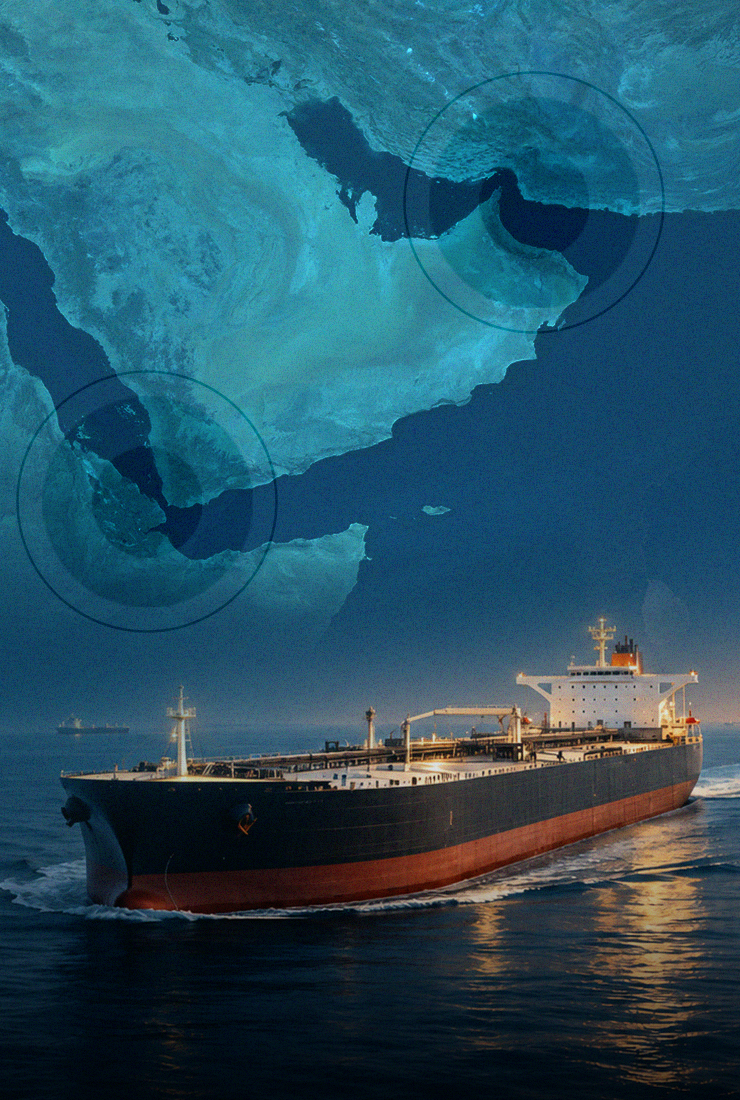
The 2026 conflict involving Iran, the United States, and Israel turned the Strait of Hormuz from a familiar strategic vulnerability into an active theater of geopolitical coercion. At the same time, attacks by Iran-aligned Houthi forces pushed the Bab el-Mandeb and Red Sea back into the center of international energy-security concerns. Oil tankers, LNG carriers, ports, pipelines, and naval vessels have all become exposed to a conflict that now stretches from the Gulf and Arabian Sea to the Red Sea and Eastern Mediterranean.
Against this background, Saudi Arabia, Türkiye, and Pakistan signed the Makkah Joint Defense Agreement on 7 August 2026. It provides a mutual defense clause that an armed attack against any one of the signatories will be regarded as an attack against all, calls for closer political and military consultation, and establishes a permanent secretariat based in Riyadh. The agreement is not a maritime security treaty and does not itself set out patrols, escorts, or a maritime command. Its relevance to shipping depends on how the three governments choose to apply their wider defense cooperation.[1]
A separate initiative that emerged at the same time is the Saudi-led Multinational Maritime Defense Alliance (MMDA), established to promote maritime cooperation in the Bab el-Mandeb, Red Sea, and Gulf of Aden. The two arrangements should not be conflated. The Makkah agreement is a trilateral collective-defense pact; the MMDA is a Saudi initiative specifically concerned with maritime security in designated waterways. They overlap in some participating countries, but neither agreement places the other under a shared command.[2]
The question is whether these political commitments and the maritime initiative can be translated into practical cooperation. Intelligence sharing, port security, crisis communication, and coordination among existing naval and coastguard operations could help reduce risk, but the Makkah agreement does not establish those measures. The MMDA’s remit is also geographically narrower than the connected energy routes at issue. It focuses on the Red Sea, Bab el-Mandeb, and the Gulf of Aden, rather than the Strait of Hormuz or the Eastern Mediterranean. This insight, therefore, asks what the arrangements provide now, what they might enable later, and where their limits remain.
Hormuz as enduring strategic leverage
In 2025, the Strait of Hormuz carried approximately 20 million barrels per day (bpd) of crude oil and petroleum products, of which nearly 15 million bpd are crude and condensate, and around 5 million bpd are products. This represented roughly one-fifth of global seaborne oil trade and about 34% of global crude trade. LNG volumes transiting the strait exceeded 110 billion cubic meters (bcm), almost 20% of global LNG trade, with Qatar accounting for the overwhelming majority. Most of these shipments moved toward Asian markets.[3]
Iran’s geography gives it enduring leverage over this traffic. The narrow navigable channels allow Tehran to threaten shipping through mines, missiles, drones, fast boats, vessel inspections, and warnings without necessarily closing the waterway completely. During the conflict, Iran also created the Strait Authority (SA), seeking to formalize Iranian oversight of passage through permits and possible charges.[4] The U.S.–Iran Islamabad Memorandum of Understanding on June 17 temporarily committed Iran to facilitate safe commercial passage, undertake demining, and discuss the future administration of the strait with Oman and other littoral states. Yet subsequent incidents showed that freedom of navigation remained contested.
The latest attacks have made that contest more dangerous. On 5 September, U.S. Central Command (CENTCOM) said American forces struck three Iranian crude oil carriers after the Islamic Revolutionary Guard Corps (IRGC) launched ballistic missiles toward two U.S. warships. CENTCOM said that the M/T Downy was disabled near Kharg Island, the M/T Stark 1 near Jask, and the unladen M/T Kylo, also known as the Noxen, was destroyed in the Gulf of Oman. Washington described the vessels as part of an IRGC-linked shadow network.[5]
The significance of the strikes goes beyond the loss of three tankers. Commercial oil carriers have become direct instruments in the U.S.–Iran confrontation. Tehran later claimed that it had targeted vessels traveling along unauthorized routes and announced plans for an exclusion zone near Hormuz.[6] Reuters reported that the average number of commodity ships passing through the strait fell to ten per day over the following ten days, the lowest level since May. On a single day, only two vessels crossed, while no very large crude carrier (VLCC) exited the waterway for several days.[7]
This is the environment in which the Makkah pact would operate. Naval cooperation may improve warning and protection, but it cannot remove Iran’s ability to impose costs on shipping. Nor can it guarantee the movement of Qatar’s LNG, which has no meaningful pipeline alternative. The recent tanker attacks have shown that any regional maritime arrangement must deal not only with attacks by non-state groups but also with the risk that commercial vessels will be drawn directly into interstate retaliation.[8]
Red Sea disruptions, rerouting, and market costs
Saudi Arabia’s dependence on both Hormuz and the Red Sea makes it the pact’s most immediate maritime security beneficiary. With traffic through Hormuz severely constrained since late February 2026, Riyadh accelerated the use of the East-West Pipeline to the Red Sea port of Yanbu. Loadings rose from pre-conflict levels near 2 million bpd toward peaks exceeding 5 million bpd in mid-2026. [9]
That shift increased the strategic importance of Bab el-Mandeb. Houthi forces responded by declaring a naval blockade against Saudi-linked shipping on 20 July and attacking tankers and related facilities. Commodity-related vessel transits through the strait fell as shipowners reassessed the risks of using the Red Sea route.[10]
The financial consequences were immediate. War-risk premiums for southern Red Sea and Bab el-Mandeb voyages rose from approximately 0.3% of hull value to more than 1%, with some Saudi-linked vessels and southern ports facing premiums of 2–3%. Hormuz-related premiums reached 7.5–10% during the most acute phases. For a VLCC valued at US$100–US$140 million, the additional insurance cost can reach hundreds of thousands of dollars or more than US$1 million per voyage. Longer diversions around the Cape of Good Hope, higher bunker consumption, demurrage, and reduced fleet availability add further costs. War-risk costs alone were estimated in some analyses to add roughly US$7–$US8 per barrel under extreme conditions.[11]
These costs show why maritime security is not measured only by whether a vessel is hit. A route can remain technically open yet become commercially unattractive because of insurance fees, freight costs, and delays. The Makkah agreement, by itself, does not provide protection for ships or alleviate these vulnerabilities. The MMDA may eventually support better coordination in its area, but its effect will depend on the capabilities and commitments its members put in place.
Bypass pipelines and alternative routes: operational realities versus strategic claims
Saudi Arabia’s East-West pipeline and the UAE’s Habshan–Fujairah pipeline provide the main operational alternatives to Hormuz. Together, however, they can carry only a fraction of the approximately 20 million bpd that passed through the strait in 2025. A second UAE West–East pipeline, reported to be about 50% complete in mid-2026, is intended to increase Fujairah’s export capacity toward 3.6 million bpd. Iran’s Goreh–Jask line and remaining Iraq–Türkiye capacity offer only limited additional relief.[12]
These routes reduce dependence on Hormuz for some Gulf-originated exports, but they do not remove vulnerability. Crude oil moved to Yanbu becomes exposed to the Red Sea and Bab el-Mandeb, while Fujairah faces its own security and congestion risks. Türkiye’s location could support links toward the Eastern Mediterranean, but neither Turkish infrastructure nor existing bypass pipelines can replace Hormuz’s capacity or provide a substitute for Qatar’s LNG. Regional agreements may help governments coordinate responses to disruptions; however, they cannot solve the infrastructure imbalance underlying the crisis.[13]
Design, participants, and practical mechanisms of the pact
To recap, the Makkah Joint Defense Agreement and the MMDA serve different purposes. The Makkah pact is a political and defense commitment among Saudi Arabia, Türkiye, and Pakistan. Its collective-defense clause does not establish a standing maritime command, automatic naval deployments, or scheduled commercial escorts.[14] The MMDA, by contrast, is the maritime initiative for the Bab el-Mandeb, Red Sea, and Gulf of Aden. Its founding statement calls for intelligence and information sharing, operational planning, joint exercises, and maritime operations. It also provides for a joint command, command-and-control centers, a Joint Maritime Operations Center, and a General Secretariat.[15] Public reporting does not specify which ships or aircraft each member would contribute, a regular patrol schedule, or a guaranteed commercial escort service.[16]
Beyond those announced activities, MMDA members might eventually coordinate port security, missile and drone warnings, search-and-rescue, and mine-awareness work. These steps would require further decisions and contributions; they do not follow automatically from the Makkah pact. Their practical value will depend on member governments agreeing on how to share information, assign responsibilities, and contribute personnel or equipment. Saudi Arabia, Türkiye, and Pakistan each have assets that could support cooperation, but the agreement itself does not commit them to a particular maritime deployment.[17]
The MMDA’s stated area is limited to the Red Sea, Bab el-Mandeb, and the Gulf of Aden; Hormuz and the Eastern Mediterranean are outside that remit.[18] On 2 September, Saudi Gazette reported that the initiative had entered its operational phase at a command headquarters. A Saudi commander and a Pakistani deputy commander had taken up their posts, and liaison officers from several member states were in place; additional officers were expected as other states completed their membership procedures. This marks institutional progress, but the report does not establish a standing combined naval force, routine patrols, or commercial escort commitments. Meanwhile, the Makkah agreement remains a separate framework and does not provide those maritime arrangements.[19]
Implications for key regional actors
For Saudi Arabia, the Makkah agreement offers a channel for closer consultation with Türkiye and Pakistan at a time when attacks and disruptions threaten the kingdom’s energy routes. It may support future cooperation, including discussion of technical or defense needs, but it does not yet amount to an agreed system for protecting Yanbu or escorting commercial traffic. Riyadh’s separate MMDA initiative is more directly focused on maritime security; its practical contribution, however, will depend on the capabilities and participation that members provide.[20]
For Türkiye, the Makkah agreement creates a closer defense relationship with Saudi Arabia and Pakistan. Ankara has offered to meet Saudi technical military needs under the pact, but that is not an announced maritime deployment or escort plan. Any maritime contribution will depend on further decisions and coordination with the MMDA and existing naval missions. Pakistan likewise gains a closer security relationship with Riyadh, but its role in any operations will depend on its own priorities and the risks of widening the conflict.[21]
In this context, Gulf states bring different interests and capabilities to regional maritime security. Oman’s engagement with Iran and its diplomatic role give it a distinct place in crisis management, while Qatar remains highly exposed because most of its LNG exports pass through Hormuz. Iraq and Kuwait also depend heavily on the strait for oil exports. The UAE is not a party to the Makkah agreement and was not listed among the states supporting the MMDA’s founding statement, but this should not be mistaken for an absence of maritime security activity or capacity. The region’s security architecture is broader than either initiative, and coordination requires links among states that do not share a single command structure.[22]
The UAE is a major maritime and energy security actor in its own right. Fujairah and Khor Fakkan provide access to the Gulf of Oman and the Indian Ocean, and have become important outlets for trade and energy exports during the Hormuz disruption. The Habshan–Fujairah pipeline allows Abu Dhabi to move some crude oil to an export terminal outside the strait, while the ports and related logistics infrastructure support shipping, storage, and cargo movement. The UAE has also deepened defense cooperation with India in areas that include maritime security, training, exercises, secure communications, and information exchange. These ports, energy links, and partnerships give the UAE a substantial regional role, whether through national capabilities, bilateral cooperation, or future coordination with wider initiatives. They do not, however, place the UAE within the Makkah pact or MMDA command structure.[23]
India has said that it is examining the agreement’s implications for national security and regional stability.[24] New Delhi has an interest in secure Gulf energy supplies and safe Arabian Sea shipping but will monitor any expansion of Pakistan’s naval or intelligence role. Egypt has a direct interest in stable Red Sea and Suez traffic. Israel is not a party to the pact, which limits direct coordination across the Red Sea, Suez, and Eastern Mediterranean.
The role of external powers
The United States remains a major high-end naval actor in the Gulf, Arabian Sea, and Red Sea. Its escorts and surveillance capabilities helped sustain partial commercial movement through Hormuz. At the same time, the September tanker strikes exposed a contradiction in Washington’s role: U.S. forces may protect commercial shipping while attacking Iranian oil carriers. This may strengthen deterrence in the short term, but it also makes U.S.-linked, Iranian-linked, and escorted vessels more politically exposed.[25]
NATO is not a party to the Makkah agreement, and Türkiye’s membership does not automatically extend NATO’s collective-defense obligations to Saudi or Pakistani operations. NATO members may support maritime awareness, logistics, training, and deconfliction, but the alliance is unlikely to enforce freedom of navigation across Hormuz, Bab el-Mandeb, and the Red Sea. European powers contribute through EUNAVFOR Aspides, sanctions coordination, and diplomacy, while China will prioritize the continuity of Gulf oil and LNG supplies without assuming a leading combat role. Russia’s direct maritime influence in these waterways remains limited relative to other external naval actors.
Limitations, distrust, enforcement challenges, and escalation risks
The main challenge in regional agreements is turning political commitments into practical arrangements. The Makkah agreement does not specify whether an attack on a commercial vessel, port, pipeline, or energy terminal would prompt a joint maritime response. It also leaves open how members would make decisions during a fast-moving crisis. The MMDA has established a headquarters and entered its operational phase, but public information still does not detail members’ force contributions, patrol plans, or escort commitments. Each government will decide how much it is willing to contribute and how much risk it is prepared to accept.
Cooperation will also require links with regional states outside the MMDA, especially the UAE and Oman. The UAE’s ports and export infrastructure help keep trade routes open, while Oman’s diplomatic channels can support crisis management. The MMDA’s ability to protect shipping will depend on members sharing information and providing the sensors, air and missile defenses, intelligence, and logistics needed for coordinated operations.
Escalation remains a serious concern. Operations against Houthi forces could lead to further attacks on Red Sea shipping, ports, pipelines, or offshore infrastructure. U.S. strikes on Iranian tankers have also shown how commercial vessels can become part of a retaliatory cycle. If either the Makkah agreement or the MMDA is seen as supporting offensive action, regional energy trade could face greater risks. A clear focus on safe navigation, crisis communication, and protecting civilian shipping would help contain them.
Conclusion: redistribution and management, not structural reduction
The Makkah Joint Defense Agreement could bring Saudi Arabia, Türkiye, and Pakistan into closer defense coordination. Yet, it does not create a standing naval force, guarantee ship escorts, or set procedures for protecting commercial vessels. The MMDA focuses specifically on maritime security in the Red Sea, Bab el-Mandeb, and the Gulf of Aden. Its command headquarters and move into an operational phase mark progress, but its effect on shipping will depend on the capabilities members contribute and how they organize their operations. Neither framework removes Iran’s leverage over Hormuz, replaces U.S. naval capabilities, or provides Qatar with an alternative route for LNG exports.
[1] Ministry of Foreign Affairs, Government of Pakistan, “Makkah Al-Mukarramah Summit for Joint Defence,” August 2, 2026, https://mofa.gov.pk/press-releases/makkah-al-mukarramah-summit-for-joint-defence.
[2] “Founding Members Approve Saudi-Led Maritime Defense Alliance to Safeguard Red Sea, Bab al-Mandab and Gulf of Aden,” Saudi Gazette, July 31, 2026, https://saudigazette.com.sa/article/663373/saudi-arabia/saudi-arabia-to-lead-new-multinational-maritime-defense-alliance.
[3] International Energy Agency (IEA), “Strait of Hormuz,” IEA, last updated February 2026, https://www.iea.org/about/oil-security-and-emergency-response/strait-of-hormuz.
[4] Seth Cropsey and Avi Davidi, “Iran’s Effort to Impose a New Maritime Order in the Strait of Hormuz: The Emergence of a New World Order?” Yorktown Institute, June 25, 2026, https://yorktowninstitute.org/irans-effort-to-impose-a-new-maritime-order-in-the-strait-of-hormuz-the-emergence-of-a-new-world-order/.
[5] U.S. Central Command (CENTCOM), “CENTCOM Destroys 3 IRGC Oil Tankers After Iran Targets 2 U.S. Navy Warships,” September 5, 2026, https://www.centcom.mil/MEDIA/PUBLIC-RELEASES/Article/4591744/centcom-destroys-3-irgc-oil-tankers-after-iran-targets-2-us-navy-warships/.
[6] Samy Magdy, Julia Frankel, and Cara Anna, “Iran Says It Plans to Announce a New ‘Exclusion Zone’ near the Strait of Hormuz,” Associated Press, September 7, 2026, https://apnews.com/article/iran-us-war-strait-hormuz-ship-attack-a52beec77dc90af3d040d0553837ad20.
[7] Florence Tan, “Hormuz Traffic Dips to Lowest Since May after U.S., Iranian Strikes on Ships,” Reuters, September 6, 2026, https://www.reuters.com/world/middle-east/hormuz-traffic-dips-lowest-since-may-after-us-iranian-strikes-ships-2026-09-06/.
[8] Burak Elmalı, “The Makkah Pact: When Security Meets Connectivity,” TRT World Research Centre, August 24, 2026, https://researchcentre.trtworld.com/publications/analysis/the-makkah-pact-when-security-meets-connectivity/.
[9] Al Jazeera Staff, “Saudi Arabia Announces Start of Red Sea Defence Alliance: Will It Work?” Al Jazeera, August 14, 2026, https://www.aljazeera.com/news/2026/8/14/saudi-arabia-announces-start-of-red-sea-defence-alliance-will-it-work
[10] Ibid.
[11] Jonathan Saul, “Red Sea War Insurance Costs Rise After Houthi Blockade, Sources Say,” EnergyNow, July 20, 2026, https://energynow.com/2026/07/red-sea-war-insurance-costs-rise-after-houthi-blockade-sources-say/.
[12] International Energy Agency, “Strait of Hormuz.”
[13] Altaf Moti, “Why There Is No Safe Route out of the Middle East War,” The Arab Weekly, September 15, 2026.
[14] Republic of Türkiye Ministry of Foreign Affairs, “Strategic Political and Defence Committee of the Makkah Agreement for Joint Defence, Joint Statement, 31 August 2026,” August 31, 2026, https://www.mfa.gov.tr/strategic-political-and-defence-committee-of-the-makkah-agreement-for-joint-defence–joint-statement–31-august-2026.en.mfa.
[15] “Founding Members Approve Saudi-Led Maritime Defense Alliance,” Saudi Gazette, July 31, 2026, https://saudigazette.com.sa/article/663373/saudi-arabia/saudi-arabia-to-lead-new-multinational-maritime-defense-alliance.
[16]Al Jazeera Staff, “Saudi Arabia announces maritime defence alliance to secure vital waterways,” Al Jazeera, July 30, 2026, https://www.aljazeera.com/news/2026/7/30/saudi-arabia-announces-maritime-defence-alliance-to-secure-vital-waterways
[17] Cao Jiaxuan, “Houthi Attacks on Saudi Arabia Test Limits of Mecca Regional Security Pact,” South China Morning Post, September 26, 2026, https://www.scmp.com/news/china/diplomacy/article/3368857/houthi-attacks-saudi-arabia-test-limits-mecca-regional-security-pact.
[18]Al Jazeera Staff, “Saudi Arabia Announces Start of Red Sea Defence Alliance.”
[19] “Multinational Maritime Defense Coalition Begins Operations from Command Headquarters,” Saudi Gazette, September 2, 2026, https://saudigazette.com.sa/article/664252/saudi-arabia/multinational-maritime-defense-coalition-begins-operational-phase
[20] Al Jazeera Staff and News Agencies, “Saudi, Turkish, Pakistani Chiefs Plan Urgent Talks Amid Yemen Fighting,” Al Jazeera, September 25, 2026, https://www.aljazeera.com/news/2026/9/25/saudi-turkish-pakistani-chiefs-plan-urgent-talks-amid-yemen-fighting.
[21] “Turkey Says It Could Help Meet Saudi Military Needs under Defence Pact,” Reuters, September 19, 2026, https://www.reuters.com/business/aerospace-defense/turkey-says-it-could-help-meet-saudi-military-needs-under-defence-pact-2026-09-19/.
[22]Ministry of Foreign Affairs, Government of Pakistan, “Makkah Al-Mukarramah Summit for Joint Defence.”
[23] “Gulf’s Fragile Trade Lifeline Hangs on Two Eastern UAE Ports,” Reuters, May 6, 2026, https://www.reuters.com/world/middle-east/gulfs-fragile-trade-lifeline-hangs-on-two-eastern-uae-ports-2026-05-06/.
[24] ANI, “‘Examining Implications’: India Reacts to Pakistan-Saudi-Turkey Defence Pact,” The Tribune, August 11, 2026, https://www.tribuneindia.com/news/world/examining-implications-india-reacts-to-pakistan-saudi-turkey-defence-pact/.
[25] Zachary Cohen and Adam Cancryn, “60 Targets Struck, 18M Barrels of Oil Protected: The US Military’s Latest Strikes against Iran Marked a Shift in Strategy,” CNN, September 2, 2026, https://edition.cnn.com/2026/09/02/politics/latest-us-strikes-against-iran-marked-a-shift-in-strategy.