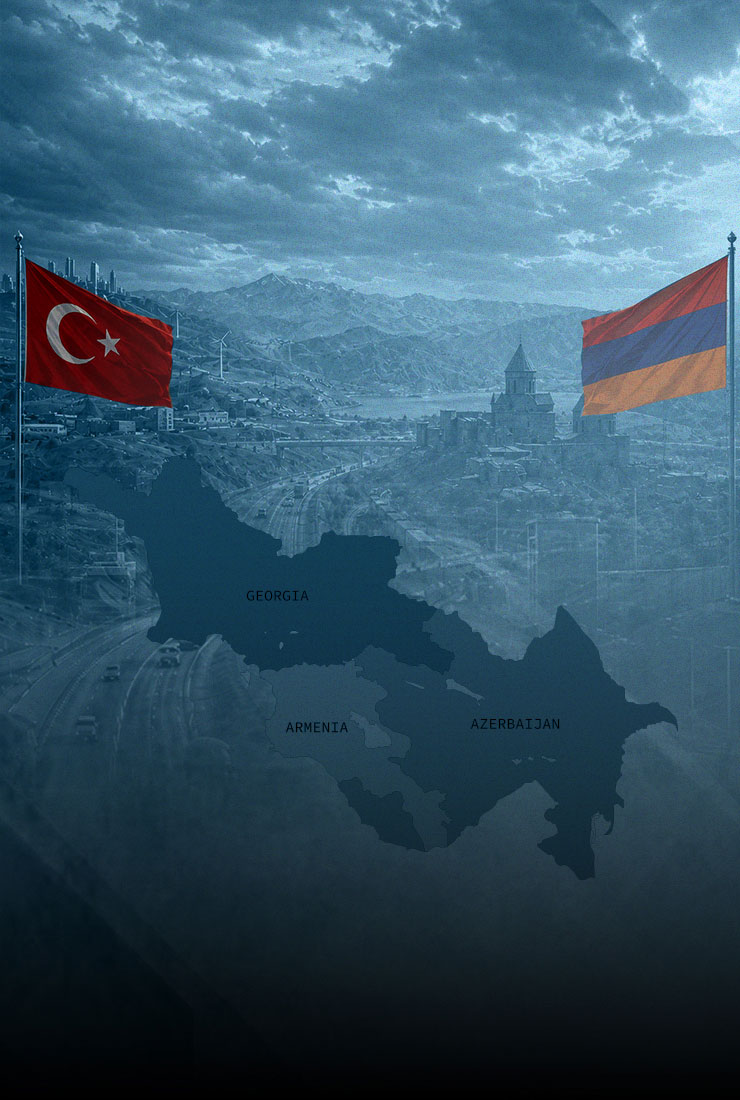
Following nearly three decades of protracted conflict, Azerbaijan and Armenia reached a landmark peace agreement in Washington on 8 August 2025, brokered by U.S. President Donald Trump. This historic accord marks a turning point in the South Caucasus, opening new horizons for economic cooperation, regional trade, and prosperity in a once war‑torn landscape. The agreement, dubbed the Washington Declaration and consisting of 17 points, aims to establish peace and interstate relations between the two parties.[1] While the agreement sought to close the chapter on enmity between Baku and Yerevan, it also laid the foundation for a more comprehensive partnership, particularly in interregional trade and energy, by launching strategically significant transportation projects.[2]
As such, the new declaration formalized the establishment of a 44‑km transit corridor, designated the Trump Route for International Peace and Prosperity (TRIPP), linking Azerbaijan’s mainland with its Nakhchivan exclave and onward to Türkiye through Armenia’s Syunik province. Despite initial criticism from Russia and Iran, the firm commitment of Azerbaijan and Armenia, backed by U.S. endorsement, to create this route and a broader network of strategic infrastructure for unhindered connectivity in the South Caucasus signaled a profound shift in the regional geopolitical landscape.[3]
However, Türkiye, Azerbaijan’s closest strategic ally and a key supporter of Baku during and after the 2020 war, was not mentioned in the new declaration, even though it provided significant support to Baku during and after the 2020 war. Since 1991, Ankara and Yerevan have lacked diplomatic relations, and the Turkish-Armenian border has remained closed since 1993.[4] Nevertheless, in the context of the ongoing Armenia–Azerbaijan peace process, Turkish officials repeatedly stated that Türkiye is prepared to normalize relations with Armenia once a final peace agreement between Baku and Yerevan is concluded. While maintaining its close alignment with Baku, Ankara has continued direct contacts with Armenia and has framed normalization as part of a broader regional peace and stability agenda rather than as an unconditional bilateral rapprochement.[5]
Current state of bilateral normalization
The current normalization process between Türkiye and Armenia after the second Karabakh war in 2020 is not a coincidence, but the result of a long and tumultuous diplomatic maneuver and the shift in the regional balance of power in favor of the Baku-Ankara axis. With the military victory in Karabakh, Türkiye and Azerbaijan established a more comprehensive regional partnership framework covering vital fields such as defense, trade, energy, and transportation, with certain benefits. From a pragmatic point of view, such a deep partnership allows the Baku-Ankara axis to prevent any external actor from using the post-conflict situation as leverage. Hence, Azerbaijan sought to maintain relations with all neighbors and avoid becoming dependent on any particular power for its security.[6] Undoubtedly, such an approach diminished Russian influence, enabling Baku, Yerevan, and Ankara to pursue a more pragmatic diplomatic line.
As such, over the last two years, Azerbaijani and Armenian authorities have openly highlighted progress in normalization between Baku and Yerevan and the establishment of interstate relations between the two countries.[7] Hence, the positive dynamics in bilateral relations facilitated a new phase of normalization between Yerevan and Ankara, undertaken with Baku’s consent. In this context, Türkiye’s engagement reflects a broader regional recalibration, where trilateral coordination is gradually reshaping the contours of South Caucasus diplomacy.[8] Nevertheless, Azerbaijan’s demand for constitutional amendments in Armenia, together with the outcome of critical parliamentary elections, remains the principal obstacle to the final phase of normalization with Ankara.
Consequently, Türkiye and Armenia have finalized the bureaucratic preparations to initiate direct trade, according to the Turkish Foreign Ministry spokesperson, Oncü Keçeli, in a recent statement. He noted that the preparations were completed on 11 May as part of the confidence‑building measures undertaken within the normalization process launched in 2022. The historical decision of Ankara marked another milestone in the “bilateral normalization process” in Armenia, while Turkish Airlines operated its first direct flight between Istanbul and Yerevan in March 2026.[9]
The European Union (EU) also reiterated its support for the steadily advancing normalization between Ankara and Yerevan, highlighting new opportunities to expand trade and economic cooperation with mutual benefits for both the South Caucasus region and the EU.[10] For example, amid the process, on 13 May, Turkish Foreign Minister Hakan Fidan approved streamlined regulations for goods moving to/from Türkiye and Armenia via third countries.[11] The launch of direct trade operations with Yerevan coincided with the visit of Turkish Vice President Cevdet Yılmaz to Yerevan on 4 May, marking the first visit by a high-level official in nearly two decades.[12]
Notwithstanding the strong commitment in Ankara and Yerevan to advance diplomatic rapprochement, the process has been far from seamless. Türkiye’s alignment with Baku’s firm stance has prolonged the normalization process since 2022. Therefore, on some occasions, it triggered certain levels of criticism within the Armenian government, as the head of the Armenian National Assembly, Alen Simonyan, claimed that “Türkiye has, in a way, become a hostage of its close relations with Azerbaijan.”[13] Indeed, this statement signaled Yerevan’s dissatisfaction with Türkiye’s leadership, openly linking the normalization process to the Armenian-Azerbaijani peace agenda from the very outset in 2020.
Since the launch of the normalization process in 2022, Prime Minister (PM) Nikol Pashinyan’s government has made significant efforts to separate the tracks with Ankara and Baku, yet these attempts have ultimately proven unsuccessful.[14] Moreover, Simonyan’s statement fails to capture the full picture, as Türkiye has never publicly cast Azerbaijan as an obstacle but rather as a co-stakeholder whose interests are organically embedded in Ankara’s strategic calculus. In this context, Azerbaijan’s pro‑government portal Caliber.az harshly criticized Simonyan’s biased stance, refuting his claims that Baku exerts undue influence over Ankara’s normalization efforts with Yerevan.[15] Azerbaijan emphasizes that the Baku-Ankara axis does not operate through coercion, but through a shared strategic framework.
Against the backdrop of shifting geopolitical dynamics in Eurasia and the Middle East, marked by the U.S.-Iran confrontation and the Russo‑Ukrainian war, alongside emerging security challenges, Armenia has shown greater enthusiasm for mending ties and reopening its border with Türkiye. The current war in Iran, with spillover risks, has largely limited Armenia’s land transit options to Georgia, which is yet another important catalyst behind the normalization efforts with Ankara. This approach reflects Yerevan’s effort to diversify partnerships and reduce dependence on a single regional power, namely Russia. A thaw with Türkiye and the reopening of the border would provide a significant boost to Armenia’s domestic market by facilitating the transit of Armenian goods to Europe and attracting Turkish investment, thereby diminishing Russia’s long‑term leverage.[16] Although Russia formally backs the Armenia-Türkiye normalization process, it sees the process as another challenge and the rise of an external influence on its southern borders.[17] On the other hand, Armenia views rapprochement with Türkiye as a pivotal step toward strengthening interregional partnerships, advancing the peace agenda, and establishing reliable communication channels with Europe ahead of the critical June elections. Hence, recently, PM Nikol Pashinyan skipped his usual trip to Moscow for Russia’s all-important 9 May Victory Day commemoration, as Armenia had begun to drift away from Russian influence in recent years.[18]
From Moscow’s perspective, Armenia’s drive to restore ties with Türkiye and reopen the border is viewed as an explicit manifestation of Yerevan’s fledgling EU aspirations, undertaken at the expense of Russia’s traditional dominance. Therefore, debates in Yerevan suggest that Russia may act as a spoiler to derail the normalization process by instrumentalizing economic tools.[19] This scenario underscores Yerevan’s urgency in finalizing a direct trade agreement with Ankara and its strong commitment to reopening the border at the earliest opportunity.
In this vein, the Armenian authorities seem optimistic that the future steps in the normalization process with Ankara could include opening the Gyumri-Kars railway to foster bilateral trade.[20] Given Armenia’s ruling government’s cordial relations with the EU amid the upcoming elections and deepening anti-Russian narratives, Brussels issued a statement underscoring that the normalization process could expand trade and economic opportunities across the region, benefiting both the South Caucasus and the EU.[21] Nevertheless, amid the ongoing normalization process, Türkiye’s cautious stance and close coordination with Azerbaijan suggest that Ankara seeks to maintain the upper hand while avoiding the influence of any regional or external actor.
Out of pragmatism, Türkiye, as Azerbaijan’s principal strategic ally with broader geopolitical ambitions in Eurasia, seeks long‑term perspectives in normalizing ties with Armenia rather than short‑term gains. Accordingly, its firm stance on the Azerbaijan-Armenia peace process should come as little surprise. A final peace treaty between Yerevan and Baku would set a positive precedent for deeper reconciliation with Ankara, opening new horizons for trade and joint infrastructure projects, and positioning Türkiye as a logistical, commercial, and economic hub for the wider region.[22]
As noted above, Türkiye’s pragmatic approach to normalization with Armenia, its role in the peace process with Azerbaijan, and its pursuit of long‑term benefits can be attributed to Ankara’s interest in advancing the TRIPP project, which would further consolidate its position as the region’s principal gateway to Europe and vice versa. Yet, the full implementation and smooth operation of such a critical infrastructure initiative will depend on resolving outstanding political and historical disputes.
Although Türkiye sees greater prospects in reconciliation with Armenia, the peace process between Azerbaijan and Armenia has advanced slowly, largely due to the June elections. Baku is closely monitoring Armenia’s domestic situation, while Azerbaijan’s ambassador to Türkiye, Rashad Mammadov, recently stated that both the Armenia-Türkiye and Armenia-Azerbaijan land borders could be opened following Armenia’s 7 June parliamentary elections and constitutional referendum. Azerbaijan hopes the vote will lead to constitutional reforms that remove what it considers to be Armenia’s “territorial claims” against Azerbaijan.[23]
Conclusion
The ongoing normalization process between Armenia and Türkiye and its earlier repercussions highlight the emergence of a new geopolitical reality in the South Caucasus that occurred in the post-Karabakh War in 2020 between Azerbaijan and Armenia. While the war significantly shifted the regional balance of power in the Eurasian region, it also paved the way for greater geopolitical rivalry over the critically important region. Indeed, political disputes and traumatic collective memory of the South Caucasus region constrained the pace of rapprochement, though Ankara and Yerevan acknowledged the strategic and economic benefits of restoring diplomatic ties amid global geopolitical uncertainty.
Türkiye, as the “middle power” and one of the main regional stakeholders, took a cautious but pragmatic approach toward the normalization of ties with Armenia, closely linking it to the progress of the Armenia-Azerbaijan peace process. Indeed, such a stance aimed at ensuring Ankara’s long-term regional ambitions, enabling it to preserve the strategic coherence of the Baku-Ankara axis. This allows Türkiye to position itself as a central logistical and economic hub connecting Europe, the South Caucasus, and Central Asia. Ambitious regional projects like TRIPP and the border reopening between Armenia and Türkiye could reshape regional trade patterns, thereby challenging traditional actors, namely Russia’s influence. Notwithstanding Türkiye’s partnership with Russia on numerous issues, both regional powers remain undisputed rivals for influence in the energy-rich South Caucasus and Central Asia.
As such, the normalization process with Armenia remains vulnerable to domestic political developments, though there has been some progress and strong Western support. The current momentum indicates that Ankara and Yerevan are pursuing an interest-driven framework for engagement after decades of neglect. Hence, with the West’s continuous support, commitment at home, and a durable peace treaty between Armenia and Azerbaijan, Türkiye-Armenia normalization could become a key pillar of an interconnected and economically integrated South Caucasus.
[1] Ministry of Foreign Affairs of the Republic of Armenia, Initialed the Armenia-Azerbaijan peace agreement text, August 11, 2025, https://www.mfa.am/en/press-releases/2025/08/11/Initialed%20Arm-Az%20Peace%20Agreement%20text/13394.
[2] Ibid.
[3] Jack Halsey and Toghrul Ali, “Armenia and Azerbaijan implement peace: Next steps in constructing the TRIPP,” Caspian Policy Center, February 2, 2026, https://www.caspianpolicy.org/research/category/armenia-and-azerbaijan-implement-peace-next-steps-in-constructing-the-tripp
[4] Thomas de Waal, “The Armenia–Azerbaijan Peace Process and the Role of Turkey,” SUITS Policy Brief, 2025:4, Stockholm University Institute for Turkish Studies, December 2025, https://www.su.se/download/18.50ef4fa119afcffccc73427/1765811684914/SUITS%20Policy%20Brief%20The%20Armenia%20Azerbaijan%20Peace%20Process%20Waal.pdf.
[5] “Türkiye links normalization with Armenia to Azerbaijan peace deal, says FM Fidan,” Türkiye Today, November 19, 2025, https://www.turkiyetoday.com/nation/turkiye-ties-normalization-with-armenia-to-azerbaijan-peace-deal-says-fm-fidan-3210079.
[6] Laura Linderman, “Divergent Paths in the South Caucasus,” Silk Road Studies Program, March 6, 2026, https://www.silkroadstudies.org/publications/joint-center-publications/item/13574-divergent-paths-in-the-south-caucasus.html.
[7] Vafa Guliyeva, “Azerbaijani official highlights progress in Baku–Yerevan normalization,” Caliber.Az, May 15, 2026, https://caliber.az/en/post/azerbaijani-official-highlights-progress-in-baku-yerevan-normalization
[8] “Azerbaijani ambassador says Turkey-Armenia border to open after Armenian constitutional changes,” Turkish Minute, May 19, 2026, https://www.turkishminute.com/2026/05/19/azerbaijani-ambassador-says-turkey-armenia-border-to-open-after-armenian-constitutional-changes/.
[9] “Turkey, Armenia complete preparations to launch direct trade in push for normalization,” Turkish Minute, May 13, 2026, https://www.turkishminute.com/2026/05/13/turkey-armenia-complete-preparations-to-launch-direct-trade-in-push-for-normalization/
[10] “Armenia’s ruling party wins majority in parliamentary elections,” May 20, 2026, Interfax. https://interfax.com/newsroom/top-stories/117558/
[11] Republic of Türkiye Ministry of Foreign Affairs, Statement by Foreign Ministry spokesperson Öncü Keçeli on the launch of direct trade between Türkiye and Armenia, May 11, 2026, https://www.mfa.gov.tr/sc_-6_-disisleri-bakanligi-sozcusu-oncu-keceli-nin-ulkemiz-ile-ermenistan-arasinda-dogrudan-ticaretin-baslatilmasi-hk-sc.tr.mfa
[12] “Türkiye says preparations completed for direct trade with Armenia,” Daily Sabah, May 13, 2026, https://www.dailysabah.com/business/economy/turkiye-says-preparations-completed-for-direct-trade-with-armenia.
[13] “Opinion: Is Azerbaijan to blame for the delay in normalizing relations between Turkey and Armenia?,” JAMnews, April 23, 2026.
[14] Ibid.
[15] Murad Abiyev, “Setting the focus,” Caliber.az, April 21, 2026, https://caliber.az/en/post/setting-the-focus.
[16] “Russia wants Armenia back in the fold. It may be too late,” The Moscow Times, May 20, 2026, https://www.themoscowtimes.com/2026/05/20/russia-wants-armenia-back-in-the-fold-it-may-be-too-late-a92801.
[17] “Russia backs possible swift normalization of Armenia-Turkey relations – Zakharova,” Armenpress, May 21, 2026, https://armenpress.am/en/article/1230004.
[18] “Armenia and Russia: Drifting apart,” Carnegie Endowment for International Peace, January 2026, https://carnegieendowment.org/russia-eurasia/politika/2026/01/armenia- -drifting-apart.
[19] “The Armenian–Turkish Normalization Process,” Discussion Paper, Konrad-Adenauer-Stiftung, March 7, 2025, https://www.kas.de/de/web/suedkaukasus/publikationen/einzeltitel/-/content/the-armenian-turkish-normalization-process.
[20] “Türkiye to launch direct trade with Armenia,” Hürriyet Daily News, May 13, 2026, https://www.hurriyetdailynews.com/turkiye-to-launch-direct-trade-with-armenia-222101.
[21] European External Action Service, Türkiye/Armenia: Statement by the Spokesperson on the initiation of bilateral trade, May 13, 2026, https://www.eeas.europa.eu/eeas/t%C3%BCrkiyearmenia-statement-spokesperson-initiation-bilateral-trade_en.
[22] Mamie Powers, “Türkiye and Armenia Initiate Official Bilateral Trade,” Jamestown Foundation, May 14, 2026, https://jamestown.org/turkiye-and-armenia-initiate-official-bilateral-trade/.
[23] “Azerbaycan Büyükelçisi Reşad Memmedov Cumhuriyet’e konuştu,” Cumhuriyet, May 20, 2026, https://www.cumhuriyet.com.tr/turkiye/azerbaycan-buyukelcisi-resad-memmedov-cumhuriyet-e-konustu-2504606.