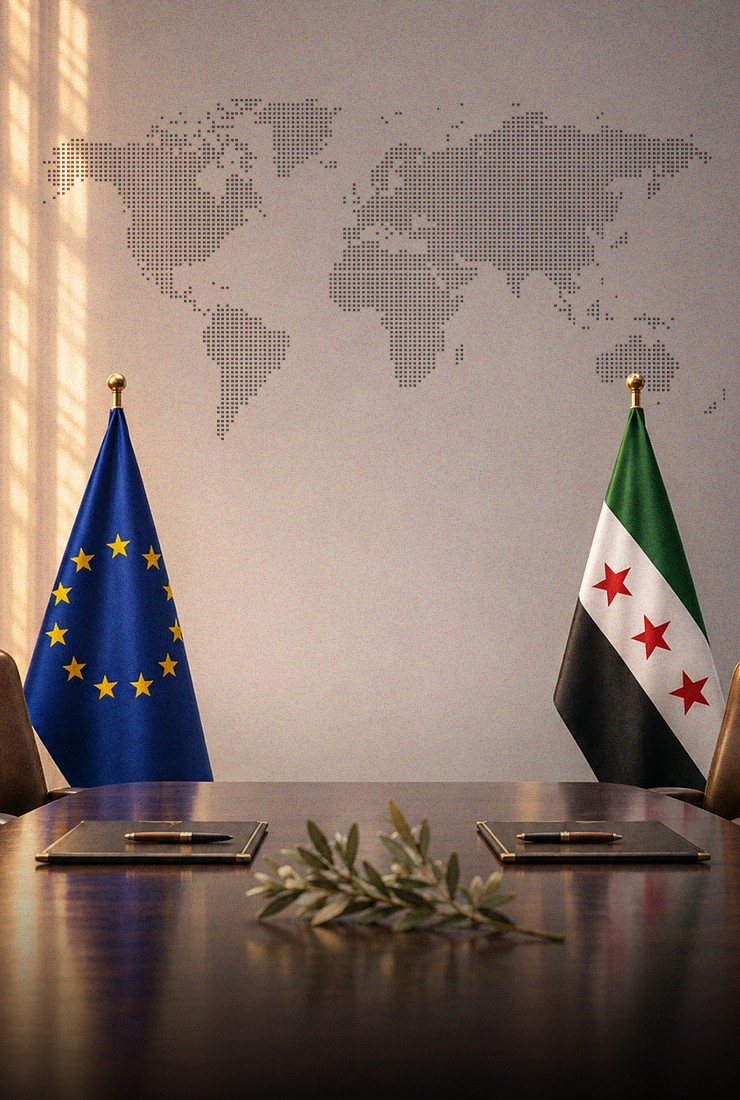
Since the fall of Bashar Al-Assad’s government in December 2024, relations between Syria and the European Union have undergone a fundamental transformation, unlike in any other aspect of the EU’s Middle East policy. During the Assad era, Brussels had largely isolated Damascus politically, imposed extensive economic sanctions and redirected most of European assistance toward humanitarian organizations, refugees and Syrian civil society outside the country rather than the Syrian state. Since December 2024, that dynamic in the relationship has been changing. Syria is gradually being reintegrated into the global economy, and the EU has emerged as an actor with a powerful toolkit to shape Syria’s behavior and play a central role in the reconstruction of the country. The EU wants political stabilization, the return of refugees, economic reconstruction and limits on the potential return of Russian or Iranian influence. Some steps have already been taken: Brussels lifted broad economic sanctions in 2025, restored the full EU-Syria Cooperation Agreement in May 2026 and initiated high-level political engagement with Syria’s transitional authorities. Syria wants as many diversified foreign partnerships as possible, and close ties with the EU fit into Damascus’ efforts to develop a multi-vector foreign policy.
Back in the game
Within less than two years since the end of the Assad dynasty in Syria and the establishment of a new de facto government in late 2024, the Arab country has achieved major success in reintegrating itself into the Middle East economy and regional connectivity projects. Moreover, Syria, with the near-complete lifting of sanctions from the U.S., is now back into the global economy.
Changes took place in geopolitical alignment as well. Since early 2025, when a new Syrian government was formed, the country’s pool of geopolitical partners has changed radically. Iran, the Assad family’s closest ally, lost its influence in Syria—ties between Damascus and Tehran were brought to a minimum. Russia, represented by its sprawling military presence centered on Syria’s two coastal military bases in Tartus and Hmeimim, has likewise lost its privileged position—Damascus reclaimed control over the two bases and, as per the new Russia-Syria military agreement,[1] Moscow is only allowed to use the bases in a limited capacity, most probably as a means to link up with its troops on the African continent.[2]
With Iranian withdrawal and Russia’s weakened position, other players emerged, among which Türkiye, the Gulf states and the U.S. have stood out most prominently. These powers possess financial resources, military power and the economic means to help stabilize Syria’s fragile government and rebuild the country. Yet, one less mentioned but potentially no less consequential actor is the EU.
EU-Syria ties prior to 2026
When the Assad dynasty’s rule ended, the EU responded by stating on 9 December 2024 that the collapse of the Syrian government was a historic development.[3] Brussels emphasized the country’s territorial integrity, sovereignty and state institutions, and called for an inclusive political transition, protection of minorities, rejection of extremism and accountability for crimes committed during the civil war. Counterterrorism and the destruction of Syria’s remaining chemical-weapons capabilities were also identified as European priorities. This is important because the EU’s approach toward Syria has remained largely the same, with a varying dose of pragmatism.
In early January 2025, French Foreign Minister Jean-Noël Barrot and German Foreign Minister Annalena Baerbock, in what was the first major visit by EU countries’ foreign ministers following the change of government, traveled to Damascus to meet Ahmed Al-Sharaa, the country’s new ruler.[4] Their message combined an offer of engagement with explicit conditions concerning political inclusiveness, minority rights and the rejection of extremism. This set the groundwork for a European approach to a post-Assad Syria: engagement in return for political moderation and institutional inclusion.
In the following months, practical steps were taken. Representatives of Syria’s transitional authorities participated for the first time in the March 2025 Brussels Conference dedicated to the Arab country.[5] The change is all the more significant given that previous Brussels conferences had largely been donor conferences with no representation from the Assad government. In March 2025, discussions on Syria’s reconstruction and political future moved toward direct dialogue with the Syrian government, and the international donors pledged approximately €5.8 billion for the Arab country and neighboring states.[6] European funding continues to target humanitarian assistance, refugees and neighboring host countries. What matters is the conceptual change that took place: European financing looks beyond emergency humanitarian relief and increasingly incorporates early recovery, economic stabilization, public services and institutional reconstruction.
The EU continued to attach political expectations to its engagement. Events on Syria’s Mediterranean coast in March 2025 demonstrated the limits of European involvement. After violence involving Assad loyalists, government-aligned forces and civilians, the EU condemned attacks by pro-Assad militias but also condemned killings of civilians reportedly carried out by forces associated with the transitional authorities. In June 2025, for example, the EU sanctioned five Syrians linked to serious abuses and sectarian violence.[7]
The broader political framework for bilateral relations was formalized in June 2025 when the EU endorsed a Syrian-led transition based on national reconciliation, accountability, rule of law, separation of powers and protection of fundamental freedoms.[8] It simultaneously declared its willingness to work with the transitional government in international and regional institutions. Thus, by mid-2025, the EU had shifted from a policy of isolation of the Syrian state to conditional engagement with the new Syrian state.
An important change in Syria-EU relations was the dismantling of the sanctions regime imposed by Brussels on the country after 2011. The first major step came on 24 February 2025, when EU governments suspended a large part of the restrictions affecting strategically important sectors in Syria, such as oil, natural gas, electricity, and transportation spheres.[9] Brussels also eased financial transactions necessary for reconstruction and humanitarian activities. Five Syrian financial and commercial entities were removed from asset-freeze restrictions: the Industrial Bank, Popular Credit Bank, Saving Bank, Agricultural Cooperative Bank and Syrian Arab Airlines. Transactions involving the Syrian Central Bank were also facilitated. For years, even economic transactions technically permitted by sanctions were often avoided by European banks because of compliance risks. Removing Syrian banks and public enterprises from sanctions lists was therefore an attempt to reconnect Syria with formal international finance.
The second critical change came in May 2025 when the EU governments reached the political decision to lift their economic sanctions against Syria.[10] The Council explicitly described the approach as gradual and reversible but argued that Syria required access to economic activity if reconstruction and political stabilization were to succeed. Brussels removed remaining economic sanctions, except measures justified on security grounds. Twenty-four entities were removed from EU asset-freeze lists, including the Central Bank of Syria and organizations operating in oil production, refining, telecommunications and other economically important sectors. From then on, European companies were allowed to deal with Syrian energy, transport, banking and commercial institutions, and the Arab country could again seek European technology, equipment, and establish commercial and financial partnerships with the EU institutions.
Some restrictions, nevertheless, remained, including arms embargo, controls on dual-use items and equipment that could facilitate internal repression or surveillance, restrictions involving Syrian cultural property, and sanctions against individuals and networks connected with the former Assad government. In May 2026, these targeted sanctions against former Assad-regime networks were extended for another full year.[11]
Additionally, on 9 January 2026, European Commission President Ursula von der Leyen and European Council President António Costa traveled to Damascus and met President Ahmed Al-Sharaa.[12] The trip marked the transition from sanctions normalization toward the construction of a new bilateral relationship. Von der Leyen presented a framework based on three pillars: a new political partnership; stronger economic and trade cooperation; and approximately €620 million in financial support for 2026-2027, covering humanitarian assistance, early recovery and bilateral assistance. The €620 million package is intended in part to restore basic public services, help rebuild state institutions and support economic recovery. Moreover, the European Commission also invited the European Investment Bank (EIB) to explore a resumption of activity in Syria, suspended after 2011.
Migration also forms part of the economic logic. Von der Leyen explicitly connected recovery assistance with creating conditions under which Syrians abroad might eventually return voluntarily and rebuild their lives, while emphasizing cooperation with Türkiye, Lebanon, Jordan and UNHCR on safe and dignified returns.
This creates an intersection between European domestic politics and Syrian reconstruction: European governments have an interest in Syrian economic stabilization not only for geopolitical reasons but also because sustainable voluntary refugee return is difficult without employment, housing, infrastructure and functioning state services.
Bilateral relations further advanced on 11 May 2026, when Brussels hosted the first EU-Syria High-Level Political Dialogue, where issues of bilateral relations, Syria’s transition, regional security, reconstruction, socio-economic recovery and protection of the rights of Syrian citizens were discussed.[13] On the same day, the EU and Syrian authorities co-chaired the Syria Partnership Coordination Forum, bringing together EU member states, international partners, the United Nations and international financial organizations to coordinate assistance, reconstruction and development around Syrian priorities. The EU has also sought to preserve a role for Syrian civil society.
Perhaps the clearest indication of how fundamentally the relationship has changed came in September 2026. In a significant development, Michael Ohnmacht presented his credentials to Syrian President Ahmed Al-Sharaa on September 6, marking the first instance since 2012 that the European Union had ambassador-level representation in the Arab country.[14]
No less significant is what Brussels and Damascus are now discussing. The EU ambassador stated that he intends to work toward establishing an EU-Syria Association Agreement, while Foreign Minister Asaad Al-Shaibani has also expressed support for moving quickly toward negotiations. Such an agreement would be much more ambitious than the restored 1977 Cooperation Agreement. It could eventually create a broader framework covering political dialogue, trade, investment, regulatory cooperation and Syria’s reintegration into the Euro-Mediterranean economic system. As of September 2026, however, a new Association Agreement had not yet been concluded. It represents the next potential stage of the relationship rather than an accomplished fact.
The EU calculus
The EU’s interests in Syria range from trade, connectivity, investments, to the safe return of Syrian migrants as well as countering Russia’s influence in the Arab Republic and the wider Middle East. Developing continental trade is indeed important for Brussels. The EU wants to integrate Syria into the India-Middle East-Europe Economic Corridor (IMEC),[15] which was unveiled in 2023 but has largely stood idle due to the war in Gaza and the failed reconciliation between Saudi Arabia and Israel. Syria was not originally part of the IMEC, but the fall of the Assad dynasty has created incentives to include the country in the project. This comes as a logical proposition given Syria’s geographic location as an important country in the Mediterranean basin. The IMEC will allow the EU to project economic power deep into the Middle East beyond its traditionally close ties with Egypt and Türkiye. Then, there is also the EU’s push to rebuild once-flourishing commercial ties with Syria.
Indeed, in 2010, a year before the civil war in Syria broke out and sanctions were imposed on the Arab country, the EU-Syria trade exceeded €7 billion. By 2025, total trade amounted to only €556 million. EU exports to Syria were approximately €391 million, while imports from Syria were around €165 million.[16] The scale of trade remains less than one-tenth of its pre-war peak. This radical contraction of commercial ties highlights the untapped potential that exists. European exports to Syria in 2025 included machinery, medical and optical equipment, fuels, vehicles, cereals, iron and steel, plastics and pharmaceuticals. Syrian exports to the EU included petroleum products, fruit and nuts, vegetables, spices and agricultural products. Bilateral trade is therefore expected to grow, given another important institutional development that came in May 2026, when the EU restored the full application of the EU-Syria Cooperation Agreement.[17] The agreement, dating from the late 1970s, was partially suspended in 2011. Its restoration reactivated provisions facilitating trade, including the elimination of EU customs duties on most Syrian industrial products and restrictions on quantitative trade barriers. This means that the relationship is moving toward rebuilding the legal architecture through which Syrian companies could eventually gain greater access to the European market.
The EU is also interested in providing support for the Syrian authorities to improve their fragile institutional capacities. European participation could eventually be particularly relevant in electricity, water infrastructure, telecommunications, transportation, healthcare, machinery and municipal reconstruction—sectors in which Syria has enormous capital requirements but limited domestic financing capacity. Improving institutional capacities is an important point. For Brussels, a strong Syria will serve as a guarantee against potential future mass migration, as it happened during the Syrian civil war. A strong Syria also means that security threats such as terrorism and extremism are reduced.
From the EU perspective, a strong Syria is likewise critical for a geopolitical balance of power in the Middle East, where Israel’s influence has grown, setting the course for long-term competition with Türkiye. If the EU limits itself only to humanitarian financing while regional actors shape security institutions, investment rules and reconstruction frameworks, Europe could end up paying much of Syria’s stabilization cost without acquiring corresponding political influence. The rapprochement, therefore, reflects an effort to obtain a seat at the table while Syria’s post-Assad institutions are being shaped. In this regard, the April 2026 EU planning is quite revealing: the EU’s agenda included not only trade and reconstruction but also security cooperation, police training, counterterrorism, organized crime, refugee return and political dialogue.
This is why official EU documents repeatedly connect engagement with stabilization, socio-economic recovery and an inclusive political transition. The first EU-Syria High-Level Political Dialogue in May 2026 explicitly addressed not only bilateral relations but also regional stability and security.[18] The EU has concluded that the economic isolation of post-Assad Syria could become counterproductive. If the Syrian economy remains dysfunctional, government institutions remain weak and large sections of the population see little material improvement, political fragmentation and renewed conflict become more difficult to contain.
Syria’s calculus
For Damascus, the central driver is Syria’s economic condition. Years of war, sanctions, infrastructure destruction, capital flight and isolation left the country with enormous reconstruction needs and weak access to international finance. The new authorities, therefore, have a strong incentive to dismantle the sanctions system inherited from the Assad period and reconnect Syria with European banking, investment and trade.
For Damascus, this matters because Europe can provide access to a large regulated market, European financial institutions, industrial technology, development expertise and eventually substantial private-sector investment. The €620 million EU package announced for 2026-2027, covering humanitarian aid, early recovery and bilateral support, illustrates that the relationship is already moving from sanctions relief toward economic reconstruction.
In Syria, economic normalization is closely connected to political legitimacy. Establishing normal relations with Brussels helps Damascus demonstrate that the new political order is being accepted internationally, in contrast to the isolation that the Assad regime experienced for more than a decade. This explains why engagement with the EU has progressed alongside Syria’s relationships with Gulf states and Türkiye rather than replacing them. Syria’s new government is pursuing what seems to be a multi-vector foreign policy. For Damascus, a broad network of external partners also reduces excessive dependence on any one patron. Türkiye possesses particularly substantial political, security and economic influence in post-Assad Syria, while Qatar and Saudi Arabia have important financial capabilities. European engagement gives the Syrian authorities another major political and economic pole with which to work. The post-Assad environment resembles a competition for influence involving Türkiye, Gulf states, Europe and other powers. With all that in store, the EU is seen by Syria as another important piece in the intricate balancing game the country has played.
Conclusion
The transformation of EU-Syria relations since December 2024 has been remarkably rapid. Within roughly twenty-one months, the EU moved from comprehensive economic sanctions and minimal governmental contact to restored diplomatic representation, removal of broad economic sanctions, renewed formal trade arrangements, financial assistance for recovery, a high-level political dialogue and discussion of a future Association Agreement.
Economic normalization is further advanced: energy and banking restrictions have been removed, the Syrian Central Bank and major state enterprises have been delisted, trade provisions have been restored, and European assistance is increasingly oriented toward recovery rather than emergency relief alone.
Politically, however, the EU is retaining leverage. Targeted sanctions remain in place, cooperation is linked to inclusiveness and human rights, and European financial support continues to be designed to involve Syrian civil society and international institutions alongside the central government.
For Damascus, the next significant objective will be to convert diplomatic normalization into tangible economic gains—higher trade, functioning international banking links, European private investment and financing for infrastructure. For the EU, the corresponding challenge is ensuring that economic reintegration strengthens Syrian institutional stability without eliminating European leverage over political inclusion, accountability and minority protection.
The relationship has therefore moved beyond the question of whether Europe should engage post-Assad Syria. The more important question is how far political and economic integration can proceed and what reforms Damascus will be expected to implement in return for deeper access to European capital, markets and institutions.
[1] “Syria Agrees Deal with Russia over Future Use of Two Key Mediterranean Bases,” CNN, August 9, 2026, https://edition.cnn.com/2026/08/09/middleeast/syria-deal-russia-mediterranean-bases-intl.
[2] “Russia Resupplies Military Bases in Syria for First Time under New Deal,” Al Jazeera, September 15, 2026, https://www.aljazeera.com/news/2026/9/15/russia-resupplies-military-bases-in-syria-for-first-time-under-new-deal.
[3] “Syria: Statement by the High Representative on Behalf of the European Union on the Fall of the Assad Regime,” Council of the European Union, December 9, 2024, https://www.consilium.europa.eu/en/press/press-releases/2024/12/09/syria-statement-by-the-high-representative-on-behalf-of-the-european-union-on-the-fall-of-the-assad-regime/.
[4] Emma De Ruiter, “German and French Foreign Ministers in Syria for First Official Visit from EU Countries,” Euronews, January 3, 2025, https://www.euronews.com/2025/01/03/german-and-french-foreign-ministers-in-syria-for-first-official-visit-from-eu-countries.
[5] “Standing with Syria: Meeting the Needs for a Successful Transition,” European External Action Service – Ninth Brussels Conference, March 17, 2025, https://www.eeas.europa.eu/eeas/standing-with-syria-conference_en.
[6] “The EU Mobilises International Support for Syria’s Transition and the Region, Raising €5.8 Billion,” European Commission, March 18, 2025, https://ec.europa.eu/commission/presscorner/detail/en/ip_25_795.
[7] “Global Human Rights Sanctions Regime: EU Imposes Restrictive Measures on Five Syrian Individuals Associated with the Former Assad Regime for Supporting Crimes against Humanity and for Fueling Sectarian Violence,” Council of the European Union, June 23, 2025, https://www.consilium.europa.eu/en/press/press-releases/2025/06/23/global-human-rights-sanctions-regime-eu-imposes-restrictive-measures-on-five-syrian-individuals-associated-with-the-former-assad-regime-for-supporting-crimes-against-humanity-and-for-fueling-sectarian-violence/.
[8] “Council Conclusions on Syria,” Council document 10688/25, Council of the European Union, June 23, 2025, https://data.consilium.europa.eu/doc/document/ST-10688-2025-INIT/en/pdf.
[9] “EU Suspends Sanctions against Syria Including on Energy, Banking,” Reuters, February 24, 2025, https://www.reuters.com/world/middle-east/eu-suspends-sanctions-against-syria-including-those-energy-banking-2025-02-24/.
[10] “Syria: EU Adopts Legal Acts to Lift Economic Sanctions on Syria, Enacting Recent Political Agreement,” Council of the European Union, May 28, 2025, https://www.consilium.europa.eu/en/press/press-releases/2025/05/28/syria-eu-adopts-legal-acts-to-lift-economic-sanctions-on-syria-enacting-recent-political-agreement/.
[11] “Syria: Council Renews Restrictive Measures Targeting the Former al-Assad Regime for One Year and De-lists Certain Entities,” Council of the European Union, May 18, 2026, https://www.consilium.europa.eu/en/press/press-releases/2026/05/18/syria-council-renews-restrictive-measures-targeting-the-former-al-assad-regime-for-one-year-and-de-lists-certain-entities/.
[12] “President von der Leyen Strengthens EU Partnerships in the Middle East,” European Commission, January 9, 2026, https://ec.europa.eu/commission/presscorner/detail/en/ac_26_68.
[13] “First EU-Syria High-level Political Dialogue, 11 May 2026,” Council of the European Union, May 11, 2026, https://www.consilium.europa.eu/en/meetings/international-ministerial-meetings/2026/05/11/.
[14] “President al-Sharaa Accepts Credentials of Several Ambassadors in Damascus,” Syrian Arab News Agency, September 6, 2026, https://sana.sy/en/presidency/2340854/.
[15] “EU to restore Syria relations, strengthen trade and security ties, document shows,” Arab News Japan, November 3, 2026, https://backup.arabnews.jp/en/middle-east/article_168402/.
[16] “Syria,” European Commission, Directorate-General for Trade and Economic Security, November 3, 2026, https://policy.trade.ec.europa.eu/eu-trade-relationships-country-and-region/countries-and-regions/syria_en.
[17] Beyza Binnur Donmez, “EU Restores Full Cooperation Agreement with Syria,” Anadolu Agency, May 11, 2026, https://www.aa.com.tr/en/europe/eu-restores-full-cooperation-agreement-with-syria/3933671.
[18] “First EU-Syria High-level Political Dialogue,” Council of the European Union, May 11, 2026, https://www.consilium.europa.eu/en/meetings/international-ministerial-meetings/2026/05/11/.