With much of the world’s attention fixed on the war in the Arabian Gulf and the crisis surrounding the Strait of Hormuz, another strategically vital basin, the Caspian Sea, is quietly emerging as a new arena of geopolitical contestation. Long regarded as a safe haven, the Caspian has held immense importance for its littoral states in terms of energy, trade, and logistics.
Since the Soviet Union’s collapse, these states agreed to bar the presence of non‑littoral armed forces, a stance that safeguarded regional autonomy and stability. This framework enabled countries such as Azerbaijan, Turkmenistan, and Kazakhstan to advance ambitious maritime and transport infrastructure projects along the basin, reinforcing the Middle Corridor transit route and positioning the Caspian as a linchpin of Eurasian connectivity.
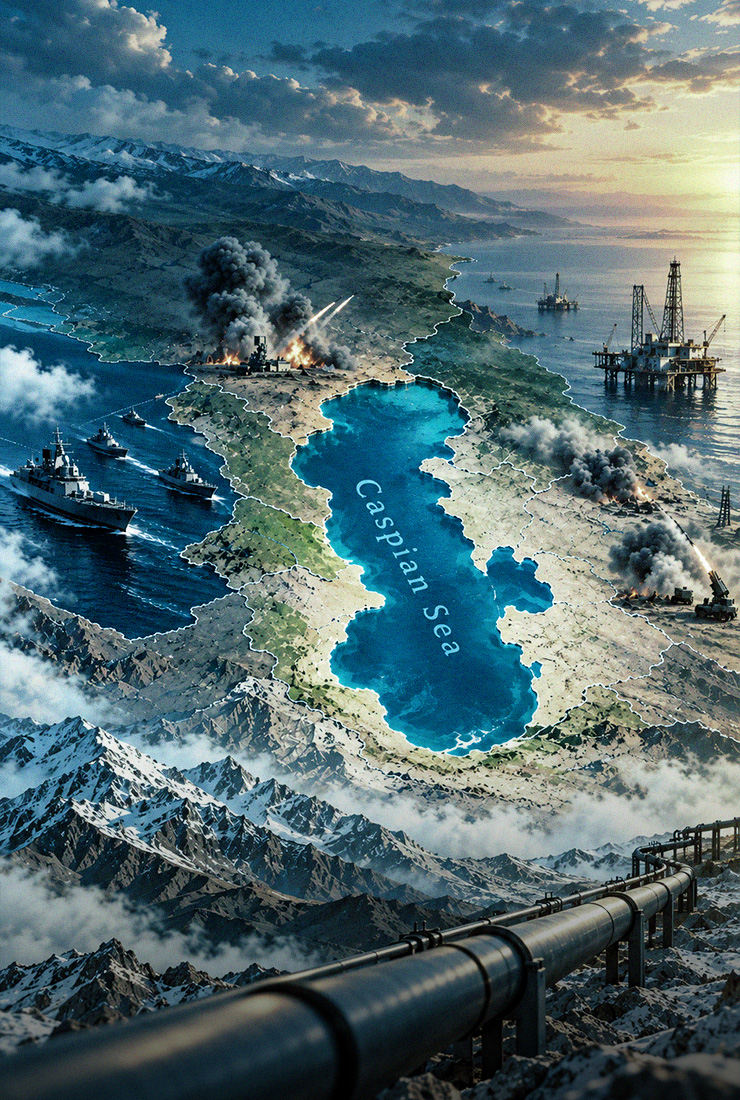
Recent developments in Caspian Sea security carry long‑term consequences well beyond the region. Against the backdrop of two major conflicts, the Russia‑Ukraine war and the U.S.‑Iran confrontation, the basin has faced unprecedented breaches. In 2025, Ukrainian drones struck Russia’s Filanovsky oil platform, marking the first attack of its kind in the Caspian. Just months later, in March 2026, Israeli missiles targeted Iranian naval assets at Bandar Anzali, drawing sharp criticism from other littoral states. These incidents culminated in renewed Ukrainian drone strikes on Iranian positions, provoking harsh rhetoric from Tehran.
From Kyiv’s perspective, strikes on Iranian military assets are justified given Tehran’s close alignment with Moscow. From Tehran’s vantage point, however, these Western‑endorsed actions are seen as deliberate attempts to erode its capabilities and diminish its presence in the Caspian. The shifting power dynamics suggest that influence is gradually slipping away from Tehran and Moscow, opening space for other littoral states to assert themselves as more consequential maritime security actors.
Securitization of the Caspian Sea
With the shifting geography of the Russo‑Ukrainian war and the ongoing U.S.–Iran confrontation, the Caspian basin risks emerging as a new theater of intensive military operations. Such a development would undermine the region’s critical energy infrastructure and disrupt East–West trade corridors. For the principal regional actors, notably Iran and Russia, the Caspian Sea has traditionally occupied a secondary position compared to the Gulf or the Black Sea. This relative neglect stems from the fact that the basin has posed fewer immediate security challenges, largely due to the decades‑long consensus among littoral states prohibiting the presence of non‑regional powers in the Caspian.
Nevertheless, the situation radically changed when in March 2026, Israeli fighter jets carried out an audacious and long-range air operation to target Iranian naval vessels and buildings on the Caspian Sea. The strikes hit Iran’s multiple missile boats, including onshore naval infrastructure around the main port of Bandar Anzali, thus complicating security issues in the basin for other regional states, namely Azerbaijan, Kazakhstan, and Turkmenistan.[1]
For the last decade, the aforementioned countries have heavily invested in the construction of maritime and energy infrastructure in the Caspian Sea, fostering the development of the Middle Corridor transit route. Stretching from China through Central Asia, the Caucasus, and onward to Türkiye, this corridor sustains historic East–West trade links while offering a viable alternative pathway. As these countries increasingly prioritized energy and trade partnerships via the Caspian basin and strengthened their naval forces while diplomatically maneuvering between East and West, the same basin has simultaneously served as a strategic platform for the Iran–Russia axis amid ongoing conflicts.
For Russia and Iran, the Caspian route not only facilitates energy cooperation and trade flows but also the movement of technologies and materials relevant to sustaining both war economies under sanctions pressure, such as drone components and dual-use technologies.[2] Therefore, in terms of the Russia-Iran axis, the Caspian route functions as a critical node in a broader resilience architecture underpinning long-term strategic convergence between the two. Nevertheless, both parties apprehend that in the last five years, the long-term power balance is shifting away from Tehran and Moscow, as other littoral states unveil enormous efforts to rebuild strong flotillas in the Caspian to tackle potential threats and protect their strategic assets.
Ukraine’s recent long‑range drone strikes against a Russian military‑industrial enterprise, an oil refinery, a fuel and lubricants depot, and transport vessels underscored the limitations of Moscow’s naval power and its diminishing regional influence. A similar vulnerability was revealed in Iran’s inability to safeguard its naval assets during the latest wave of Ukrainian drone attacks, highlighting the broader challenges faced by both states in protecting maritime infrastructure under evolving conflict dynamics.[3] As such, Caspian’s historical status as a “safe haven” for the Moscow-Tehran axis has come under question.
The potential air strikes toward the Caspian in the near future will likely force Russia and Iran to consolidate efforts on multi-level air defense systems and drone monitoring, including the deployment of additional troops and warships.[4] This scenario illustrates how two distinct conflicts converge within a single geographic space, gradually evolving into an emerging Eurasian conflict system in which allied actors are increasingly interdependent. In this context, the Caspian basin provides a unique platform for the coordination of economic and military exchange for the Moscow-Tehran axis.
Moreover, unlike Russia, Iran has demonstrated hesitancy in pursuing open confrontation with Kyiv, a posture that can be attributed to practical limitations. At the same time, Tehran signals preparations for an expanded campaign of air strikes targeting its assets in the Caspian Sea, including the northern provinces of Gilan and Mazandaran. A further source of vulnerability stems from Iran’s longstanding neglect of maritime infrastructure in the Caspian basin, where strategic focus has consistently been directed toward the Gulf and the Strait of Hormuz.[5]
In retaliation, Iran and Russia may further increase the deliveries of military components via the Caspian route as part of efforts to deter future Ukrainian drone attacks targeting maritime infrastructure. Although Russia places considerable value on this partnership, Iran currently possesses only limited capacity to deliver substantial quantities of weaponry. In addition, the evolving geopolitical dynamics across greater Eurasia, coupled with persistent security gaps, have compelled non‑regional actors such as Ukraine and Israel to partially view the Caspian basin as an additional theater of war. Indeed, the prospect of conflict spillover into the Caspian region and its littoral states has emboldened regional actors to pursue large‑scale modernization of naval forces and air defense systems, investing in advanced technologies while simultaneously seeking new alliances, such as the emerging Azerbaijan‑Kazakhstan partnership.
Emerging alliances in the Caspian Sea
In recent years, the security of the Caspian basin has emerged as a central concern for nearly all littoral states, driven above all by the imperative to safeguard trade routes. The rapid expansion of the Middle Corridor and the development of critical maritime infrastructure along this axis, highly vulnerable to potential air strikes, underscore the urgency of ensuring its protection. Consequently, there is a growing recognition that the resilience and capacity of the land routes underpinning this transit corridor must be strengthened to guarantee its long‑term security.[6] In light of the continuing disruption of global supply chains due to the ongoing conflicts in Europe and the Middle East, the disruption of the Middle Corridor would have grave consequences both for Western countries and the landlocked Central Asian states.
Recently, Azerbaijan, Türkiye, and Kazakhstan introduced a new partnership framework aimed at enhancing coordination in joint military exercises, naval drills, and air defense systems. For example, in 2023, joint tactical naval exercises held in the Azerbaijani sector of the Caspian Sea between the Azerbaijani and Kazakh Naval Forces near Baku, marking the first such joint exercise between the two and followed by another exercise dubbed Caspian Breeze-2025, were the first-ever large-scale naval drills.[7] The drills specifically covered repelling asymmetric threats, assisting vessels in distress, and live fire drills at sea and against air targets.[8] Moreover, in 2024, Azerbaijani special forces participated in the “Eternal Brotherhood” exercises alongside Kazakhstan, Uzbekistan, and Türkiye, conducted under a scenario focused on the protection of strategic infrastructure and military bases.[9]
While these exercises laid the foundation of a new interregional security format, they also highlighted the importance of regional alliances between “middle powers” like Azerbaijan and Kazakhstan to maintain stability in the Caspian basin. Undoubtedly, such measures enable Azerbaijan, Georgia, and Kazakhstan to strengthen coordination and management in partnership with Türkiye, widely regarded as the principal regional military power.
Beyond bilateral formats, the parties have also established a productive framework within the Organization of Turkic States (OTS), which not only deepens military cooperation but also paves the way for expanded economic and trade ties among member states, thereby elevating the strategic role of the Middle Corridor route.[10] The re-emergence of the OTS as an influential interregional organization since 2022 overlapped with the extension of the Middle Corridor route in terms of additional critical infrastructure across the Caspian. For example, at the OTS summit in 2025 in Azerbaijan, member states placed greater emphasis on expanding military, security, and trade cooperation.[11]
Indeed, the Middle Corridor’s importance regained momentum amid the ongoing Azerbaijan-Armenia peace process and the current work on the establishment of the Trump Route for International Peace and Prosperity (TRIPP), which is set to be a key component of the main trade route through Georgia and its Black Sea ports, potentially increasing connectivity between the South Caucasus and Central Asia.[12] Consequently, the multimodal character of the route, integrating railways, highways, and maritime links, complicates efforts to guarantee comprehensive security. Despite the coordination mechanisms and joint initiatives established by regional states, uncertainty persists regarding how Iran and Russia may respond to the gradual expansion of the Middle Corridor, particularly the TRIPP route, across the Caspian basin.[13]
The complexity of the region, coupled with the entrenched Moscow-Tehran axis around the Caspian, has made external powers such as the United States, China, and European states reluctant to commit to the military defense of the Middle Corridor and its associated infrastructure. As such, the OTS member states, notably Azerbaijan, Türkiye, Kazakhstan, appeared to be more suitable countries for assuming such a role in a volatile region. In this regard, for example, these countries may seek the establishment of a Middle Corridor Air Defense Initiative, either bilaterally or through the OTS, thus expanding the organization’s role into the security sphere. Moreover, the establishment of an air defense unit within the OTS presents a low-risk starting point. These countries apprehend that the Caspian Sea constitutes a vital importance for them. Over 90% of Azerbaijan’s oil and gas production is offshore in the Caspian region, while Kazakhstan rerouted its oil exports through the Baku-Tbilisi-Ceyhan pipeline via the Caspian since 2022 amid the rising risks of the Russo-Ukraine war.[14]
From a Western perspective, the stability of the Caspian basin carries particular significance, as it provides long‑sought access to Central Asia and its vast reserves of critical minerals, bypassing Russian and Iranian territories.[15] These important nuances explain the Western enthusiasm in fostering investments across the Middle Corridor route and related projects, such as the recently U.S.-sponsored Trans-Caspian Enterprise Fund, in an effort to catalyze private-sector investment in trade links across the South Caucasus and Central Asia.[16] Such investments are important to develop port infrastructure in the Caspian Sea to solve the remaining bottleneck problems of the Middle Corridor.[17]
Conclusion
The Caspian Sea, long been a neutral zone out of foreign military presence, is now at risk of being drawn into extended war campaigns originating far from the region. Israeli and Ukrainian strikes against Iranian and Russian military and energy assets in the basin could further endanger the energy and trade flow in the East-West direction while threatening the expanded network of critical infrastructure of the littoral states.
On the other hand, the risks of a new wave of escalation in the basin could further contribute to the erosion of the Moscow-Tehran axis, which could be a significant shift in the regional balance of power. As a result, littoral states like Azerbaijan, Kazakhstan, and to a lesser extent Turkmenistan gradually walked away from their traditional neutral stance, taking a more assertive role by building a stronger naval force, fostering regional alliances, and deepening bilateral and multilateral partnership formats through different frameworks. The strong commitment of these countries to advancing internationally significant initiatives such as the Middle Corridor, TRIPP, and the Trans‑Caspian Fund is poised to prevent the basin from sliding into open militarization.
At the same time, Türkiye’s vocal support for regional alliances across the Caspian and its leading role in the regional security architecture enable it to assume a more direct role in defending the corridor, unlike China or the United States, which remain hesitant to commit militarily. Nevertheless, the emerging regional order remains fragile, as Iran and Russia are unlikely to embrace it, instead relying on strengthened deterrence in the Caspian Sea to block external influence. Yet Tehran’s reluctance to confront Ukraine directly and Moscow’s limited naval capabilities create openings for regional actors to assume a more prominent role in shaping the basin’s security landscape.
[1] Luke Coffey, “The Far-Reaching Implications of Israel’s Caspian Sea Strikes,” Hudson Institute, August 2026, https://www.hudson.org/global-economy/far-reaching-implications-israels-caspian-sea-strikes-luke-coffey.
[2] Basil Germond, “Why the Caspian Sea has become so important in both the Ukraine and Iran wars,” The Conversation, May 13, 2026, https://doi.org/10.64628/AB.jt63cvhfc.
[3] Iryna Balachuk, “Ukraine strikes Russian plant, oil refinery and Caspian Sea ships – photo, videos,” Ukrainska Pravda, July 25, 2026, https://www.pravda.com.ua/eng/news/2026/07/25/8045863/.
[4] Azizi, H., “Iran War Sitrep: Energy infrastructure in crosshairs, Israel hits Caspian fleet,” Amwaj Media, March 19, 2026, https://amwaj.media/en/media-monitor/iran-war-sitrep-19-energy-infrastructure-in-crosshairs-israel-hits-caspian-fleet.
[5] Tzvi Jasper, “Iranian Navy ships destroyed in first Israeli strikes in Caspian Sea,” The Jerusalem Post, March 19, 2026, https://www.jpost.com/israel-news/defense-news/article-890567
[6] Andrei Matveev, “Opinion: A Sea of Discord? Intensifying Military Drills Threaten Stability in the Caspian Region,” The Times of Central Asia, July 24, 2025, https://timesca.com/opinion-a-sea-of-discord-intensifying-military-drills-threaten-stability-in-the-caspian-region/.
[7] “Azerbaijan and Kazakhstan Hold Naval Exercises in Caspian Sea; Iran Participates as Observer,” Caucasus Watch, October 4, 2023, https://caucasuswatch.de/en/news/azerbaijan-and-kazakhstan-hold-naval-exercises-in-caspian-sea-iran-participates-as-observer.html.
[8] “Azerbaijan Embarks on Naval Modernization Program to Strengthen Caspian Maritime Security,” Saratoga Foundation, May 12, 2025, https://www.saratoga-foundation.org/p/azerbaijan-embarks-on-naval-modernization
[9] “Azerbaijani special forces participating in Eternal Brotherhood – III exercise,” Azerbaijan State News Agency (AZERTAC), June 10, 2024, https://azertag.az/en/xeber/azerbaijani_special_forces_participating_in_eternal_brotherhood___iii_exercise-3171554.
[10] Luke Coffey, “Security of the Middle Corridor,” Caspian Policy Center, May 13, 2026, https://www.caspianpolicy.org/research/category/security-of-the-middle-corridor.
[11] Vusal Guliyev, “Organization of Turkic States advances Eurasian trade connectivity,” Jamestown Foundation, February 19, 2025, https://jamestown.org/organization-of-turkic-states-advances-eurasian-trade-connectivity/.
[12] Robert M. Cutler, “TRIPP and the Middle Corridor after Vance,” The Times of Central Asia, February 13, 2026, https://timesca.com/tripp-and-the-middle-corridor-after-vance/.
[13] “Azerbaijan embarks on naval modernization amid Caspian tensions,” TRT World, August 29, 2026, https://www.trtworld.com/article/e743287d1179.
[14] Alyona Pavlenko, “KazTransOil reveals scope of oil transport via Kazakhstan–China pipeline,” Trend News Agency, September 14, 2026, https://www.trend.az/casia/kazakhstan/4223480.html.
[15] Emil Avdaliani, “Middle Corridor Development Lacks Security Component,” Jamestown Foundation, July 22, 2026, https://jamestown.org/middle-corridor-development-lacks-security-component/.
[16] U.S. Department of State, “The Anniversary of a Historic Breakthrough and the Trump Route for International Peace and Prosperity (TRIPP), August 8, 2026, https://www.state.gov/releases/office-of-the-spokesperson/2026/08/the-anniversary-of-a-historic-breakthrough-and-the-trump-route-for-international-peace-and-prosperity-tripp.
[17] “Azerbaijan’s Transit Freight Hits Five-Year High,” Caspian News, August 13, 2026, https://caspiannews.com/news-detail/azerbaijans-transit-freight-hits-five-year-high-2026-8-11-37/.