This insight examines the trajectory of Iran’s use of unmanned aerial vehicles (UAVs or drones), tracing the evolution of Iranian drones from a limited tactical tool to a major strategic component of the architecture of deterrence and asymmetric warfare in the Gulf. The study is based on the hypothesis that the military value of Iranian drones, and in particular the Shahed family, is not only in their direct offensive capabilities but also in their contribution to a wider structure of strategic pressure. This structure aims to saturate multi-layered air defenses, deplete stocks of high-cost interceptor missiles, and impose continuous economic, psychological, and operational burdens on adversaries.
The study relies on a qualitative analysis of two pivotal cases: the April 2024 attacks against Israel and Operation Epic Fury in the Gulf throughout 2026 (up to the date of the study’s preparation). In some theaters of operations, drones constituted the largest proportion of recorded projectiles. The research draws on a composite theoretical framework that integrates asymmetric warfare, the logic of cost imposition, the attack-defense balance under saturation conditions, algorithmic warfare, and the proliferation of drones as an instrument of influence for middle powers.
The study found that traditional reliance on missile interceptor defenses alone is no longer economically sustainable nor operationally sufficient when facing dense swarms of low-cost drones. To counter this challenge, the development of multi-layered defense systems, increased electronic warfare capabilities, hardening of critical infrastructure, increased integration in command and control and early warning systems, and clearer governance for the military use of artificial intelligence are required.
Introduction
Unmanned aerial vehicles have become one of the most influential factors in reshaping contemporary warfare over the past decade. [1] These systems are no longer merely tools for reconnaissance or surveillance; they have evolved into central instruments for long-range strikes, defensive saturation, economic and psychological attrition, and the redefinition of the relationship between offense and defense. [2] Field experiences in Ukraine and the Middle East have demonstrated that low-cost drones are capable of achieving strategic effects that far exceed their technical simplicity when employed in dense waves and integrated with other firepower assets. [3]
In this context, Iran has emerged as one of the leading regional powers that has systematically invested in developing an integrated system of offensive, reconnaissance, and loitering munitions (suicide) drones, whether for direct use or through its regional proxy networks. The significance of the Iranian case is no longer limited to possessing an increasing number of unmanned aircraft, but also extends to its ability to integrate these systems within a coherent operational and strategic logic aimed at exhausting enemy defenses, raising the cost of response, and imposing a pattern of prolonged attrition on adversaries. [4]
The April 2024 attacks on Israel, followed by Iranian operational patterns in the Gulf during 2026, revealed a clear shift in Iran’s use of drones. In the first case, drones featured prominently in a large-scale direct attack designed to test the capacity of multi-layered air defenses to absorb and become saturated. In the second case, drones became the densest tool on certain Gulf fronts, where their waves were designed to impose sustained defensive pressure, increase interception costs, and maintain a long-term attrition effect. [5]
Consequently, understanding the Iranian case requires moving beyond the technical description of platforms to a broader analysis that connects low-cost technology with the logic of asymmetric warfare, the erosion of traditional defense sustainability, and the transformation of regional deterrence. Recent literature indicates that Iran’s use of drones should no longer be viewed merely as an expansion of low-cost combat tools, but rather as an advanced pillar in an asymmetric strategy that exploits the gap between launch costs and interception costs, as well as the acceleration of network-driven and intelligent decision-making environments. [6]
This makes Iranian drones part of a broader transformation in the conflict environment, rather than a standalone technical element. This issue acquires additional importance in the Gulf region specifically because the threat architecture there is not limited to conventional war between regular armies. It also includes proxy networks, highly sensitive critical infrastructure, heavy dependence on energy, ports, and communications, all of which are highly vulnerable to low-cost, repeated attacks. In this sense, drones do not function solely as offensive weapons, but as tools to disrupt both the security and economic environment, forcing the defender to protect many targets simultaneously or near-simultaneously. [7]
From a wider perspective, the rise of Iranian drones cannot be separated from global transformations in the proliferation of sensor technologies, navigation systems, additive manufacturing, and lessons learned from other battlefields. A force that previously required traditional air superiority to exert strategic pressure has become capable of using swarms or waves of cheap systems to produce similar or complementary effects, albeit to varying degrees. This makes the study of the Iranian case important not only for understanding Iran’s behavior but also for grasping broader trends in modern warfare. [8]
For the Gulf states and their Western partners, this development does not represent merely a technical or tactical challenge. It imposes a broader review of air defense concepts, burden-sharing, the cost of protection, and the limits of reliance on high-cost interceptor missiles when facing dense attacks that employ relatively inexpensive platforms. [9] Hence, the importance of studying the Iranian transformation in drone usage emerges as a shift in the logic of deterrence and the structure of power alike, rather than merely an update in warfare tools.
Problem of the Study
The problem of this study lies in the clear gap between the expanding Iranian use of unmanned aerial vehicles and the level of analysis that addresses this use as a strategic pressure architecture rather than merely a tactical activity. Much of the literature on Iran continues to focus on ballistic missiles, the nuclear file, and regional proxies, while drones are often treated as accompanying tools or low-cost alternatives, without sufficient analysis of their emergence as a central element in campaigns aimed at exhausting enemy defenses and altering deterrence equations. [10] The problem is also evident in the fact that a significant portion of the literature separates the phenomenon of Iranian drones from the broader shift toward algorithmic warfare and military artificial intelligence. This occurs despite the modern combat environment becoming increasingly dependent on network speed, data-driven decision support, improved navigation, resistance to jamming, and accelerated kill chains. [11] This analytical separation weakens the understanding of the phenomenon because the source of the threat lies not in the platform alone but in the way it operates within an interconnected, fast-paced combat system.
Accordingly, the problem of the study is the existing deficiency in explaining how Iranian drones have transformed from low-cost tools into a strategic architecture for reshaping deterrence and imposing costs in the Gulf, how this transformation has intersected with the rise of network-driven and AI-powered combat environments, and what implications this carries for defensive sustainability, escalation management, and adaptation options for the Gulf states and their Western partners. [12]
Significance of the Study
The study gains further importance by offering a reading that can academically bridge the gap between specialized Iran-focused literature and broader literature on drones and military AI. Practically, it benefits decision-makers in the Gulf by assisting in the re-evaluation of defense priorities, resource allocation, and adaptation options in the face of low-cost, high-attrition threats.
Objectives of the Study
The study also seeks to demonstrate the impact of Iran’s intensive use of drones in the April 2024 attacks on Israel and subsequent operations in the Gulf during 2026 on the air and missile defense architecture of the Gulf states and their Western partners. It further aims to situate this case within broader discussions on algorithmic warfare and military artificial intelligence, ultimately developing an analytical understanding that helps propose more appropriate strategic and operational options for dealing with this escalating threat.
Research Question
How have Iranian unmanned aerial vehicles, gradually supported by intelligent functions linked to artificial intelligence, transformed from a limited tactical tool into a strategic component in the architecture of deterrence and cost imposition in the Gulf? What implications does this transformation have for defensive sustainability, escalation management, and adaptation options for the Gulf states and their Western partners?
Methodology
This study adopts a qualitative descriptive-analytical methodology, as it is the most appropriate for understanding a complex security and military phenomenon in which technical, strategic, and policy dimensions overlap. The study relies on the analysis of two main cases: the April 2024 attacks against Israel and Operation Epic Fury in the Gulf during 2026 (up to the date of the study’s preparation).
These cases serve as revealing examples of the transformation of Iranian drones from a tactical tool to a tool of strategic pressure. The study draws on diverse open-source materials, including academic research, think-tank reports, military analyses, and open-source monitoring materials, while employing source triangulation to support the analysis and reduce interpretive bias.
This comparative methodological design allows for the examination of similarities and differences between two cases belonging to relatively different operational environments, while keeping the main actor and the strategic logic under study constant. Through this comparison, it becomes possible to observe whether Iran’s use of drones has remained governed by the logic of limited military incidents or has shifted toward the logic of prolonged campaigns and cumulative attrition. The comparative approach also enables the assessment of the influence of geographical and political context on reshaping patterns of use and determining the degree of continuity or transformation.
The study also benefits from process-tracing within each case to reconstruct the interaction among several variables, such as launch density, target distribution, interception costs, and the ability of multi-layered defenses to provide a sustainable response. The study does not view these variables as separate elements, but as parts of a single causal chain that ultimately produces a strategic effect that goes beyond the outcome of a single strike. This highlights the importance of the qualitative approach, as it allows for understanding the underlying logic behind Iranian behavior rather than merely describing its visible outputs.
To clarify the logic of comparison between the two cases, the main characteristics of each can be presented as follows:
Table 1: Comparison between the Study’s Two Cases
| Element | April 2024 Attacks against Israel | Operation Epic Fury Campaign in the Gulf 2026 |
| Nature of Use | Large-scale direct attack | An extended and repeated pressure campaign |
| Defensive Impact | Multi-layered exhaustion | Saturation and sustained pressure |
| Strategic Significance | Demonstration of capability followed by attrition | Raising interception costs and resource consumption |
| Nature of the Case | Concentrated / Single event | Continuous / Ongoing |
| Operational Objective | Testing defensive absorption capacity | Raising interception costs and imposing sustained pressure |
| Resource Consumption | High-intensity, short-duration | Continuous depletion |
| Time Horizon | Short (centered event) | Long (prolonged campaign) |
Theoretical Framework
The theoretical framework of this study is based on four interrelated approaches: asymmetric warfare and the logic of cost imposition, the offense–defense balance under saturation conditions, algorithmic warfare, and the proliferation of drones as an instrument of influence for middle powers. As illustrated in Figure 1, these approaches are used to understand not only what Iran has done but also why it has done so in this manner, and how this approach has influenced the nature of deterrence in the Gulf.

Figure 1: The theoretical framework illustrates the key factors shaping deterrence dynamics in the Gulf.
The approach of asymmetric warfare and the logic of cost imposition start from the assumption that relatively weaker actors do not usually seek to match their opponents in conventional power balances, but rather to compensate for the gap through tools and methods that reduce their vulnerabilities and amplify the cost of the opponent’s superiority. In this context, Iranian drones represent a clear example of a tool that allows the transformation of relative weakness in traditional air power into a flexible and repeatable offensive capability that relies more on density and attrition than on direct qualitative superiority. [13]
The approach of the offense–defense balance under saturation conditions re-examines the relationship between offense and defense in light of the phenomenon of quantitative saturation. Defensive superiority is no longer associated exclusively with technical quality or surveillance accuracy, but also with the system’s ability to withstand economic and operational pressure in the face of repeated waves of cheap targets. [14] This approach appears clearly in the Gulf case, where it places air defenses before a dilemma between the cost of interception and the cost of non-interception.
The algorithmic warfare and military artificial intelligence approach focuses on the shift toward combat environments in which the rapid processing of data, decision support, network integration, and reliance on systems capable of operating at a faster pace than traditional human rhythms become increasingly important. [15] This approach helps explain how intelligent functions related to navigation, timing, and handling jamming can increase the effectiveness of drones even without reaching the highest levels of automation.
The approach of drone proliferation as an instrument of influence for middle powers explains that the development and spread of drone technology has provided middle powers such as Iran with greater maneuverability margins and contributed to expanding influence while reducing dependence on traditional arms suppliers. [16] In this sense, drones are understood not only as offensive or attritional means but also as a tool for redistributing military power and regional influence. Collectively, these four approaches help transcend narrow readings that view drones merely as technical platforms or cheap alternatives to missiles. The current study proceeds from the premise that the meaning of Iranian drones is not exhausted by their engineering characteristics or specifications of range and payload, but is also determined by the context in which they are used, the nature of the targets they are directed toward, the defensive environment with which they interact, and the pattern of military decision-making they produce or impose on the adversary.
Therefore, combining these theoretical approaches is not a formal arrangement, but an analytical necessity for understanding a complex, multi-dimensional phenomenon. [17] This theoretical construction also allows the introduction of the decision-maker dimension more clearly. Each of these approaches not only explains the past but also helps anticipate what may happen if the current trend continues without adjustment. Asymmetric warfare and the logic of cost imposition clarify how a less-resourced adversary can prolong pressure. The offense–defense balance under saturation reveals the fragility of some traditional protection concepts. Algorithmic warfare draws attention to the shrinking time available for decision-making, while the middle powers’ influence approach highlights that drones have become a tool for rearranging regional status and influence. [18]
Previous Studies
The previous studies related to the research topic can be classified into four main overlapping tracks, each addressing one aspect of the main research question. The first track consists of studies that examined the development of the Iranian unmanned aerial vehicle system in terms of diversity, operational roles, and characteristics linked to intelligent functions. The second track includes studies that focused on how Iran employs drones within the logic of saturation, cost imposition, and defensive attrition.
The third track is composed of studies that have focused on the effects of this use on the air and missile defense architecture of adversaries, particularly in the Gulf. The fourth track is composed of studies that have positioned this phenomenon within the wider debate on algorithmic warfare, military artificial intelligence and the proliferation of drones as an instrument of influence for middle powers. [19]
The Belfer Center’s 2025 study titled “Drone Warfare in Today’s World” is one of the important foundational references for understanding the global proliferation of military drones. [20] It places Iran among the leading countries that have succeeded in building an effective system of unmanned aircraft despite restrictions and sanctions. The importance of this study lies in its going beyond merely describing Iran as a drone producer to indicating that the development of artificial intelligence and associated functions has contributed to raising the autonomy and operational efficiency of these systems.
Regarding Iran’s use of drones within the logic of saturation and cost imposition, the Carnegie Endowment’s 2026 study “What We Know About Drone Use in the Iran War” stands out as one of the most relevant studies. It clarifies that the essence of Iranian drone use lies not only in penetration or direct destructive effect, but in exhausting air defenses, raising the cost of engagement, and forcing the adversary into a state of permanent alert. [21]
On the impact of this use on the air and missile defense architecture of the Gulf states, the CSIS 2026 study “Unpacking Iran’s Drone Campaign in the Gulf: Early Lessons for the Future of Drone Warfare” is among the most important. [22] It centers the Gulf in the analysis, discusses Operation Epic Fury directly, and shows that drones constituted a high proportion of Iranian projectiles in certain phases of the campaign.
In the context of algorithmic warfare and military artificial intelligence, the Georgetown Journal of International Affairs 2024 article “War, Artificial Intelligence, and the Future of Conflict” is a central theoretical reference. [23]
A review of these studies reveals that while the existing literature has made important contributions, it remains fragmented—with some studies describing the development of Iranian drones, others analyzing specific campaigns, and yet others discussing AI and algorithmic warfare in a broader context—without sufficient integration of these tracks within a unified analytical framework. The contribution of the current study lies in integrating these literatures to answer the main research question.
Table 2: Previous Studies and Their Relation to Research Question
| Study | Year | Main Focus | Relation to the Research Question |
| Belfer Center, Drone Warfare in Today’s World. | 2025 | Global proliferation of drones and Iran’s position. | Supports understanding of the development of the Iranian system. |
| Carnegie, What We Know About Drone Use in the Iran War. | 2026 | Drone use and cost imposition. | Supports the hypothesis of strategic pressure. |
| CSIS, Unpacking Iran’s Drone Campaign in the Gulf. | 2026 | Iranian campaign in the Gulf. | Explains the impact on Gulf defenses. |
| Georgetown Journal, War, AI, and the Future of Conflict. | 2024 | Artificial intelligence and algorithmic warfare. | Links the Iranian case to the broader framework. |
| Hudson Institute, The Impact of Drones on the Battlefield. | 2025 | Offense–defense balance and saturation. | Supports the interpretation of defensive imbalance. |
| CSIS Futures Lab, Artificial Intelligence and the Future of Conflict. | — | Artificial intelligence and the future of conflict. | Links the study to institutional and military transformation. |
Analysis of Results and Discussion
The results of the study indicate that Iran’s use of unmanned aerial vehicles during the April 2024 attacks and the 2026 campaign reflected a shift from limited tactical employment toward a broader strategy of saturation, cost imposition, sustained pressure, and the distribution of defensive burdens. A central feature of this strategy is the cost asymmetry created when relatively low-cost drones require the defender to maintain continuous surveillance, readiness, and interception capabilities. As illustrated conceptually in Figure 2, the defensive burden may substantially exceed the cost of the attacking platform, particularly when high-cost interceptor systems are employed. However, the magnitude of this asymmetry varies according to the type of drone, interceptor system, engagement conditions, and defensive response. Therefore, Figure 2 represents the conceptual mechanism of cost imposition rather than a fixed numerical cost ratio.
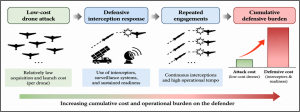
Figure 2: Conceptual illustration of cost asymmetry in drone warfare, showing how repeated low-cost drone attacks can generate increasing cumulative defensive costs and operational burdens through interception, surveillance, and sustained readiness.
The results also reveal that the offense–defense relationship in the Gulf is heading toward increasing structural imbalance. Air defenses designed to intercept fewer, higher-value targets now find themselves forced to deal with waves of cheap targets, making the cost of defense higher than the cost of attack over time. Moreover, the results show that the relationship between offense and defense in the Gulf is heading toward an increasing structural imbalance. Air defense systems, which were designed to intercept a smaller number of higher-value targets, have found themselves forced to deal with waves of cheap targets. This makes the cost of defense significantly higher than the cost of attack over time. [24] Consequently, defensive sustainability itself has become a strategic question. The problem is no longer limited to the effectiveness of interception alone but also extends to the state’s ability to sustain this pattern of response amid prolonged or repeated campaigns.
On the other hand, the results indicate that the Iranian case must also be read within an accelerated algorithmic warfare environment, even if Iran has not reached the highest levels of automation. Iranian drones operate within a battlefield where speed, network connectivity, flexibility in the face of electronic warfare, and algorithmic targeting support have become factors of growing importance. [25] In this context, the threat does not lie in each platform individually, but in the system that connects them within a fast combat rhythm capable of reducing the defender’s decision-making window.
The results also show that the Iranian threat should not be understood as merely local or internal. Rather, it is part of a cross-theater military learning and development network that benefits from interaction with experiences from other battlefields, such as Ukraine. [26] This makes the threat in the Gulf more complex, as it reflects not only what Iran produces locally but also what it absorbs and develops through networks of expertise and integration. The importance of this finding for decision-makers lies in the fact that it requires expanding the perspective from confronting a single platform to confronting a broader system of military development and learning.
From a deterrence perspective, the results indicate that Iranian drones do not function merely as offensive tools but also as instruments for reshaping the adversary’s strategic calculations. When the cost of protection itself becomes part of the problem, the meaning of deterrence shifts from merely preventing a strike to the ability to absorb it and continue operating despite it. [5] This compels the Gulf states to view defensive sustainability as an integral element of deterrence itself, rather than merely a logistical dimension subordinate to it.
The comparison between the two cases under study further demonstrates that Iran’s use of drones has moved closer to the concept of a campaign rather than a single event. In the April 2024 attacks, the use was intense but tied to a specific incident. In contrast, operational patterns in the Gulf during 2026 showed clearer indicators of continuity, repetition, and sustained pressure. This shift is significant because it means that drones are no longer understood merely as strike tools, but as instruments for managing the defender’s time and controlling its operational tempo.
It is important to emphasize here that the impact of Iranian drones is not measured solely by the number of successful strikes or the extent of direct physical damage, but also by the psychological and organizational pressure they exert on defense and decision-making institutions. When defense systems are forced to operate in a high state of alert for extended periods, readiness itself becomes a depletable resource. This type of pressure does not always appear in traditional loss indicators, but is reflected in operating costs, sortie numbers, crew fatigue, rapid ammunition consumption, and the difficulty of maintaining long-term readiness. [4]
The results also suggest that the gradual integration of intelligent functions into the drone operating environment increases the complexity of the defense task, even in the absence of full autonomy. Simply improving timing, navigation, flexibility in handling jamming, or task distribution within launch waves can enhance the effectiveness of the offensive campaign and reduce the attacker’s margin of error. This aligns with literature that views algorithmic warfare not necessarily as reaching fully autonomous weapons, but primarily as the reorganization of time, data, and decision-making within the battle.
In terms of comparing the two theaters, the study shows that the April 2024 attacks constituted a moment of demonstration and testing of the ability to integrate strike assets and create density aimed at exhausting defenses. The Gulf campaign during 2026, to a greater extent, represented a shift toward a logic of continuity, repeated pressure on highly sensitive defensive and critical infrastructures. Studying the two cases together thus reveals not only the development trajectory of the tool but also the evolution of logic governing its use—from a focused strategic message to a sustained pressure mechanism that treats time itself as a weapon. [27]
Accordingly, the final results of the study strongly support the hypothesis that Iranian drones are no longer merely low-cost offensive means but have become a strategic pressure architecture capable of reshaping certain elements of deterrence in the Gulf. What gives this conclusion its analytical weight is its consistency with previous literature, on the one hand, and with the indicators of the applied cases, on the other, in addition to its alignment with broader transformations in the patterns of modern warfare.
Strategic and Academic Implications of the Study
The significance of the findings reached by this study does not stop at explaining the transformation in Iranian drone use and its direct effects on the Gulf deterrence environment; it extends to the broader understanding it provides of the strategic and academic implications of this shift. By linking the logic of cost imposition, defensive saturation, algorithmic warfare, and defensive sustainability, the study reveals a set of meanings that go beyond the immediate applied case while simultaneously touching upon the priorities of decision-makers and future research directions in this field.
This study reveals that the threat posed by Iranian drones should not be viewed merely as a technical extension of low-cost offensive capabilities, but as an indicator of a deeper transformation involving deterrence and defensive sustainability in the Gulf. The issue is no longer confined to the defender’s ability to intercept a specific target; it has expanded to include its ability to manage resources, maintain readiness, and continue operating under dense, repeated, and relatively low-cost offensive pressure.
From this perspective, the study clarifies that the strategic value of Iranian drones lies not only in the direct damage they cause, but in their ability to turn cost itself into a tool of pressure. The more air defenses are forced to use high-cost interceptors against low-cost targets, the greater the likelihood of an imbalance in the equation of defensive sustainability over time. Thus, deterrence in the Gulf environment becomes less about merely preventing a strike and more about the ability to withstand prolonged waves of pressure without economic and operational erosion that weakens the defense’s effectiveness.
The study also indicates that the Gulf environment requires a broader review of the traditional concept of air defense. Drone attacks do not only target the downing of physical objects; they can also affect readiness, deplete ammunition stocks, disperse surveillance systems, and impose psychological and institutional pressure on military and civilian agencies. Therefore, dealing with this type of threat requires a more integrated defensive vision that merges air defense, electronic warfare, critical infrastructure security, and crisis management, rather than keeping these domains in relatively separate frameworks. [28]
The study further shows that the Iranian threat should not be read merely as a platform-specific threat (i.e., linked to specific drone models), but as a broader systemic threat related to the method of employing these systems within dense, repeated campaigns driven by the logic of networks, flexibility, and learning. This means that a decision-maker who focuses solely on the platform may succeed in improving one aspect of the response but may remain far from understanding the full logic governing this threat.
Academically, the importance of the study lies in its connection between four fields often discussed separately: literature on Iran and its military behavior, drone literature, offense–defense balance literature, and literature on algorithmic warfare and military artificial intelligence. In this sense, the study contributes to transcending approaches that view drones merely as technical platforms and pushes toward understanding them as part of a coercive and strategic architecture that reshapes defensive and regional interactions.
The study also opens the door for future research that can expand in three main directions. The first is building more accurate databases on the cost of interception versus the cost of attack in Gulf environments. The second is a deeper study of the actual levels of integration of intelligent functions in Iranian systems, with a distinction between technical autonomy and partial algorithmic support. The third relates to analyzing the impact of cross-theater military learning networks—particularly the interaction between Iranian and Russian experiences and lessons learned from the war in Ukraine—on shaping future threats in the Gulf.
Conclusion
The study concludes that Iran has succeeded in transforming drones from low-cost military tools into a central component in the strategy of deterrence and asymmetric warfare in the Gulf. By combining numerical density, low cost, integration with missiles, operational flexibility, and gradual engagement in an algorithmic warfare environment, Iranian drones have become a tool for redistributing cost, pressure, and attrition capacity.
The overall reading of the study indicates that the greatest value of Iranian drones lies not only in the munitions they carry or the direct damage they cause, but in the redefinition they impose on the battle itself. The battle is no longer only about who possesses the better platform, but about who has the greater ability to impose tempo, disrupt defensive calculations, and turn time, readiness, and cost into weapons in their own right. Hence, successful defensive adaptation in the Gulf will not merely be a technical response, but a reconstruction of the concept of deterrence in the era of dense, low-cost attacks.
[1] Siyavush Mammad Babayev, Elshan G. Hashimov, and Ramil Akhundov, “The impact of unmanned aerial vehicles on the strategy and tactics of modern warfare,” in Modern tools and methods of scientific investigations: Proceedings of the VI International Scientific and Theoretical Conference (2025): pp. 28-36, https://doi.org/10.36074/scientia-10.10.2025.
[2] Tsiporah Fried, “The Impact of Drones on the Battlefield: Lessons of the Russia-Ukraine War from a French Perspective,” Hudson Institute, November 13, 2025, https://www.hudson.org/missile-defense/impact-drones-battlefield-lessons-russian-ukraine-war-french-perspective-tsiporah-fried.
[3] Neil Hollenbeck, Muhammed Hamza Altaf, Faith Avila, Javier Ramirez, Anurag Sharma, and Benjamin Jensen, “Calculating the Cost-Effectiveness of Russia’s Drone Strikes,” Center for Strategic and International Studies, February 19, 2025, https://www.csis.org/analysis/calculating-cost-effectiveness-russias-drone-strikes.
[4] Bilal Khan, “Shahed Drone: Iran’s Attrition Weapon and 2026 Cost Crisis,” Quwa, May 3, 2026, https://quwa.org/iran/military-news-iran/shahed-drone-irans-attrition-weapon-and-the-cost-exchange-crisis-of-2026/.
[5] James M. Page, “Clear warning: The Iran War and the Loitering Munitions Threat,” Royal United Services Institute, May 13, 2026, https://www.rusi.org/explore-our-research/publications/commentary/clear-warning-iran-war-and-loitering-munitions-threat.
[6] Steve Feldstein, “The Unintended Consequences of Iran’s Asymmetric Strategy and America’s AI War,” Carnegie Endowment for International Peace, May 13, 2026, https://carnegieendowment.org/research/2026/05/the-unintended-consequences-of-irans-asymmetric-strategy-and-americas-ai-war.
[7] Aaron Yu, Iuliia Kolotylo, Hashim A. Hashim, and Abdelrahman E. E. Eltoukhy, “Electronic Warfare Cyberattacks, Countermeasures, and Modern Defensive Strategies of UAV Avionics: A Survey,” IEEE Access 13 (2025): pp. 68660–68681, https://doi.org/10.1109/ACCESS.2025.3561068.
[8] Michael C. Horowitz and Loren Kahn, “First Ukraine, Now Iran: A New Era of Drone Warfare Takes Hold,” Council on Foreign Relations, March 9, 2026, https://www.cfr.org/articles/the-new-era-of-drone-warfare-takes-root-in-iran.
[9] Stacie Pettyjohn and Molly Campbell, “Countering the Swarm: Protecting the Joint Force in the Drone Age,” Center for a New American Security, September 10, 2025, https://www.cnas.org/publications/reports/countering-the-swarm.
[10] Shahram Akbarzadeh, “Iran’s Missile and Drone Program: Disrupting U.S. Aerial Hegemony,” [Issue brief], Middle East Council on Global Affairs, July 2024, https://mecouncil.org/wp-content/uploads/2024/07/ME-Council_Issue-Brief-Iranian-Drones-Final-_WEB.pdf.
[11] Lamia Faris, “Algorithmic targeting in the Iranian–Israeli confrontation: Technical realities, legal thresholds, and the boundaries of human control,” [version 1; peer review: 1 approved with reservations], F1000Research, 2025, 14: Article 1200, https://doi.org/10.12688/f1000research.169794.1.
[12] Joseph Jarnecki and Noah Sylvia, “Iranian Data Strikes Shake Global Digital Infrastructure,” Royal United Services Institute, March 19, 2026, https://www.rusi.org/explore-our-research/publications/commentary/iranian-data-strikes-shake-global-digital-infrastructure.
[13] C. Anthony Pfaff, “Anticipation in Asymmetric Warfare,” in Roberto Poli (Ed.), Handbook of Anticipation, pp. 1–26, Springer (2017), https://doi.org/10.1007/978-3-319-31737-3_75-1.
[14] Petros Violakis, “Iran’s Military Operations at the Next Level: Decentralised Coercion and Transnational Destabilisation Threat,” Rabdan Security & Defence Institute, April 14, 2026, https://rsdi.ae/en/publications/irans-military-operations-at-the-next-level-decentralised-coercion-and-transnational-destabilisation-threat.
[15] Shoaib Ul Haq, “Psychopolitics of warfare: Algorithmic violence and the digital unconscious in military AI systems,” Philosophy of Management, 2026, https://doi.org/10.1007/s40926-026-00387-1.
[16] Federico Borsari, “Tools of influence: Drone proliferation in the Middle East and North Africa,” European Council on Foreign Relations, May 27, 2022, https://ecfr.eu/article/tools-of-influence-drone-proliferation-in-the-middle-east-and-north-africa/.
[17] Research Staff, “US Adopts Iranian Drone Design to Counter Asymmetric Threats in Middle East,” DC For Transparency (n.d.), https://dctransparency.com/us-adopts-iranian-drone-design-to-counter-asymmetric-threats-in-middle-east/.
[18] Mohammad Eslami and Lauro Borges, “Military Drones and the Offense–Defense Balance in Future Wars,” in The Drones Race and International Security, pp. 137–154, Springer (2025), https://doi.org/10.1007/978-3-032-05921-5_7.
[19] Dominika Kunertova, “How NATO can integrate AI to prevail in future algorithmic warfare,” Atlantic Council, March 30, 2026, https://www.atlanticcouncil.org/in-depth-research-reports/report/how-nato-can-integrate-ai-to-prevail-in-future-algorithmic-warfare/.
[20] Gonzalo Arana and Javier Romero, “Drone Warfare in Today’s World: 15 Policy Recommendations to Improve the European Union’s Defense Capabilities,” Belfer Center for Science and International Affairs, January 13, 2025, https://www.belfercenter.org/research-analysis/drone-warfare-todays-world-15-policy-recommendations-improve-european-unions.
[21] “UAE says it engaged six drones in past 48 hours,” Iran International, May 19, 2026, https://www.iranintl.com/en/202605195600.
[22] Kateryna Bondar, “Unpacking Iran’s Drone Campaign in the Gulf: Early Lessons for Future Drone Warfare,” Center for Strategic and International Studies, March 10, 2026, https://www.csis.org/analysis/unpacking-irans-drone-campaign-gulf-early-lessons-future-drone-warfare.
[23] Kristian Humble, “War, Artificial Intelligence, and the Future of Conflict,” Georgetown Journal of International Affairs, July 12, 2024, https://gjia.georgetown.edu/conflict-security/war-artificial-intelligence-and-the-future-of-conflict/.
[24] Francesco Salesio Schiavi, “Towards an Integrated Gulf Air and Missile Defence Network,” Rabdan Security & Defence Institute, September 18, 2026, https://rsdi.ae/en/publications/towards-an-integrated-gulf-air-and-missile-defence-network.
[25] Leah Siskind, “5 Ways Iran Is Exploiting AI in Warfare,” Foundation for Defense of Democracies, May 6, 2026, https://www.fdd.org/analysis/2026/05/06/5-ways-iran-is-exploiting-ai-in-warfare/.
[26] Steve Feldstein and Dara Massicot, “What We Know About Drone Use in the Iran War,” Carnegie Endowment for International Peace, March 2, 2026, https://carnegieendowment.org/emissary/2026/03/iran-drones-shahed-us-lessons.
[27] Mehfooz Pathan, “Cyber Defense Strategies for GCC Critical Infrastructure: Navigating the 2026 Middle East Crisis,” LinkShadow, March 18, 2026, https://www.linkshadow.com/blog/cyber-defense-strategies-for-gcc-critical-infrastructure-navigating-the-2026-middle-east-crisis/.
[28] Constantin Grigoraș and Octavian-Ștefan Mușat, “Countering Unmanned Aircraft Systems: A Multi-Domain Effort,” International Conference Knowledge-Based Organization 30, no. 1 (2024): pp. 79–85, https://doi.org/10.2478/kbo-2024-0011.