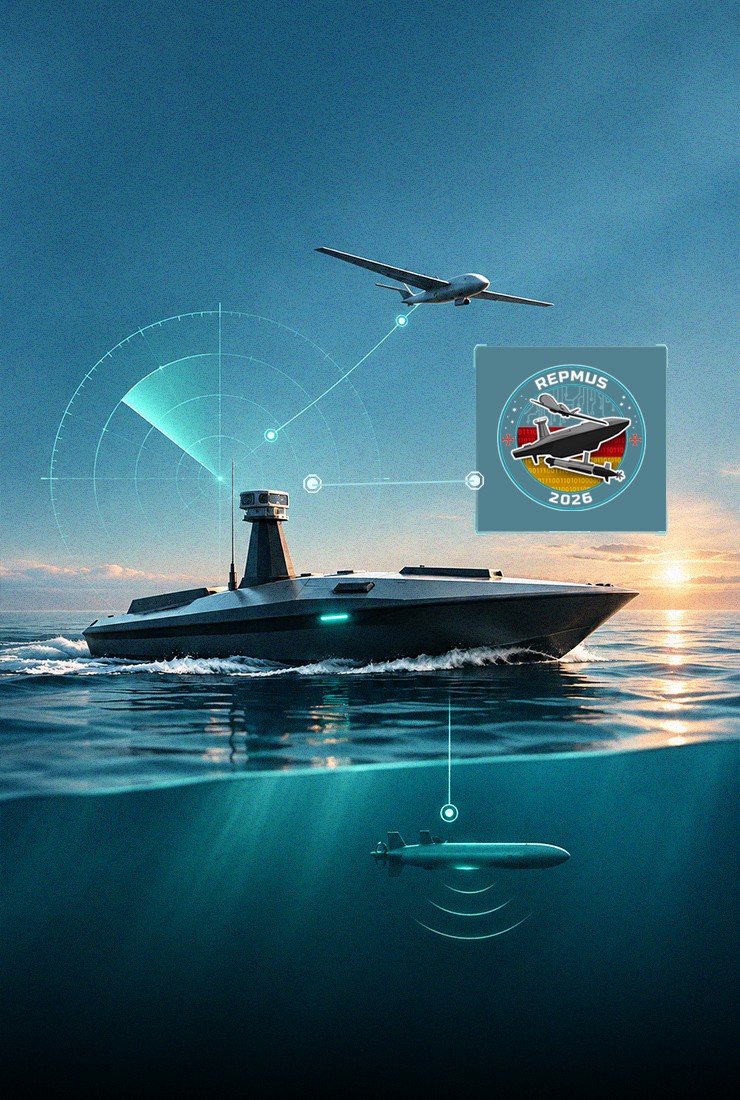
Demand for maritime domain awareness (MDA) is gradually becoming a collective rather than an individual factor. From 31 August to 25 September 2026, the Portuguese Navy hosted the Robotic Experimentation and Prototyping using Maritime Uncrewed Systems (REPMUS), the world’s largest maritime unmanned-systems experimentation exercise. This event encompassed 36 nations, approximately 300 unmanned platforms, and several thousand participants across the surface, air, and sea domains.1 Within the military exercise, SEA.AI’s machine-vision technology was integrated as a shared optical perception layer onto heterogeneous vessels. This involved the development of uncrewed surface vessels (USV) from Maritime Robotics, the SYOS Aerospace SM300, and the Portuguese Navy’s in-house Shiver USV.2 Operator workflows and central fusion would be fed with consistent contact tracks provided by edge-processed optical capability, which was operational in various hulls, autonomy stacks, and national or commercial operators and not by each single platform. This exercise demonstrates a subtle yet profound change, as the core operational value of unmanned systems is evolving from single-platform autonomy to collective MDA and fusion at staff levels.
This shift matters because, while the navy and its partners are putting unmanned systems on the seas to obtain distributed sensing at reasonable costs and with persistence, those systems’ contributions to a common operational picture (COP) are conditional on interoperability, shareability, and usability of sensing outputs in staff processes beyond any given serial. The 2026 exercise provided a scale environment in which NATO’s Task Force X-Arctic tested connectivity and mission-engineering layers relevant to multi-domain, including undersea awareness. In addition, subsequent REPMUS iterations have already advanced STANAG 4817 as a common messaging blueprint for unmanned systems.3 Raw video is being replaced by edge-processed optical tracks because the latter are easier to share. They are not standing as permanent architecture yet, but they are steps toward making the shared sense.
The issue is that institutionalization is still not complete and uniform. Sharing of data and integration of constraints still defines the amount of what the small experimental cell and non-leading partners can share and completely process. The high-resolution or sensitive classification outcomes, details of the model and the full logic of the fusion remain inaccessible, which means an unequal access where most are able to go with the general image easily but not to develop and preserve it. This evolution of the one-shot exercise sequences towards a continuous structure and from surface optical to undersea multi-domain perception also entails a conflict on the linkage of multiple sensor fusion issues, the long-term preservation of the model and the organization shift from the experimenter cell toward a continuous personnel process.
The existing series of exercises already shows this, where the machine vision used in the hull and the operator’s inputs for the optics platform combine to produce more reliable contact images. It is now fused in the center instead of forcing all the platforms to resolve it independently. The staff-level fusion and COP provided by experimental multi-platform sensing edge processed tracks, alignments to STANAG 4817 and links to connectivity and mission engineering work of Task Force X-Arctic are also present. At the same time, they also illustrate the factors that still constrain the smaller experiment cells and partner contributions, such as data sharing, classification, and integration. Non-lead allies are better placed to draw out MDA value rather than equal ability to add their own platform, model, or fusion rule. The closing of that gap will define whether shared sensing will become an episodic exercise result or the groundwork of a more distributed and persistent maritime COP.
Shared Optical Perception Across Heterogeneous Platforms
The optical perception layer that was shared was operationalized during REPMUS 2026 when SEA.AI’s edge-processed machine-vision system was integrated across many platforms. Heterogeneous hulls, autonomy stacks, and operators received consistent contact tracks, and those tracks could be fed into the operator’s workflow and central fusion, as opposed to being restricted within each platform. The exercises in Tróia and Sesimbra under the leadership of the Portuguese Navy were a live operational environment that involved several hundred unmanned systems. The explicit objective of the exercise was to test the interoperability of systems developed by different manufacturers and nations.4 The deployment of SEA.AI represented the most comprehensive multi-platform integration in a defense context to date. The company intentionally positioned machine vision as a common perception layer that could support a variety of vessels, missions, and operators, rather than as an accessory for a single autonomy system.5 The same detection core, which has been trained on real-world maritime imagery collected across ocean racing, recreational boating, and commercial shipping since 2018 and has been installed on over 1,300 civilian vessels, processed live camera feeds into actionable contextual intelligence that identified and classified objects on and above the water.6 The layer, which was optical and passive, provided an independent data stream that was not susceptible to detection or jamming and did not inherit the GNSS-derived vulnerabilities that affect both satellite navigation and AIS in contested environments such as the Baltic and Black Seas.7 The practical outcome was a uniform sensing output that could be assessed in conjunction with existing radar and AIS suites without necessitating that each platform developer independently resolve the baseline perception problem.8
The manufacturer could analyze whether adding a further layer of optics to the Maritime Robotics USV, along with its current autonomous navigation systems for coast and open-sea operation, would be applicable. Vegard Evjen Hovstein, CEO of Maritime Robotics, observed that good autonomy begins with good situational awareness and that a USV must detect and understand its surroundings as reliably as it controls its course. The REPMUS setting facilitated the demonstration of the collaboration between sensors and platforms from various partners.9 From an analytical perspective, the presence of a pre-existing edge-processed system, whose output can be ingested in the platform’s current workflows, lowers duplicated development cost with every new hull and control architecture. This occurred when the Maritime Robotics platform, having no custom-built optical capability, had a consistent stream of contacts from the machine vision system to be fed into the platform operators. This way, the contact tracks that were generated were available to the operator more quickly and were easily shared, instead of remaining stuck inside the platform’s autonomy. The same was true with the SM300 from SYOS Aerospace. The UK-New Zealand manufacturer, upon establishing a partnership in 2024, equipped its multi-domain uncrewed surface vessels with the system. This system provided an independent optical channel for interpreting the surroundings as the platform operated in more demanding and less predictable environments.10 As for consistency, the contact tracks made by the SM300 were similar in format and classification logic, even with the different hull, autonomy software, and national commercial operator, because the core of the detection was the same as the one that was used in the Maritime Robotics system. As a result of this consistency, it allowed for a collective image as to what was happening around the platform instead of only focusing on the navigation of the SM300 itself.
The benefit that this layer offered to the staff level was best exemplified through the Portuguese Navy’s own-made Shiver USV. During the exercise, the Navy’s X31 unmanned-systems unit operated Shiver, which was designed and assembled by Navy engineers. The AI-embedded camera system was specifically installed to alleviate the cognitive load of the operator.11 Project Lead for USV Shiver Pedro Pereira said that it added another layer of detection so the operator does not get overwhelmed with information. He described the system as functioning like receiving the warning before the warning is real. The Navy was sufficiently satisfied with the positive detections to consider incorporating the capability into future projects.12 Furthermore, it acted as a means of independently confirming radar contact and was useful for providing the panoramic picture and vessel identification. The system was also capable of transmitting classified tracks, which can be viewed, correlated with other sensors, and forwarded to the fusion cell, not the streaming of the raw video, which will overwhelm operators or even require central processing. Captain Caldeira de Carvalho, Director of the Operational Experimentation Center of the Portuguese Navy, observed that the integration of a common perception system across multiple platforms provided valuable evidence of its maturity and interoperability under realistic conditions.13 This example also highlights how Shiver presents the shared layer as being used in both platform-level operator decisions and in larger staff processes to make a shared operational picture, while the platform has been under the design and control of a national sovereign.
This example also demonstrates how the perception layer was modular when Polar Mist Technologies introduced the SEA.AI Sentry payload to its payload-agnostic, GPS-independent USV architecture. CEO of Polar Mist, Gustaf von Grothusen, said that the systems are designed to be affordable and mass-produced yet still allow them to choose to arm an unmanned fleet as per the threat and missions at hand. The live REPMUS trials demonstrated that a world-class day-and-night ISR capability could be added on the fly without the need to redesign the underlying vessel.14 The analytical point is that, instead of needing a platform to be homogenously equipped with the same sensors as another to create a COP, it was already happening when one platform (the Perseus) was used with four different modules (USVs, UAVs, helicopters, and drones). The contact tracks provided by the identical detection core across the four platforms were homogeneous in format and class logic so that operators and fusion cells could treat them similarly. This is the mechanism through which experimental multi-platform sensing begins to establish a shared operational vision, where the sensory issues are solved at the edge and the resultant tracks are available collectively instead of being platform locked.
The same also reveals that the contribution remains partial. REPMUS 2026 provided evidence that shared sensing can reduce duplicate development effort while generating the consistent tracks required for staff-level fusion by demonstrating that a single edge-processed optical capability can be integrated onto commercial USVs, a national sovereign design, and a modular low-cost platform within a single multinational exercise.15 The exercise serials did not yet create a standing fusion architecture where each participant cell automatically assimilated and compared the tracks under shared guidelines, though they fed the operator’s panoramic views and proved the radar finds to be correct. That shared layer has been successful in launching institutionalization, which transfers the value from the platform’s autonomy to the MDA. However, it has yet to determine how much the tracks can be shared, classified, and aggregated when the exercise is over.
Enabling Mechanisms and Emerging Institutional Alignment
Along with the maturity of STANAG 4817 and the scaling up of the connectivity and mission-engineering layers of Task Force X-Arctic in REPMUS 2026, the concrete set of mechanisms through which the optical perception layer can contribute to the fusion of the staff and COP is the edge processing of the optical feeds into classified shareable tracks. Though they do not yet make up a standalone architectural arrangement, these demonstrations taken together are a step in making multi-platform sensing a norm.
It is the technical milestone, in this case, that is the transformation of raw video into edge-processed results. Unless an analyst is watching in real time, the electro-optical cameras produce continuous imagery that is unusable on autonomous platforms. Instead, the architecture of SEA.AI conducts AI inference at the sensor, classifying each contact and generating structured information such as the type of vessel or object, its bearing, and its proximity, which eliminates the need for human review of imagery.16 This is relevant to the vessels that operate off the operator’s line of sight. In May 2026, a MARTAC T38 Devil Ray successfully completed an eight-day fully autonomous transit off the coast of California, navigating multiple surface contacts in open-ocean and Sea State 5 conditions more than 400 nautical miles from shore without crew or escort. At that distance, no remote operator can review imagery in time, so the platform must detect and understand its environment onboard.17 The design rationale of Marcus Warrelmann, CEO of SEA.AI, was that the information needed to be pre-built in the system rather than in the person who was watching the screen, and that need is becoming crucial as the trial-to-operational-use case of the autonomously operated vehicles has progressed. This requirement has become increasingly urgent as autonomous platforms transition from trials to operational deployment.18 This is because the output is already down to actionable tracks rather than raw video, so it is far simpler to pass over bandwidth-limited links, while also usable by the platform operator or by the central fusion cells, than raw video would have been. The continuous contact tracks established in the USVs, homogeneous in their hardware in REPMUS, are the logical result of the same edge processing logic displayed in the MARTAC platforms, transforming a common optical capability into a common data product.
The message blueprint through which those channels are interchangeable is based on alignment with STANAG 4817. The NATO standard for unmanned-systems interoperability has been ratified and is currently in the process of being delivered to nations, having been developed and matured through successive editions of REPMUS since 2021.19 As the standard moved forward, the integration of all assets that transmitted telemetry according to STANAG 4817, as implemented with Ukrainian DELTA, was successful for REPMUS 2026. Optical tracks edge-processed to the same format can also be merged into the existing radar, telemetry, and sensor streams. Technical prerequisites for the transfer of tracks from the platform to the staff have not remained just theories because of the approved standard, and these assets are actively integrated. This included unmanned aerial, surface, and subsurface systems, as well as radars, thereby confirming compatibility with NATO combat systems and bringing Ukrainian solutions closer to standardization.20 Ukraine’s third consecutive participation in the event, which involved the coordination of reconnaissance, maritime-area monitoring, maneuvering, and simulated engagement through DELTA while sharing combat experience in the employment of unmanned systems, further demonstrated that a national command-and-control platform can ingest STANAG-compliant data from multinational contributors without the need for custom translation layers.21 Once formatted to the same standard, edge-processed optical tracks can be incorporated into the same data flows that already accommodate radar, telemetry, and other sensor outputs. This is the analytical implication. The horizontal layer that enables the exchange of data between participating navies, industry, and academic institutions during the exercise is provided by CMRE’s interoperability infrastructure, which includes CMRE, Data Mesh, Data Fusion Cell, and PRIMUS.22 The technical conditions for the transfer of optical tracks from the platform to the staff process are no longer theoretical, as evidenced by the ratified standard and the active integration of STANAG-compliant assets.
The connectivity and mission-engineering context that allowed for the orchestration of those tracks at scale were provided by Task Force X-Arctic’s activity at REPMUS. The ACT-led project, which was led by CMRE as technical lead, tested a data-sharing layer, a digital command-and-control architecture, and a mission-engineering layer. These layers, when combined, enable commanders to employ sensors, platforms, and effectors as a coordinated coalition that operates from a shared understanding.23 This was the first time the architecture had been tested at this scale. Task Force X-Arctic connected nearly 300 capabilities to its digital backbone within the broader REPMUS environment, which consisted of approximately 1,500 participants from the 36 navies and hundreds of uncrewed craft. João Alves of CMRE observed that multiple serials automatically and continuously tasked and re-tasked systems to optimize performance, validating the mission-engineering layer within a dynamic environment and integrating new systems on the fly.24 A parallel account indicates that the exercise brought together 3,700 participants, 60 companies and 13 academic institutions. This exposed Task Force X-Arctic’s PRIMUS mission-engineering capability to a complex range of new systems that must be interchangeable within a multinational coalition. Autonomous digital tasking was completed and adapted to the changing exercise environment.25 The framework was described by Captain João Piedade of ACT as demonstrating the ability of crewed and uncrewed systems to collaborate under the ultimate human control, connect data and technology, and transform information into faster decisions while testing innovative solutions in real operational conditions.26 The digital backbone, which is supported by the shared STANAG 4817 protocols that close the loop between data-gathering and decision-making, connects crewed and uncrewed assets across air, surface, and underwater domains, enabling automatic detection, target tracking, and retasking.27 The REPMUS serials have shown that the same data-centric architecture is capable of absorbing a variety of surface optical traces in addition to undersea and other domain sensors, despite the fact that the Arctic and High North are the project’s primary focus. The concurrent presence of surface machine-vision outputs and Task Force X-Arctic’s multi-domain backbone demonstrates how experimental optical sensing is beginning to feed the broader interoperability infrastructure that NATO is preparing for persistent awareness.
These concurrent mechanisms, a ratified messaging standard, a scaled mission-engineering layer, and edge-processed tracks, represent genuine progress in the institutionalization of shared sensing. They demonstrate that a shared optical capability can produce outputs that are technically shareable, standards-compliant, and are currently being tested within an architecture that is intended for automatic tasking and re-tasking across hundreds of assets. CMRE Director Eric Pouliquen noted that NATO has transitioned from a fragmented approach to a more data-centric, cohesive, and interoperable approach to working with unmanned systems as a result of the successive REPMUS editions. He also noted that the last five years of protocol and standard adoption have resulted in true multi-domain integration.28 The NATO Chief Scientist and CMRE Director jointly characterized REPMUS as science for impact, which ensures that decisions about emerging technologies are informed by evidence and connects experimentation with operational requirements.29 Nevertheless, the residual experimental nature of the arrangement is also confirmed by the same evidence. The REPMUS tests, which were conducted at an unprecedented scale, are serials within an annual exercise rather than a standing operational network. Task Force X-Arctic’s subsequent steps involve returning to Arctic conditions in northern Norway later in 2026 and aiming for a broader capability demonstration in summer 2027.30 The optical tracks were utilized in operator workflows and were accessible for fusion; however, no permanent staff process has yet to automatically correlate the edge-processed output of all participating platforms in accordance with shared guidelines outside the exercise window. Institutionalization is therefore advanced by the mechanisms without its completion. The conversion of these demonstrated enablers from exercise outcomes to persistent architecture will be determined by the remaining constraints on data sharing, classification, and the ability of smaller experimentation cells or non-lead partners to contribute on equal terms.
Limits on Institutionalisation and Implications for Non-Lead Partners
In spite of the fact that edge-processed optical tracks are more easily usable than raw video, the contribution of smaller experimentation cells and non-lead partners to the emerging shared sensing architecture remains constrained by persistent limitations on data sharing, classification, and integration. An asymmetric access pattern is generated by these constraints, which allows non-lead participants to more easily consume a shared operational picture than to inject their own platforms, models, or fusion logic on an equal basis. No longer is the scarcity of platforms the constraint; rather, it is the volume, fragmentation, and restricted management of the data that these platforms generate.
The volume of data increases exponentially as navies transition to persistent sensing with a large number of uncrewed systems. The primary challenge is no longer the collection of data; rather, it is the movement, storage, and conversion of data into usable information. Rear Admiral Paul Flos cautioned that the over-classification of data actively impedes cooperation and that restricting data to an excessive extent makes cooperation extremely complicated.31 The issue is not limited to military systems; commercial operators frequently own and oversee critical undersea infrastructure. They are hesitant to share data due to its commercial value or concerns about losing control. Captain Chris Hill observed that certain actors are already adopting commercial-grade cryptography as opposed to conventional military methods due to the rapidity with which capabilities must be implemented.32 These observations illustrate that autonomy at scale is contingent upon data at scale; until the handling, access, and classification issues are resolved, the addition of platforms does not inherently result in an increase in usable capability. Surface optical sensing is directly affected by the same data-mastery requirement. Captain Bryan McCavour, the Royal Navy’s Deputy Assistant Chief of Staff for Information Warfare, stated at the Paris Naval Conference that a modern hybrid navy will be at a disadvantage if it fails to achieve a high level of data mastery. This is due to the fact that battlespace awareness is compromised without the capacity to curate and share data at a rapid pace in order to sense, decide, and effect.33 He advocated for fused data, target-quality data, and authoritative data catalogs, all of which would be supported by a reliable command-and-control system that could transfer the data at the pace of a machine.34
The asymmetry is further exacerbated by cross-border technical and procedural barriers. Scott Sumner observes that, despite the legal gateways for defense-data exchange that were opened by AUKUS export-control reforms, there is no shared technical security architecture that allied industries can use to transfer data.35 An engineer in one AUKUS nation who is collaborating with a counterpart in another still encounters unresolved questions regarding method, access controls, classification markings, audit trails, and governing rules. The NIST Risk Management Framework and CMMC in the United States, the Government Security Classifications and the Defense Cyber Protection Partnership in the United Kingdom, and the Protective Security Policy Framework and Defense Industry Security Program in Australia were never intended to interact, and classification levels do not directly align.36 The underlying pattern is general, despite the fact that AUKUS is a trilateral arrangement rather than a NATO-wide one: legal permissions advance more rapidly than the technical and procedural means of moving data. Consequently, smaller or non-lead contributors are better positioned to consume than to contribute.
Efforts to reduce data latency within REPMUS itself demonstrate both progress and residual limits. In the Naval Mine Warfare and Rapid Environmental Assessment focal areas, north.io is participating in the 2026 exercise with its Ocean Data Platform, Ocean Data Processing Engine, and secure hardware configured as a Naval Ocean Data Warehouse.37 The objective is to reduce the latency of analysis and transfer by integrating, managing, and sharing ocean and seabed data from multiple sources for rapid dissemination into the COP. The company’s processing engine in Naval Mine Warfare is designed to analyze sonar data and disseminate it almost immediately, thereby addressing the void created by modern sensors that generate a significantly greater volume of data than legacy mine-hunting tools were intended to handle. It integrates data from glider swarms and other unmanned platforms into a shared, continuously updated picture in Rapid Environmental Assessment.38 These tools illustrate that commercial data platforms can expedite the integration of environmental and seabed information into staff workflows during an exercise. However, they do not address the classification, sovereignty, and contribution asymmetries that are relevant to national AI models or optical classification outputs with greater sensitivity. The same exercise environment that enables a commercial processing engine to feed a common picture still subjects smaller experimentation cells and non-lead partners to the broader constraints on what they may share, how they may share it, and whether they may influence the fusion logic that consumes their contributions.
The policy implication is that the institutionalization of shared optical sensing necessitates a deliberate focus on data governance, classification reform, and contribution pathways, rather than merely enhancing platform integration. The technical barrier to sharing is already reduced by edge-processed tracks; the remaining barriers are political and organizational. In order to convert REPMUS serials into persistent architecture, policymakers must address over-classification that impedes cooperation, align or bridge divergent national security frameworks, and establish mechanisms that enable non-lead partners to contribute models and fusion rules without relinquishing sovereignty. Until those measures are implemented, the demonstrated capacity of a common optical layer to produce consistent, shareable tracks will persist in generating asymmetric access rather than wholly reciprocal institutionalization. The subsequent evaluation of whether shared sensing can expand from exercise outcomes to standing capability is necessitated by the dual implications of this asymmetry for non-lead allies, who are more easily able to integrate into a shared operational picture than to shape or maintain it.
Conclusion
The REPMUS 2026 demonstration shows that a shared optical perception layer, when edge-processed into consistent tracks and exercised alongside maturing standards and multi-domain connectivity architectures, can begin to shift the value of unmanned systems from isolated platform autonomy to collective MDA and staff-level fusion. The progressive delivery of STANAG 4817, the concurrent operation of the same machine-vision capability across commercial, national, and modular platforms, and the scaling of Task Force X-Arctic’s data-sharing and mission-engineering layers together demonstrate that experimental multi-platform sensing is already capable of providing a COP. However, the same evidence also confirms that institutionalization is still incomplete: classification regimes, national and commercial data boundaries, and the absence of reciprocal contribution pathways continue to place non-lead partners in a better position to consume than to shape or sustain the emerging architecture. The rationale for policy action is based on the demonstrated gap between the outputs of exercise serials that shared sensing can already generate and the necessary steps to transform them into a persistent, distributed maritime COP, rather than on any single technical triumph.
The translation of edge-processed optical tracks into the ratified STANAG 4817 framework should be a priority for NATO Allied Command Transformation, the Center for Maritime Research and Experimentation, and the Joint Capability Group on Maritime Unmanned Systems. This should include clear guidance on which classification levels apply to structured track data versus raw imagery or model weights. National navies that host or regularly contribute to REPMUS, beginning with the Portuguese Navy, should establish standing data-sharing agreements that enable smaller experimentation cells and partner nations to inject their own platforms and algorithms under defined rules, rather than solely as consumers of a centrally generated picture. The subsequent iteration of Task Force X-Arctic and related mission-engineering work should extend an invitation to industry participants and non-lead allies. This invitation should include explicit mechanisms for maintaining sovereignty over national models while still contributing to fusion logic. These steps are administratively and politically feasible within the current NATO processes and do not necessitate the development of new platform programs. Rather, they necessitate the extension of existing standards, classification practices, and partnership arrangements that are currently being tested.
In implementing these measures, the optical and multi-domain sensing capabilities displayed at REPMUS can transition from episodic demonstration to a permanent contribution to MDA, thereby reducing the obstacle for a broader array of allies to both benefit from and influence a shared operational perspective. If they are not, shared sensing will be limited to annual serials, the asymmetries between lead and non-lead participants will become more pronounced, and the Alliance will continue to deploy an increasing number of unmanned platforms whose collective outputs cannot be fully fused or sustained outside the exercise window. The distinction between the two outcomes is no longer primarily technological; it is a matter of whether the institutional conditions that were demonstrated as feasible in 2026 are intentionally implemented.
[1] North Atlantic Treaty Organization, “REPMUS 2026 in Portugal Brings Together NATO Allies to Test Uncrewed Maritime Systems,” October 8, 2026, https://www.nato.int/en/news-and-events/articles/news/2026/10/08/repmus-2026-in-portugal-brings-together-nato-allies-to-test-uncrewed-maritime-systems.
[2] “SEA.AI Deploys Machine Vision Across USVs at NATO REPMUS Exercise,” Breakbulk.News, October 1, 2026, https://breakbulk.news/sea-ai-deploys-machine-vision-across-usvs-at-nato-repmus-exercise/.
[3] Tamara Rozouvan, “Ukraine Tests DELTA Interoperability with Unmanned Systems at REPMUS 2026,” Janes, October 16, 2026, https://www.janes.com/defence-intelligence-insights/defence-news/air/ukraine-tests-delta-interoperability-with-unmanned-systems-at-repmus-2026.
[4] SEA.AI, “SEA.AI Brings Machine Vision to Multiple USV Platforms at REPMUS 2026,” October 2, 2026, https://www.sea.ai/repmus-2026/.
[5] “SEA.AI Deploys Machine Vision Across Multiple USV Platforms at REPMUS 2026,” Bunker Market, October 1, 2026, https://bunkermarket.com/sea-ai-machine-vision-usv-platforms-repmus-2026/.
[6] Abi Wylie, “Machine Vision & Shared Optical Perception Tested Across Autonomous Naval Fleets,” Ocean Science & Technology, October 7, 2026, https://www.oceansciencetechnology.com/news/machine-vision-shared-optical-perception-tested-across-autonomous-naval-fleets/.
[7] SEA.AI, “SEA.AI Brings Machine Vision.”
[8] Pôle Mer Bretagne Atlantique, “SEA.AI Deploys AI-Powered Vision Across Multiple USVs at REPMUS 2026,” October 1, 2026, https://www.pole-mer-bretagne-atlantique.com/en/agenda-actualites/seaai-deploys-ai-powered-vision-across-multiple-usvs-repmus-2026.
[9] Joseph Macey, “Machine Vision Plugs Critical Maritime Detection Gaps Across USV Fleet at NATO’s REPMUS 2026,” Defense Advancement, October 7, 2026, https://www.defenseadvancement.com/news/machine-vision-plugs-critical-maritime-detection-gaps-across-usv-fleet-at-natos-repmus-2026/.
[10] “SEA.AI Brings Machine Vision to Multiple USV Platforms at NATO’s REPMUS 2026,” Cyprus Shipping News, October 8, 2026, https://cyprusshippingnews.com/2026/10/08/sea-ai-brings-machine-vision-to-multiple-usv-platforms-at-natos-repmus-2026/.
[11] SEA.AI, “SEA.AI Brings Machine Vision.”
[12] Macey, “Machine Vision Plugs Critical Maritime Detection Gaps.”
[13] “SEA.AI Deploys Machine Vision Across Multiple USV Platforms.”
[14] “Naval Defence: Computer Vision Becomes Essential for NATO Maritime Drones,” GICAN, October 1, 2026. https://gican.asso.fr/en/cat-news/naval-defence-computer-vision-becomes-essential-for-nato-maritime-drones/.
[15] Pôle Mer Bretagne Atlantique, “SEA.AI Deploys AI-Powered Vision.”
[16] “MARTAC USVs Gain Real-Time Machine Vision from SEA.AI,” Naval News, October 16, 2026, https://www.navalnews.com/naval-news/2026/10/martac-usvs-gain-real-time-machine-vision-from-sea-ai/.
[17] Ibid.
[18] Ibid.
[19] Steen Søndergaard and Eric Pouliquen, “Science for Impact: From Multi-Domain Experimentation to NATO Operational Advantage,” NATO Science and Technology Organization, September 16, 2026, https://www.sto.nato.int/repmus-2026-cmre-nato-chief-scientist-statement/.
[20] Ministry of Defence of Ukraine, “Ukraine DELTA System Confirms NATO Compatibility at REPMUS 2026: Service Members Practice Maritime Operations,” October 14, 2026. https://mod.gov.ua/en/news/ukraine-delta-system-nato-repmus-2026.
[21] Ibid.
[22] NATO Centre for Maritime Research and Experimentation, “Task Force X-Arctic Scales Up at REPMUS 26.” October 9, 2026, https://www.cmre.nato.int/task-force-x-arctic-scalesup-at-repmus-26/.
[23] Allied Command Transformation, “Task Force X-Arctic Takes Its Next Step at REPMUS 2026,” September 24, 2026. https://www.act.nato.int/article/tfx-arctic-repmus/.
[24] Ibid.
[25] NATO Centre for Maritime Research and Experimentation, “Task Force X-Arctic Scales Up.”
[26] Ibid.
[27] Navy Leaders, “Forging Ahead Into a Crewed-Uncrewed Future at REPMUS 26,” September 22, 2026, https://navyleaders.com/news/forging-ahead-into-a-crewed-uncrewed-future-at-repmus-26/.
[28] NATO Centre for Maritime Research and Experimentation, “Task Force X-Arctic Scales Up.”
[29] Søndergaard and Pouliquen, “Science for Impact.”
[30] Navy Leaders, “Forging Ahead Into a Crewed-Uncrewed Future.”
[31] George Allison, “Undersea Data, Not Platforms, Now Limiting NATO Capability,” UK Defence Journal, April 17, 2026, https://ukdefencejournal.org.uk/undersea-data-not-platforms-now-limiting-nato-capability/.
[32] Ibid.
[33] Lee Willett, “NATO Navies Need Data Mastery for Battlespace Domination,” Naval News, March 17, 2026, https://www.navalnews.com/naval-news/2026/03/nato-navies-need-data-mastery-for-battlespace-domination/.
[34] Ibid.
[35] Scott Sumner, “AUKUS Needs a Better Way to Communicate,” Proceedings 152, no. 10 (October 2026), https://www.usni.org/magazines/proceedings/2026/october/aukus-needs-better-way-communicate.
[36] Ibid.
[37] north.io, “REPMUS 2026: How north.io Is Advancing Maritime Unmanned Systems with Ocean Data,” August 11, 2026, https://www.north.io/insights/repmus-2026/.
[38] Ibid.