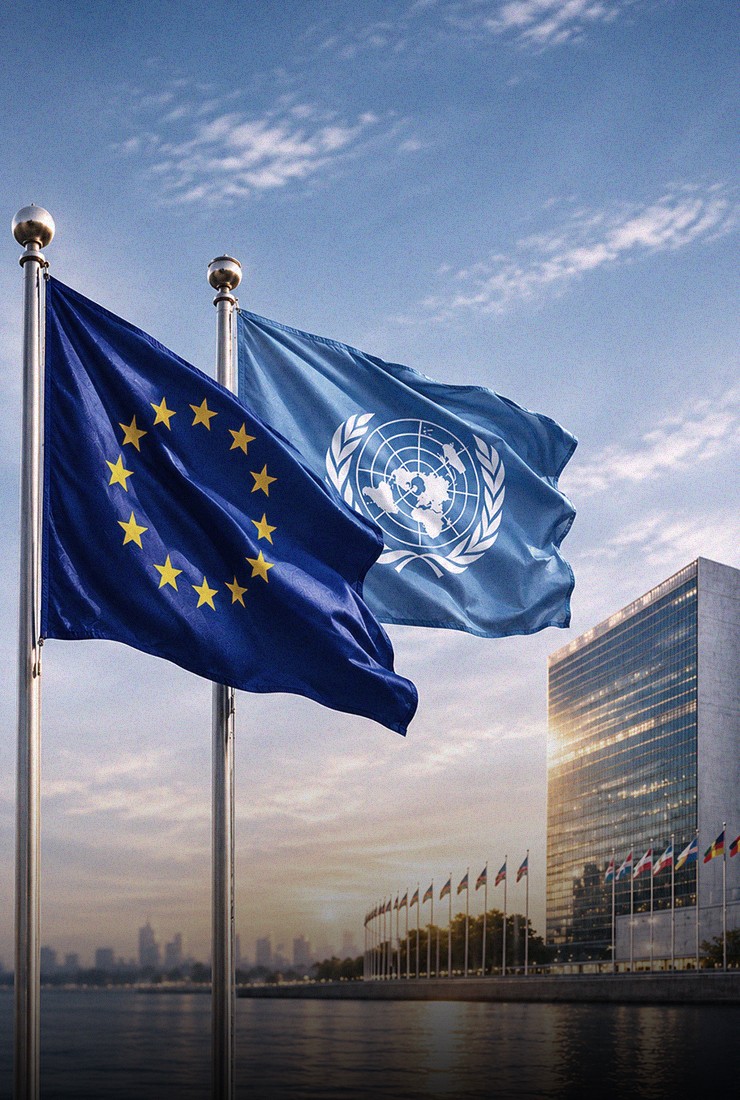
The 2026 United Nations General Assembly represents a critical moment in defining the future role of the United Nations on the global stage. As the role of the United States in the international system continues to evolve, sovereign states are increasingly repositioning themselves in response to shifting geopolitical, economic, and security dynamics. These developments also present an important opportunity for the European Union (EU) to reassess and strengthen its relationship with the United Nations in response to this evolving geopolitical landscape.
It is imperative that the EU reevaluate its position within the United Nations and consider how it can strengthen its influence, advance its strategic interests, and contribute to more effective global leadership. As geopolitical competition intensifies and multilateral institutions face growing challenges, the EU must assess how it can reinforce international cooperation, uphold the principles of the UN Charter, and advance a rules-based international order. This process should include examining opportunities to strengthen EU representation and participation within UN institutions, expand diplomatic engagement with the Global South, enhance its leadership in peacekeeping and conflict prevention, and mobilize financial and political resources to address global challenges.
Additionally, the EU should consider how to leverage its collective economic power, development assistance, climate diplomacy, technological capabilities, and security partnerships to respond to emerging threats. Ultimately, the EU must determine how to translate its collective influence into effective multilateral leadership while navigating strategic competition, strengthening transatlantic relations, and building more equitable partnerships with countries across the international system. What strategic priorities and institutional reforms should the EU consider to strengthen its relationship with the United Nations and shape the future of effective global leadership?
The History of EU-UN Relations
The relationship between the EU and the UN traces its origins to the establishment of the world body. In 1945, fifty-one countries became founding members of the organization. Among these founding members, six countries that are now EU member states were among the original signatories: Belgium, Denmark, France, Greece, Luxembourg, and the Netherlands. However, the EU did not exist in 1945. The post-World War II international order encouraged European states to engage in multilateralism and participate in international institutions.[1]
For more than three decades, EU–UN relations have remained active and have continued to evolve. Although the EU is not a sovereign state, it has recognized the importance of participating in the UN system. This participation provides a mechanism for representing shared European interests in international affairs, particularly in global trade, environmental policy, multilateral diplomacy, and humanitarian affairs.
In 1974, the European Economic Community (EEC), the predecessor of the European Union, was granted permanent observer status at the United Nations. This status permitted the EEC to participate in certain UN activities without becoming a full member of the organization. Under this arrangement, the EEC could attend UN General Assembly meetings, participate in debates, and deliver statements in accordance with applicable rules.[2]
Through its legal personality, the EU subsequently deepened its institutional relationship with the UN. The Maastricht Treaty, which entered into force in 1993, established an important foundation for the EU’s external relations and its commitment to international cooperation. Article 21 of the Treaty on European Union emphasizes that the Union’s external actions must be guided by the principles that inspired its own creation, development, and enlargement. These principles include democracy, the rule of law, the universality and indivisibility of human rights and fundamental freedoms, respect for human dignity, equality, solidarity, and respect for the principles of the UN Charter and international law. Article 21 also emphasizes the importance of developing partnerships with countries and international, regional, and global organizations that share these principles. Furthermore, it underscores the EU’s commitment to promoting multilateral solutions to common challenges, particularly within the framework of the United Nations.[3]
The EU treaties also underscore the importance of cooperation with the UN on international peace and security. Article 34 of the Treaty on European Union, as amended by the Treaty of Lisbon, addresses coordination among EU member states within international organizations and international conferences. The EU benefits from the fact that two of the five permanent members of the UN Security Council—France and, historically, the United Kingdom—have been European powers. In addition, EU member states periodically serve as non-permanent members of the Security Council, providing further opportunities for European representation in international security deliberations.[4]
Over the years, EU–UN relations have focused on a range of global issues, including peace and security, sustainable development, human rights, and the rule of law. In terms of policy implementation, much of the cooperation has involved peace operations, crisis management, and humanitarian assistance.[5]
Through these efforts, the EU has progressively expanded its engagement with the UN system and various international instruments. These include the United Nations Convention on the Law of the Sea (1982),[6] the Convention on the Rights of the Child (1989),[7] the Convention on the Elimination of All Forms of Discrimination against Women (1979),[8] the Convention on the Rights of Persons with Disabilities (2006),[9] and the Paris Agreement on climate change (2015). These instruments reflect the EU’s broader commitment to international law, human rights, environmental protection, and multilateral cooperation.
In 2003, the EU and the UN strengthened their cooperation by establishing a framework for collaboration on crisis management. This initiative focused particularly on the Balkans and Africa and established a joint consultative mechanism built around four areas: planning, training, communication, and the exchange of best practices. Several years later, the Treaty of Lisbon, which entered into force in 2009, further strengthened the EU’s external representation by establishing the European External Action Service (EEAS). The EEAS supports the EU’s diplomatic engagement with the UN and other international organizations, including through the EU Delegation to the United Nations in New York.[10]
The EU continued to expand its role within the UN system. In 2011, it obtained enhanced participation rights in the UN General Assembly. These rights enabled the EU to participate more actively in debates, make statements, and submit proposals and amendments under the applicable rules. This arrangement strengthened the EU’s ability to represent its collective positions on international peace and security, sustainable development, and other global issues while coordinating with its member states.[11]
The EU has also expanded its financial contributions to the UN system, becoming one of its major financial partners when contributions from EU institutions and member states are considered together. Over the years, EU institutions have provided substantial funding to UN agencies, funds, and programs. Between 2013 and 2024, the EU reportedly contributed more than $33 billion to these entities. Beyond supporting peacekeeping and crisis-management activities, EU funding has supported initiatives related to the UN’s 2030 Agenda for Sustainable Development and the Sustainable Development Goals (SDGs). Major recipients of EU funding have included the World Food Programme (WFP), the United Nations Children’s Fund (UNICEF), the United Nations Development Programme (UNDP), the Office of the United Nations High Commissioner for Refugees (UNHCR), and the International Organization for Migration (IOM).[12]
The Current State of EU–UN Relations
Despite major geopolitical challenges, EU–UN relations remain strong. The EU’s priorities continue to align with UN principles and strategic goals. In July 2026, the EU introduced its latest priorities for engagement with the UN at the 81st session of the UN General Assembly. These priorities included reforming effective multilateralism and international law, advancing UN reform, strengthening peace and security, and promoting sustainable development. More specifically, the EU’s priorities focus on global conflict prevention, developing a framework for artificial intelligence (AI) and emerging technologies, strengthening relations with the Global South, enhancing global economic and energy resilience, improving the effectiveness of human rights protections and international law, and developing a more effective division of labor.[13]
To advance these priorities, the EU actively defends the core principles reflected in the UN Charter. The EU has publicly expressed its opposition to actions that undermine multilateralism and international law. During the 81st session of the United Nations General Assembly (UNGA), the President of the European Council spoke out against unilateralism and discouraged countries from withdrawing from the UN. He argued that no country could independently address the wide range of global challenges or achieve international peace and security. One example of the EU’s engagement is its support for collectively developing global standards for AI through the Global Digital Compact. The EU has also defended the importance of international law by calling for the protection of the International Criminal Court (ICC) and the International Court of Justice (ICJ). These institutions play important roles in promoting accountability and upholding international law, including international humanitarian law and international human rights law.[14]
At the UN, institutional power and influence are particularly significant within the Security Council, one of the organization’s principal organs. The Security Council has primary responsibility for maintaining international peace and security and can adopt decisions that UN member states are obligated to carry out under the UN Charter. A substantial portion of the UN budget supports peacekeeping operations. The Security Council’s permanent members also possess veto power over substantive resolutions, giving them significant influence over international peace and security matters.[15]
Over the next two years, EU representation on the Security Council will include France, a permanent member, and several non-permanent members. Denmark, Greece, and Latvia are among the European countries serving on the Council during this period. Beginning in January 2027, Austria and Portugal will also join the Security Council. This representation provides EU member states with opportunities to influence discussions on international peace and security, although they do not always hold identical positions on every issue.[16]
The EU’s financial contributions also reflect the importance it places on the UN’s role in international affairs. In 2025, EU financial contributions were estimated at approximately $4 billion, representing a substantial share of the funding provided to the UN system. The EU and its member states collectively contribute significant resources to UN operations and programs.[17] All 27 EU member states are responsible for paying their assessed UN contributions in accordance with the applicable financial obligations. EU funding supports peacekeeping operations and various UN agencies and programs, including the World Food Programme (WFP), the United Nations Children’s Fund (UNICEF), the International Organization for Migration (IOM), and the Office of the United Nations High Commissioner for Refugees (UNHCR).[18]
Policy Recommendations
The EU’s priorities already align closely with UN principles and strategic goals. In July 2026, the EU introduced its latest priorities for engagement with the UN during the 81st session of the UN General Assembly. These priorities included promoting effective multilateralism and international law, advancing UN reform, strengthening peace and security, and promoting sustainable development. More specifically, the EU’s priorities focus on preventing global conflicts, developing a framework for artificial intelligence (AI) and emerging technologies, strengthening relations with the Global South, enhancing global economic and energy resilience, improving the effectiveness of human rights protections and international law, and developing a more effective division of labor.
To advance these priorities, the EU should evolve into a stronger and more reliable institutional supporter of the UN. Several approaches could help achieve this objective.
First, the EU should make UN reform a central priority, particularly reform of the Security Council and its veto structure. There is growing support for expanding permanent representation on the Security Council to include states from the Global South, especially African states, given that Africa hosts a substantial share of UN peacekeeping operations. A reformed permanent membership should also move beyond a predominantly Eurocentric perspective and reduce the Council’s vulnerability to rivalry among the United States, Russia, and China.
The EU should also focus on issues that resonate globally and affect people’s daily lives. It should use media and public-engagement tools to communicate its work on financial insecurity, AI, food and water insecurity, inequality, energy prices, the war involving Iran, and the crisis in Gaza. At the same time, the EU should pursue these priorities through effective coalition-building in the General Assembly and by improving institutional accountability. It should demonstrate that the UN process can be more inclusive and representative of global leadership. When appropriate, the EU should support member states from non-Western regions in leading global initiatives.
Second, the EU should support a strong candidate for the next UN Secretary-General. The candidate should be highly qualified, preferably from the Global South, and capable of representing universal democratic principles. Democratic governance and multilateral norms are under pressure amid intensifying strategic competition among major powers, including China, Russia, and the United States. The EU should also consider gender representation as part of a broader assessment of qualifications, experience, and the ability to secure broad international support.
The next Secretary-General should be capable of engaging effectively with leaders of major powers and influential regional actors across different political systems. The candidate should embody UN values and norms while also demonstrating adaptability, innovation, and political courage. As emphasized in the 2026 speech by the President of the European Council, the next Secretary-General should be able to prevent conflict, mediate crises, and build peace, particularly in the Middle East, Sudan, and Ukraine.[19]
The next Secretary-General should also be more globally visible. This could include conducting more media interviews, traveling more extensively, and communicating directly with communities affected by international crises. During the UN General Assembly, the President of the European Council emphasized that the UN should help build a stronger global financial architecture. The EU should support a visible, globally inclusive project on this issue, working with international partners and presenting the initiative in ways that resonate with ordinary people.[20]
Third, the EU should strengthen its leadership among Western allies and partners while deepening European integration. Stronger European integration would reinforce the EU’s influence at the UN by ensuring that member states are more closely aligned on foreign policy, resource allocation, and responses to international crises. The EU should also explore innovative ways to become a more cohesive and effective actor within the UN system.
One possible approach would be to pursue Timothy Snyder’s idea of building a wider European bloc. The EU could strengthen cooperation with the United Kingdom, Canada, and Ukraine, creating a broader network of like-minded democracies capable of coordinating both hard- and soft-power initiatives.[21] Recent proposals for closer EU–Canada institutional cooperation could provide a foundation for deeper collaboration. The EU should explore expanded collaboration with Canada on intelligence, advanced manufacturing, technology, defense-industrial capacity, critical minerals, and artificial intelligence.[22]
This broader European bloc could also help the EU strengthen relations with the Global South, particularly Latin America and the Caribbean, through the UN. The bloc should initially focus on shared initiatives involving cybersecurity, energy security, information integrity, and global supply chains. Such cooperation would complement and reinforce the EU’s global role at the UN.
Fourth, the EU should deepen its partnerships across the Global South. Effective partnerships require cooperation not only with governments but also with local private organizations, civil society groups, and media figures who can communicate with millions of people. The 2026 Munich Security Conference emphasized that rising populism is partly driven by the perception that ordinary people have been excluded by elitist institutions. Global institutions, therefore, need to improve their outreach and demonstrate how their work benefits communities directly.[23]
The EU should help the UN communicate more effectively with the public and make international cooperation more accessible. People should be able to understand and experience the benefits of UN programs, including those related to food security, health, economic stability, climate resilience, and peacebuilding. Public engagement should become a central component of the EU’s multilateral strategy.
Fifth, the EU should continue pressing for fuller participation in UN-related agreements and institutions. Without broader participation rights, the EU will remain limited in its ability to leverage its diplomatic, economic, and security capabilities. The EU should work with the UN to explore expanded participation rights, within applicable legal and institutional frameworks, so that it can more effectively support critical international instruments, including nuclear non-proliferation agreements, the Paris Agreement, and global initiatives addressing poverty and health security.
Given current geopolitical and financial challenges, the EU should demonstrate that fuller participation would benefit the entire UN system. Greater EU participation could provide additional financial support, strengthen promotion of the UN Charter, and deepen engagement with the Global South. The EU should present expanded participation as a mutually beneficial arrangement rather than as an institutional privilege sought solely for its own advantage.
Finally, the EU should manage strategic competition with China and Russia while continuing to support multilateral cooperation. As China’s role within the UN system expands, the EU should assess how changing patterns of financial and institutional influence affect multilateral governance. It should continue to support transparency and balanced institutional participation as financial contributions and political influence evolve. China is now one of the largest contributors to the UN, making the relationship between financial support and institutional influence an important issue to monitor. The EU should continue to support international law, human rights, and democratic accountability while avoiding assumptions that financial contributions alone determine political influence.
With respect to Russia, the EU should pursue a coordinated diplomatic strategy focused on coalition building, international law, accountability, human rights, support for Ukraine, and dialogue where feasible. The EU should engage actively in debates and resolutions in the General Assembly and the Human Rights Council concerning the war in Ukraine, particularly because Russia possesses veto power in the Security Council. Although the EU has limited direct influence within the Council, it can increase its impact through coordinated diplomacy in other UN bodies.
EU coalition-building should also include non-EU regional partners such as Moldova, Montenegro, and Albania. Cooperation with these states could strengthen European positions on Ukraine, democratic resilience, regional security, and international law. More broadly, the EU should use its diplomatic, economic, and institutional resources to demonstrate that principled multilateralism remains effective. The EU has also supported the collective development of global AI standards through the Global Digital Compact and defended the importance of international law by calling for the protection of the International Criminal Court and the International Court of Justice. These institutions play essential roles in promoting accountability and upholding international humanitarian and human rights law.
Lastly, the EU should use these financial contributions strategically and transparently. Financial support should be linked to stronger accountability, improved program delivery, and greater engagement with underrepresented regions. By combining financial reliability, diplomatic coordination, institutional reform, public outreach, and principled leadership, the EU can help restore confidence in the UN and establish itself as a dependable and constructive partner.
Conclusion
The EU has an opportunity to play a larger role at the United Nations. At a time when global governance faces significant pressure, rapid changes in the international system are being driven partly by shifts in U.S. leadership and by the need to adapt to advances in artificial intelligence. The EU can use this period of change to promote resilient and cooperative multilateral leadership. Through the UN system, the EU can strengthen its political legitimacy by responding to changes in the level and form of U.S. engagement in multilateral institutions, expanding effective financial assistance, and contributing to leadership on critical global and cross-border issues, including trade, artificial intelligence, the war involving Iran, the Israel–Palestine two-state solution, and energy security.
To secure enduring political influence, the EU’s growing contributions must produce measurable results, strengthen multilateralism, and expand global partnerships that deepen international cooperation. Financial assistance alone, however, will not be sufficient. The EU must also demonstrate that its resources are connected to effective policies, transparent institutions, and tangible improvements in people’s lives. By combining financial reliability, diplomatic coordination, institutional reform, public outreach, and principled leadership, the EU can help restore confidence in the United Nations and establish itself as a dependable and constructive partner.
[1] United Nations, “History of the United Nations,” accessed October 11, 2026, United Nations Official Website.
[2] United Nations General Assembly, “Status of the European Economic Community in the General Assembly,” Resolution 3208 (XXIX), October 11, 1974, United Nations Digital Library.
[3] Council of the European Union, “Treaty on European Union (Maastricht Treaty),” signed February 7th 1992, entered into force November 1, 1993, Council of the European Union Treaty Records.
[4] European Union, Consolidated Version of the Treaty on European Union, art. 21, Official Journal of the European Union C 202 (June 7, 2016), 28–29, https://eur-lex.europa.eu/legal-content/EN/ALL/?uri=celex%3A12016M021; Council of the European Union, “Treaty on European Union (Maastricht Treaty),” signed February 7, 1992, entered into force November 1, 1993, https://www.consilium.europa.eu/en/documents/treaties-agreements/agreement/?docLanguage=en&id=1992004.
[5] Ibid.
[6] Council of the European Union, “United Nations Convention on the Law of the Sea,” December 10, 1982, https://www.consilium.europa.eu/en/documents/treaties-agreements/agreement/?id=1984001.
[7] United Nations Treaty Collection, “Convention on the Rights of the Child,” November 20, 1989, https://treaties.un.org/pages/viewdetails.aspx?chapter=4&clang=_en&mtdsg_no=iv-11&src=treaty; United Nations Treaty Collection, “Convention on the Elimination of All Forms of Discrimination against Women,” December 18, 1979, https://treaties.un.org/pages/viewdetails.aspx?chapter=4&clang=_en&mtdsg_no=iv-8&src=ind.
[8] United Nations Treaty Collection, “Convention on the Elimination of All Forms of Discrimination against Women.”
[9] “Council Decision of 26 November 2009 concerning the conclusion, by the European Community, of the United Nations Convention on the Rights of Persons with Disabilities,” January 27, 2010, https://eur-lex.europa.eu/eli/dec/2010/48(1)/oj; and Council of the European Union, “Paris Agreement Adopted under the United Nations Framework Convention on Climate Change,” October 5, 2016, https://www.consilium.europa.eu/en/documents/treaties-agreements/agreement/?id=2016028.
[10] United Nations Secretary-General, Joint Declaration on UN-EU Cooperation in Crisis Management (September 24, 2003).
[11] United Nations General Assembly, Participation of the European Union in the Work of the United Nations, A/RES/65/276, May 3, 2011.
[12] Council of the European Union, “EU Cooperation with the United Nations,” accessed October 11, 2026.
[13] European External Action Service, “EU Priorities at the United Nations,” August 3, 2026, outlining the European Union’s priorities for the 81st session of the United Nations General Assembly, adopted by the Council of the European Union on July 14, 2026.
[14] European Council, “President Costa’s Global Outreach: Strengthening Relations with International Partners,” covering the EU’s engagement at the 81st session of the UN General Assembly, September 21-25, 2026.
[15] United Nations, Charter of the United Nations, arts. 24, 25, and 27, June 26, 1945. Articles 24 and 25 establish the Security Council’s primary responsibility for international peace and security and member’s obligation to accept and act out its decisions. Article 27 establishes the voting procedure, including the role of the permanent members in substantive decision.
[16] United Nations Peacekeeping, “How We are Funded,” explaining that peacekeeping is financed collectively by UN Member States and that the General Assembly apportions peacekeeping expenses. For the 2025-2026 fiscal year, the General Assembly approved approximately $5.38 billion for peacekeeping operations.
[17] United Nations, “Assessed Contributions,” accessed October 11, 2026, https://policy.un.org/en/finance-and-budget/contributions-and-other-income/assessed-contributions.
[18] Council of the European Union, “EU Cooperation with the United Nations,” accessed October 11, 2026, https://www.consilium.europa.eu/en/policies/eu-un-cooperation/.
[19] European Council, “Speech by President Antonio Costa at the United Nations General Assembly,” 2026, https://www.consilium. europa.eu/en/press/press-releases/2026/09/24/speech-by-president-antonio-costa-at-the-united-nations-general-assembly/.
[20] Ibid.
[21] Timothy Snyder, Ben Meiselas, and MeidasTouch Network, “Authoritarianism Expert Tim Snyder Warns America Is Committing “Superpower Suicide,”” Meidas Plus, October 4, 2026. Substack, https://substack.com/app-link/post?publication_id=3078900&post_id=218814352&utm_source=podcast-email&play_.
[22] Ursula von der Leyen, “2026 State of the Union Address,” European Commission, September 16, 2026, proposing that Canada become the European Union’s first “associate member,” https://state-of-the-union.ec.europa.eu/index_en.
[23] Munich Security Conference, “Munich Security Report 2026: Under Destruction,” Munich Security Conference, February 2026, https://securityconference.org/en/publications/munich-security-report-2026/.