This study aims to analyze the role of digital technology, especially algorithmic platforms and generative artificial intelligence, in shaping public opinion in the context of information warfare and the impact of modern media, with a focus on the strategic implications and future risks that arise from this transformation for the Arab Gulf states. The study proceeds from the assumption that digital technology has ceased to be a mere carrier of information, becoming a regulatory framework for the management of attention, distribution of significance and formation of collective perception. This has made the information space a key field of geopolitical confrontation and contestation of legitimacy and public trust.
The research was conducted in a descriptive-analytical and qualitative content analysis method of peer-reviewed literature, international reports, and related reference documents to extract interpretive patterns and policy implications related to the research subject.
The findings show that media power has been transformed in the digital age of platforms and algorithms through the manipulation of visibility, amplification, and agenda-setting orders. Generative artificial intelligence has aggravated information warfare by speeding up the production of synthetic content, lowering the cost of disinformation, and making verification and detection more challenging.
The study also shows that the main danger no longer lies solely in the spread of misleading content, but extends to weakening public trust and creating confusion between the real and the artificial.
The study concludes that the adoption of integrated proactive policies would greatly enhance information resilience in the Arab Gulf states. These policies should be based on algorithmic governance, media and digital literacy, and the development of national capabilities in monitoring, verification, and response.
1. Introduction
The digital revolution has brought about profound transformations in the structure of the public sphere. The formation of public opinion is no longer solely linked to traditional media institutions or direct political discourse. It has instead become governed by digital platforms, algorithms, recommendation systems, and fluid networked environments that rearrange priorities, distribute attention, and determine what appears and what disappears from public content [1].
This transformation has created a new environment in which the functions of media, influence, and security overlap. The threat is no longer limited to the dissemination of false or misleading information, but has extended to the manufacturing of competing narratives, the reframing of facts, psychological and behavioral targeting of audiences, and the weakening of trust in institutions and in public knowledge itself. In this context, technology is no longer a neutral medium for information exchange but has evolved into a governing structure for distributing attention and meaning. Consequently, control over visibility, dissemination, and engagement has become one of the most important sources of power in the digital age [2].
The seriousness of this transformation increases with the rise of algorithmic platforms, generative artificial intelligence, and synthetic media, which have provided unprecedented capabilities for producing convincing, customizable, and rapidly spreading content. This raises the intensity of disinformation, complicates verification processes, and expands the vulnerability of the public sphere to perceptual penetration [3]. Artificial intelligence is no longer merely a supporting technical tool; it has become a significant factor in shaping collective perception, creating confusion between the real and the artificial, and directing public behavior in environments of conflict and geopolitical competition [4].
As a result, information warfare is no longer a marginal activity or a transient media phenomenon, but has become a structural component of contemporary conflicts. It focuses on managing perception, reshaping public trust, and influencing legitimacy and societal trends. The question is no longer limited to how messages are transmitted through technology, but has expanded to include how the public sphere itself is being rebuilt and how technology is used in the struggle over meaning, legitimacy, and symbolic power [5].
These issues above are particularly important in the context of the Arab Gulf states, given the accelerating pace of digital transformation, the growing reliance on platforms and artificial intelligence in the economy, services, and public communication, alongside the rising challenges related to disinformation, polarization, cross-border influence, and synthetic media. Therefore, studying the role of digital technology in reshaping public opinion within the context of information warfare is not merely an academic necessity but also a strategic necessity for decision-makers seeking to build information resilience policies capable of protecting stability, trust, and future readiness [6].
1-1: Research Problem
The problem of this study stems from the fact that the rapid developments in digital technology, particularly algorithmic platforms and generative artificial intelligence applications, no longer merely influence patterns of information exchange and public communication. They have come to directly contribute to reshaping public opinion, rearranging public priorities, and influencing collective perception and public trust within an environment characterized by escalating information warfare and direct media influence.
This transformation has shifted the information sphere from being a space for exchanging messages and opinions to becoming a strategic arena of competition over attention, meaning, and legitimacy. In this area, digital tools are used to manage narratives, direct attitudes, deepen polarization, and produce new forms of disinformation, impersonation, and synthetic media. This imposes increasing challenges on the stability of the public sphere and on the ability of states and institutions to protect societal trust and manage information crises efficiently [7]. This issue is further exacerbated in light of the rapid digital transformation taking place in the Arab Gulf states and the expanded reliance on platforms and artificial intelligence in media, services, and public communication, in contrast to the growing risks associated with information disinformation, cross-border influence, algorithmic manipulation, and perceptual penetration of societies.
Based on this transformative reality and the increasing cognitive and strategic challenges it poses, this study seeks to question the nature of the role that digital technology has come to play in reshaping public opinion within the contexts of information warfare and contemporary media influence, and to clarify the resulting implications and risks that require more prepared and proactive policy and strategic responses in the Arab Gulf states.
1-2: Main Research Question
To what extent does digital technology, particularly algorithmic platforms, and generative artificial intelligence contribute to reshaping public opinion within the environment of information warfare and contemporary media influence? What are the strategic implications and future risks resulting from this on the Arab Gulf states, considering the need to build proactive policies to enhance information resilience and preserve institutional and societal stability?
1-3: Objectives of the Study
This study aims to analyze the role of digital technology in reshaping public opinion within the context of information warfare, to anticipate its strategic implications for the Arab Gulf states, and to propose proactive policies to enhance information resilience.
1-4: Significance of the Study
The significance of this study arises from its examination of an issue that combines digital technology, public opinion, and information warfare, along with the strategic and policy implications that affect stability and public trust in the Arab Gulf states.
The originality of this study lies in the fact that it does not address digital technology, information warfare, or public opinion separately. Rather, it seeks to integrate them within a single analytical framework that links algorithmic platforms, generative artificial intelligence, the reshaping of public opinion, and information resilience, with a special focus on their strategic implications for the Arab Gulf states.
The study contributes scientifically to bridging the gap between theoretical academic analysis and the requirements of decision-making. It also provides a foundation upon which subsequent studies can build, whether more specialized or more reliant on quantitative or mixed methods, particularly in the Gulf and Arab environments, which still require more specialized research in this field.
1-5: Methodology
This study adopted the descriptive-analytical approach, as it is the most suitable method for addressing a topic characterized by overlapping technical, media, political, and strategic dimensions. It examines the role of digital technology in reshaping public opinion within the context of information warfare and contemporary media influence.
Its approach involves describing the major transformations in the digital environment, analyzing their trends and characteristics, and then interpreting their implications for the public sphere and for decision-making requirements in the Arab Gulf states. The study employed qualitative content analysis of peer-reviewed literature, international reports, and relevant reference documents, with the aim of extracting interpretive patterns and strategic implications related to the research topic.
The study falls within the category of theoretical analytical research, with a forward-looking character. It does not rely on the collection of primary field data, but rather on the analysis of available knowledge and its linkage to the Gulf context to build a comprehensive interpretive understanding of the phenomenon under study.
2. Conceptual and Theoretical Framework
2-1: Conceptual Framework
The conceptual framework of the study is based on five central concepts: Digital Public Opinion, Information Warfare, Algorithmic Media Influence, Generative Artificial Intelligence and Synthetic Media, and Information Resilience.
To achieve a higher level of conceptual precision and to clarify the meaning of the central concepts upon which this research is based, the following table presents the operational definitions adopted.
Table 1: Main Concepts in the Study and Their Operational Definitions [8]
| Concept | General Definition | Operational Definition in the Study |
| Digital Public Opinion | The sum of trends, perceptions, and evaluations formed within society toward public issues in the networked environment, in which platforms and algorithms determine access, visibility, and engagement. | The way public attitudes are formed under the influence of digital platforms, algorithms, and generative artificial intelligence. |
| Information Warfare | Information warfare is the systematic use of information, narratives, symbols and digital media to influence public perception, weaken adversaries, undermine trust, or direct political and social behavior. | Organized digital influence patterns that target the public sphere through disinformation, narrative management, and manipulation of trust. |
| Algorithmic Media Influence | The ability of recommendation and ranking systems to influence what users see and how they interact with it, making the algorithm an active actor in shaping public priorities and emotions | Used here to analyze the role of algorithms in rearranging public attention and amplifying certain narratives at the expense of others. |
| Generative artificial intelligence and synthetic media | Systems capable of generating or modifying texts, images, audio, and video realistically and convincingly, thus increasing the vulnerability of the public sphere to perceptual penetration | Digital tools that expand the production of synthetic content and multiply the capabilities of disinformation, impersonation, and influence. |
| Information Resilience | The ability of the state, society, and institutions to prevent information threats, absorb their effects, and adapt to them by means of integrated regulatory, technical, educational, and institutional means | The regulatory, technical, educational, and institutional policies and capabilities necessary to protect the public sphere from perceptual penetration. |
2-2: Theoretical Framework
For this study, a composite theoretical framework is used that consists of three complementing theories: Algorithmic Gatekeeping Theory, Agenda-setting Theory, and Framing Theory.
Algorithmic Gatekeeping Theory describes the media gatekeeping function performed mechanically and non-transparently by digital platforms and recommendation systems, determining what is presented and what is concealed from the audience based on criteria of engagement, profitability and virality [9]. Agenda-setting Theory is an explanation of why some issues are more prioritized than others in the public sphere, and the way in which digital platforms influence the order of priorities and attention in the public sphere [10]. While Framing Theory explains how an issue or event is presented influences how the audience interprets the issue or event and what their attitudes are toward it. The influence of the media is not just in the facts given but in the angle from which the facts are presented [11].
The theories can be combined to understand information warfare as a system starting with controlling access, proceeding through rearranged priorities, and ending with reformulating perception, meaning and trust [12].
Table 2 below shows the theories adopted and their direct relationship with the problem of reshaping public opinion in the context of information warfare. Theoretical frameworks on which the study is based, and the function of each of them in interpreting the research topic.
Table 2: Integration of Theories Explaining the Reshaping of Public Opinion in the Context of Information Warfare
| Theory | Main Content | Function in the Study |
| Algorithmic Gatekeeping Theory | Explains how digital platforms and recommendation systems perform media gatekeeping by controlling what appears to the audience and what is hidden. | Used in the study to explain control over content access and determining what gains visibility and spread in the digital public sphere. |
| Agenda-Setting Theory | Explains how certain issues are granted greater presence in public awareness compared to others, and how public attention priorities are reformulated. | Used in the study to explain the rearrangement of public priorities and issues within the digital platform’s environment. |
| Framing Theory | Explains how the way an issue or event is presented affects the audience’s interpretation and attitudes toward it. | Used in the study to explain the reformulation of perception, meaning, and trust through the semantic frames in which facts and narratives are presented. |
Table 2 shows that the study does not rely on a single theoretical framework, but on integrated frameworks. The first addresses control over access, the second focuses on arranging priorities, and the third deals with how perception, meaning, and trust are reformulated. This gives the study a broader interpretive capacity to understand media influence in the digital environment.
2-3: Previous Studies (Literature Review)
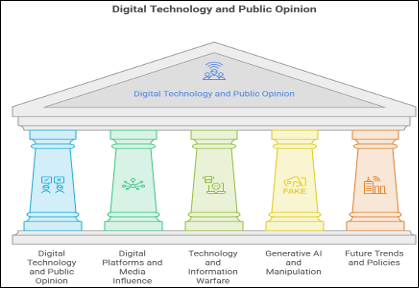
Figure 1. The five axes of the literature review: digital technology and public opinion, digital platforms and media influence, technology and information warfare, generative AI and manipulation, and future trends and policies.
First Axis: The Role of Digital Technology in Shaping Public Opinion
Napoli (2014) and Bakshy et al. (2015) addressed the impact of algorithmic recommendation systems on news consumption patterns and public opinion. They showed that algorithmic exposure directly shapes public attitudes, with trust and issue salience mediating this relationship [13][14]. Similarly, Tufekci (2015) analyzed the intersection of digital algorithms and public opinion formation, concluding that public opinion in the networked environment has become heavily influenced by algorithmic ranking patterns and digital selectivity [15]. In the same context, Kitchin (2017) demonstrated that artificial intelligence and algorithms do not operate as neutral tools, but intervene in shaping the public sphere by rearranging access to information and influencing patterns of public perception [16]. This axis reveals that digital technology has become a structural element in the production and reshaping of public opinion, although these studies do not sufficiently link this to the broader structure of information warfare.
Second Axis: The Impact of Digital Platforms and Algorithms on Media Influence
Ananny and Crawford (2018) showed that algorithmic systems have reshaped the media gatekeeping function, making virality and engagement criteria more influential than traditional journalistic standards [17]. Vosoughi et al. (2018) indicated that digital platforms have redefined media influence through automated selectivity, precise targeting, and engagement-linked amplification [18]. Others clarified that the influence of platforms cannot be separated from social behavior itself, as algorithms reproduce and feed social interactions within a mutual influence loop [19]. These studies indicate that media influence in the digital age is no longer based solely on message content, but on the mechanisms of its ranking, amplification, and visibility.
Third Axis: The Relationship Between Technology and Information Warfare
Benkler et al. (2018) provided an analysis of the transformation of information warfare in light of generative artificial intelligence, highlighting that this transformation is based on the abundance of synthetic content, speed, expanded scope, and difficulty of attribution and verification [20]. Bradshaw and Howard (2019) explained that information warfare is linked to the technological infrastructure that enables the manipulation of narratives, the fragmentation of public truth, and the targeting of psychological and social environments of the audience [21]. Pauwels (2024) added that current information warfare has become a highly complex environment in which real, fake, and synthetic content overlaps, giving actors capable of managing narratives a significant strategic advantage [22]. This axis of literature review confirms that the relationship between technology and information warfare has become a structural enabling relationship that multiplies the speed, scope, and impact of these wars.
Fourth Axis: Generative Artificial Intelligence, Synthetic Media, and Manipulation of Public Perception
Goldstein et al. (2023) confirmed that generative artificial intelligence has changed the information influence environment by producing highly convincing and customizable texts, images, audio clips, and videos [23]. A systematic review by Westerlund (2019) concluded that generative tools have increased the complexity of the disinformation environment, as detection tools themselves can be used to improve forgery methods [24]. Newman et al. (2025) showed that the public expects a wide impact of artificial intelligence on the media field, while concerns about accuracy, transparency, and trust remain at the forefront of public concerns [25]. This axis reveals that artificial intelligence threatens not only the credibility of content but also the possibility of maintaining shared trust in the public sphere.
Fifth Axis: Future Trends and Appropriate Policies
An analysis conducted by the European Commission in 2022 indicated that an effective response to future waves of disinformation requires combining governance, source standards, scrutiny, regulatory accountability, and community education [26], while a report by the Organisation for Economic Co-operation and Development (OECD) emphasized that building information resilience is based on the integration of government institutions, society, platforms, education, and early intervention mechanisms [27]. Newman and Cherubini (2025) explained that institutional dealing with artificial intelligence in news will largely depend on transparency, institutions’ ability to build trust, and the development of effective verification mechanisms [28]. This literature indicates that future trends will revolve around the rise of synthetic media, the growing need for flexible legislation, and the building of national capacities.
Commentary on Previous Literary Studies:
To organize the analytical presentation of previous studies and highlight the position of the current study among them, the following table presents the most prominent relevant studies, along with the topic of each study, its main findings, and the ways in which the current research benefits from them.
Table 3: Analytical Presentation of Previous Literary Studies
| Axis | Study | Topic of the Study | Key Findings | Benefits for the Current Research |
| Digital Technology & Shaping Public Opinion. | Napoli (2014) and Bakshy et al. (2015) | Impact of algorithms on news exposure and public opinion. | Algorithmic exposure affects the formation of public attitudes. | Supports the idea that technology is a structural element in shaping public opinion. |
| Tufekci (2015) | Formation of public opinion in the digital age. | Public opinion has become linked to algorithmic ranking. | Used to interpret the networked environment of public opinion. | |
| Kitchin (2017) | AI and public opinion. | Algorithms are not neutral tools. | Supports the analysis of reshaping public perception. | |
| Platforms, Algorithms & Media Influence. | Ananny and Crawford (2018) | Algorithmic gatekeeping. | Algorithms rearrange visibility and priority. | Supports the theoretical framework of the study. |
| Vosoughi et al. (2018) | Algorithms, disinformation, and polarization. | Media influence is now based on targeting and amplification. | Explains the transformation, like media influence. | |
| Computational propaganda: Political parties, politicians, and political manipulation on social media (2018) | Relationship between social behavior and algorithms. | Mutual influence between algorithms and social interaction. | Supports the compound interpretation of media influence. | |
| Technology & Information Warfare | Benkler et al. (2018) | Information warfare and generative AI. | Synthetic content has expanded information warfare. | Supports strategic analysis of digital threats. |
| Bradshaw and Howard (2019) | Post-truth and information warfare. | Technology enables manipulation of narratives and public truth. | Supports the theoretical analysis of information warfare. | |
| Pauwels (2024) | Information warfare in contemporary conflict. | Real and fake content overlap in one environment. | Supports the analysis of the current complexity of information warfare. |
Table 3 shows that previous literature has provided important knowledge accumulation in explaining the dimensions of the topic. However, it remained distributed across partial paths, which justifies the need for the current study to provide a more integrated analytical treatment that links digital technology, public opinion, information warfare, and generative artificial intelligence within a single framework.
The review of previous studies reveals a significant knowledge accumulation in analyzing the impact of algorithms, platforms, and generative artificial intelligence on shaping the public sphere and information warfare. Nevertheless, this accumulation remained fragmented across partial approaches. Studies focused on public opinion, others on algorithms, others on information warfare, and others on generative artificial intelligence, without sufficient integration among these elements within a single analytical framework. It is also evident that most relevant literature tends to focus on Western environments, while treatments directed at the Gulf context remain limited. Hence, the current study comes as an attempt to fill these gaps by building an integrated analytical and forward-looking treatment that links digital technology, the reshaping of public opinion, information warfare, and generative artificial intelligence, with a special focus on the strategic implications and proactive policies required in the Arab Gulf states.
3. Analysis and Results
The analysis reveals that digital technology is no longer merely a medium for information exchange or a channel for transmitting messages. It has instead become a governing structure of the public sphere, reshaping the conditions of visibility, priority, influence, and meaning. This structural transformation has turned public opinion itself into an arena of competition and conflict, rather than a mere automatic reflection of events or an output of traditional public debate.
Influencing public opinion no longer depends solely on the content of messages or the strength of arguments; it has come to rely significantly on algorithmic ranking mechanisms, targeting capabilities, repetition density, and the speed of networked circulation [29].
The results show that digital platforms and algorithms no longer perform a neutral technical function but have become influential actors in shaping the public agenda and in amplifying certain issues and narratives at the expense of others. The digital public sphere is no longer governed by the logic of social or professional value of content as much as it is governed by the logic of appeal, engagement, and virality. Consequently, control over attention has become one of the most important sources of media and political power in the digital age.
The analysis also indicates that information warfare is no longer a secondary activity complementing political or military conflicts. It has become a structural component of contemporary geopolitical competition. The goal is no longer merely spreading propaganda or misleading information, but managing collective perception itself: influencing what the public sees, what it considers important, how it interprets it, and the extent to which it trusts it.
The results further confirm that generative artificial intelligence has represented a qualitative leap in information influence tools. It has multiplied the density of synthetic content production, reduced its cost, and expanded its potential for customization and adaptation to different targeted audiences. The results show that the most dangerous aspect of this transformation lies not only in the quantity of misleading content but also in weakening public trust in the ability to verify information and creating an environment in which the real and the artificial are mixed, thereby increasing the fragility of the public sphere.
From a forward-looking perspective, the results indicate that the global information environment is heading toward greater complexity due to the increasing reliance on generative artificial intelligence in producing public content, the growing importance of provenance and digital attribution techniques, content authenticity verification, the expansion of regulatory frameworks for platforms and artificial intelligence, and the emergence of information resilience as a governing concept that links cybersecurity with media literacy and institutional trust.
4. Discussion of Results
The findings of the study reveal that traditional ideas that separate the medium, the content and the audience no longer make it possible to grasp public opinion in the digital era. Digital technology is not an external structure that carries messages but has become one of the interior conditions for the formation of public opinion itself [14]. This is consistent with the theoretical framework used by the study: Algorithmic Gatekeeping Theory explained the mechanisms used by platforms to control the visibility of content, Agenda-Setting Theory explained how the priorities of public awareness are redefined, and Framing Theory explained how issues are reinterpreted within semantic frames designed to influence collective perception.
The study also demonstrates that information warfare is no longer just about distributing misinformation or direct propaganda messages. It now works by reordering the perceptual field itself. What this means is that the powerful actor is not the one who produces the message, but the one who controls its timeliness, visibility, density, and interpretational context. The information threat today is not just the incorrect piece of information in its direct sense, but the capacity to re-engineer public trust, to produce broad uncertainty, to normalize misunderstanding between the reliable and the fake [22].
The results further show that generative artificial intelligence has not just provided a new instrument to influence the environment, but has redefined the ecosystem itself. The transformation requires a radical rethinking of approaches to confrontation, because traditional models of detection, correction and denial are no longer sufficient on their own—especially in an environment where synthetic media proliferate at a pace that sometimes outpaces the ability of institutions to respond.
In terms of the Gulf context, the results highlight not just the enormity of the threats but also a substantial strategic opportunity. The Gulf states are characterized by relatively high institutional and technical readiness, which allows them to transition from delayed response to proactive building of information resilience, driven by the rapid speed of digital change. But this shift demands a move away from the narrow defensive approach that emphasizes cybersecurity in the traditional sense, to a broader approach that recognizes that the information threat is not only to technical infrastructure but also to public trust, attention, legitimacy, and social cohesion.
5. Conclusion
The study concludes that digital technology has reshaped public opinion in a way that has made the information sphere part of the structure of conflict and competition in the digital age, rather than merely a space for communication or expression. It also shows that digital platforms, algorithms, and generative artificial intelligence have increased the ability of actors to influence public perception, produce misleading or directed content, and undermine shared trust. This makes information warfare one of the most prominent challenges to governance and stability in the near future.
The study demonstrates that the real danger lies not only in the abundance of misleading information but also in the transformation of the technological structure itself into a governing mediator of attention, interpretation, and trust. This grants certain actors an unprecedented ability to rearrange public priorities, frame facts, and control the conditions of their circulation. In this context, contemporary information warfare not only targets public awareness directly but also targets the environment in which this awareness is formed, making it too complex to be confronted with partial media or technical tools.
The study affirms that the response of the Gulf states to this reality must go beyond the traditional defensive approach and adopt a comprehensive vision of digital preparedness. This vision should integrate governance, regulation, innovation, verification, education, and early warning. Therefore, superiority in the future will not belong only to states that possess advanced digital infrastructure, but to those that can protect their public sphere from perceptual penetration, enhance their information resilience, and build institutional and societal trust capable of withstanding escalating digital pressures.
6. Recommendations
In light of the results reached by the study, it is recommended, in the short term, to establish specialized national mechanisms for the early monitoring of information campaigns, develop protocols for verifying synthetic content, and enhance the readiness of government and media personnel in dealing with emerging information risks.
Over the medium term, it is advisable to implement adaptive regulatory frameworks governing digital platforms and artificial intelligence, strengthening algorithmic governance, and activating partnerships between governments, universities, think tanks, and technical entities to develop national tools for monitoring, verification, and response.
In the long term, the study advocates adopting an integrated Gulf strategy for information resilience. This strategy should be based on integrating information security with media and digital literacy, developing institutional capacities, and expanding regional and international cooperation in confronting information warfare. Such an approach would ensure the building of an initiative-taking model that enhances public trust and protects institutional and societal stability.
- Jürgen Habermas, The Structural Transformation of the Public Sphere: An Inquiry into a Category of Bourgeois Society (T. Burger, Trans.), MIT Press, 1989, (Original work published 1962).
- Manuel Castells, “Communication, Power and Counter-power in the Network Society,”International Journal of Communication 1 (2007): 238–266, https://ijoc.org/index.php/ijoc/article/view/46/.
- Robert Chesney and Danielle Keats Citron, “Deep Fakes: A Looming Challenge for Privacy, Democracy, and National Security,”California Law Review 107, no. 6 (2019): 1753–1819, https://doi.org/10.2139/ssrn.3213954.
- The Global Risks Report 2025(20th ed.), World Economic Forum, January 15, 2025, https://www.weforum.org/publications/global-risks-report-2025/.
- Philip Seib, Information at War: Journalism, Disinformation, and Modern Warfare, Wiley, 2021.
- OECD, Facts Not Fakes: Tackling Disinformation, Strengthening Information Integrity, OECD Publishing, March 4, 2024,https://doi.org/10.1787/d909ff7a-en.
- Clare Wardle and Hossein Derakhshan, Information Disorder: Toward an interdisciplinary framework for research and policy making, Council of Europe, 2017,https://rm.coe.int/information-disorder-toward-an-interdisciplinary-framework-for-researc/168076277c.
- UNESCO, Guidelines for the governance of digital platforms: Safeguarding freedom of expression and access to information through a multi-stakeholder approach, 2023, https://unesdoc.unesco.org/ark:/48223/pf0000387339.
- Karine Barzilai-Nahon, “Toward a theory of network gatekeeping: A framework for exploring information control,”Journal of the American Society for Information Science and Technology 59, 9 (2008): 1493–1512, https://doi.org/10.1002/asi.20857.
- Maxwell E. McCombs and Donald L. Shaw, “The agenda-setting function of mass media,”Public Opinion Quarterly 36, no. 2 (1972): 176–187, https://doi.org/10.1086/267990.
- Robert M. Entman, “Framing: Toward clarification of a fractured paradigm,”Journal of Communication 43, no. 4 (1993): 51–58, https://doi.org/10.1111/j.1460-2466.1993.tb01304.x.
- Tarleton Gillespie, “The Relevance of Algorithms,” in T. Gillespie, P. J. Boczkowski, & K. A. Foot (Eds.),Media Technologies: Essays on Communication, Materiality, and Society, 167–194, (MIT Press, 2014), https://doi.org/10.7551/mitpress/9780262525374.003.0009.
- Philip M. Napoli, “Automated Media: An Institutional Theory Perspective on Algorithmic Media Production and Consumption,”Communication Theory 24, no. 3 (2014): 340–360, https://doi.org/10.1111/comt.12039.
- Eytan Bakshy, Solomon Messing, and Lada A. Adamic, “Exposure to ideologically diverse news and opinion on Facebook,”Science 348, no. 6239 (2015): 1130–1132, https://doi.org/10.1126/science.aaa1160.
- Zynep Tufekci, “Algorithmic Harms Beyond Facebook and Google: Emergent Challenges of Computational Agency,”Colorado Technology Law Journal 13 (2015): 203–218, https://scholar.law.colorado.edu/ctlj/vol13/iss2/4/.
- Rob Kitchin, “Thinking critically about and researching algorithms,”Information, Communication & Society 20, no. 1 (2017): 14–29, https://doi.org/10.1080/1369118X.2016.1154087.
- Mike Ananny and Kate Crawford, “Seeing without knowing: Limitations of the transparency ideal and its application to algorithmic accountability,”New Media & Society 20, no. 3 (2018): 973–989, https://doi.org/10.1177/1461444816676645.
- Soroush Vosoughi, Deb Roy, and Sinan Aral, “The spread of true and false news online,”Science 359, no. 6380 (2018): 1146–1151, https://doi.org/10.1126/science.aap9559.
- Samuel C. Woolley and Philip N. Howard, (Eds.), Computational Propaganda: Political Parties, Politicians, and Political Manipulation on Social Media (Oxford University Press, 2018),https://doi.org/10.1093/oso/9780190931407.001.0001.
- Yochai Benkler, Robert Faris, and Hal Roberts, Network Propaganda: Manipulation, Disinformation, and Radicalization in American Politics (Oxford University Press, 2018),https://doi.org/10.1093/oso/9780190923624.001.0001.
- Samantha Bradshaw and Philip N. Howard, The Global Disinformation Order: 2019 Global Inventory of Organised Social Media Manipulation(Working Paper 2019.2), Project on Computational Propaganda, Oxford, 2019, https://demtech.oii.ox.ac.uk/wp-content/uploads/sites/12/2019/09/CyberTroop-Report19.pdf.
- Eleonore Pauwels, Preparing for Next-Generation Information Warfare with Generative AI, Centre for International Governance Innovation, 2024, https://www.cigionline.org/publications/preparing-for-next-generation-information-warfare-with-generative-ai/.
- Josh A. Goldstein, Girish Sastry, Micah Musser, Renee DiResta, Matthew Gentzel, and Katerina Sedova, “Generative Language Models and Automated Influence Operations: Emerging Threats and Potential Mitigations,” arXiv, 2023,https://doi.org/10.48550/arXiv.2301.04246.
- Mika Westerlund, “The Emergence of Deepfake Technology: A Review,”Technology Innovation Management Review 9, no. 11 (2019): 40–53, https://doi.org/10.22215/timreview/1282.
- Nic Newman, Amy Ross Arguedas, Craig T. Robertson, Rasmus Nielsen, Richard Fletcher, Digital News Report 2025, Reuters Institute for the Study of Journalism, 2025,https://doi.org/10.60625/risj-8qqf-jt36.
- European Commission, 2022 Strengthened Code of Practice on Disinformation, June 16, 2022,https://digital-strategy.ec.europa.eu/en/library/2022-strengthened-code-practice-disinformation.
- OECD, Building Trust and Reinforcing Democracy: Preparing the Ground for Government Action,” OECD Publishing, November 17, 2022,https://doi.org/10.1787/76972a4a-en.
- Nic Newman and Federica Cherubini, Journalism, media, and technology trends and predictions 2025, Reuters Institute for the Study of Journalism, 2025,https://doi.org/10.60625/risj-vte1-x706.
- David M. Lazer, Mathew A. Baum, Yochai Benkler, Adam J. Berinsky, Kelly M. Greenhill, Filippo Menczer, Miriam J. Metzger, Brendan Nyhan, Gordon Pennycook, David Rothschild, Michael Schudson, Steven A. Sloman, Cass R. Sunstein, Emily A. Thorson, Duncan J. Watts, and Jonathan L. Zittrain, “The science of fake news,”Science 359, no. 6380 (2018): 1094–1096, https://doi.org/10.1126/science.aao2998.