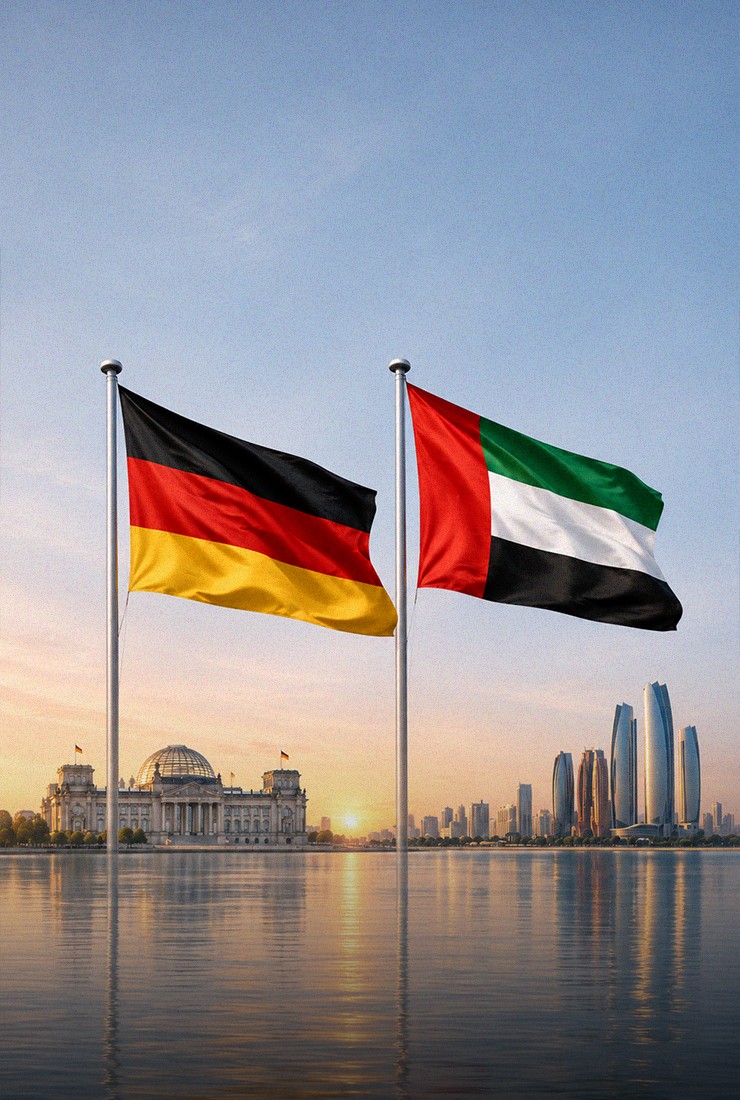
The UAE’s historic state visit by President His Highness Sheikh Mohamed bin Zayed Al Nahyan to Germany between 9 and 11 September 2026 has important implications beyond simple diplomatic symbolism and large economic commitments. This trip highlights efforts to elevate German-UAE relations beyond an economic partnership into a more strategic, interdependent relationship.
As part of this extensive visit, a Strategic Dialogue was set up between the two countries to breathe new life into their Comprehensive Strategic Partnership, which was set up in 2004. Both parties also announced plans to establish a German-UAE Investment Council. The UAE also announced plans to invest €40 billion in Germany, which includes around one gigawatt of data center capacity. Over the next decade, Bavaria will receive €10 billion of this investment. Additionally, 29 business-to-business agreements totaling more than €9.356 billion were also announced.
Moving past October, we are seeing increasing signs of how this political momentum is translating into different areas. We have witnessed meetings between the UAE Federal National Council (FNC) and the Bundestag, as well as the German Ambassador. This demonstrates how important parliamentary diplomacy is becoming. In addition, the UAE business community is discussing how to work more collaboratively using joint ventures and technology. There are now 7,685 German companies in the UAE, up by 35% since 2024.
However, the main issue moving forward will be how to implement these plans. Since the €40 billion investment plan is long-term, it is crucial to deliver the projects, funds, technology collaboration and productive industry.
Looking at the wider picture in Europe, the second EU-GCC summit, which was due to take place in Saudi Arabia on 24 October 2026, was postponed on the 15th of October due to security and logistical issues in the region.
Overall, this policy insight argues that the growing German-UAE partnership should be viewed as a result of three key factors. Firstly, the establishment of a strategic partnership. Secondly, increased economic and technological ties. Thirdly, the increasing importance of the UAE to Europe’s relationship with the Gulf.
This relationship should be seen as a strategic interdependence rather than a strategic exclusivity. It will be important going forward to ensure that these plans are implemented and sustained. Ultimately, it will be vital to manage any differences between the two countries to ensure long-term success.
1. Beyond the State Visit: From Momentum to Collaboration
The state visit was historic, as it was the first-ever state visit from the President of the UAE to Germany. However, the real impact of this visit was the collaborative framework created. A German-UAE Strategic Dialogue was launched to foster collaboration across international and regional security and defense, trade and investment, energy and climate, new technologies, digitalization, transport, culture and education. An Investment Council was proposed to improve collaboration between the government, investors and the private sector.
This helps overcome a key issue within the bilateral relationship. While there are strong economic and diplomatic links between Germany and the UAE, there has never been a comprehensive collaboration framework between the two countries.
Additional frameworks were created through the UAE-Germany Joint Economic Committee. The twelfth session of this committee took place in Munich during the visit and focused on collaboration across renewable energy, artificial intelligence, manufacturing, logistics, healthcare, financial services, education, agriculture and infrastructure.
There is evidence that this momentum is developing further.
On 13th October, Saqr Ghobash, Speaker of the UAE Federal National Council, met with German Ambassador Dr Tobias Tunkel to strengthen parliamentary relations. The collaboration between both parties focused on sharing knowledge and enhancing cooperation between the FNC and the German Bundestag. Both sides highlighted the importance of ensuring that parliament can keep up with the momentum of the political and economic relationship.
On 20 October, Dr. Ali Rashid Al Nuaimi, Chairman of the FNC Defence, Interior and Foreign Affairs Committee, met with a German Bundestag delegation led by Dr. Norbert Röttgen and Alexander Radwan. This discussion centered on building a framework for cooperation between parliaments, collaboration across the economic and investment sectors, clean energy, hydrogen, artificial intelligence, and advanced industries. The delegations also discussed regional security and stability between the Gulf and Europe.
Dr. Anwar Gargash, Diplomatic Adviser to the UAE President, also held a separate meeting with the German parliamentary delegation on the same day to discuss bilateral relations and regional/international developments.
This shows that collaboration between the two countries has started to develop more widely. Cooperation between parliaments will open up additional avenues for political dialogue, policy, and the sharing of knowledge. This may help with maintaining political support for implementing bilateral commitments.
The focus now will be on creating consistent frameworks, working groups and timelines to deliver tangible outcomes.
2. Trade to Co-Investment
The most high-profile economic outcome of the visit was the announcement of the €40 billion investment package that will be targeted at supporting German industries, including high tech and AI, digital developments and energy (with around 1GW of data center capacity). This is in addition to the existing Emirati investment in Germany, which is around €34 billion, and follows on from the €15 billion that has been invested by XRG in Covestro.
One key area of this investment is Bavaria, with €10 billion set to be invested over the next decade. This can help to link the diplomatic relationship between the two countries to local industrial sectors in Bavaria. Due to its strengths in high-tech manufacturing, automotive, aerospace, AI and research, it is an attractive region for Emirati investment.
Another indicator of the increasing private sector engagement is the 29 business deals signed during the visit. These include partnerships with ADNOC, XRG, Masdar and RWE, among others and have a total value of over €9.356 billion. These are spread across energy, high-tech materials, industrial tech and infrastructure.
This trend has been highlighted by business leaders within the sector. Martin Henkelmann spoke about how the relationship between Germany and the UAE is shifting from traditional business to investment, innovation and working together. This was stated in an interview with Gulf News on 2 October 2026. Advanced manufacturing, AI, digitization, energy and infrastructure were highlighted as key areas of interest. The interview also underlined how the strengths of the German industry (especially the Mittelstand) work well with the investment capability of the UAE.
Overall, this shows how the UAE is becoming an attractive place for German companies to develop, test and grow new solutions together.
The growing presence of German businesses in the UAE is also evident. According to the UAE Ministry of Economy and Tourism, there was a 35% increase in the number of German companies operating in the UAE in 2025 (up from 2024). At the end of May 2026, there were 7,685 German companies operating in the UAE. Additionally, there were 20,842 German trademarks registered in the UAE in early June 2026.
This demonstrates how strong the current relationship is and how valuable the UAE is as a business hub in the region.
However, it is important to note that the €40 billion figure represents an investment package and a long-term commitment rather than an immediate financial transfer. Memoranda of Understanding (MoUs) and Letters of Intent (LoIs) do not necessarily constitute legally binding agreements. Accordingly, the figure should be understood as encompassing existing investments, concluded business deals, financial commitments and potential future investments. Ultimately, the long-term value of this partnership will depend on the extent to which these commitments translate into tangible outcomes, including increased production capacity, job creation, technology transfer, research collaboration and sustainable industrial development.
3. Energy Security: From Commercial Cooperation to Strategic Resilience
German-UAE energy cooperation is one of the strongest pillars of bilateral relations. However, it has gained strategic importance in recent years due to the regional instability, supply chain issues, and uncertainty within the international energy market.
The new deals announced during the State Visit show the diversification of the energy relationship between the two countries. RWE and Masdar are looking to work together in offshore wind projects in Germany. RWE and ADNOC have moved forward with talks on LNG cooperation. XRG and SEFE have also signed deals. The mix of fossil fuels and renewables demonstrates the different timeframes of the energy transition. Germany needs secure, short- and medium-term energy sources while moving toward a decarbonized future. The UAE wants to increase its presence in traditional energy markets and emerging low-carbon sectors.
This relationship sees a broad range of energy interdependencies between the two countries, including LNG, renewables, hydrogen and supporting infrastructure.
The strategic aspect of this relationship can be seen in the 2026 regional security crisis, which showed how the Gulf’s energy production cannot be separated from security, transport infrastructure and international supply chains. The strategic importance of the Strait of Hormuz demonstrates how any disruption to shipping can have a significant effect on energy markets, industrial production and international trade.
For Germany, cooperation with the UAE presents an opportunity to diversify relationships with an important strategic producer that has vast logistics and international business networks. Different technologies need to be considered. LNG markets are well established; offshore wind is a mature technology; however, international hydrogen value chains are not as mature.
Therefore, the strategic value of cooperation will depend on the political commitment being converted into secure infrastructure and viable business.
4. Artificial Intelligence and Digital Sovereignty: A New Dimension of Strategic Interdependence
Looking ahead, one of the most interesting elements of the state visit is looking at digital infrastructure and artificial intelligence. By investing in around 1GW of data center capacity in Germany and working together on data centers and information systems, referred to as Data Embassies, it brings a whole new element to the relationship between Germany and the UAE.
Traditionally, economic cooperation between Germany and the Gulf has focused on industrial exports, hydrocarbons and investment. However, a whole new partnership is forming around computer power, artificial intelligence, the cloud and the control of critical data. The UAE has identified cutting-edge tech and artificial intelligence as key in its diversification strategy, and Germany provides industrial knowledge, research power, high-quality manufacturing and access to the European Single Market. This creates great opportunities for innovative research, digital industrialization and AI applications within manufacturing, energy, logistics and public sectors.
The UAE’s participation in GITEX AI Europe 2026 in Berlin highlights its push to expand its tech sector internationally. It had a strong delegation, including Emirati start-ups and SMEs. The UAE had 20 companies within its delegation, with government, academic and business bodies, according to the Ministry of Economy and Tourism.
But there are some tricky issues surrounding digital infrastructure. Data security, cybersecurity, jurisdiction, access to data and protecting critical industrial data must be considered to make sure Data Embassies can become a reality. This is a particularly difficult factor to overcome in Europe, where digital sovereignty is a key priority.
To ensure success, systems must be in place that are both commercially attractive and comply with regulations. Digital infrastructure is becoming just as important in international partnerships as energy infrastructure and investment.
5. Defense and Security: Diversification without Alliance Formation
The visit in September progressed bilateral security relations by signing letters of intent on defense cooperation and police and security partnerships. This willingness to look past a traditional buyer/seller relationship suggests a desire to form closer partnerships around defense technology, cybersecurity, air and missile defense, counter drone systems, maritime security and critical infrastructure.
It is also important to understand the regional security landscape. Recent threats and disruptions to Gulf security have highlighted the importance of protecting infrastructure, having the latest technology, and having a diverse set of international partners.
For the UAE, Germany provides cutting-edge industry, defense technology and access to a larger European security network. Germany also has a keen interest in working closely with a key strategic partner in the Gulf that has economic and logistical significance throughout Europe, Asia and Africa.
However, this does not mean a new military alliance will be formed.
The U.S. remains a key player in the Gulf’s security with its military capabilities, defense systems, training partnerships and strong relationships. This means that any cooperation with Europe is more likely to be a supplementary partnership to the current U.S. security framework. The most significant impact Germany will have is if it can bring extra technology, industrial partnerships and security specialisms. The main indicator for progression will be whether there are collaborative developments, technology sharing and security partnerships being formed from within the defense framework.
6. From Berlin to Brussels: The European Dimension
The German-UAE relationship is more relevant than ever for the EU-GCC relationship overall. There is already significant economic trade between the EU and the GCC. In 2025, approximately €165.6-165.7 billion (in merchandise) and €84.4 billion (in services) were traded. Additionally, investments were made totaling €163.1 billion from the EU to GCC countries and €189.8 billion from GCC to the EU.
The UAE plays a key role in this relationship, with approximately 53% of EU-GCC services trade. There was also significant investment between the two regions. However, there has been little political and institutional collaboration between the two.
The EU’s Strategic Partnership with the Gulf in 2022, the first EU-GCC Summit in October 2024 and the EU-UAE Free Trade Agreement negotiations attempt to counter this. The EU-UAE negotiations began in 2025 and include trade in goods, services, investment, digital, energy and raw materials. As of July 2026, there have been seven rounds of negotiation.
This indicates the true nature of the EU-UAE relationship. Due to the digital infrastructure, there must be correct regulations around digital trade and data. Additionally, there are questions regarding Sovereign Investment, meaning there must be consideration around state-owned enterprises and investment regulation. Finally, there is industrial collaboration, meaning there must be regulations around IP, investment and technology sharing.
In October 2026, the second EU-GCC Summit was postponed. Originally planned for 24th October in Riyadh, on 15th October, it was postponed. The GCC General Secretariat stated that this was due to ongoing security issues and the prolonged suspension of flights at King Khalid International Airport. The EU also confirmed that a new date will be announced.
This indicates the ongoing challenges facing diplomatic efforts in the region. However, it also displays how the strategic importance of the European Gulf relationship is increasing. The German-UAE relationship plays an important role in this scenario. Bilateral relationships will continue to grow while multilateral processes are delayed.
As a result, the European-Gulf relationship will likely be multi-layered. There will be EU-GCC institutions, bilateral trade deals and strategic partnerships between individual European countries and Gulf countries.
7. The UAE as a Networked Middle Power
The improvement in relations with Germany should also be seen as part of a wider shift in Emirati foreign policy. The UAE has begun to develop an international role that goes beyond its financial wealth and energy resources to include being a world leader in transport, logistics, air, ports, wealth management and diplomacy.
The UAE’s foreign policy increasingly displays the characteristics of a ‘networked middle power’. While the UAE has relationships with a variety of nations, including the United States, Europe, China and India, it does not have a sole geopolitical ally. In this context, the partnership between Germany and the UAE is a natural fit.
Germany has advanced industries and technology, plus access to European markets. The UAE offers wealth, energy resources, logistics and a growing role in international wealth and transport.
This increases the UAE’s strategic independence by increasing its diversification. This aligns with the UAE’s actions with other key partners. Its relationship with India, economic ties with China and long-term security partnership with the United States show that the country is not shifting its geopolitical allegiances.
For Germany, increasing relations with the UAE will give it access to a powerful partner with far-reaching international relationships. Overall, this partnership demonstrates the changing nature of international relations with middle powers seeking to increase their flexibility by diversifying their relationships.
8. Assessing Progress: Five Indicators for the Next Phase
Overall, it is too soon to gauge the full impact of these initiatives on the relationship between Germany and the UAE, just two months after the state visit. It would be better to measure success by using these five metrics:
- Investment: How much of the 40 billion euros will go into actual investment, with clear financial commitments and actually being delivered on the ground (industry, energy, digital).
- Strategic Dialogue and Investment Council: Whether a real dialogue has been set up between the countries, with working groups and an implementation plan.
- Technology: Whether any progress has been made on collaboration efforts (research, AI, data center development, technology transfer and industry).
- Security: The creation of tangible security and defense measures (cybersecurity, maritime security, air defense and critical infrastructure protection).
- Integration within Europe: More progress on EU-UAE trade discussions and for the delayed EU-GCC Summit to be held, showing that Germany can deliver on bilateral relationships and push for regional collaboration.
This enables us to assess the dynamic of the relationship and observe a real shift.
Conclusion
The new German-UAE partnership that began following President Sheikh Mohamed bin Zayed’s visit to Germany marks a significant step in the development of the European-Gulf relationship. This visit has created an overarching partnership covering multiple aspects, including investment, industry, energy, AI, digital, defense and policy. This isn’t just because they have committed to investing €40 billion, but it also highlights how there is more of a connection between economic power, technology, and geopolitical strength.
This month has seen developments in the relationship as both sides are building up the partnership by working together with Parliament (Federal National Council and Germany’s Bundestag), political discussions continue at a high level, more German businesses are entering the UAE, and there is a greater focus on partnerships and innovation.
However, the implementation of all the investments mentioned has yet to be verified, so there is a need for a measured approach to the relationship. In addition, the second EU-GCC meeting has been postponed, highlighting how important security is to the region.
The UAE is an important partner for Germany and Europe as it is a well-connected middle power. The UAE has a lot to offer Germany as it has strong capital, energy, technology goals, and connections to other countries around the world.
However, this relationship shouldn’t be viewed as an alliance. Both countries still have their own goals and partnerships globally. It should be seen as a strategic relationship. Ultimately, the success of this new relationship will depend on whether they can translate the political commitments into actual outcomes. They also need to ensure they can build trust in regulation, have continuity in their institutions and manage any differences.
The September visit could turn out to be significant, not only as a milestone in the German-UAE relationship but also as an example of how two well-connected middle powers can increase their strategic autonomy by partnering with a variety of countries in an increasingly uncertain multi-polar world.
References
Federal Government of Germany, “Joint Declaration on the Occasion of the State Visit of the President of the United Arab Emirates to the Federal Republic of Germany, September 11, 2026.
- UAE Ministry of Foreign Affairs, Joint Declaration on the Occasion of the State Visit of the President of the United Arab Emirates to the Federal Republic of Germany, September 10, 2026.
- Emirates News Agency (WAM), “UAE President and German Chancellor Witness Launch of Strategic Dialogue, Declaration of Intent to Establish UAE-German Investment Council, and Other Agreements,” September 10, 2026.
- Emirates News Agency (WAM), “UAE Announces Plans to Invest €40 Billion in Germany,” September 10, 2026.
- Emirates News Agency (WAM), “FNC Speaker, German Ambassador Discuss Ways to Enhance Parliamentary Cooperation,” October 13, 2026.
- Emirates News Agency (WAM), “FNC and German Bundestag Discuss Strengthening Parliamentary Cooperation,” October 20, 2026.
- Emirates News Agency (WAM), “Gargash and German Parliamentary Delegation Discuss Strengthening Bilateral Ties,” October 20, 2026.
- “Unlocking Bilateral Potential: UAE and Germany Forge New Business Models,” Gulf News, October 2, 2026.
- UAE Ministry of Economy and Tourism, “UAE Participates in GITEX AI Europe 2026 in Berlin to Strengthen Presence of Emirati SMEs on Global Technology Platforms,” July 3, 2026.
- Council of the European Union, “Rescheduling of the EU-GCC Summit,” October 15, 2026.
- GCC General Secretariat, Statement Regarding the Rescheduling of the GCC-EU Summit, October 15, 2026.
- European Commission, “EU-United Arab Emirates: Documents and Negotiation Round Reports,” 2026.
- Germany Trade & Invest, Wirtschaftsdaten kompakt – Vereinigte Arabische Emirate, 2026.
- ADNOC, “ADNOC, XRG and Masdar Deepen Germany Partnerships with Strategic Energy, Industry and Technology Agreements,” September 11, 2026.
- Stephan Roll, Sovereign Wealth Funds and Foreign Policy: How Saudi Arabia, the UAE and Qatar Invest in Their Power, SWP Research Paper, 2026.
- Cinzia Bianco, “The Gulf on the Front Line: The End of Strategic Hedging and New Space for Europeans,” European Council on Foreign Relaions, March 26, 2026.
- Rym Momtaz, “Europe and the Arab Gulf Must Come Together,” Carnegie Endowment for International Peace, March 17, 2026.
- Robert Mason, “From Relative Autonomy to Relational Autonomy? A Reappraisal of GCC State-Building and Foreign Policy,” Journal of Arabian Studies, 14, no. 2 (2024).