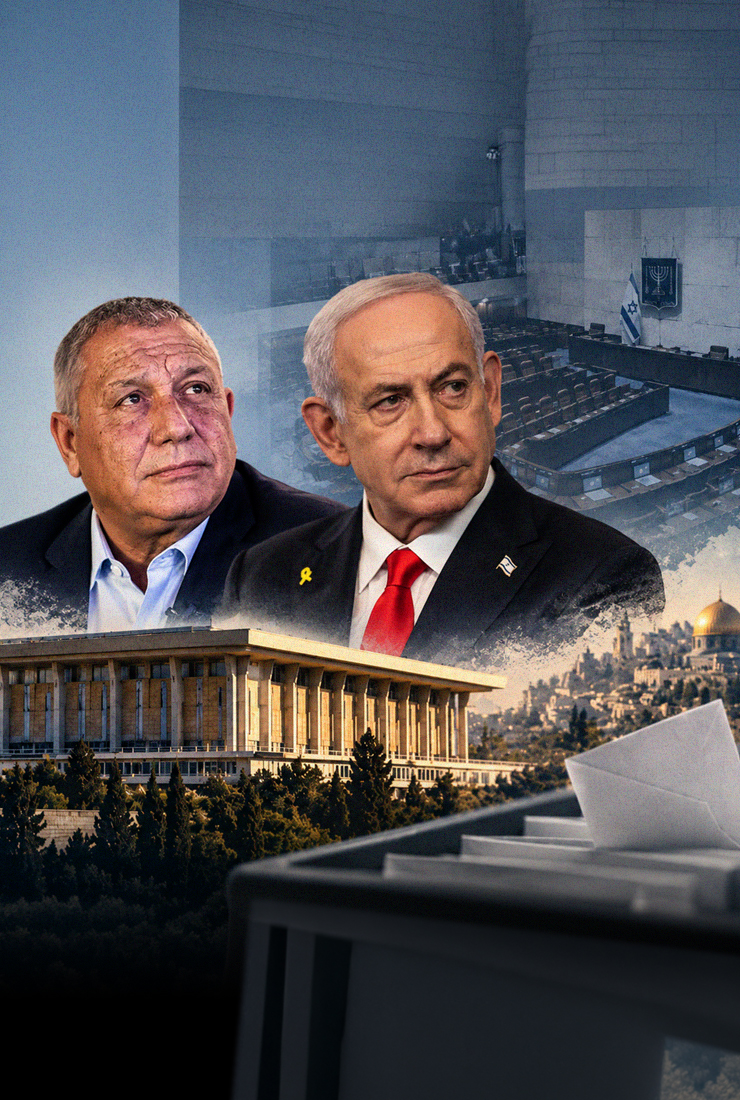
Israel held legislative elections on 27 October 2026 to elect the 120 members of the 26th Knesset. Security issues dominated the election campaigns and political competition, amid mounting pressure on the Israeli economy from the wars that have continued since 2023. These conflicts contributed to a 3.3% contraction in the Israeli economy in the first quarter of 2026.[1]
The elections marked a significant turning point in Israel’s political landscape, producing a divided parliament in which neither political camp secured a decisive majority. Although Benjamin Netanyahu’s Likud party emerged as the largest party, his right-wing and religious bloc lost the parliamentary majority it had held since the 2022 elections. This has once again plunged Israel into difficult coalition negotiations and raised the prospect of a realignment of the political landscape.
The results do not indicate a profound ideological shift within Israeli society. Rather, they reveal Netanyahu’s diminishing ability to dominate the political landscape and the return of the political deadlock that has characterized Israeli politics over the past decade, particularly the difficulty of forming stable governing coalitions. In the foreseeable future, the identity of the next government will remain less significant than the continued broad Israeli consensus on national security priorities and confronting regional threats. This means that change is more likely to occur in political leadership and alliances than in the substance of Israel’s strategic policies.
This insight examines the Israeli election results and their implications for Israel’s foreign policy and economic conditions.
1.Election Results and Their Implications
The Israeli elections produced no clear winner, as neither Prime Minister Benjamin Netanyahu nor opposition leader Gadi Eisenkot secured a clear path to power. Israel may now face weeks of political uncertainty.
In the early hours of Friday morning, Israel’s Central Elections Committee announced the final results of the parliamentary (Knesset) elections. Following the completion of the vote count in the elections for the 26th Knesset, with the results scheduled to be formally announced on 4 November, the distribution of seats was as follows:
Table 1: Israeli Legislative Election Results by Party
| Party | Seats won in 2026 | Seats in 2022 |
| Likud | 27 | 32 |
| Yashar | 21 | Founded in 2025 |
| Together (Beyachad) | 12 | Founded in 2026 |
| Joint List | 11 | “5”(أ) |
| United Arab List (Ra’am) | 8 | 5 |
| The Democrats | 8 | Founded in 2024 |
| Yisrael Beiteinu | 7 | 6 |
| United Torah Judaism | 7 | 7 |
| Otzma Yehudit (Jewish Power – Ben-Gvir) | 7 | 6 |
| Shas | 6 | 11 |
| Religious Zionist Party (Smotrich) | 6 | 7 |
The alliance comprising the Democratic Front for Peace and Equality and the Arab Movement for Change, together with the United Arab List, won a combined total of 19 seats.
Source: Keshet Neev, “Israel Election Results: Netanyahu Bloc Holds Lead with Double Envelopes after 97% of Votes Counted,” Jerusalem Post, October 28, 2026, updated October 30, 2026, https://www.jpost.com/israel-election-2026/article-913164.
As Table 1 shows, popular support for the governing coalition declined, despite Likud emerging as the largest party with 27 seats, five fewer than in the previous Knesset. The ultra-Orthodox Shas party also suffered an unprecedented setback, winning just six seats for the first time since 1992, a loss of five seats compared with the November 2022 elections.[2] Meanwhile, the Religious Zionist Party, led by Bezalel Smotrich, and Otzma Yehudit (Jewish Power), led by Itamar Ben-Gvir, each lost one seat compared with the November 2022 elections.
By contrast, Yashar, led by the main opposition candidate Gadi Eisenkot, secured 21 seats, while its three allies—Together, the Democrats, and Yisrael Beiteinu—won 12, 8, and 7 seats, respectively. Notably, the opposition parties forming the “Change” bloc, with the exception of Yisrael Beiteinu, which gained one seat compared with the November 2022 elections, are newly established political formations that did not contest the previous elections under their current names. However, the Democrats, led by Yair Golan, gained four seats compared with the combined performance of its two constituent parties, Labor and Meretz, in the November 2022 elections. The alliance between former Prime Minister Naftali Bennett and opposition leader Yair Lapid (the Together party) lost approximately 12 seats compared with their combined representation in the previous Knesset.
Meanwhile, the Arab parties, organized into two electoral alliances—the United Arab List (Ra’am) and the Joint List—delivered a surprise in these elections, securing a combined 19 seats, approximately 16% of the Knesset. This represents the greatest electoral achievement by Arab parties in the history of their representation in the Knesset.
Table 2: Israeli Legislative Election Results by Electoral Bloc
| Electoral Bloc | Seats won in 2026 | Percentage of Seats |
| Likud–Netanyahu Bloc | 53 | 44% |
| Change–Eisenkot Bloc | 48 | 40% |
| Joint List | 11 | 9.2% |
Source: Sky News Arabia, “Official: Final Israeli Election Results Announced,” October 30, 2026, https://2u.pw/zpKrtq.
As Table 2 shows, Netanyahu’s bloc (Likud, Shas, United Torah Judaism, Jewish Power, and the Religious Zionist Party) lost its parliamentary majority.[3] Nevertheless, it remains the largest bloc, securing 53 seats (approximately 44% of the Knesset), eight seats short of the 61 required to form a government.
Meanwhile, the Change bloc (Yashar, Beyachad, Yisrael Beiteinu, and the Democrats) won 48 seats (approximately 40% of the total), leaving it 13 seats short of the 61-seat majority needed to form a government.
Together, Ra’am and the Joint List hold the balance of power, as they are the only parties capable of enabling either bloc to cross the 61-seat threshold. Mathematically, this makes the Arab parties kingmakers. In practice, however, analysts believe they are unlikely to play this role because other parties’ refusal to include them in government amounts to a political veto. Both Netanyahu and Eisenkot have rejected partnerships with them, citing a lack of shared values. Netanyahu even described a coalition with Arab parties as “shameful.”
The results of the 26th Knesset elections thus point to continued political uncertainty, with neither Netanyahu’s nor Eisenkot’s bloc securing the 61 seats needed to form a new government. Eisenkot would need either to forge an alliance with the Arab parties or join forces with Netanyahu in a national unity government. Netanyahu, meanwhile, would need to attract allies from the opposition. Given the difficulties associated with these options, as discussed below, coalition negotiations could drag on and potentially lead to another election, raising the prospect of a prolonged governance crisis or Netanyahu’s continued hold on power.
Netanyahu could remain in power by forming a coalition government through attracting parties or members of the right-wing opposition, or by establishing a national unity government that includes Eisenkot or Bennett while excluding some of his far-right allies. A third option would involve securing the support of an Arab party to achieve a parliamentary majority, although this would be politically difficult. Netanyahu himself has warned against forming a “dangerous government” that includes Arab parties.
Voter turnout in the elections for the 26th Knesset reached 77.97%, the highest level since 1999, while turnout among Arab voters in Israel stood at approximately 80%. The elections saw a substantial increase in participation among Arab citizens, whose turnout has traditionally been lower than that of Jewish Israelis. A strong desire to remove Netanyahu’s right-wing coalition from power drove Arab citizens of Israel, who account for approximately 20% of the population, to vote in large numbers. This record turnout gave Arab parties unprecedented parliamentary weight. According to Nir Hasson, Palestinians in East Jerusalem voted at their highest rate since 1967. In the town of Sur Baher, the number of voters increased three-and-a-half-fold compared with the 2022 elections.[4]
The election results also reflect a shift in the political standing of both Eisenkot and Netanyahu. They exposed Netanyahu’s diminished ability to form a government but did not undermine his central position as leader of Israel’s largest party. At the same time, they established Eisenkot’s legitimacy as Netanyahu’s principal challenger. The results also present a test for both leaders. Eisenkot will have to demonstrate his ability to maintain the cohesion of his heterogeneous bloc and the extent to which he can honor his electoral commitments. Netanyahu, meanwhile, will face a test of his ability to keep his own bloc united, attract or persuade elements of the Change bloc to join a coalition government, and determine how far he is prepared to make concessions to retain the premiership under any potential coalition arrangement.
The elections also revealed the extent of divisions within Israeli society. They reflect a political system in which the prospects for forming coalitions have narrowed considerably because of ideological polarization, the rightward shift among Jewish voters, the growing normalization of the Religious Zionist movement within society, and disagreements over the legitimacy of Arab political participation.[5]
Overall, the election results strengthened the position of parties smaller than the two largest parties, Likud and Yashar, giving them bargaining power disproportionate to their political strength.
2.Scenarios for Forming the New Government
The election results open the door to several possible scenarios for forming a government,[6] including the following:
- Failure to Form a Government and the Prospect of New Elections
Neither bloc may succeed in forming a government, potentially leading to another election or even several rounds of elections over the coming months or years, as occurred repeatedly between 2019 and 2022. This possibility would become more likely if leaders of the Change bloc maintained their refusal to enter a governing coalition with Netanyahu, while he remained unable to attract political forces from outside his bloc and continued to reject cooperation with Arab parties.
If Israel heads to another election, Eisenkot is likely to make a second attempt to form a government. However, if he fails again, Netanyahu could emerge from the process in a stronger position, potentially leaving Eisenkot with little choice but to accept a Likud-led government or provide it with tacit support. In the meantime, Netanyahu, as caretaker prime minister, will do everything possible to keep public attention focused on the war while continuing to pursue increasingly hardline policies.
However, this scenario is not inevitable. The cost of holding another election and fears of losing parliamentary seats could prompt some parties to reconsider their commitments. The likelihood of this scenario, therefore, depends on how firmly political actors maintain their positions once negotiations begin, rather than solely on the pledges made during the election campaign.
- Formation of a National Unity Government
The inability of either bloc to form a government on its own could lead to an agreement between Likud and elements of the Change bloc, either under Netanyahu’s leadership or through a power-sharing arrangement involving a rotating premiership. Such an agreement could be driven by the cost of holding another election, domestic pressures, and U.S. intervention. The success of this scenario would depend on reaching an agreement over the order of rotation in the premiership, guarantees for implementing the agreed arrangements, the composition of the coalition, and the distribution of powers and ministerial portfolios. Such a government could broaden the decision-making base, but it would not automatically guarantee stability.
Complex negotiations are likely to continue over the coming weeks, with a national unity government remaining the most realistic scenario. Some Israelis are looking to President Donald Trump to break the deadlock by supporting a national unity government, which they regard as the most practical way out of the crisis and one that would serve U.S. interests. They believe that a government excluding the far right would give Trump an opportunity to advance his plan for the Gaza Strip. However, the success of this scenario would depend on overcoming a crisis of trust, particularly given accusations that Netanyahu failed to honor the power-sharing agreement with Benny Gantz in 2020.
- Possibility of Forming a Minority Government
A minority government could potentially secure the confidence of the Knesset without holding an absolute majority of 61 seats. Under this scenario, Arab parties might agree to support the opposition bloc from outside the government.
Yousef Jabareen, leader of the Joint List, and Ahmad Tibi, head of its parliamentary group, have both expressed willingness to support a minority government if certain demands are met in order to prevent Netanyahu from remaining in office. However, opposition from some parties within the opposition bloc to relying on Arab support could complicate this option. Yisrael Beiteinu leader Avigdor Lieberman explicitly rejected such an arrangement before the elections.
It is noteworthy that the government formed by Naftali Bennett and Yair Lapid in 2021 was the first in Israel’s history to include an Arab party, Ra’am, led by Mansour Abbas. However, the experiment was short-lived and controversial. Bennett has since adopted a firm position against including any Arab party in a future coalition.
Consequently, forming an Eisenkot-led minority government with Arab support remains extremely difficult, given the positions of parties within the Change bloc and the political cost of pursuing such an arrangement.
Nevertheless, the opposition bloc could succeed in forming a government by persuading a number of Likud members to defect to its side. In this regard, Lieberman is seeking to leverage his connections within Likud to attract some of its members. However, the prospects of success are slim, as the initiative would require 11 Knesset members to defect, despite Lieberman’s assertion that some members are prepared to take such a step.[7]
3.Prospects for Israeli Foreign Policy After the Elections
The overall picture emerging from the elections suggests that substantial changes in Israeli foreign policy are unlikely in the near term.[8] Whether Prime Minister Netanyahu or the opposition bloc succeeds in forming a government, neither is expected to make fundamental changes to Israel’s long-term strategic objective of prioritizing preventive warfare, preemptive operations, and forward defense over traditional deterrence, while extending Israel’s security perimeter beyond its recognized borders by establishing flexible, loosely defined buffer zones and maintaining a sustained military presence within them. Tensions with Türkiye are also likely to remain high, although there is a very slim possibility of an armed confrontation over Syria or Cyprus, depending on the role Greece might play.
The war with Iran is likely to continue for an extended period, punctuated by episodes of escalation, heightened tensions, and limited military operations, without reaching a decisive settlement. Netanyahu is expected to face greater constraints as caretaker prime minister, although experts believe his government may retain broad powers, including the authority to wage war against Iran. Some experts suggest that Netanyahu could exploit the outbreak of another full-scale war to press for the formation of a national unity government with himself remaining prime minister.[9]
This could postpone something Netanyahu has long resisted: a public inquiry into the security failures preceding the 7 October 2023 attack, the most devastating attack in Israel’s history, which triggered the Gaza war.
According to an emerging Israeli security doctrine, “the United States is a declining power, and given the social and political transformations underway there, it will eventually abandon Israel, and in the not-too-distant future.” Israel has therefore begun recalibrating its strategy to achieve greater self-reliance in anticipation of a possible decline in U.S. support and to consolidate its position as a dominant regional power. This strategic shift is reflected in Prime Minister Benjamin Netanyahu’s acknowledgment that dependence on U.S. military assistance will “gradually decline” over the coming decade, signaling a new phase of developing indigenous strategic capabilities and expanding military activity.
Nevertheless, investing in soft power to improve Israel’s international image will remain a priority for any new governing coalition, provided that this does not entail fundamental compromises on Israel’s core security principles and guarantees or on the limits of what Israel may regard as its “independence of decision-making.”
4.Economic Implications
Beyond the immediate uncertainty, the next government, regardless of which political camp forms it, will inherit mounting fiscal pressures, rising living costs, labor shortages, and an exodus of skilled professionals and young talent. Despite recording modest annual GDP growth of 3.4%, the Israeli economy remains vulnerable to domestic weaknesses and dependent on foreign trade.
Notably, economic concerns rank far below security issues among Israeli voters, who regard security as their overriding priority. Nevertheless, economists warn that the economy’s resilience during wartime masks a deterioration in fundamental macroeconomic indicators. Increased government spending has led to higher taxes and placed pressure on household incomes, while rising public debt has added to future fiscal burdens.
Any Netanyahu-led coalition is likely to maintain existing budgetary priorities, including funding for ultra-Orthodox Jewish (Haredi) communities and illegal settlements in the West Bank. These allocations support groups with low labor force participation rates while diverting financial resources away from public services.
By contrast, an opposition-led government might prioritize reducing the cost of living, expanding employment opportunities, and restoring confidence in institutions. Gadi Eisenkot’s Yashar party proposes lowering barriers to imports, strengthening market competition, and giving working families, young people, and military reservists priority access to housing assistance and childcare subsidies. However, implementing these policies would depend on coalition agreements and fiscal constraints.
Regardless of who forms the next government, protecting the technology sector will remain essential, given the rising costs of attracting and retaining skilled professionals and the growing tendency of startups to register their businesses in the United States. Increased defense spending will also continue to strain public finances, while any further expansion of settlements could deepen Israel’s international isolation and expose its foreign trade to more extensive restrictions.
Conclusion
The Israeli election results show that declining support for the governing coalition has not translated into a clear mandate for the opposition, reflecting the continuing difficulty of securing a governing majority amid political, ideological, and societal polarization. Netanyahu has retained his position as a central figure in the political landscape, while Eisenkot has emerged as his main challenger, facing the challenge of translating electoral gains into a viable coalition agreement. The increased parliamentary representation of Arab parties has also exposed a paradox between their growing electoral weight and the continued political constraints on their participation in government formation. The ultimate outcome of the elections will therefore depend as much on the competing political forces’ willingness to make concessions and build trust as on the distribution of parliamentary seats.
In foreign policy, there is likely to be greater scope for change in the methods used to manage conflicts and in diplomatic priorities than in Israel’s fundamental security doctrine, with confronting Iran and maintaining military superiority remaining central objectives. Nevertheless, the composition of the next government and its degree of dependence on far-right parties will influence its ability to engage with regional initiatives and respond to international pressure. Consequently, the formation of a new government, even a national unity government, will not necessarily signal a shift toward a more conciliatory approach unless accompanied by a reassessment of the calculations governing the use of force and the costs of continued conflict.
Economically, the next government will face the challenge of reconciling rising defense expenditure with the need to maintain fiscal stability and improve living standards at a time when coalition commitments and the financial burdens of successive wars are narrowing its room for maneuver. Economic recovery will therefore depend on restoring a degree of political and security stability, as well as trust in institutions. The central question remains whether the anticipated coalition agreement will be capable of addressing these structural imbalances or merely managing and perpetuating the existing deadlock, with all the implications this would entail for Israel and its regional environment.
[1] “Israel’s economy shrinks in first quarter but seen rebounding after Iran war,” Reuters, May 18, 2026, https://www.reuters.com/world/middle-east/israel-q1-gdp-shrinks-33-annualised-iran-war-weighs-2026-05-17/.
[2] Gerry Shih and Lior Soroka, “Israeli Election Results Show Netanyahu Is Far from Defeated,” Washington Post, October 28, 2026, https://www.washingtonpost.com/world/2026/10/28/latest-israeli-results-show-netanyahu-is-far-defeated/.
[3] “Israeli Election: PM Loses a Significant Number of Seats since 2022 Election,” France 24, October 28, 2026, video, https://www.france24.com/en/video/20261028-israeli-election-pm-loses-a-significant-number-of-seats-since-2022-election.
[4] Nir Hasson, “Breaking a Decades-Old Taboo, East Jerusalem Palestinians Turn Out in Force,” Haaretz, October 28, 2026, https://www.haaretz.com/israel-news/elections/2026-10-28/ty-article/.premium/breaking-a-decades-old-taboo-east-jerusalem-palestinians-turn-out-in-force/000001a1-838d-d852-a7bf-ab9dbfb40000.
[5] Shira Efron, “‘Israeli Electorate Has Moved Rightward: Many Underestimated Extent of Fracture in Israeli Society,’” interview by Erin Ogunkeye, France 24, October 28, 2026, video, https://www.france24.com/en/israeli-electorate-has-moved-rightward-many-underestimated-extent-of-fracture-in-israeli-society.
[6] Rachel Nelson et al., “How Israel Forms a Government: Coalition Scenarios and the Timeline Ahead,” Middle East Policy Council, October 27, 2026, https://mepc.org/principals-brief/how-israel-forms-a-government-coalition-scenarios-and-the-timeline-ahead/.; Tom Bennett, “How Could Israel Break Election Deadlock? Here Are Four Scenarios,” BBC News, October 30, 2026, https://www.bbc.com/news/articles/cm62y46d97wwo.
[7] ILH Staff, “Partial Count Gives Netanyahu’s Bloc 53 Seats to Eisenkot’s 48,” Israel Hayom, October 28, 2026, https://www.israelhayom.com/2026/10/28/netanyahu-likud-largest-party-exit-polls/.
[8] “Israeli Election: Lebanon Expects Little Change in Israeli Policy,” France 24, October 28, 2026, video, https://www.france24.com/en/video/20261028-israeli-election-lebanon-expects-little-change-in-israeli-policy.
[9] “Israel Election: What Impact on Iran as the War in the Middle East Continues?,” France 24, October 28, 2026, video, https://www.france24.com/en/video/20261028-israel-election-what-impact-on-iran-as-the-war-in-the-middle-east-continues.