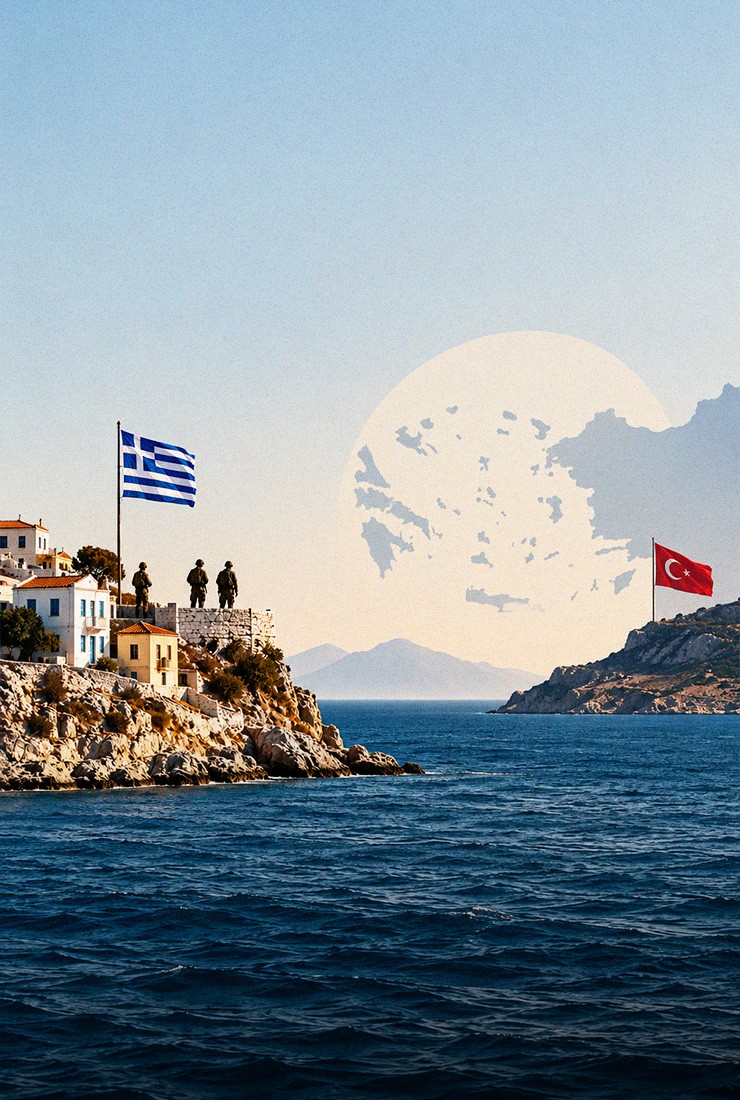
Greek Prime Minister Kyriakos Mitsotakis chose one of Europe’s smallest and most exposed islands to deliver a large message in September 2026. During a three-day tour,[1] he visited military posts on the tiny, picturesque island of Kastellorizo and the nearby islets of Ro and Strongyli, accompanied by Greece’s senior military officers. The trip coincided with the 83rd anniversary of Kastellorizo’s liberation from Italian rule in World War II. From an island just a few hundred meters from the Turkish coast, Mitsotakis spoke of the three principles of “security, stability and consistency,”[2] emphasizing that Greece is pursuing “a responsible, patriotic, and realistic foreign policy.”
Figure 1: Kastellorizo, Greece
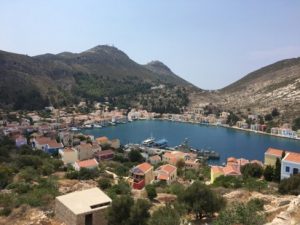
Source: Author
On a geostrategic level, it is a challenge for Greece to resupply this distant, tiny island, let alone defend it against the far larger Turkish military right there on the opposite coast. As a frequent flashpoint, the island cannot support a large, independent garrison due to its size and location. Fuel, ammunition, and food all have to move by sea or air across a vast distance under the close watch of Turkish naval and air units. The nearest island of Rhodes is roughly 130 km away, and Athens is a much farther 570 km.
Because geography constrains what military positions Greece can station nearby, any crisis reinforcement would have to move visibly and quickly across a heavily contested narrow body of water. Sustaining the island requires a functioning harbor, runway, and local power. Below the threshold of war, a potential closure of airspace, electronic interference, close naval shadowing, or persistent drone surveillance could restrict the island’s air and sea approaches for days.
Figure 2: Kastellorizo lies less than a mile off the Turkish coast
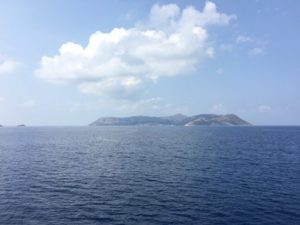
Source: Author
Recent littoral conflicts in the Black Sea, the Red Sea, and the Gulf show how inexpensive precision systems can impose sea and air denial on even conventionally superior forces. Ukraine’s asymmetric warfare using long-range missiles and unmanned surface vehicles forced Russia’s Black Sea Fleet out of its main base in Crimea.[3] Iran’s drones, mines, and fast-attack craft have disrupted traffic through the Strait of Hormuz,[4] and the Houthis made Red Sea shipping a major challenge with missiles and drones despite lacking a conventional navy.[5] Around Kastellorizo, geography gives Türkiye the ability to generate continuous pressure at times of heightened tensions while new technology offers ways to do so without crossing into open war.
Figure 3: Kastellorizo, Greece and the Turkish coast
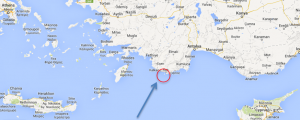
Source: Google, Author
This vulnerability is what makes even a symbolic visit carry outsized weight. Mitsotakis’s deliberate political signal did not create the latest Greek-Turkish tension, but it revealed how quickly an old dispute is acquiring new triggers. In this new normal, maritime parks, competing planning maps, undersea infrastructure, drones, and new air defense systems are turning legal disagreements into operational challenges. The most immediate danger in the bilateral relationship is no longer another war of words over maps. It is rather an encounter at sea when survey vessels return to work on the planned Greece-Cyprus(-Israel) electricity interconnector in waters claimed by both Ankara and Athens.
Competing claims over the status of islands and maritime jurisdictions
To assert its claims in the Mediterranean, Türkiye issues a notice to mariners (NAVTEX) from Antalya station and reserved waters southwest of Kastellorizo through 15 September for scientific research by the TÜBİTAK Marmara vessel.[6] The ship approached south of the island, at times near the edge of Greece’s six-nautical-mile territorial sea. A Greek Coast Guard vessel shadowed it while Athens issued a counter-NAVTEX from Heraklion station in Crete. The vessel was not escorted by warships, and surface-water research is lawful on the high seas. Yet the deployment also served as political signaling from Ankara.[7] This was a controlled way for Türkiye to reject any Greek move toward expanding its territorial waters to 12 nautical miles and to foreshadow how it might respond if seabed surveys resume without Turkish notification. A month later, Türkiye issued another NAVTEX for a multinational live-fire exercise named “Eunomia” south of Kastellorizo to assert its jurisdiction in direct challenge to a similar NAVTEX by Greece.[8]
In this tense atmosphere, Kastellorizo concentrates nearly every source of mistrust between the two countries. The 1947 Paris Peace Treaty,[9] which transferred the Dodecanese from Italy to Greece, required the islands to remain demilitarized. Türkiye reads this as restricting permanent forces, fortifications, and large stockpiles, arguing that Greek troops and installations on Kastellorizo violate that obligation. Greece counters that Türkiye was not a party to the treaty and that its forces on the nearby Anatolian coast, including the Aegean Army, justify defensive measures. Mitsotakis’s inspection of military installations on the Kastellorizo complex, therefore, carried a message that both sides could read in opposite ways, namely as reassurance in Athens and provocation in Ankara.
Beyond demilitarization, the dispute extends across territorial waters, the continental shelf and exclusive economic zones (EEZ), national airspace, flight information and search-and-rescue regions, and the legal effect of islands. Much of the disagreement traces back to a foundational difference in the interpretation of maritime law.
Türkiye is not a party to the United Nations Convention on the Law of the Sea (UNCLOS) and remains a persistent objector to its treatment as naturally applicable customary law in every context.[10] Greece ratified UNCLOS in 1995 and treats the convention as having already settled questions Ankara still regards as open. The crux of the issue is how each side defines and adjusts maritime entitlements. Türkiye takes a functionalist perspective relying on equitable principles and core legal precedents alongside customary law; Greece adopts a strictly treaty-centric perspective based on codified law.
The 12-mile question is especially explosive. Article 3 of UNCLOS permits a territorial sea of up to 12 nautical miles but does not require a state to use the maximum everywhere. Greece regards extension as a sovereign right while Ankara argues that blanket application across the semi-enclosed Aegean would shrink the high seas and restrict Turkish navigation and strategic mobility. Türkiye presents its 1995 parliamentary declaration,[11] also known in public as a “casus belli”, as deterrence against a unilateral change in the status quo. Greece treats it as an unlawful threat of force.[12]
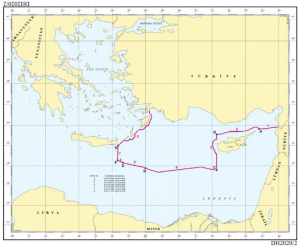
Those competing interpretations were translated into formal state practice when Türkiye submitted a November 2019 maritime jurisdiction agreement with Libya’s UN-recognized Government of National Accord to the UN on 18 March 2020, along with a map setting out the limits of its continental shelf in the Eastern Mediterranean. Athens responded on 6 August 2020 by signing a partial EEZ delimitation agreement with Egypt, defining their respective rights over offshore resources. On 20 October 2026, Libya’s House of Representatives ratified the 2019 MoU, removing a major legal roadblock to Türkiye’s maritime claims and offshore activities, raising further anxieties in Athens.[13]
Figure 4: Türkiye’s continental shelf declaration to the UN, 18 March 2020
Source: UN, https://digitallibrary.un.org/record/3856643.
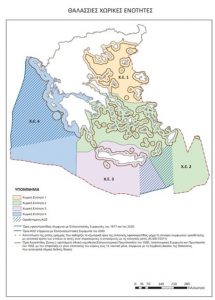
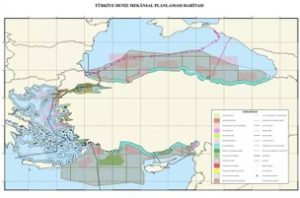
Environmental policy has now joined that list, after Greece announced a large marine park in the southern Cyclades in July 2025.[14] Athens and Ankara also released competing maritime spatial-planning maps in April last year.[15] Türkiye followed in August 2026 with national marine parks in the northern Aegean and the Fethiye-Kaş area opposite Kastellorizo. The Turkish planning platform in Ankara states that its project zones do not necessarily denote national jurisdiction.[16] Yet in a region where even a line on a map can be treated as a sovereignty claim, marine conservation zones have become instruments of strategic signaling.
Figure 5: Greek and Turkish maritime spatial planning maps, 2025
Sources:ProtoThema,https://en.protothema.gr/2025/04/16/the-maritime-spatial-planning-was-announced/; DEHUKAM, https://dmpturkiye.dehukam.org/en/home-page/.
The limits of choosing sides in Libya
Over the years, Greece invested in relations with eastern Libya partly to counter Ankara’s influence in the Mediterranean. Yet political access offered no guarantee that Khalifa Haftar’s Benghazi-based administration would continue delaying the maritime MoU it could recast as serving Libyan interests and enable it to recoup political capital. Türkiye offered economic opportunities and security cooperation to both sides while retaining its established partnership with Tripoli, which outmatched anything on the table that Greece could plausibly offer.
The difficulties and tense atmosphere in relations between Athens and Tripoli had already become visible in November 2022. During an official visit, Greek Foreign Minister Nikos Dendias refused to disembark from the aircraft in Tripoli when his counterpart, Najla Mangoush, arrived to greet him.[17] Greece cited an understanding that he would meet only the Presidential Council’s head. This episode illustrated the diplomatic costs of disagreements between Athens and Tripoli over Türkiye–Libya cooperation. Ankara’s primary advantage rested on its ability to engage both camps in an effective, non-conflictual, and inclusive manner. Greece’s offer to access European funding and political backing has not sufficed to counterbalance Türkiye’s expanding presence on either side in Libya.[18]
Heightened risk of crisis over maritime zones
Türkiye is preparing a draft maritime law,[19] often described as the “Blue Homeland” bill,[20] that would authorize the president to formalize an EEZ and define responsibilities in Turkish waters. Drafted by Ankara University’s Center for Maritime Law, its rationale reflects a longstanding demand within Turkish political circles to give the Blue Homeland doctrine a statutory foundation.[21] Türkiye’s desire to codify its interpretation of maritime law despite remaining outside UNCLOS, public appetite for a firmer maritime posture, and the government’s drive to secure economic opportunities in the surrounding seas provide the main momentum for the motion. Domestically, the bill’s passage would also allow the government to demonstrate resolve for access to energy deposits, fisheries, and seabed resources.
The draft bill is reportedly expected to reach the parliament in the coming months,[22], [23] potentially after Greek seabed surveys in the Mediterranean resume.[24] Legislation alone cannot settle overlapping claims with Greece or Southern Cyprus, but it can harden Ankara’s position at home and create pressure to enforce the lines it codifies at sea. If the parliamentary and survey calendars converge, an internal legal initiative in Türkiye could become an operational challenge with Greece near Crete and the Dodecanese.
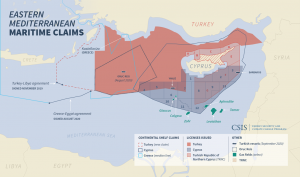
Given this context, Kastellorizo’s importance lies less in its size than in its possible effect on delimitation. Under Article 121 of UNCLOS, inhabited islands can generate a territorial sea, continental shelf, and EEZ in principle. However, marginal features in the Kastellorizo complex, such as Strongyli and Ro, that host artificial settlements and cannot sustain independent economic lives should generate no continental shelf, and by implication, no EEZ. Athens’s reported €5,000 tax-free incentive for residents to settle on Kastellorizo may aim to build a record of habitation and economic life in order to sustain the evidentiary basis for its entitlement claim.[25] A shrinking population and fading local economy could weaken Greece’s effort to treat the wider island complex as a fully entitled unit.
Figure 6: Maritime Claims in the Eastern Mediterranean, 2019-2026
Source: Center for Strategic and International Studies (CSIS), https://www.csis.org/analysis/getting-east-med-energy-right.
For maritime delimitation in practice, the International Court of Justice applies a three-step test by drawing a provisional equidistance line, adjusting it for relevant circumstances, and then checking the result for gross inequity and disproportionality.[26] Greece maintains that Kastellorizo is entitled to all maritime zones, including continental shelves and EEZs. Türkiye argues that a small island so close to its mainland cannot be allowed to cut off the much longer Turkish coast. The island’s entitlement, therefore, does not seem to determine its ultimate weight in a final boundary.
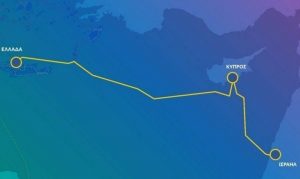
That question has no direct impact on the route of the proposed Great Sea Interconnector (GSI),[27] a €1.9 billion European project designed to link the Greek and Greek Cypriot electricity grids and, in a later phase, Israel. The contested survey area lies much farther west, near Kasos and southeast of Crete. Kastellorizo nevertheless serves as the political shorthand for the larger dispute on whether Greek islands should project extensive maritime rights into waters that Türkiye regards as part of its continental shelf.
The proposed undersea cable has already produced a dangerous rehearsal. In July 2024, Turkish warships appeared near an Italian-flagged vessel surveying the seabed east of Kasos.[28] Türkiye demanded information about the route on the grounds that the work crossed its claimed continental shelf. Greece insisted that the activity was lawful and later withdrew the vessel after it completed only part of its mission. No shots were fired, but the episode showed how a civilian infrastructure project can bring two NATO navies into proximity without resolving the underlying jurisdictional question.
Figure 7: Great Sea Interconnector’s proposed route
Source: ADMIE, GSI, Proto Thema, https://en.protothema.gr/2026/09/28/cyprus-crete-cable-route-will-not-change-due-to-turkish-marine-park-see-maps/, https://www.great-sea-interconnector.com/en.
The legal issue over the cable is often described plainly within the framework of codified law. Article 79 of UNCLOS entitles all states to lay submarine cables and pipelines on the continental shelf and says coastal states may not impede them, subject to reasonable measures for resource exploitation and pollution prevention.[29] Differences in interpretation of the article again sit at the heart of the dispute. Although not a party to UNCLOS, Ankara invokes Article 79’s paragraphs (4) and (5) to argue that this entitlement is not unqualified, and that the course of laying transit cables and associated survey activities on its claimed continental shelf requires coordination with Türkiye. Article 79 (4) preserves the coastal state’s jurisdiction over infrastructure connected with the exploitation of its continental shelf, while paragraph (5) requires states laying new cables to have due regard for infrastructure already in place.
Ankara’s interpretation also draws some support from the convention’s preparatory history, which highlights that the omission of submarine cables in paragraph (3) does not preclude a coastal state from delineating the course of a cable as a reasonable measure under paragraph (2).[30] Prior coordination allows Ankara to assess possible interference with its resource rights or existing infrastructure without claiming veto power over the cable’s route.
Athens rejects this interpretation. It argues that Türkiye has no jurisdiction over the disputed area and the enumerated consent requirement in Article 79 (3) is textually confined to pipelines. Accordingly, since Türkiye has no stake in the project, laying the interconnector does not require any prior notification. Ankara, for its part, rejects Greece’s proposed EEZ agreement with Egypt where it overlaps with the Turkish continental shelf, and demands prior coordination for any seabed work.[31] Its diplomatic protests and naval deployments also preserve a persistent objection to Greek practice in those waters, preventing silence from being read as acquiescence.[32] That logic makes even a routine survey a sovereignty contest.
The interconnector project’s changing ownership adds another layer, after Paris-based Meridiam acquired a controlling stake,[33] while France’s Nexans is supplying the cable. After talks between Mitsotakis and French President Emmanuel Macron, Athens said France would lead the project’s next phase within months.[34] French commercial exposure may strengthen Greece’s expectation of political backing, yet it does not automatically create a French security guarantee in contested waters. If French naval units accompany a renewed survey, however, a Greek-Turkish standoff could quickly involve a third NATO power.
Despite the harsher rhetoric, a negotiated workaround may still be possible. Senior Greek officials insist the cable will proceed, even as Mitsotakis has reiterated Greece’s right to extend its territorial waters to 12 nautical miles. Yet some officials in Athens reportedly believe the interconnector is not necessarily under threat.[35] Turkish Foreign Minister told European interlocutors on 21 October 2026 that the project itself was not a concern, provided that the operator company shares prior notification in writing.[36]
An early rehearsal of a similar case happened this month. On 15 October 2026, the Greek Cypriot Administration issued a NAVTEX announcing that a research vessel would conduct geophysical surveys for the East to Med Corridor (EMC) cable system in an area west of Cyprus between 21 October and 2 November.[37] In response, Türkiye issued a NAVTEX on 20 October,[38] declaring that the area in question lies within the Turkish continental shelf and that the Greek Cypriot announcement is invalid. Athens, in turn, issued its own counter-NAVTEX.
One proposal by French officials would have Meridiam formally notify every state in the region before work resumes,[39] although some Greek diplomats reportedly resisted the idea because they fear setting a precedent that Ankara could cite in future disputes, while Turkish officials continue to insist on prior coordination. If a notification arrives, Türkiye is expected to portray it as a formal request and issue its own NAVTEX, which Greece will then reciprocate with a counter-NAVTEX. That disagreement captures the dilemma. Coordination could reduce operational risk without conceding jurisdiction, but only if all parties state clearly that it is without prejudice to their maritime claims. Washington also has a stake in preventing the dispute from escalating, given its support for the interconnector as part of Europe’s energy security architecture and its close defense relationships with both Greece and Türkiye.[40]
Alliance politics complicates the map
To make matters somewhat more complicated, the military setting is also less forgiving than it was in 2024. Greece, Egypt, France, Italy, and Southern Cyprus conducted the Medusa-15 exercise across the Eastern Mediterranean,[41] with scenarios involving research vessels and critical infrastructure. Athens has separately imposed temporary drone restrictions around the islands of Kasos and Karpathos through 31 October.[42] The notices may be precautionary, but Ankara is likely to view them alongside the interconnector cable’s reported restart in early November and Greece’s growing defense partnerships.[43]
Greece is indeed investing heavily in those partnerships, especially with its new US$3.4 billion Achilles Shield agreement with Israel that adds David’s Sling, SPYDER, BARAK MX, surveillance radars, and a national command-and-control network to its air defense.[44] Athens has also signed a US$750 million agreement for Israeli-made PULS rocket artillery,[45] whose longest-range munitions can reach 300 km. It is upgrading F-16s, has received 24 Rafales from France, and expects its first F-35s to be delivered in the United States in late 2028 before arriving in Greece in 2030.[46] Planned drone bases on the islands of Rhodes and Lesvos have already drawn Turkish objections.[47]
These programs give Athens greater confidence, but they do not create an uncontested Greek advantage. Türkiye retains NATO’s second-largest armed forces, a large navy, a dense drone inventory, long-range precision weapons, and a rapidly expanding defense industry. The Ministry of Defense’s budget for 2026 is around US$17 billion, with a plan to more than double it next year to US$44.5 billion.[48] Türkiye builds its own Steel Dome network-centric, AI-assisted, multi-layered air defense system with a range of up to 150+ km, combining different types of locally produced sensors, weaponry, and communication networks into a single framework.[49]
The growing Turkish drone ecosystem and fighter aircraft programs, plus the local ship-building projects, continue to evolve alongside stand-off guided munitions and electronic warfare systems. These capabilities complement the navy’s enhanced firepower, while ballistic missiles with ranges of 500+ km increase deterrence. Türkiye’s overall advantage lies in deep, local know-how on 80% of its weapon systems, giving it greater control over maintenance, upgrades, integration, and doctrinal unity.
From this vantage point, Ankara views the proximity of militarized Greek islands and Cyprus as an obstacle to its maritime interests and sees them as platforms for offensive capabilities that could strike deep into the Turkish mainland.[50] Greece’s acquisition of PULS will reinforce that perception, whatever Athens’s intentions are. Although both sides frame their military doctrines in defensive terms, their offensive capabilities reinforce mutual threat perceptions. This dynamic creates a particularly dangerous security dilemma in which defensive preparations may be interpreted as offensive intentions, increasing incentives for preemptive action and the risk of unintended escalation.[51]
Cyprus makes that dilemma more combustible, since the Greek Cypriot defense minister said explicitly that the Greek-Israeli air defense network also addresses a perceived threat from Türkiye.[52] Türkiye, meanwhile, is the only country that recognizes the Turkish Republic of Northern Cyprus and maintains forces there. The island remains divided by a UN-monitored cease-fire line, not a peace settlement. A confrontation that begins around a survey ship or drone between Greece and Türkiye could thus spill into a theater where the military status quo remains unsettled.
Despite the drumbeat, no government appears to want a war. Instead, they continue to carry forward their mutual commitment to improving ties with one another. Yet, that is not a sufficient reason for complacency, and a conflict does not necessarily involve war. As evidenced in theaters elsewhere, electronic warfare and unmanned systems allow states to signal resolve below the formal threshold of hostilities, and they also shorten decision time and obscure intent. A drone entering disputed airspace, a warship maneuvering close to a survey vessel, or a warning shot intended as coercion could force leaders to respond before facts are clear.
A similar accidental incident involving Turkish and Greek frigates west of Cyprus in 2020 almost brought the two sides to the brink of war.[53] Should another encounter take place, outside partners may then encourage firmness in the belief that their own commitments will deter the other side. This is the classic route from balancing to chain-ganging, whereby local actors take greater risks because they expect aligned powers to stand behind them.
Potential approaches to de-escalate tensions
The immediate priority to overcome the risk of a conflict should therefore be to separate infrastructure work from the sovereignty dispute. Greece, Türkiye, and the French project consortium need a technical notification and deconfliction protocol for survey operations that is explicitly without prejudice to either side’s maritime claims. NATO should reactivate and expand the military deconfliction mechanism established in 2020, including direct procedures for drones, research ships, and naval escorts.[54]
France and the European Union should support the interconnector cable without turning a commercial project into a demonstration of alliance resolve. That said, Greece and Greek Cypriots are themselves EU member states, which already makes the interconnector an internal European matter in ways that constrain neutrality in Brussels. Ankara and Athens should resume political talks on delimitation, and where Cypriot seabed rights are implicated, both communities on the island should be included. Any durable maritime delimitation must lie between full effect for every island and no effect for islands at all.[55] All sides should agree that marine parks will not be used to imply sovereignty in disputed waters.
Kastellorizo matters not because it can settle the eastern Mediterranean’s legal order on its own, but because it condenses history, geography, and national prestige into a space narrow enough for soldiers on one shore to see the lights of the other. That proximity is what turns a routine survey ship or drone sortie into a contest of military resolve rather than a technical dispute. The crisis will stay manageable only if Athens and Ankara stop treating every civilian activity as a sovereignty test and instead insulate the cable, the marine parks, and the oceanographic surveys from the underlying boundary dispute. Absent that convergence, the next seabed survey may chart a route to conflict that no capital intended.
[1] Vassilis Nedos, “PM Signals Resolve from Kastellorizo,” eKathimerini.com, September 12, 2026, https://www.ekathimerini.com/politics/foreign-policy/1315055/pm-signals-resolve-from-kastellorizo/.
[2] “Mitsotakis Sends Message to Turkey from Kastellorizo: We Threaten No One, but We Will Not Accept Threats — €5,000 Incentives to Settle on the Remote Island,” ProtoThema English, September 13, 2026, https://en.protothema.gr/2026/09/13/mitsotakis-sends-message-to-turkey-from-kastellorizo-we-threaten-no-one-but-we-will-not-accept-threats-e5000-incentives-to-settle-on-the-remote-island/.
[3] Alina Frolova and Stepan Yakymiak, “The Changing Military Balance in the Black Sea: A Ukrainian Perspective,” Carnegie Endowment for International Peace, April 2, 2026, https://carnegieendowment.org/research/2026/04/the-changing-military-balance-in-the-black-sea-a-ukrainian-perspective.
[4] “Iranian Drones May Disrupt Strait of Hormuz for Months, Analysts Warn,” TRT World, Istanbul, Turkey, March 4, 2026, https://www.trtworld.com/article/726459b10184.
[5] “Timeline: Houthi Attacks,” Wilson Center, Washington D.C, US, July 26, 2024, https://www.wilsoncenter.org/article/timeline-houthi-attacks.
[6] “Turkish Research Vessel Near Kastellorizo,” To Vima (Athens, Greece), September 1, 2026, https://www.tovima.com/world/turkish-research-vessel-near-kastellorizo/.
[7] Vassilis Nedos, “Turkish Research Vessel Stirs Tensions,” eKathimerini.com, September 2, 2026, https://www.ekathimerini.com/politics/foreign-policy/1314003/turkish-research-vessel-stirs-tensions/.
[8] Newsroom, “Turkey Issues Navtex for Multinational Exercise South of Kastellorizo,” eKathimerini.com, October 16, 2026, https://www.ekathimerini.com/politics/foreign-policy/1318414/turkey-issues-navtex-for-multinational-exercise-south-of-kastellorizo/.
[9] “Treaty Series: Treaty of Peace with Italy,” United Nations, September 15, 1947, https://treaties.un.org/doc/Publication/UNTS/Volume%2049/v49.pdf.
[10] UNCLOS, “UN Convention on Law of the Sea,” United Nations, 1982, https://www.un.org/depts/los/convention_agreements/texts/unclos/unclos_e.pdf.
[11] “Greece Plans Extension of Territorial Waters despite Turkish Warning,” Reuters, January 16, 2026, https://www.reuters.com/world/middle-east/greece-plans-extension-territorial-waters-despite-turkish-warning-2026-01-16/.
[12] “Territorial Sea – Casus Belli,” Hellenic Republic, Ministry of Foreign Affairs (Athens, Greece), 2026, https://www.mfa.gr/en/foreign-policy/foreign-policy-issues/issues-of-greek-turkish-relations/territorial-sea-casus-belli/.
[13] Constantinos Filis, “Turkey Moves to Cement Maritime Pact with Libya,” eKathimerini.com, October 20, 2026, https://www.ekathimerini.com/opinion/1318740/turkey-moves-to-cement-maritime-pact-with-libya/.
[14] “Prime Minister Kyriakos Mitsotakis’ Announcement on the Two New Marine National Parks: Ionian and South Aegean 1 – Southern Cyclades,” Prime Minister of the Hellenic Republic, Athens, Greece, July 21, 2025, https://www.primeminister.gr/en/2025/07/21/36697.
[15] Newsroom, “Greece Finalizes Marine Spatial Planning, Releases Official Map,” eKathimerini.com, April 16, 2025, https://www.ekathimerini.com/politics/foreign-policy/1267174/greece-finalizes-marine-spatial-planning-releases-official-map/.
[16] “DEHUKAM: Türkiye Marine Spatial Planning,” Türkiye MSP Platform, 2026, https://dmpturkiye.dehukam.org/en/home-page/.
[17] Newsroom, “FM Dendias Cuts Visit to Tripoli Short after Libyan Official Tries to ‘Force’ Meeting,” eKathimerini.com, November 17, 2022, https://www.ekathimerini.com/news/1198076/fm-dendias-cuts-visit-to-tripoli-short-after-libyan-official-tries-to-force-meeting/.
[18] “Turkey-Libya Deal Tests Greece’s Influence in Benghazi,” To Vima (Athens, Greece), October 21, 2026, https://www.tovima.com/world/turkey-libya-deal-tests-greeces-influence-in-benghazi/.
[19] Amr Emam, “Türkiye’s Proposed Maritime Bill Risks Reigniting Old Rivalries,” Al Majalla, June 1, 2026, https://en.majalla.com/node/331343/business-economy/t%C3%BCrkiye%E2%80%99s-proposed-maritime-bill-risks-reigniting-old-rivalries.
[20] “Mavi Vatan Yasası: Türk Deniz Yetki Alanları Kanunu Detayları,” Fokus, July 30, 2026, https://www.fokusplus.com/siyaset/mavi-vatan-yasasi-geliyor-turk-deniz-yetki-alanlari-kanununun-detaylari.
[21] Ferhan Oral and Serhat Süha Çubukçuoğlu, “Assessing Türkiye’s Blue Homeland Doctrine through Mahanian Sea Power Theory,” Gazi Akademik Bakış 19, no. 38 (2026): 417–40, https://doi.org/10.19060/gav.1973768.
[22] Bülent Aydemir, “Yunan basını da yazdı: ‘Mavi Vatan yasası’ geri çekilmedi, sadece bekliyor,” Habertürk (Istanbul, Turkey), n.d., accessed October 22, 2026, https://www.haberturk.com/yunan-basini-da-yazdi-mavi-vatan-yasasi-geri-cekilmedi-sadece-bekliyor-3889071.
[23] Buse Gençtürk, “AK Parti, denizlerdeki hakları güçlendirecek düzenlemeyi Meclis’e sunmaya hazırlanıyor,” Habertürk (Istanbul, Turkey), October 24, 2026, https://www.haberturk.com/gundem/ak-parti-denizlerdeki-haklari-guclendirecek-duzenlemeyi-meclis-e-sunmaya-hazirlaniyor-3922295.
[24] “Ankara Appears to Delay ‘Blue Homeland’ Bill,” eKathimerini.com, October 13, 2026, https://www.ekathimerini.com/politics/foreign-policy/1318069/ankara-appears-to-delay-blue-homeland-bill/.
[25] Newsroom, “Mitsotakis Sends Message to Turkey from Kastellorizo: We Threaten No One, but We Will Not Accept Threats — €5,000 Incentives to Settle on the Remote Island,” ProtoThema English, September 13, 2026, https://en.protothema.gr/2026/09/13/mitsotakis-sends-message-to-turkey-from-kastellorizo-we-threaten-no-one-but-we-will-not-accept-threats-e5000-incentives-to-settle-on-the-remote-island/.
[26] “Maritime Delimitation in the Black Sea (Romania v. Ukraine),” International Court of Justice, February 3, 2009, https://www.icj-cij.org/case/132.
[27] “Great Sea Interconnector,” Athens, 2026, https://www.great-sea-interconnector.com/.
[28] Menelaos Hadjicostis, “EU Irked by Turkish Warnings against Greece-Cyprus-Israel Electricity Cable Link, Cyprus Says,” AP News, April 11, 2025, https://apnews.com/article/cyprus-turkey-greece-undersea-electricity-cable-interconnector-ccce85737cbf99cddd7cf1fa72678771.
[29] UNCLOS, “UN Convention on Law of the Sea.”
[30] “Submarine Cables: International Framework,” U.S. Department of Commerce: National Oceanic and Atmospheric Administration, 2026, https://www.noaa.gov/general-counsel/gc-international-section/submarine-cables-international-framework.
[31] “Haftalık Basın Bilgilendirme Toplantısı, 100’üncü Yılını Kutlayan Kayseri’deki 2’nci Hava Bakım Fabrika Müdürlüğümüzde Gerçekleştirildi,” MSB | T.C. Millî Savunma Bakanlığı, Ankara, October 1, 2026, https://www.msb.gov.tr/SlaytHaber/3712a65d5aa2477d97fb68dbe3ec858b.
[32] Yücel Acer, “Turkey’s Legal Approach to Maritime Boundary Delimitation in the Eastern Mediterranean Sea,” Articles, Insight Turkey, March 9, 2021, https://www.insightturkey.com/articles/turkeys-legal-approach-to-maritime-boundary-delimitation-in-the-eastern-mediterranean-sea.
[33] “Meridiam Takes Control of Cyprus-Greece Power Link,” MEES, August 21, 2026, https://www.mees.com/2026/8/21/news-in-brief/meridiam-takes-control-of-cyprus-greece-power-link/7b582260-9d7f-11f1-ac5a-93206beb6574.
[34] “Paris Talks Reboot Greece–Cyprus Power Cable Project,” To Vima (Athens, Greece), n.d., accessed October 22, 2026, https://www.tovima.com/politics/paris-talks-reboot-greece-cyprus-power-cable-project/.
[35] “Christodoulides Backs GSI, Signals Stronger Support for Interconnector,” Politis, September 9, 2026, https://en.politis.com.cy/news/economy/1031829/christodoulides-backs-gsi-signals-stronger-support-for-interconnector.
[36] “Crete-Cyprus Power Cable: Diplomatic Opening for Surveys to Resume without Confrontation with Turkey,” Proto Thema, October 21, 2026, https://en.protothema.gr/2026/10/21/crete-cyprus-power-cable-diplomatic-opening-for-surveys-to-resume-without-confrontation-with-turkey/.
[37] Turan Oguz [@TyrannosurusRex], “🇹🇷🇨🇾🇬🇷 Doğu Akdeniz’de küçük çaplı bir zafer daha. Mavi Vatan’da Türkiye’nin dediği olur! Türkiye tehdit etti, Mavi Vatan’dan geçecek kablo hattının jeofizik araştırmalarını Türk makamları ile koordine etmek ve Türk makamları tarafından izin verilen güzergahı kullanmak zorunda https://t.co/scU8xMPrd4,” Tweet, Twitter, October 21, 2026, https://x.com/TyrannosurusRex/status/2112783978272891236.
[38] “Doğu Akdeniz’de Kablo Gerilimi: Türkiye Itirazdan ‘Izin Bizden Alındı’ Aşamasına Geçti,” Bugün Kıbrıs, October 21, 2026, https://bugunkibris.com/dogu-akdenizde-kablo-gerilimi-turkiye-itirazdan-izin-bizden-alindi-asamasina-gecti/.
[39] Politis, “Christodoulides Backs GSI, Signals Stronger Support for Interconnector.”
[40] Mark Schiefelbein, “Rubio Says US Committed to Mediterranean Undersea Power Cable,” Al Monitor, October 8, 2026, https://www.al-monitor.com/originals/2026/10/rubio-says-us-committed-mediterranean-undersea-power-cable.
[41] Stavros Ioannidis, “Greece, Egypt Lead Multinational Medusa-15 Exercise,” eKathimerini.com, September 9, 2026, https://www.ekathimerini.com/politics/foreign-policy/1314809/greece-egypt-lead-multinational-medusa-15-exercise/.
[42] “Athens Imposes Drone Restrictions Across SE Aegean Through Oct.,” To Vima (Athens, Greece), September 12, 2026, https://www.tovima.com/politics/athens-imposes-drone-restrictions-across-se-aegean-through-oct/.
[43] Vassilis Nedos, “A Challenge to Greece’s East Med Policy,” eKathimerini.com, October 26, 2026, https://www.ekathimerini.com/politics/foreign-policy/1319239/a-challenge-to-greeces-east-med-policy/.
[44] Lee Ferran, “Greece Approves over $3.4B in Air Defenses for Achilles’ Shield,” Breaking Defense, July 23, 2026, https://breakingdefense.com/2026/07/greece-approves-over-3-4b-in-air-defenses-for-achilles-shield/.
[45] Seth J. Frantzman, “Greece Inks $750M Deal with Israel for Elbit’s PULS Rocket Artillery Systems,” Breaking Defense, April 6, 2026, https://breakingdefense.com/2026/04/greece-inks-750m-deal-with-israel-for-elbits-puls-rocket-artillery-systems/.
[46] Stavros Ioannidis, “Production of Greek F-35s to Start in Coming Weeks, Says Lockheed Martin Official,” eKathimerini.com, May 14, 2025, https://www.ekathimerini.com/economy/1269710/production-of-greek-f-35s-to-start-in-coming-weeks-says-lockheed-martin-official/.
[47] “After Syros and Rhodes, Greece Plans Drone Base on Lesvos,” Greek City Times, September 21, 2026, https://greekcitytimes.com/2026/09/21/after-syros-and-rhodes-greece-plans-drone-base-on-lesvos/.
[48] Agnes Helou, “Turkish Defense Procurement Spending Proposed to Rise 229% in 2027,” Breaking Defense, October 20, 2026, https://breakingdefense.com/2026/10/turkish-defense-procurement-spending-proposed-to-rise-229-in-2027/.
[49] S. Süha Çubukçuoğlu and Umud Shokri, “Türkiye’s Steel Dome Air Defense Solution,” TRENDS Research & Advisory, January 18, 2025, https://trendsresearch.org/insight/turkiyes-steel-dome-air-defense-solution/.
[50] Serhat Süha Çubukçuoğlu, Turkey’s Naval Activism: Maritime Geopolitics and the Blue Homeland Concept, SpringerLink, 1st Edition, Palgrave Studies in Maritime Politics and Security (Palgrave Macmillan, 2023), 75, https://link.springer.com/book/10.1007/978-3-031-37204-9.
[51] Τι Σημαίνει Το «προληπτικό Πλήγμα» Που Τρέμουν Οι Τούρκοι Στρατηγοί, (Athens, Greece), September 27, 2026, https://www.tanea.gr/2026/09/27/greece/ti-simainei-to-proliptiko-pligma-pou-tremoun-oi-tourkoi-stratigoi/.
[52] “‘Achilles Shield Protects Greece, Israel and Cyprus from Turkey,’” Cyprus Mail, September 4, 2026, https://cyprus-mail.com/2026/09/04/achilles-shield-protects-greece-israel-and-cyprus-from-turkey.
[53] Michele Kambas and Tuvan Gumrukcu, “Greek, Turkish Warships in ‘Mini Collision’ Ankara Calls Provocative,” World, Reuters, August 14, 2020, https://www.reuters.com/article/world/greek-turkish-warships-in-mini-collision-ankara-calls-provocative-idUSKCN25A160/.
[54] “Military De-Confliction Mechanism between Greece and Turkey Established at NATO,” NATO News, October 1, 2020, https://www.nato.int/en/news-and-events/articles/news/2020/10/01/military-de-confliction-mechanism-between-greece-and-turkey-established-at-nato.
[55] Serhat S. Çubukçuoğlu, “Rethinking Equitable Maritime Delimitation between Türkiye and Greece,” The SAIS Review of International Affairs, January 19, 2026, https://saisreview.sais.jhu.edu/rethinking-equitable-maritime-delimitation-between-turkiye-and-greece/.