
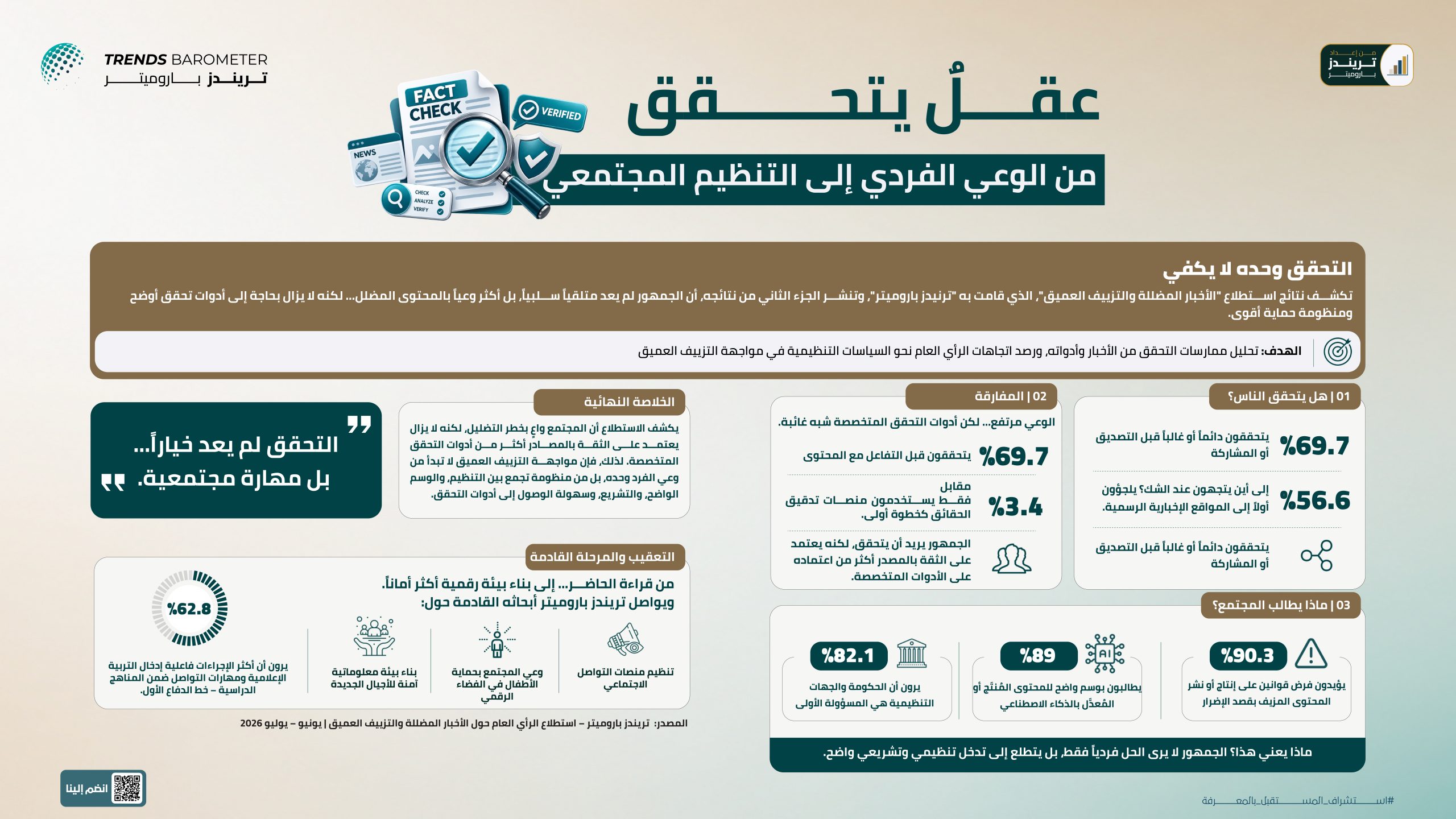
- 89% demand clear labeling for AI-generated or modified content
- 82 % believe governments have responsibility for restricting misleading content
- 77% of respondents believe they are capable of identifying fake content
- 7% always or often verify news before believing or sharing it
- 60% of those surveyed follow news on Instagram
A recent survey titled Misinformation and Deepfakes, conducted by TRENDS Barometer, part of the TRENDS Group, revealed that about 85 percent of participants have been exposed to fake or misleading content more than once. Misleading news and content are no longer rare; most survey participants have experienced them, but 77 percent believe they can distinguish fake content.
During June and July 2026, 88.3 percent of those surveyed trusted the official accounts of government entities, confirming that high trust is related to the nature of the source and not the means of publication, while only 5.5 percent trusted influencers, despite the heavy use of messaging applications, with 60 percent of participants following the news via the Instagram platform.
The survey found that 33.8 percent encountered suspicious content more than five times in three months, and that 69.7 percent of participants always or often verify news before believing or sharing it, while 56.6 percent turn to official news sites when they doubt the source.
Trust in Traditional Sources
The survey reveals that when the public encounters questionable news, they first turn to official news websites for verification, reflecting continued trust in traditional sources. 69.7 percent verify information before interacting with content, while only 3.4 percent use fact-checking platforms as a first step when they are in doubt. However, despite this increased awareness, a clear gap remains between intention and actual behavior in using specialized verification tools.
The survey also demonstrates widespread support for regulatory and legal interventions to curb deepfakes and misleading content. 90.3 percent support enacting laws or regulations against the production or dissemination of fake news and content created with malicious intent, while 89 percent call for clear labeling of content produced or modified using artificial intelligence tools. 82 percent of respondents believe governments and regulatory bodies bear primary responsibility for restricting fake content, and others support allocating government budgets to digital awareness initiatives and promoting a culture of verification.
The Deepfake Challenge
Fahad Al-Mahri, General Manager of TRENDS Barometer, stated that the “misinformation and deepfakes” survey aimed to measure exposure to misleading content and analyze the relationship between platform usage and trust in sources. Its results underscore the importance of adopting a critical, verification-based approach before sharing to counter the challenges of deepfakes and misinformation in the digital space.
He noted that the survey results indicated a high level of awareness regarding news verification on social media, but the use of specialized verification tools remains limited. There is also widespread support for stronger regulation and clear content labeling. He explained that the survey offers a methodology to protect users from falling into the trap of spreading misinformation, based on three key elements: not sharing content immediately, searching for the source and verifying the date and context, and sharing only after confirming the information’s accuracy.
Awareness of Content Credibility
Al-Mahri added that the survey indicates a clear gap between the platform used to access information and the source that is trusted; users may get news from social platforms or messaging applications, but their actual trust is directed towards official entities, bodies, and traditional institutions, reflecting a growing awareness of the need to distinguish between the means of transmission and the credibility of the content.
He noted that the results showed the audience is no longer negative, but is instead more aware of misleading content. However, the survey confirms that individual verification alone is insufficient, as the public still lacks specialized verification tools and relies heavily on trust in official sources. The survey also reveals a clear societal demand for stronger regulatory policies, including legislation and awareness initiatives, to combat deepfakes.
Integrated Verification Tools
The survey results recommend a shift from individual awareness to community-based organization. This can be achieved by launching national awareness campaigns about digital verification tools, requiring platforms to provide integrated, user-friendly verification tools, and enacting clear legislation that criminalizes the production and dissemination of malicious content while also defining the responsibilities of publishers and platforms.
The survey concluded that the information landscape across the digital space has fundamentally shifted. The primary challenge is no longer accessing news, but rather assessing the trustworthiness of the source. Exposure to information does not necessarily equate to believing it.

