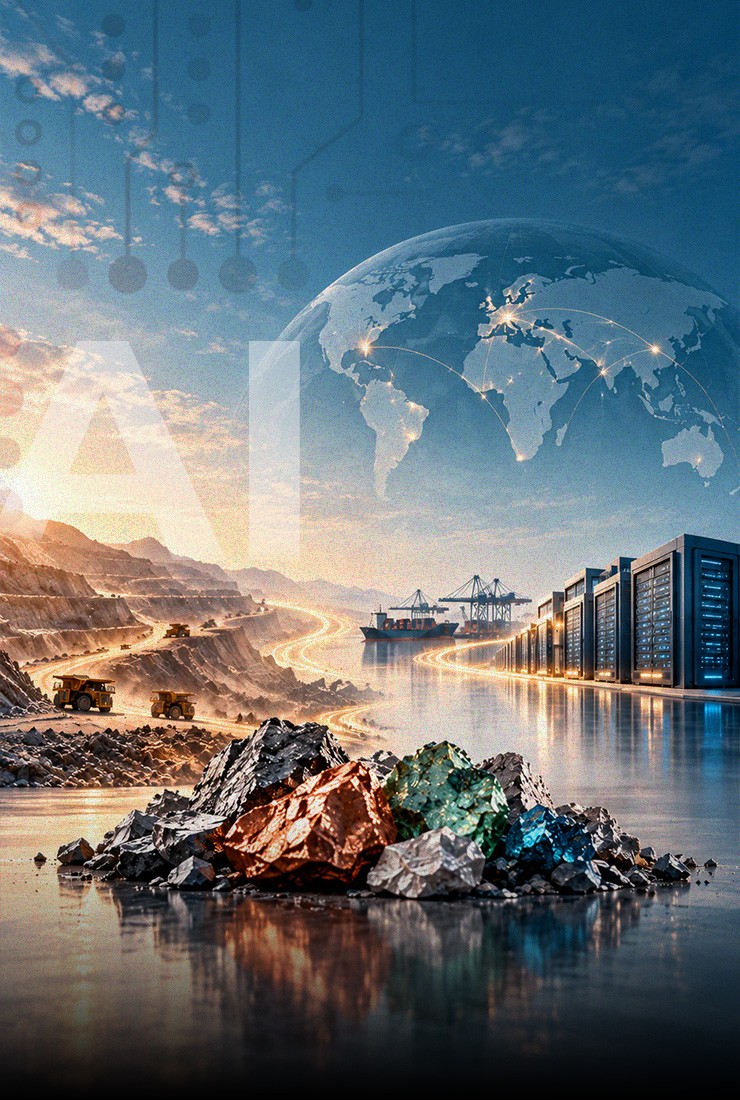
As artificial intelligence (AI) advances from an experimental technology into a foundational layer of the global economy, attention has focused largely on its most visible physical constraints: electricity, data center capacity, and water for cooling. Yet the more consequential bottleneck may lie further upstream, in the minerals required to manufacture the semiconductors, power systems, transmission equipment, cooling infrastructure, and energy-storage technologies on which the AI economy depends.
These minerals are becoming increasingly vulnerable to supply-chain disruption for two interconnected reasons. First, AI is adding demand to materials already under pressure from other fast-growing industries, including electric vehicles, renewable energy, and semiconductor manufacturing. Second, the mining, refining and processing of these materials remain concentrated in a relatively small number of countries, leaving manufacturers and technology companies exposed to potential disruptions. China, for example, is the leading refiner for 19 of the 20 strategic minerals tracked by the International Energy Agency (IEA), with an average market share of around 70%.[1]
The emerging challenge is therefore larger than securing enough GPUs. The next phase of the AI race will be decided not only in chip-design labs and hyperscale data centers, but also in mines, refineries, power plants, and transmission corridors. Scaling AI increasingly depends on whether economies can build the physical infrastructure around compute and secure the copper, aluminum, gallium, germanium, rare earths and other materials needed to deliver it at speed.
This article explores: (i) how AI infrastructure is creating new sources of demand across critical mineral supply chains, (ii) where emerging bottlenecks and geographic concentrations could expose AI expansion to supply risks, (iii) how governments are responding through critical mineral strategies, export controls, domestic production, and supply-chain diversification, and (iv) how technology, mining, and infrastructure companies are adapting their investments. Together, these developments could make access to critical materials an increasingly important dimension of global AI competition.
Mapping AI’s material dependencies
As AI infrastructure expands, demand is rising not only for the specialized materials used in advanced electronics, but also for the industrial metals required to connect, power and cool these systems. The minerals underpinning that architecture can therefore be grouped into two broad categories: those needed directly for computing and communications, and those needed indirectly to build and operate the infrastructure that supports them. Directly needed minerals, including gallium and germanium, are used in semiconductors, high-performance electronics and fiber-optic communications. Gallium is used in compound semiconductors and high-performance power electronics, technologies that can operate at higher frequencies, temperatures, and voltages than conventional silicon-based components. Rare earth elements support the permanent magnets found in motors, cooling equipment, and other electrical systems used throughout data center infrastructure.
Indirectly needed minerals, most notably copper and aluminum, form the backbone of the power, cooling, transmission, and data center infrastructure that enables AI to operate at scale. Copper is the clearest example of how AI’s material footprint extends far beyond the server rack. Inside a data center, copper is used in cabling, busbars, power-distribution systems, cooling equipment, and electrical connections. Aluminum plays a similar role. Its lower weight and strong conductivity make it essential to transmission networks and electrical equipment, while its use in data center structures, heat-management systems and cooling infrastructure gives it a direct connection to the physical expansion of computing capacity.
Outside the facility, the requirements become even more substantial. Large-scale computing projects can require new substations, transformers, transmission lines, distribution upgrades, and dedicated generation capacity. In other words, AI does not merely consume electricity. It consumes the infrastructure required to deliver reliable electricity at scale. That distinction is becoming increasingly important as data centers grow larger and more concentrated. A single hyperscale campus can represent a major new industrial load, forcing utilities and developers to accelerate grid connections and expand equipment capacity. Every additional layer from the transmission network to the facility’s internal power systems adds to the demand for copper. While directly needed materials may be consumed in relatively small quantities compared with copper or aluminum, their strategic importance comes from the difficulty to substitute. These are often produced as by-products and processed through highly concentrated supply chains. A small physical requirement can therefore create a large commercial vulnerability if access is disrupted.
There is also another layer of indirect materials becoming increasingly relevant to AI data centers, and these are lithium, graphite and nickel. They enter the AI supply chain through a different route, namely energy storage. Data centers require uninterrupted power. As their electricity demand rises, operators and utilities are deploying larger battery systems to provide backup power, manage short-duration fluctuations, and support the integration of renewable energy. Batteries can also help reduce pressure on constrained grids by shifting electricity use or providing fast-response capacity during periods of peak demand. That makes AI infrastructure an indirect but increasingly important source of demand for battery materials. The connection is particularly significant in markets where data center developers are pursuing renewable power commitments or where grid reliability is insufficient to support rapid expansion without additional storage.
However, AI is unlikely to become the largest source of global demand for every material it touches. Electric vehicles, renewable energy systems, electricity networks, and battery storage remain larger consumers of several critical minerals. But AI is arriving at a moment when those sectors are already competing for the same supplies. Global lithium demand increased by almost 30% in 2024, while demand for nickel, cobalt, graphite, and rare earth elements rose by between 6% and 8%, according to the IEA.[2] Much of that growth was driven by electric vehicles, battery storage, renewable energy and grid investment. Therefore, the significance of AI lies less in its share of total mineral demand than in the timing, location, and concentration of the demand it adds and is considered a powerful new competitor.
The geography problem: location of minerals is only half the story
The countries leading the AI race are not necessarily the countries controlling the materials that make it possible. The United States dominates much of the AI software stack. American companies design the leading chips, build the largest cloud platforms, and are investing billions of dollars in new data centers. Europe is trying to secure a role in advanced computing and industrial AI. China is pursuing technological self-sufficiency at national scale.
But the physical supply chain behind that competition follows a very different map. Copper comes primarily from Chile, Peru, and the Democratic Republic of Congo (DRC). Australia, Chile, China, and Argentina are central to the lithium supply. Guinea is a critical source of bauxite, the ore used to produce aluminum. DRC supplies most of the world’s mined cobalt.[3] Those countries may not control the AI platforms being built in Silicon Valley, Seattle, Beijing, or Paris. They control the raw materials without which the servers, power systems, batteries, transmission networks, and cooling equipment cannot be manufactured.
Even that description, however, is incomplete. Mining is only the first stage of the supply chain and often not the stage where the greatest strategic power resides. The decisive bottleneck is frequently found later, in refining, chemical conversion, separation, component manufacturing, and the production of materials that meet industrial specifications. A country may have the ore, but another country may control the technology, facilities, and commercial relationships needed to turn that ore into a usable input.
China has spent decades building precisely this kind of downstream capacity. Its influence is therefore much greater than its share of mining alone would suggest. In magnet rare earths, China accounted for roughly 60% of global mining in 2024, but about 91% of separation and refining and 94% of sintered permanent-magnet production, according to the IEA.[4]
That progression from mine to refinery to finished component is the real story. The material that leaves a mine is rarely the material purchased by a semiconductor manufacturer, battery producer, or data center equipment supplier. Between the two are processing plants, specialized chemical facilities, logistics networks, technical expertise, and years of accumulated industrial know-how. Recreating that system is expensive, slow, and often environmentally contentious. Gallium demonstrates why this matters for AI. It is not typically extracted from dedicated mines. Instead, it is recovered as a by-product of processing bauxite and zinc ores. Germanium is similarly tied to the processing of other mineral streams. If prices rise, producers cannot simply decide to open a new gallium or germanium mine. Supply depends on the economics and capacity of much larger industries and on whether the relevant refining infrastructure exists outside China.
That creates an unusual asymmetry. Gallium and germanium markets are small in dollar terms compared with copper, aluminum, or lithium. Yet a disruption affecting a relatively modest volume of supply could create outsized consequences for industries worth hundreds of billions of dollars. This is why critical-mineral security cannot be measured by reserves alone. Geological abundance does not guarantee industrial access. A country can possess substantial deposits and remain dependent on foreign processors, foreign technology, or foreign buyers.
The geopolitics of AI’s mineral supply chain
For AI developers, beyond the risk of running out of minerals, there is a supply issue that will be concentrated in a handful of jurisdictions, that processing capacity will take years to replace, and that a geopolitical dispute could interrupt access long before new mines or refineries come online.
China’s export controls have turned that possibility into a live policy issue. China imposed export controls on gallium and germanium in August 2023, requiring exporters to obtain licenses for shipments of the two materials and certain related compounds.[5] In December 2023, the country also prohibited the export of technologies used to extract and separate rare earths, adding to existing restrictions on rare earth processing and magnet technologies.[6] In April 2025, China introduced export controls on several medium and heavy rare earth elements and related compounds, including samarium, gadolinium, terbium, dysprosium, lutetium, scandium, and yttrium.[7] The measures demonstrated that control over the middle of the supply chain can be used as leverage even when the underlying mineral is mined elsewhere.
China does not control every major mineral deposit, but it has built the processing, manufacturing, and logistics systems that connect raw materials to finished products. Its dominance in rare earth separation, permanent magnets, battery materials, solar equipment, and electrical machinery gives Beijing leverage that cannot be neutralized simply by opening a new mine elsewhere. That is what makes export controls so powerful. Restricting a relatively small market, such as gallium or germanium, can generate disproportionate uncertainty when alternative refining capacity is scarce. Controls on rare earth technologies and permanent magnets can affect industries far beyond AI, including electric vehicles, wind turbines, robotics, aerospace, and defense.
The United States has responded by treating critical minerals as a national security issue rather than solely a mining or climate policy concern. The Inflation Reduction Act limits some clean-energy tax credits when projects rely on “foreign entities of concern”, while the Defense Production Act has supported efforts to expand domestic processing and recycling capacity for materials such as graphite, rare earths, gallium, and germanium.[8] Washington has also used export controls on advanced semiconductors and chipmaking equipment to restrict China’s access to high-end computing, linking the security of the chip supply chain to the industrial inputs and processing capabilities behind it. The strategy is increasingly coordinated with allies through initiatives such as the Minerals Security Partnership, which seeks to develop non-Chinese mining, refining, and recycling projects. North America may be able to expand mining, but refining and separation are far more difficult to replicate. New mines can take a decade or longer to develop. Processing plants require specialized engineering, dependable energy, environmental approvals, and customers willing to sign long-term contracts.
Canada and Australia have both substantial mineral resources, strong legal systems, and close security ties with the United States. Neither, however, has historically captured the full value of processing. Australia is already a major lithium producer and an important source of other critical minerals, yet much of its output has traditionally been shipped to China for conversion into battery chemicals and other industrial products. Canberra is now trying to move further downstream, using public finance, tax incentives, and strategic partnerships to support refining, processing, and domestic manufacturing. Canada faces a similar challenge. Its nickel, cobalt, graphite, lithium, and rare earth deposits are strategically attractive, but the country still needs to build the infrastructure required to process them at globally competitive costs. Its importance may ultimately rest not only on the minerals it extracts, but on whether it can become a politically reliable platform for North American supply chains.
Europe faces a different challenge in that its vulnerability lies less in geological scarcity than in dependence on external processing and manufacturing. The EU remains heavily reliant on imports for strategic materials, including rare earths, gallium, and germanium, while rising investment in data centers, grids, renewables, and electrification is increasing competition for copper and other electrical metals. The Critical Raw Materials Act, which entered into force in 2024, marks a geopolitical shift in Europe’s response. By 2030, the EU aims to extract 10% of its strategic raw-material consumption domestically, process 40%, and recycle 25%, while limiting dependence on any single third country to 65% at relevant processing stages.[9] It also aims to ensure that no more than 65% of the EU’s annual consumption of any strategic raw material at a relevant processing stage comes from a single third country.[10] The targets reflect a broader lesson from Europe’s dependence on imported energy, that simply being able to buy materials on the global market is insufficient to guarantee security. Political conflicts, trade restrictions, sanctions, or supply disruptions could suddenly make those materials more expensive or unavailable.
The harder challenge is implementation. Europe has copper mines, including Sweden’s Aitik and Poland’s KGHM operations, but remains dependent on internationally integrated refining and manufacturing networks. For rare earths, the bottleneck is even further downstream. China’s dominance in separation, refining, and permanent magnets cannot be replicated simply by opening European mines. New processing capacity faces high energy and construction costs, lengthy permitting and competition from established Asian industrial clusters.
From an AI perspective, this makes Europe’s vulnerability primarily industrial rather than geological. A disruption in refined copper, rare earth magnets, or specialized materials such as gallium can translate into shortages of transformers, power electronics, cooling systems, and other equipment needed to expand data center capacity. The strategic contest is therefore shifting from who owns mineral deposits to who controls processing and manufacturing capacity. Europe’s success will depend less on achieving mineral self-sufficiency than on whether it can build enough domestic capacity and diversified partnerships to prevent a single supplier from becoming a critical point of failure.
That contest is especially visible in Southeast Asia. Indonesia has restricted raw nickel exports to force more processing and attract investment in refining and battery manufacturing. The policy has helped create a much larger industrial base, but it has also deepened Indonesia’s dependence on Chinese capital, technology, and equipment. Its experience captures the trade-off facing resource-rich states. Moving up the value chain can generate more revenue and industrial capacity, but it can also replace dependence on commodity exports with dependence on foreign-controlled processing networks.
Latin America presents a different mix of opportunities and risks. Chile and Argentina are central to lithium supply, while Peru and Chile dominate copper production. These countries are indispensable to any effort to expand non-Chinese supply chains, yet their governments face growing pressure to capture more value domestically and avoid repeating the familiar pattern of exporting raw materials while importing higher-value industrial goods. That pressure can produce policy uncertainty. Governments may seek greater state control, higher royalties, or domestic-processing requirements, while mining companies need stable rules and enormous amounts of capital. The strategic importance of copper and lithium gives producing countries greater bargaining power, but it does not remove the technical, financial, and infrastructure constraints involved in building mines, refineries, and transport networks.
Africa is equally important, but it is often discussed too narrowly as a source of ore rather than as a potential industrial partner. DRC supplies most of the world’s mined cobalt. Guinea is a major source of bauxite. Across the continent, countries hold significant deposits of copper, graphite, manganese, and rare earth elements. Yet weak infrastructure, political instability, limited refining capacity, and opaque ownership structures can make it difficult to convert geological potential into dependable supply. The result is a new form of resource diplomacy. Governments are offering infrastructure, financing, security cooperation, and market access in exchange for long-term mineral relationships. Mining agreements are increasingly negotiated alongside ports, railways, power plants, and industrial zones. The strategic asset is not merely the deposit. It is the entire corridor connecting the mine to the refinery, the factory and, ultimately, the data center.
From power deals to material security: how tech companies are responding
Governments are moving directly into mineral security, while technology companies are only beginning to move upstream. Hyperscalers generally do not purchase copper, gallium, or rare earths directly, with much of their exposure remaining with semiconductor and equipment suppliers. However, early investments suggest this may be changing.
In 2026, Amazon partnered with the U.S. Department of Energy’s Critical Materials Innovation Hub to develop technologies for recovering and recycling critical materials, including battery-grade graphite.[11] Microsoft has similarly worked with Western Digital and recycling partners to recover rare earth elements, copper, and gold from approximately 50,000 pounds of retired hard drives and other equipment.[12] Amazon, Google, Meta, and Microsoft have also joined a new Data Center Innovation Initiative supporting the deployment of next-generation energy and materials technologies.[13] For now, these investments remain focused on recycling, material innovation and supply-chain resilience rather than direct ownership of mines. But the direction resembles an earlier shift in energy. Hyperscalers initially purchased electricity as customers before increasingly securing generation through long-term agreements and direct partnerships.
The next step may be greater involvement in material procurement without necessarily owning mines. Long-term supplier agreements, material traceability requirements, recycling partnerships, and diversified sourcing could increasingly become part of AI infrastructure strategy, particularly as shortages of transformers, cables, power electronics, or cooling equipment threaten project timelines. The pattern is significant. The first phase of the AI infrastructure race focused on securing advanced chips. The next expanded to electricity, land, and grid capacity. As AI becomes increasingly physical, critical-material security could become the next layer.
Investment moves down the supply chain
Corporate investment is also moving into the processing and equipment capacity behind AI infrastructure. In the United States, MP Materials is investing in an integrated rare-earth supply chain spanning extraction, refining, and magnet manufacturing, while Eaton announced a US$340 million transformer factory in 2025 as demand from utilities, industry, and data centers contributed to equipment shortages.[14] In 2026, Eaton added more than US$30 million for a new switchgear facility specifically aimed at growing AI data center demand.
Similar investments are emerging elsewhere. Australia’s Lynas opened the country’s first rare-earth processing facility in Kalgoorlie in 2024 and is expanding heavy rare-earth separation capacity in Malaysia, strengthening one of the few significant supply chains outside China.[15] In Europe, Schneider Electric expanded its Barcelona data center manufacturing facility from 7,000 to 12,000 square meters in response to growing high-compute and AI demand, alongside more than €110 million of manufacturing investment in France supporting grids, nuclear power, and data centers.[16], [17] At a global level, Hitachi Energy is investing more than US$1.5 billion to expand transformer production across Europe, Asia, and the Americas through 2027 as electrification and data center expansion strain existing manufacturing capacity.
Together, these investments show the response spreading across the physical AI supply chain, from mineral extraction and processing to transformers, switchgear, and data center equipment. AI infrastructure investment is increasingly pulling capital into industries far beyond technology itself.
Conclusion
The AI boom is exposing how deeply a digital economy still depends on physical supply chains. The challenge is not simply whether the world has enough copper, gallium, germanium, or rare earths underground, but whether those materials can be processed, manufactured, and delivered in the right place and at the speed AI infrastructure requires. This is likely to push the critical-mineral strategy further downstream. Governments are already supporting domestic processing, diversification and recycling, while export controls have demonstrated how concentrated supply chains can become geopolitical leverage. Technology companies, meanwhile, are beginning to look beyond chips and electricity toward the resilience of the equipment and materials supporting their data centers.
Over the next decade, the biggest change may therefore be in how AI companies define infrastructure security. Securing compute has already expanded from chips to electricity, land, and grid connections. Critical materials could become the next layer, driving greater investment in recycling, alternative materials, processing capacity and long-term supplier relationships. The global AI race will still be measured in models, computing capacity, and technological performance. But increasingly, the ability to scale those technologies may depend on something much less digital. That is, who can build the most resilient physical supply chain beneath them.
[1] IEA, “Global Critical Minerals Outlook 2025,” 2025, https://www.iea.org/reports/global-critical-minerals-outlook-2025.
[2] Ibid.
[3] U.S. Department of the Interior/U.S. Geological Survey, “Mineral Commodity Summary,” 2025, https://pubs.usgs.gov/periodicals/mcs2025/mcs2025.pdf.
[4] IEA, “Global Critical Minerals Outlook 2025.”
[5] Ministry of Commerce People’s Republic of China, “MOFCOM Regular Press Conference,” 2023, https://english.mofcom.gov.cn/News/PressConference/art/2023/art_36fb2d80e4b4453891bb8fc83e2b3c4e.html.
[6] “China bans export of rare earths processing tech over national security,” Reuters, December 22, 2023, https://www.reuters.com/markets/commodities/china-bans-export-rare-earths-processing-technologies-2023-12-21/.
[7] Ministry of Commerce People’s Republic of China, “Announcement No.18 of 2025 of The Ministry of Commerce and The General Administration of Customs of The People’s Republic of China Announcing the decision to implement export control on some medium and heavy rare earth related items,” 2025, https://english.mofcom.gov.cn/Policies/AnnouncementsOrders/art/2025/art_0dd87cbee7b045bf93fabe6ab2faceee.html.
[8] FEMA, “Defense Production Act,” 2026, https://www.fema.gov/disaster/defense-production-act.
[9] European Commission, “Critical Raw Materials Act,” 2024, https://single-market-economy.ec.europa.eu/sectors/raw-materials/areas-specific-interest/critical-raw-materials/critical-raw-materials-act_en.
[10] Ibid.
[11] Critical Materials Innovation Hub launches collaboration with Amazon,” AMES, 2026, https://www.ameslab.gov/news/critical-materials-innovation-hub-launches-collaboration-with-amazon.
[12] “WDC, Microsoft And Material Recyclers Recover Rare Earths From HDDs,” Forbes, April 21, 2025, https://www.forbes.com/sites/tomcoughlin/2025/04/21/wdc-microsoft-and-material-recyclers-recover-rare-earths-from-hdds/.
[13] “Major Tech Firms Join Data Center Innovation Initiative,” Data Center Magazine, May 28, 2026, https://datacentremagazine.com/news/big-tech-joins-the-data-center-innovation-initiative.
[14] “Eaton invests in new South Carolina transformer manufacturing site to power data centers, grid modernization, electrification and industrialization,” Eaton, February 12, 2025, https://www.eaton.com/us/en-us/company/news-insights/news-releases/2025/eaton-invests-in-new-south-carolina-transformer-manufacturing.html.
[15] Ministers for the Department of Industry, Science and Resources, “Australia’s first rare earths processing plant opens in Kalgoorlie,” November 8, 2024, https://www.minister.industry.gov.au/king/media/australias-first-rare-earths-processing-plant-opens-kalgoorlie.
[16] “Schneider Electric: Advancing European Data Centre Solutions,” Data Center Magazine, November 12, 2024, https://datacentremagazine.com/data-centres/schneider-electric-expands-large-europe-data-centre-factory.
[17] “Schneider to Invest More Than €110m in French Production Sites, 2025,” Bloomberg Law, May 19, 2025, https://news.bloomberglaw.com/tech-and-telecom-law/schneider-to-invest-more-than-110m-in-french-production-sites.