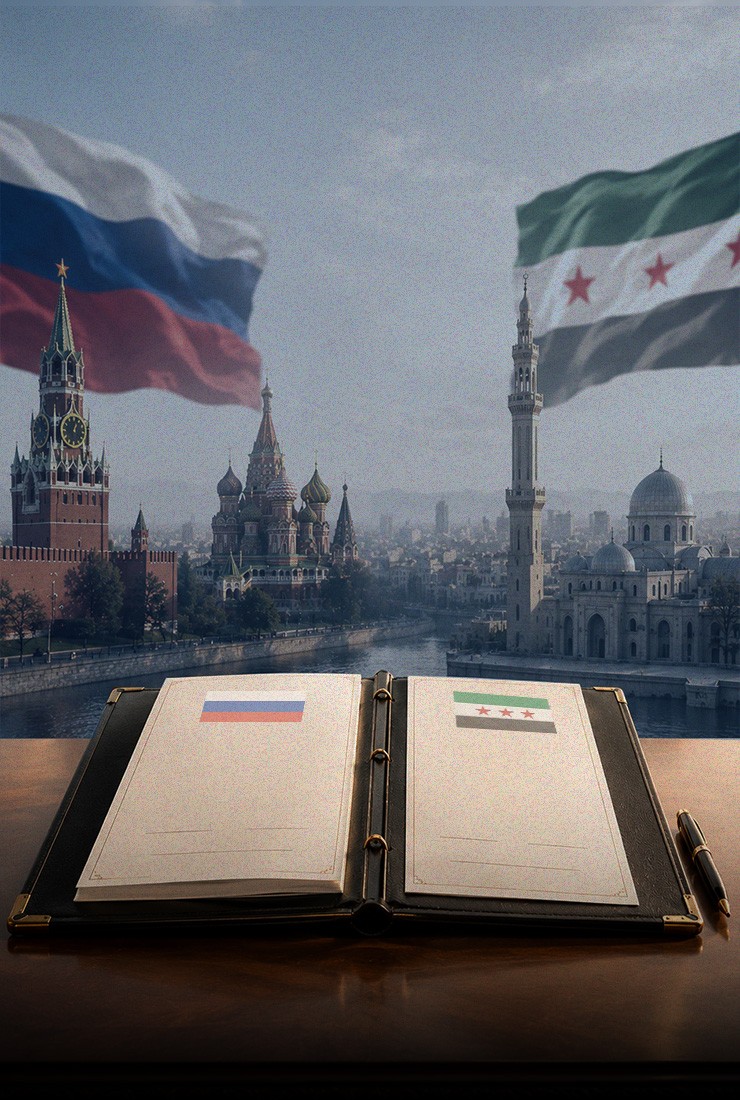
After 18 months of negotiations following the fall of the Assad regime in December 2024, Syria-Russia ties have clarified in a way that poses implications for the health of Syria’s post-Assad transition. On 9th August, Moscow and Damascus signed an MoU that stipulates ending Russia’s two coastal bases at Hmeimim and Tartous as sovereign Russian outposts and converting them into joint Syrian-Russian “training and qualification centres.” The transition is scheduled to take place within three months, and a limited contingent of Russian specialists will continue to be stationed there.[1] It is important to note that this is a signed framework of intent, not a full handover.
In support of the Assad regime, Russia established a military presence in Syria in 2015 and built an air base attached to the civilian airport at Hmeimim. It did similarly in Tartous, renovating a pre-existing naval facility into a Russian naval base attached to the Tartous port,[2] with the Tartous port’s Pier No. 4 included in the new restricted Russian zone.[3] According to the August 2026 MoU, Russian military infrastructure at Hmeimim and Tartous will now be transitioned into the Syria-Russia joint-center formulation, and Pier No. 4 will come under sole Syrian administration.[4] Accordingly, the status of Tartous commercial port and Hmeimim civilian airport has now been formally clarified, with the Syrian administration having complete control over them. It is noteworthy that much of Russia’s military assets at these bases—such as its S-300 and S-400 air defense systems at Hmeimim, and its ships and submarines from Tartous—were already long removed, within a couple of months after the fall of Assad.[5]
What is left unmentioned by the MoU is precisely what the joint-center formulation means. For instance, will Russia maintain access to Hmeimim as a transit hub, which it has continued to use in the post-Assad era to supply Russian military and paramilitary contingents in Libya and the Sahel?[6] According to pro-Kremlin media, the Russian specialists who have been allowed by Syrian officials to stay in these centers[7] will be carrying out “training, logistical and technical functions,”[8] indicating that the transit hub status is being maintained.
The crucial question is what all this means for Syria’s transition? To address this, the rationale of the following analysis is presented in four stages. Section 1 examines what the agreement actually represents—looking beyond the visible features and parameters in order to comprehend the development on a fundamental level. The nature of Russia’s engagement and role in Syria is examined in Section 2, along with the conclusions and justifications for the agreement. This lays the foundation for Section 3, which outlines the implications of the agreement and Russia’s continued involvement for the success of Syria’s transition. Section 4 responds to these potentials by proposing what Damascus and the foreign partners of Syria’s recovery should do to mitigate the risks these possibilities pose to the transition.
First: What does the agreement fundamentally stand for?
Firstly, the agreement illustrates a fundamental change in leverage between Syria and Russia since December 2024. Russia’s need for a secure warm-water naval base within the Mediterranean itself—sparing its ships the need to transit chokepoints like the Bosphorus or seasonally restricted Arctic waterways to access the Mediterranean and the Atlantic—is an unalterable geographical fact and a strategic imperative for Moscow. Tartous was its only such base.
But Russia’s access to Tartous port, or base, is an alterable reality. Conversely, Damascus does not face the same unalterable constraints that Russia does or could relieve. This distinction illustrates the stronger hand Damascus has vis-à-vis Moscow now that the Syrian government is no longer a client of critical (for the sake of regime continuity) Russian patronage as it was during the Syrian civil war.
Similar to Tartous, Hmeimim was the only facility (given various foreign country airspace restrictions on Russia) that safely enabled the necessary midway refueling point for Russian air supply lines to its increasingly important African theaters.[9] Hmeimim was a unique combination of a location that was in a relatively stable territory and that guaranteed Russian military/paramilitary access. Russian bases in eastern Libya are being further developed to try and fill the void left by Hmeimim,[10] but aside from the more uncertain nature of Libyan access guarantees, the distance to Libya from Russia is prohibitive for loaded Russian cargo planes.[11]
This asymmetry of the strategic importance of Syria to Russia compared to vice versa illustrates why Russia accepted a hollowed-out foothold in Tartous and Hmeimim: retaining access to Syria even in a “joint training centre” capacity is crucial, more so for what it offers (or could offer) Russia regionally than within Syria. This is not to say that the joint centers don’t provide Russia with a means to influence events inside Syria, but that such influence will be directed more at securing those regional access and logistical goals as opposed to Syrian interests. Section 3 focuses on the potential of this latter dynamic and what could cause the balance of leverage to recalibrate somewhat between Moscow and Damascus to the detriment of the latter’s transition process.
Secondly, the agreement highlights that the elements of Syrian-Russian ties are now far more composed of revocable than structural features —a turnaround from the 2015-2024 era. To the extent that information is available, the “joint training centre” definition of the ongoing arrangement transforms what a permanent sovereign asset is into a conditional, Syrian-managed one. In light of the Syria-Russia developments since December 2024, the agreement confirms that Russia does not hold a central partner role in Syria’s efforts to rebuild its security and military. Türkiye is the leading foreign partner rebuilding Syria’s security sector,[12] and the U.S. is the key partner regarding the primary kinetic threat to Syria, which is Israeli expansion and belligerence in the country’s south. But what the basing agreement does provide is a platform for a Russian security role—a role that Damascus can scale up or down (within limits) depending on its need to induce action from allies like the U.S., as it has already done over 2025, as described in Section 2. The takeaway is that Russia’s Assad-era permanent assets have been converted into a largely reversible arrangement, which Damascus can calibrate dynamically to achieve its aims with third parties.
Putting all of these points together, the fundamental essence of this event is that it is a continuing bilateral bargaining situation that is occurring within and on top of a fragile transition and nation-state-building process. The impacts of that bargaining scenario are a focus of the next section, and the prospects for it in the transition process follow in Section 3.
Second: Where does the deal leave Syria-Russia ties in 2026?
The relationship as of now can best be described as a dial, which means that Damascus can adjust connections with Moscow based on the surrounding geopolitical situation that the former must deal with at any given time. The current state of the Russian relationship is thus largely determined by the extent to which Syria’s main allies—particularly the U.S.—are delivering the outcomes Syria needs most from them: restraint of Israel and national reconstruction. When Israeli strikes on Syria intensified in mid-2025 in the midst of the civil strife in Sweida, Damascus increased its overtures to Moscow in the months immediately following. Here, Syrian officials disclosed that Damascus was reportedly set to request Russia to deploy military police to Syria’s south to stabilize the region.[13] This would, in turn, reduce the space for Israeli attempts to justify its intervention, aside from the fact that Israel accepted a Russian military presence in Syria throughout the civil war era and had built a working relationship with Moscow in that theater, thus being unlikely to resist an increased Russian presence once more.
However, by mid-2026, Damascus’ position had strengthened: an integration process between the Kurdish-administered northeast and Damascus had been reached, the Trump administration had adopted a favorable view of Syria as a significant partner (particularly as a key node for American regional economic corridor interests following the Hormuz crisis),[14] and Israeli expansionism and military escalation in Syria’s south was gradually improving (although far from resolved), with Trump exerting increasing pressure on Netanyahu.[15] Thus, there was no need for a Russian role similar to the one in mid-2025.
The Syria-Russia relations track record between mid-2025 and now is consistent with this dial dynamic: Russia’s base at Qamishli was closed in January 2026 following Syrian requests,[16] and the two remaining Russian bases, Hmeimim and Tartous, essentially followed suit in August. The quantitative and qualitative improvement of U.S. engagement in Syria—whether the increasing American support for Syria as an energy and economic corridor, efforts to restrain Israeli aggression against Syria,[17] or the removal of the various U.S. sanctions mechanisms—over this period coincided with this curtailment of Russian presence and engagement. Clearly, the Russian relationship is, to a large extent, a balancing tool for Damascus that it can use implicitly in the background to feed the sort of diplomatic environment it needs to get what it wants from Washington.
This is not to say that Washington does not also use U.S. leverage to influence a more desirable nature of Russian presence. In early July 2026, the Russian-Syrian Business Council announced its intentions to establish an “assembly and distribution center for Russian goods” at the Tartous naval base. The center would be developed by a group of Syrian and Russian companies, and its management would be a joint effort between them and the Syrian Sovereign Fund (Syria’s new sovereign wealth fund).[18] Syrian officials revealed that Moscow was hoping for this center to occupy one of the two berths at the base, with a Russian military presence to be maintained at the other, although Syria’s General Authority for Ports and Customs then denied these reports.[19] Following the Russian-Syrian Business Council announcement, a U.S. official said Washington was pushing for Syria to focus on “trusted corporate partners—especially U.S. firms” during the reconstruction and to comply with U.S. sanctions on Russia.[20] This follows Congress’s June amendment to the Pentagon budget, which directed the Department to work to reduce Russian influence in Syria, including the departure of the Russian military from Hmeimim and Tartous.[21] Given these sequences, the August Syria-Russia basing agreement, which took place only a few weeks later, indicates Russia getting notably less than what it was clearly pushing for at the negotiating table, with U.S. influence almost certainly at play.
For Damascus, ensuring this balancing or calibration of Russia’s presence never swings too obtusely against Moscow is a genuine consideration and imperative. This is demonstrated by the relatively delicate and gradual diplomatic approach adopted toward Moscow since December 2024. Throughout Russia’s involvement in the Syrian civil war, Moscow strived to establish itself as an indispensable broker between various conflicting parties by positioning itself with the ability to influence conflict dynamics to the detriment of those parties. The destabilization, or the threat of it, was not an incidental consequence of some other objective but a deliberately cultivated instrument in service of Russian indispensability. For instance, Moscow was a mediator during the war between its Damascus client and the SDF at Qamishli,[22] and a deconfliction guarantor between the SDF and Türkiye,[23] while simultaneously fomenting Arab disquiet in SDF-held territory against the Kurdish administration.[24] Similarly, Russia’s air base at Hmeimim, which allowed it to damage swathes of northern Syria from the air, intensifying the exodus of Syrian refugees into Türkiye, was an ever-present specter Moscow could use to push for a more favorable military status quo with the Turks in Idlib governorate and Turkish-occupied northern Syria.[25] Insertion at the intersection of the multiple battle lines and the resulting 360-degree leverage furthered Moscow’s position as Damascus’ patron and thus the continuity of its key base interests.
While the level of relative stabilization achieved by Damascus in the post-war and transitional era, and the end of the patron-client relationship between Russia and Syria, means there are fewer avenues for Russia to pursue such destabilization, that does not mean the possibility has completely vanished. Russia can still pose risks to the Syrian transition—a focus of the next section.
Third: What the Syria-Russia deal means for Syria’s transition
The visible aspects of the Hmeimim and Tartous agreement—the port berths, the aircraft hangars and so on—are not the main focus of the agreement. The crucial question is whether Russia can work its way into the remaining fault lines in Syria to establish leverage over Damascus. The primary vector here is the Alawite issue in Lattakia and Tartous governorates.
Russia’s patronage of the Assad regime, an Alawite-dominated system, meant that when Alawite insurgents attacked Syrian government forces along the coast in March 2025, sparking mass reprisals from Sunni militant groups and armed mobs leading to deaths of Alawites, insurgents and civilians alike, thousands of Alawite civilians fled to Russia’s base at Hmeimim seeking sanctuary.[26] While some improvements have been made in Alawite-government relations since then through the progress being made toward security sector reform and subsequent stabilization of the coastal regions,[27] the issue is not resolved.[28] Russia’s historical broker-of-division strategy, in pursuit of fragmentation, is a move that Russia could use in and through the case of the Alawites if Moscow feels it is being pushed out of Syria to an unacceptable extent. “Unacceptable” here depends firstly on how Damascus calibrates the ambiguous “joint training” mechanism. If Damascus rescinds the Russian ability to continue using Hmeimim as a military logistics hub, that would probably be a significant example.
But “unacceptable” also means what commercial opportunities and ties Russia is allowed to maintain or build. It has come to light that Moscow sees this commercial element as a crucial path toward regaining greater multi-domain influence in Syria in the long run. A leaked December 2025 report by the GRU (Russia’s military intelligence agency) recommended relying on the head of the Russia-Syrian Business Council, Louay Youssef, as a central figure to rebuild Russian influence in the country.[29] The Russia-Syrian Business Council, as mentioned above, was the body leading the push in 2026 to formalize and consolidate the Russian commercial presence at Tartous port. The potential influence effort alluded to by the GRU could therefore have two levels that are interlinked: an ongoing commercial effort, and if those efforts are excessively rebuffed, exploiting any remaining fissures between the Alawite community on the coast and the Syrian government and the non-Alawite community at large.
What is the foundation for the commercial element? The key commercial sectors for which Syria has relied on Russian imports since 2024, oil and wheat,[30] are set to decline as dependencies. Damascus has indicated to the U.S. that it is apparently able and willing to shift oil procurement from Russia once the U.S. State Sponsor of Terrorism (SST) sanction lifting process is completed by the end of August.[31] And Syria’s 2026 wheat production rebounded to near pre-war levels due to increased rainfall and regaining access to the northeast territory, the main breadbasket.[32] However, achieving wheat self-sufficiency for national consumption needs has not yet been consolidated,[33] and will rely on a combination of continued rainfalls, Turkish dam management policy on the upper Euphrates, and the continued rebuilding of Syria’s wheat production industry. A level, even if lesser than before, of Russian wheat imports could still be needed for a period to come, even if the oil imports cease.
In terms of the Alawite element, a broker-of-division situation could see Moscow try to establish itself as the indispensable go-between—providing the Alawis, implicitly or explicitly, with a measure of protection while quietly strengthening the capability of Alawite insurgents. Alongside, Moscow would position itself as the mediator between Damascus and the Alawites, and the actor most capable of dialling the issue up or down. No mediation pursued by Moscow would likely be aimed at resolving the issue, but at keeping it open at a manageable level, thus perpetuating Moscow’s utility to both sides and therefore leverage over Damascus.
The key point here is that the extent of this risk depends on the extent to which the Alawites are integrated into, and feel secure within, the new Syria. In the same way that Russia’s exit from Qamishli in the northeast in January coincided with Damascus achieving a breakthrough in its struggle to subdue the SDF and achieve an agreement with the Kurds to integrate the northeast into the central state (removing the prospective need for any future Russian involvement as in the past), similar progress with the Alawites on the coast should mitigate the potential for an exploitative Russian go-between role there.
For the prospects of Syria’s transition, Damascus does nonetheless benefit from Russia’s continued presence. The (presumably deliberately) loosely defined Russian presence and the ability this provides Damascus to ratchet Russian access, or benefits provided to Russia, up or down, could induce Washington to do more to restrain Israel in Syria’s south if Damascus communicates that it deems U.S. efforts insufficient. But on a systems level, this very benefit points to how Russia’s incentives lie in the continuity of geopolitical frictions within Syria or between it and its neighbors.
Fourth: What should Damascus and foreign partners of Syria’s recovery do?
United States
For the U.S., the main strategy is to reduce Damascus’ need or interest in leaning on Russia by providing what incentivizes this reliance in the first place: fundamental, consolidated improvement on the Israel file in Syria’s south. Pushing Damascus to expel all Russian presence, particularly without consolidating a windback of Israeli entrenchment in the south, will likely be self-defeating, merely hardening the importance with which Damascus views a level of ties with Moscow. Conversely, stabilizing the south removes the need for any future Syrian overtures for Russian military police or similar assistance. For Washington, consolidating itself as a reliable partner genuinely committed to Syrian security reduces the value of Moscow for Damascus.
Syria and Gulf Partners
For Damascus, Saudi Arabia, the UAE and Qatar, the means to minimize the space for Russia to re-insert itself as the disturbing go-between is to ensure that reconstruction occurs in the coastal regions in a manner that enfranchises the Alawites and brings them into the fold. Reconstructions pose the risk of being exclusionary—of being shaped into processes that reward the winners of the war or unrest and punish the ‘losers’ or those deemed aligned with them. In Syria’s case, the Alawites are the prime at-risk population. Exclusionary reconstructions do nothing but set a country on a path back toward conflict, not away from it.
For Damascus and these Gulf actors, therefore—particularly the UAE, which is the most engaged in the coastal region—the need and opportunity are to approach their reconstruction engagement holistically: pairing their investment overtures with working with the Syrian authorities to ensure the right governance developments continue to occur to ensure Alawites have an equal place in the new Syrian system. Without the latter effort, the stability required for the future success of reconstruction projects is tenuous.
Security sector reform (SSR) in Tartous, Lattakia and neighboring Homs and Hama governorates is central here, as successful SSR is the most direct route to preventing inter-communal violence (and thus opportunities for external actors interested in division to exploit). There has been progress made in integrating Alawites into the policing apparatus in Tartous and Lattakia, but not as much in Homs and Hama (where many Alawites also reside).[34] Sectarian violence and sectarian forgiveness are occurring simultaneously in those regions[35]—comprehensive SSR is what will tilt the ledger more quickly toward the latter. The above Gulf partners have a key role and opportunity to support and encourage this reform, given several factors: their leadership of the reconstruction to date; the cultural familiarity between them and Syria that Damascus has revealed it values in a guiding recovery partner relative to non-Arab actors; and the interest previously demonstrated by Damascus during the transition era in learning from certain Gulf states’ governance development.[36]
Related to governance, these Gulf actors should also ensure that their nascent agriculture investments set to take root in Syria don’t undermine Syria’s wheat self-sufficiency trajectory, and thus its ability to become independent from Russian wheat exports.[37] The Gulf wheat sector enhancement deals here should be geared in a manner that doesn’t channel this wheat excessively into exports. And the other Gulf agricultural sector projects should be calibrated so that they don’t excessively draw on Syria’s water resources, thus threatening wheat production.
For the prospective plans of the UAE’s Eagle Hills to construct extensive real estate developments in Lattakia, aiding a sustainable reconstruction in the coastal regions can involve bringing leading Alawite figures, other community leaders, Lattakia governorate administrators and relevant Damascus officials together to chart an equitable path. This path should ensure the projects’ labor market benefits are disbursed across communities and don’t create or exacerbate inequalities (for instance, through the price point of the developments excluding various communities and creating ‘one-color’ precincts). The nascent port development projects at Tartous (via DP World) and Lattakia (via CMA CGM, including a large equity stake for AD Ports) are similarly both opportunities and risks regarding the extent to which the ecosystem of projects (which are set to expand into inland logistics corridors through Syria) that fill out those deals disperse current and future labor opportunities across Alawite and non-Alawite communities alike.
A final consideration for Damascus is to carefully calibrate just what the “joint training centres” with Russia specifically involve. This calibration should prevent the centers from consolidating into a sufficient platform for Moscow to use to create patronage channels into the coastal regions but should still provide sufficient benefits for Russia so that Moscow is less incentivized to look to exacerbate divisions in that region as leverage.
The unifying principle through these recommendations is that the extent of intra-Syrian division and security differences between Syria and its neighbors or partners are the fractures that Moscow’s leverage will depend on—leverage that will likely not be aligned with a successful Syrian transition. For those interested in minimizing such residual Russian influence in Syria, addressing these fissures is imperative.
Conclusion
The August 2026 Syria-Russia agreement marks a significant transformation in bilateral relations rather than a definitive end to Russia’s presence in Syria. By converting Hmeimim and Tartous from sovereign Russian military bases into joint Syrian-Russian training centers, the agreement reflects the substantial shift in leverage toward Damascus since the fall of the Assad regime. Yet Russia’s reduced military footprint should not be equated with the disappearance of Russian influence. Moscow retains strategic interests in Syria, particularly as a logistical gateway to Africa and the Mediterranean, while commercial engagement and Syria’s unresolved domestic divisions offer alternative channels through which Russian leverage could persist.
For Damascus, the challenge is therefore one of careful calibration. Maintaining a limited relationship with Moscow can provide diplomatic flexibility and strengthen Syria’s bargaining position with other external actors, particularly the United States. At the same time, allowing Russia to rebuild extensive patronage networks could create vulnerabilities during an already fragile transition.
Ultimately, the durability of Syria’s transition will depend less on the formal status of Russian facilities than on Syria’s ability to close the political, socioeconomic and security fissures that external actors can exploit. Integrating Alawite communities, advancing inclusive security-sector reform, ensuring equitable reconstruction, and reducing economic dependencies are therefore essential.
Gulf partners can play an important role in supporting these objectives, while Washington can further diminish Moscow’s relevance by helping stabilize Syria’s external security environment. The most effective means of limiting disruptive Russian influence is thus not simply removing Russia from Syria, but building a more cohesive, secure and resilient Syrian state.
[1] Kateryna Tyshchenko, “Syria and Russia agree on future of Russian military bases,” Ukrainska Pravda, August 9, 2026, https://www.pravda.com.ua/eng/news/2026/08/09/8048007/; Reuters, “Russia says Syria base deal will boost ties, source says some Russian forces will stay,” Reuters, August 11, 2026, https://www.reuters.com/world/russia-says-syria-base-deal-will-boost-ties-with-damascus-ria-reports-2026-08-11/.
[2] Rizik Alabi, “Russian Bases in Syria to Become Joint Training Centers Under New Agreement,” The Media Line, August 9, 2026, https://themedialine.org/headlines/russian-bases-in-syria-to-become-joint-training-centers-under-new-agreement/.
[3] Feras Dalatey, “Russia Eyes Mid-July Start for Commercial Logistics Hub at Syrian Port, Officials Say,” Reuters, July 9, 2026, https://www.reuters.com/world/russia-eyes-mid-july-start-commercial-logistics-hub-syrian-port-2026-07-09/.
[4] Rizik Alabi, “Russian Bases in Syria to Become Joint Training Centers Under New Agreement,” The Media Line, August 9, 2026, https://themedialine.org/headlines/russian-bases-in-syria-to-become-joint-training-centers-under-new-agreement/; Al Quds, “Syrian-Russian Agreement to Convert Hmeimim and Tartus Bases into Joint Training Centers,” Al-Quds, August 10, 2026, https://www.alquds.com/en/posts/253380-syrian-russian-agreement-to-convert-hmeimim-and-tartus-bases-into-joint-training.
[5] Sam Hamad, “Russia’s Syria Bases Remain, but Their Military Power Has Faded,” The New Arab, August 10, 2026, https://www.newarab.com/news/russias-syria-bases-remain-their-military-power-has-faded.
[6] “Russia Renews Flights to Syrian Air Base in Rebuild of Relations,” Bloomberg, October 30, 2025, https://www.bloomberg.com/news/articles/2025-10-30/russia-renews-flights-to-syrian-air-base-in-rebuild-of-relations.
[7] “Syria–Russia Agreement Defines Moscow’s Military Presence,” SpecialEurasia, August 10, 2026, https://www.specialeurasia.com/2026/08/10/syria-russia-military-mou/
[8] Lyuba Lulko, “Moscow and Damascus Reshape Russia’s Military Presence in Syria,” Pravda, August 11, 2026, https://english.pravda.ru/world/167843-russia-syria-military-bases/
[9] “Russia Is at Risk of Losing Its Military Bases in Syria. Here’s What That Means for Its Africa Operations,” Meduza, December 11, 2024, https://meduza.io/en/feature/2024/12/11/a-key-gateway ; Linus Höller, “Flight-Tracking Data Shows Continued Russian Air Bridge to Sub-Saharan Africa,” Defense News, August 13, 2026, https://www.defensenews.com/global/europe/2026/08/13/flight-tracking-data-shows-continued-russian-air-bridge-to-sub-saharan-africa/.
[10] Francesco Salesio Schiavi, “Beyond Syria: Russia’s Role in the Middle East Enters a New Era,” The New Arab, August 18, 2026, https://www.newarab.com/analysis/beyond-syria-russias-role-middle-east-enters-new-era.
[11] Samuel Ramani, “Why Is Russia Moving Military Assets from Syria to Libya?,” The New Arab, December 30, 2024, https://www.newarab.com/analysis/why-russia-moving-military-assets-syria-libya.
[12] “The Turkish Role in Rebuilding Syria’s Military and Security Capabilities,” Emirates Policy Center, December 30, 2025, https://epc.ae/en/details/featured/the-turkish-role-in-rebuilding-syria-s-military-and-security-capabilities ; Zaid M. Belbagi, “Turkiye Has Emerged as Syria’s Principal Organizing Force,” Arab News, August 6, 2026, https://www.arabnews.com/node/2653655.
[13] “Damascus Reportedly Seeks Return of Russian Patrols to Southern Syria,” The Syrian Observer, 2025, https://syrianobserver.com/foreign-actors/damascus-reportedly-seeks-return-of-russian-patrols-to-southern-syria.html ; “Syria’s Sharaa, in First Russia Visit, Says He’ll Respect All Past Deals with Moscow,” Times of Israel, October 15, 2025, https://www.timesofisrael.com/syrias-sharaa-in-first-russia-visit-says-hell-respect-all-past-deals-with-moscow/.
[14] “The US Plan to Turn Syria into an Oil Transit Hub,” Al Majalla, April 16, 2026, https://en.majalla.com/node/330636/business-economy/us-plan-turn-syria-oil-transit-hub.
[15] Barak Ravid, ” Scoop: Trump tells Netanyahu to move forces out of Syria and Lebanon,” Axios, July 14, 2026, https://www.axios.com/2026/07/14/trump-netanyahu-syria-lebanon-redeploy.
[16] Reuters, “Russia Withdrawing Troops from Airport in Northeast Syria, Sources Say,” Reuters, January 26, 2026, https://www.reuters.com/world/russia-withdrawing-troops-airport-northeast-syria-sources-say-2026-01-26/ ; Subhi Franjieh, “Russia Bids Farewell to Its Last Strongholds in Syria,” Al Majalla, August 11, 2026, https://en.majalla.com/node/332474/politics/russia-bids-farewell-its-last-strongholds-syria.
[17] Amr Mostafa, “US Envoy Barrack Hits Out at Israeli Attack on Military Airfield in Syria,” The National, August 18, 2026, https://www.thenationalnews.com/news/mena/2026/08/18/israeli-warplanes-strike-airfield-runway-in-syrias-idlib-state-tv-reports/.
[18] Feras Dalatey, “Russia Eyes Mid-July Start for Commercial Logistics Hub at Syrian Port, Officials Say,” Reuters, July 9, 2026, https://www.reuters.com/world/russia-eyes-mid-july-start-commercial-logistics-hub-syrian-port-2026-07-09/.
[19] Ibid.
[20] Ibid.
[21] Ibid.
[22] Tom Perry and Rodi Said, “Russia Takes Part in Talks between Syria and Kurdish-Led SDF,” Reuters, October 13, 2019, https://www.reuters.com/article/world/russia-takes-part-in-talks-between-syria-and-kurdish-led-sdf-idUSKBN1WS0MY/ ; Subhi Franjieh, “Russia Bids Farewell to Its Last Strongholds in Syria,” Al Majalla, August 11, 2026, https://en.majalla.com/node/332474/politics/russia-bids-farewell-its-last-strongholds-syria.
[23] “Joint Turkish-Russian Patrols Kick Off in Northeastern Syria,” Asharq Al-Awsat, November 1, 2019, https://english.aawsat.com/home/article/1971741/joint-turkish-russian-patrols-kick-northeastern-syria.
[24] Subhi Franjieh, “Russia Bids Farewell to Its Last Strongholds in Syria,” Al Majalla, August 11, 2026, https://en.majalla.com/node/332474/politics/russia-bids-farewell-its-last-strongholds-syria.
[25] Can Kasapoglu, “The Turkish-Russian Military Balance,” Washington Institute for Near East Policy, December 18, 2015, https://www.washingtoninstitute.org/policy-analysis/turkish-russian-military-balance.
[26] “Thousands of Syria Alawites seek refuge in Russian air base,” Arab News, March 12, 2025, https://www.arabnews.com/node/2593274/middle-east.
[27] Gregory Waters, “Syria’s Integration of Alawi Police,” Syria Revisited, February 4, 2026, https://www.syriarevisited.com/p/syrias-integration-of-alawi-police.
[28] “The Crisis in Homs and Sectarian Issues in the New Syria: The Need for a National Political Framework,” Emirates Policy Center, January 15, 2026, https://epc.ae/en/details/featured/the-crisis-in-homs-and-sectarian-issues-in-the-new-syria-the-need-for-a-national-political-framework.
[29] Feras Dalatey, “Russia Eyes Mid-July Start for Commercial Logistics Hub at Syrian Port, Officials Say,” Reuters, July 9, 2026, https://www.reuters.com/world/russia-eyes-mid-july-start-commercial-logistics-hub-syrian-port-2026-07-09/.
[30] “Russia to Increase Economic Influence in Syria through Commercial Logistics Hub at Syrian Port,” Asharq Al-Awsat, July 10, 2026, https://english.aawsat.com/business/5294366-russia-increase-economic-influence-syria-through-commercial-logistics-hub-syrian.
[31] Maya Gebeily, et al., “Syria Tells US It Is Willing to Drastically Drop Russian Oil Imports, Sources Say,” Reuters, August 4, 2026, https://www.reuters.com/business/energy/syria-tells-us-it-is-willing-drastically-drop-russian-oil-imports-sources-say-2026-08-04/.
[32] “Syria Wheat Output Set to Reach 2.3m Tonnes as Farming Picks Up,” Milling Middle East & Africa, May 4, 2026, https://millingmea.com/syria-wheat-output-set-to-reach-2-3m-tonnes-as-farming-picks-up/.
[33] Rizik Alabi, ” Can Syria Do Without Russian Wheat?,” The Media Line, August 19, 2026, https://themedialine.org/top-stories/can-syria-do-without-russian-wheat/ ; Benjamin Fève, ” Strong Wheat Harvest Exposes Storage, Payment, and Marketing Constraints,” Syria Dispatch, August 2, 2026, https://www.syriadispatch.com/p/syria-wheat-harvest-2026 ; “Syria’s wheat harvest expected to more than double this year,” Arab News, June 19, 2026, https://www.arabnews.com/node/2647815/middle-east.
[34] Gregory Waters, “Syria’s Integration of Alawi Police,” Syria Revisited, February 4, 2026, https://www.syriarevisited.com/p/syrias-integration-of-alawi-police.
[35] Gregory Waters, “The Long Arm of Violence in Hama’s Asharenah,” Syria Revisited, August 12, 2026, https://www.syriarevisited.com/p/the-long-arm-of-violence-in-hamas.
[36] Interviews by Nicholas Lyall (Senior Researcher at Trends Research and Advisory) with Gulf state and United Nations officials (August and November 2025).
[37] Khaled Yacoub Oweis, “Qatar’s Baladna to invest $3.3bn in Syrian farming project as Gulf flows grow,” The National, July 31, 2026, https://www.thenationalnews.com/business/economy/2026/07/31/syria-qatar-euphrates-baladna/ ; Pramod Kumar, “UAE Signs Food Security Pact with Syria,” AGBI, July 7, 2026, https://www.agbi.com/trade/2026/07/uae-signs-food-security-pact-with-syria/ ; “Syria, UAE’s Silal Group Discuss Agricultural Investment, Export Deals,” Syrian Arab News Agency, June 22, 2026, https://sana.sy/en/economic/2324893/ ; “Syria, Qatar discuss agricultural cooperation, trade exchange,” Syrian Arab News Agency, July 24, 2026, https://sana.sy/en/economic/2331729/ ; “Saudi Al-Muhaidib to Fund Syrian Dairy Plan, Restart Two Milk Plants,” SP Today, July 8, 2026, https://sp-today.com/en/news/saudi-al-muhaidib-syria-dairy-investment-july-2026.