
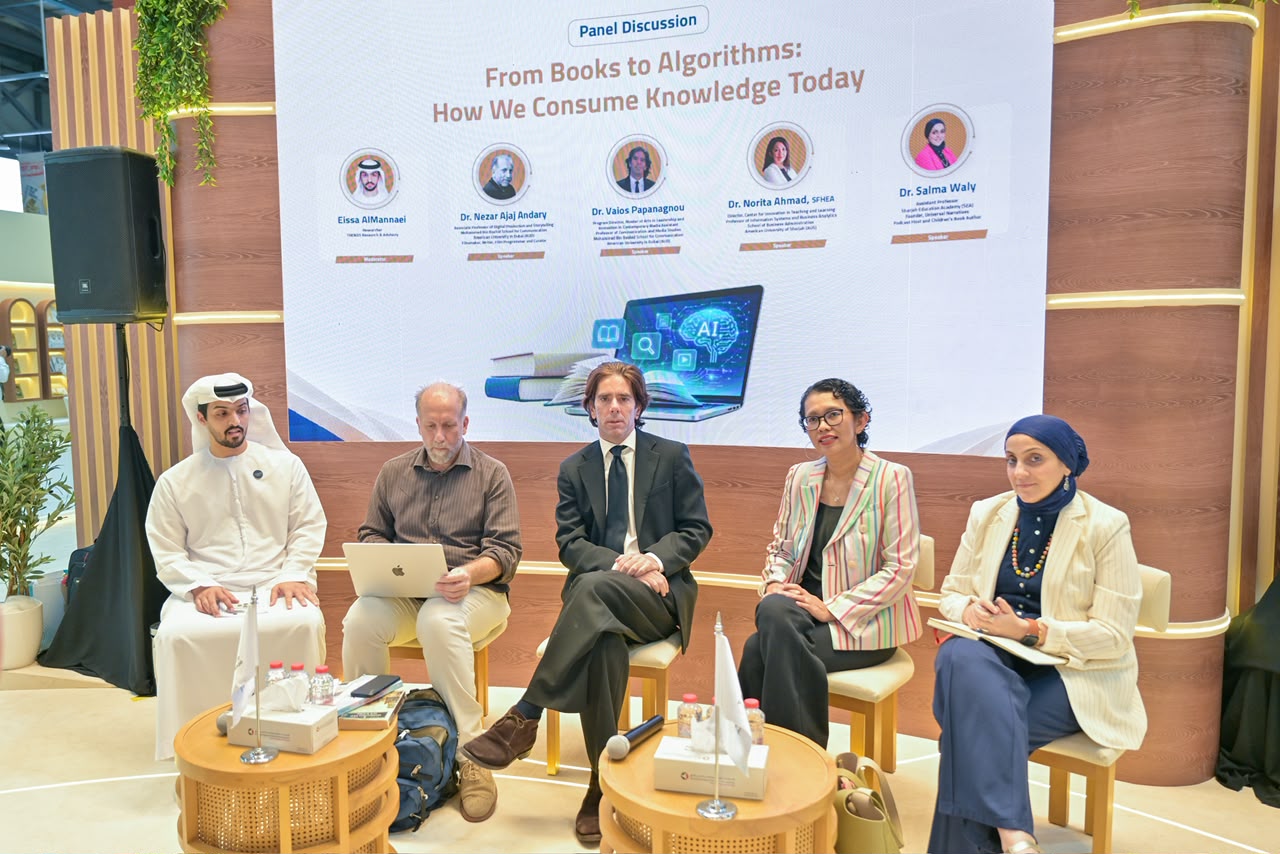
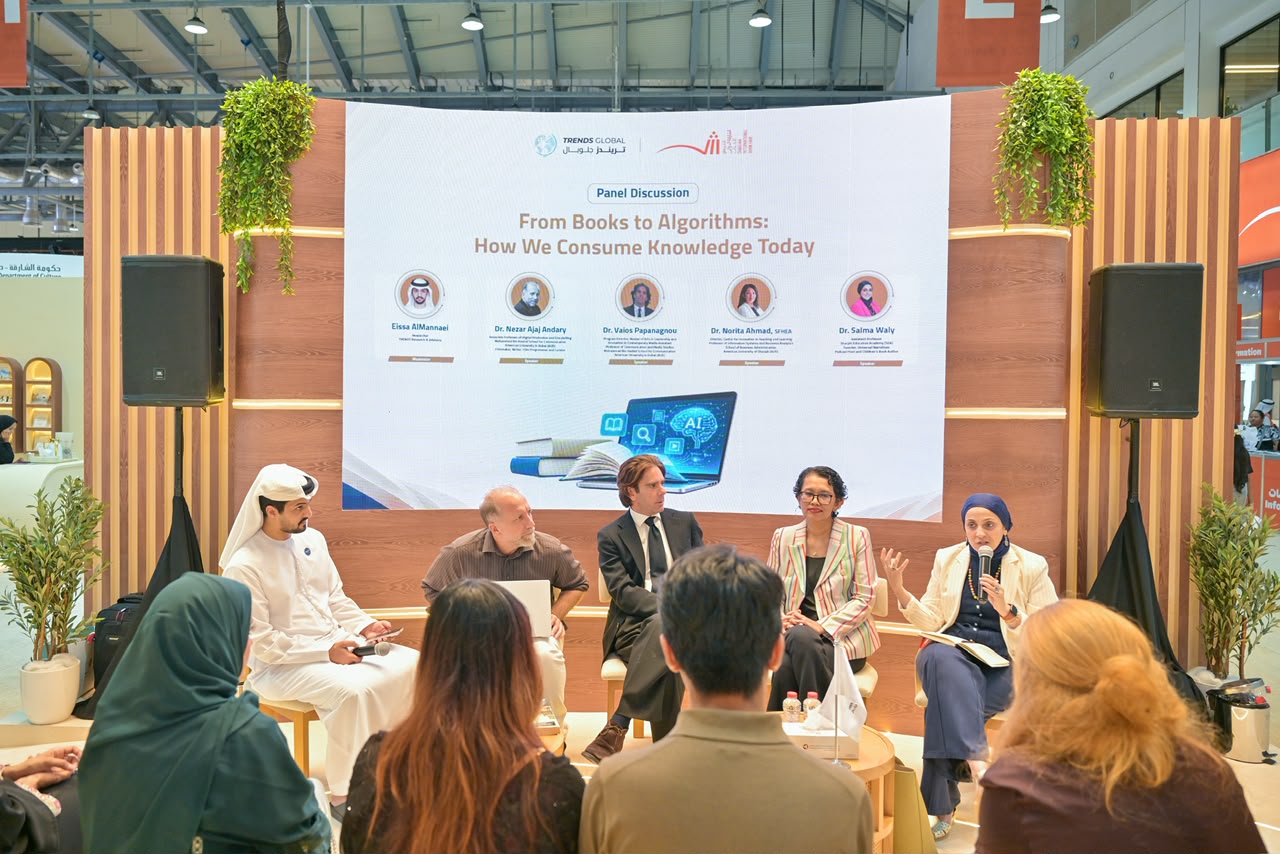
As part of the intellectual and knowledge-focused programming of TRENDS — the knowledge partner for the 45th edition of the Sharjah International Book Fair — the organization’s pavilion hosted a panel discussion titled From Books to Algorithms: How We Consume Knowledge Today?
Organized by TRENDS Global, the session brought together a distinguished group of academics, experts, specialists, and thinkers to examine the rapid transformations unfolding in culture and knowledge in an era dominated by artificial intelligence (AI), digital platforms, and algorithms.
The speakers addressed the shift among new generations from traditional reading to digital content, exploring its implications for literacy, cultural identity, and the future of books, publishing, and learning. They also examined the evolving relationship between traditional storytelling and digital formats, the role of algorithms in shaping what audiences discover and consume, and the skills people need to stay well-informed and discerning in a constantly changing knowledge landscape.
Technology and the Future of Publishing
Eissa Al-Mannaei, AI Researcher at TRENDS Research & Advisory, opened the session. In his introductory remarks, he explained that the session aims to explore the evolving relationship between humans and knowledge in an era shaped by artificial intelligence, digital platforms, and algorithms. By bringing together perspectives from storytelling, media, publishing, and education, the session examines the shift from traditional reading to new forms of digital content and knowledge consumption.
Al-Mannaei added that the discussion addresses how technology is reshaping the future of publishing and how information is shared and engaged with, while also considering the implications for literacy, educational thought, cultural identity, and the future of books, publishing, and learning.
The contributions were organized around four key themes: Storytelling, books, and the preservation of cultural memory; Digital media, algorithms, and the future of publishing; Generative AI, digital knowledge, and shifts in learning; and Education, literacy, and critical thinking in the age of artificial intelligence.
Preserving Cultural Memory
Dr. Nezar Ajaj Andary, Associate Professor of Digital Production and Storytelling at the Mohammed Bin Rashid School for Communication at the American University in Dubai, delivered a presentation titled Storytelling, Books, and the Preservation of Cultural Memory. He emphasized that digital media and emerging technologies have reshaped storytelling, influencing how stories are created, shared, and experienced.
Dr. Andari highlighted the enduring role of books and long-form narratives in preserving cultural memory, identity, and collective heritage. He also explored how traditional storytelling can coexist with digital forms, while safeguarding the depth, diversity, and value of human cultural narratives.
Dr. Andary noted that digital media and emerging technologies have fundamentally transformed how stories are created, narrated, and experienced — shifting from linear storytelling to an interactive, participatory model that leverages imagery, video, artificial intelligence, and augmented reality. While this has given people faster access, more diverse voices, personalization, and the capacity for immediate interaction, it has also come at the cost of some of the depth, contemplation, and focus long-form reading fosters.
Nevertheless, books and long-form narratives continue to play a unique and irreplaceable role in shaping cultural memory and preserving collective narratives; they provide the historical context and human complexity that short-form, rapid content cannot capture.
Digital Media and Algorithms
Dr. Vaios Papanagnou, Program Director of the Master of Arts in Leadership and Innovation in Contemporary Media and Assistant Professor of Communication and Media Studies at Mohammed Bin Rashid School for Communication, American University in Dubai (AUD), focused his discussion on digital platforms, algorithms, and the future of publishing. He explored how the operational mechanisms of digital platforms and algorithm-driven distribution are transforming the publishing and media landscape and reshaping relationships among content creators, publishers, and audiences. He also addressed the growing influence of algorithms and AI on content production, journalism, and audience engagement.
Papanagnou emphasized that digital platforms and algorithm-driven distribution have fundamentally altered the dynamics between content creators, publishers, and audiences. Publishers are no longer the sole gatekeepers; content creators can now reach their audiences directly.
Meanwhile, the primary influence over what people discover and consume has shifted to the platforms themselves — and their underlying algorithms — which prioritize content based on user interest and engagement rather than editorial value, effectively turning the audience into active participants in the dissemination process.
Furthermore, he noted that media organizations’ adoption of AI has transformed the roles of journalists and media professionals; their work has shifted from merely producing news to managing data, verifying and fact-checking information, and editing content with the aid of intelligent tools. While this has enhanced productivity and speed, it has also introduced new challenges concerning editorial independence and credibility.

Digital Literacy and Learning
In a session titled Generative AI, Digital Literacy, and Transformations in Learning, Dr. Norita Ahmad— Director, Center for Innovation in Teaching and Learning, Professor of Information Systems and Business Analytics, School of Business Administration, American University of Sharjah (AUS) — examined the impact of Generative AI, Digital Knowledge, and Transformations in Learning.
She explored the distinction between genuine understanding and the ability to retrieve or generate information, emphasizing the need for critical thinking and intellectual engagement in an AI-driven environment. Furthermore, she underscored the importance of ensuring that AI-supported learning remains reliable, responsive, and intellectually rigorous.
Dr. Norita noted that key considerations for maintaining the reliability of AI-supported learning include ensuring transparency regarding data sources and model limitations, teaching information verification, and designing educational tasks that require critical thought and analysis rather than simple reproduction. She also highlighted the need for clear ethical frameworks for AI usage.
As AI becomes increasingly integrated into our daily consumption of knowledge, individuals must develop new skills to remain well-informed, discerning, and able to make independent decisions. These include digital and algorithmic literacy, the ability to formulate effective prompts and verify AI-generated responses, and the cultivation of intellectual curiosity and independent judgment.
Education and Literacy
Dr. Salma Waly, Assistant Professor at Sharjah Education Academy (SEA), Founder of Universal Narratives, Podcast Host, and Children’s Book Author, addressed Education, Literacy, and Critical Thinking in the Age of AI. She explained that the growing influence of artificial intelligence and digital platforms is reshaping literacy, education, and the human relationship with knowledge. Dr. Waly emphasized the importance of shifting the focus from mere access to information toward a deeper understanding, critical thinking, and informed decision-making. She also highlighted the need for a human-centric, culturally responsive approach to technology — one that acknowledges diverse identities and varied learning needs — and stressed that education must evolve to enhance human potential.
Dr. Waly noted that the transition must move beyond simply making technology accessible; it requires designing learning experiences and systems that reflect individuals’ diverse identities, circumstances, life experiences, and needs. This entails incorporating culturally and linguistically diverse content, as well as flexible, inclusive learning pathways.
Fundamentally, this means education must undergo a profound transformation—not just in the tools used, but in its underlying philosophy, objectives, and assessment methods. We must shift away from rote memorization and standardized testing toward fostering critical thinking, creativity, empathy, and the capacity for lifelong learning. The future will not reward those who possess the most information, but rather those who can understand, critically evaluate, and apply that information with wisdom and humanity.