
The session brought together young people and others interested in technology and criminal justice.
TRENDS Group continued its participation in the 15th United Nations Congress on Crime Prevention and Criminal Justice – Abu Dhabi 2026, with the TRENDS Youth Council organizing an interactive session titled “Mock Courtroom: The Voice That Wasn’t There” at the Youth Lab at ADNEC Centre Abu Dhabi.
The TRENDS Group pavilion at the exhibition accompanying the Congress also continued to attract participants and visitors. The pavilion was visited by H.E. Sheikh Nahyan bin Mubarak Al Nahyan, Minister of Tolerance and Coexistence, who stopped by to learn about TRENDS’ new identity and its five companies, which form an integrated ecosystem for producing, analyzing, disseminating, and applying knowledge to support policymaking and anticipate the future. The pavilion also welcomed a number of Congress guests and visitors, who explored the Group’s publications, projects, and knowledge products.
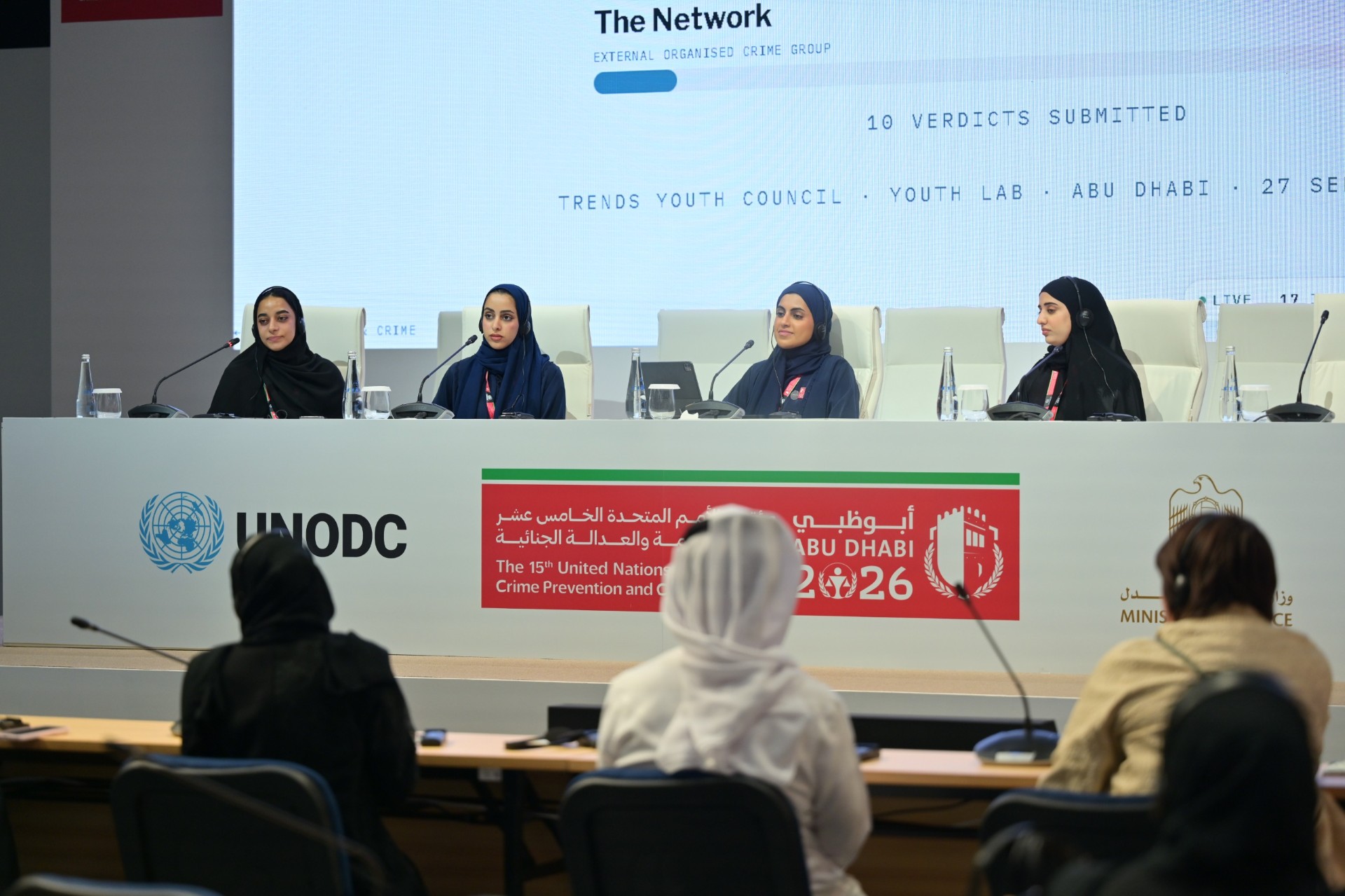
A Hypothetical Case
The mock courtroom session offered a practical experience simulating a courtroom setting through a hypothetical case involving financial fraud using AI-powered voice-cloning deepfake technology. Participants engaged in an interactive exercise that involved examining digital evidence, listening to statements, asking questions, and analyzing the available information before making their own decision on the case.
The session highlighted the challenges posed by artificial intelligence in verifying digital evidence, amid the growing ability to produce convincing fake voices, images, videos, and information, and the resulting challenges for crime prevention and criminal justice efforts.
The session was moderated by Abrar Al Ali, a member of the TRENDS Youth Council, with the participation of Najla Al Midfa, Hessa Al Nuaimi, and Amna Khalid, members of the Council. They discussed various forms of AI-related crime, including identity impersonation, voice cloning, fake identities, social engineering, and cyberattacks.
The discussion also addressed the importance of strengthening institutional capacities to verify digital evidence and establishing stricter identity-verification standards for sensitive transactions, particularly financial transactions. It also highlighted the importance of enhancing international cooperation to address cross-border digital crimes.