
Interactive maps track political violence trends and measure digital discourse on the group across 243 countries and territories..
TRENDS Barometer, a company under TRENDS Group, announced during its participation in the 35th Abu Dhabi International Book Fair the launch of two interactive maps for global indices. The first, the Strategic Political Violence Index (SPVI), is a pioneering initiative designed to measure levels of political violence, anticipate emerging trends, and identify potential escalation hotspots early.
The second, the Index for Measuring Acceptance and Rejection of the Muslim Brotherhood, tracks global digital discourse and attitudes toward the group.
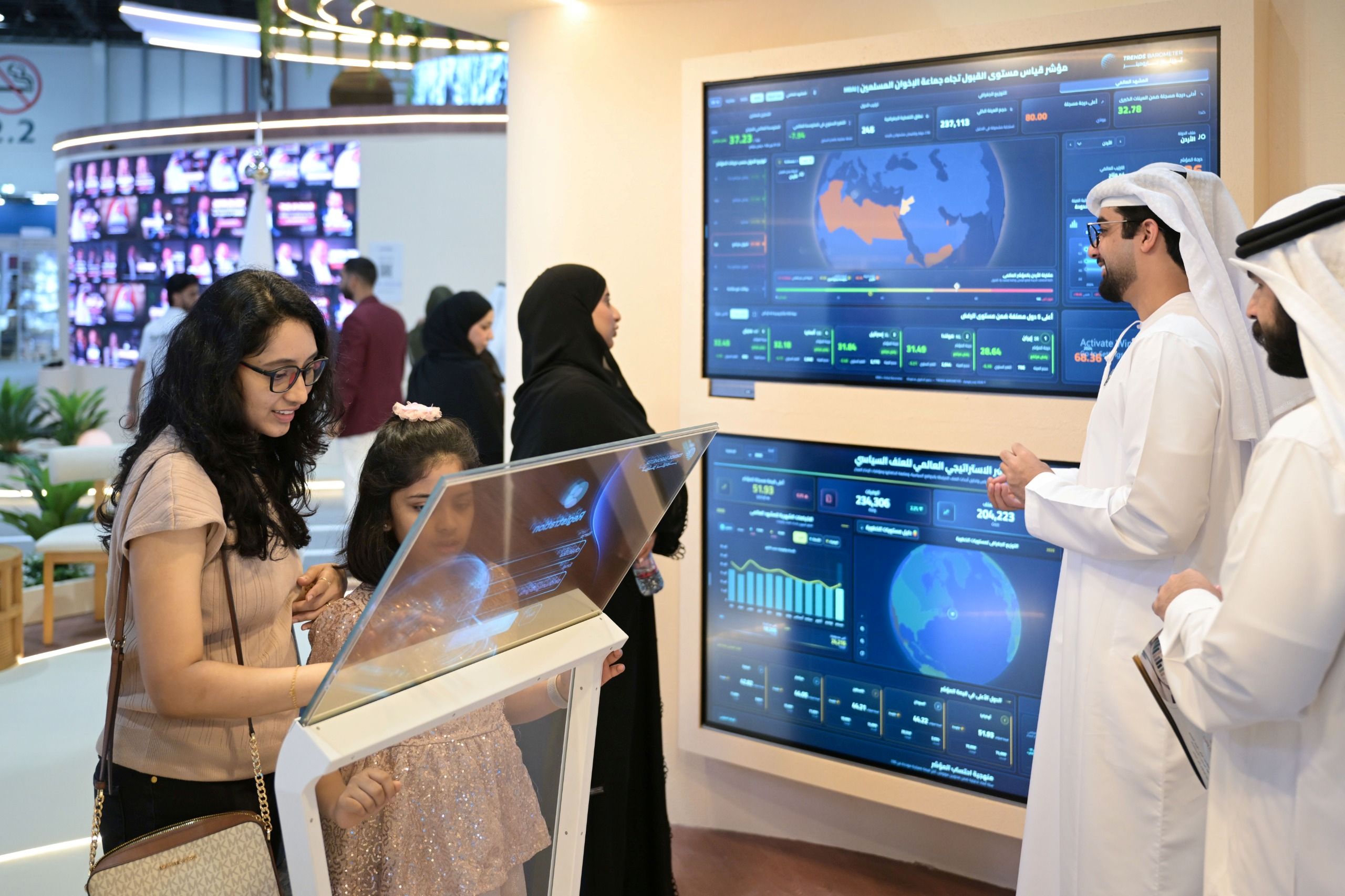
The Strategic Political Violence Index covers 243 countries and territories worldwide. It draws on data from the Armed Conflict Location & Event Data Project (ACLED) as a primary source for incidents and fatalities, which TRENDS Barometer experts then process using an independent methodology. According to 2025 data, 159 countries recorded incidents of political violence, totaling approximately 208,000 incidents and resulting in around 241,000 fatalities.
The index allocates 60 percent of its analytical weighting to the actual burden of violence, covering volume, lethality, and severity, and 40% to violence dynamics, covering momentum, volatility, and persistence. This provides a quantitative basis for researchers, policymakers, and risk-management institutions to understand patterns and trends in political violence.
Fahd Issa Al Mahri, General Manager of TRENDS Barometer, said the launch of the two indices reflects the company’s commitment to developing innovative analytical tools based on data and modern technologies. He noted that the tools provide researchers, policymakers, and institutions with quantitative, objective insights into political and security phenomena and their trajectories, helping deepen understanding of global transformations and support early forecasting efforts.
Mariam Al Junaibi, Head of Digital Monitoring and Analysis at TRENDS Barometer, said the Strategic Political Violence Index represents a significant advancement in methods for analyzing security and political phenomena globally. She explained that its methodology goes beyond traditional measurements that focus primarily on the number of incidents and casualties by analyzing six interconnected components: volume, lethality, severity, momentum, volatility, and persistence.
She added that this methodology distinguishes between countries with frequent incidents and relatively limited losses and those with fewer incidents that are more lethal and impactful. This provides researchers and policymakers with a deeper understanding of whether violence represents a temporary wave or a prolonged structural pattern.
Regarding the Index for Measuring Acceptance and Rejection of the Muslim Brotherhood, Al Junaibi explained that it relies on monitoring and analyzing digital content circulated daily across social media platforms worldwide.
The index classifies published material by country, language, and content to determine whether the discourse supports, is neutral toward, or rejects the group, turning fragmented digital content into quantitative results that can be measured, compared, and analyzed.
Zayed Al Marzouqi, Software Specialist at TRENDS Barometer, explained that the acceptance and rejection index uses a scale ranging from 0 to 100 points, with lower scores indicating higher levels of rejection of the group.
He noted that the system accounts for each country’s relative weight based on sample size and level of digital presence, supporting accurate comparisons across countries and regions.
The index classifies levels of acceptance and rejection into five categories: 0–20: Very High Rejection; 21–40: High Rejection; 41–60: Neutral; 61–80: High Acceptance; and 81–100: Very High Acceptance. According to the index results, the score measuring the group’s acceptance and rejection stood at 29.3 in 2025, compared with 37.2 in 2024 and 46 in 2023.
The two indices launched by TRENDS Barometer reflect the company’s focus on developing digital and quantitative tools to monitor political, security, and social phenomena and provide measurable and comparable data to support scientific research and enhance understanding of trends and transformations at both regional and global levels.

