TRENDS Deconstructs Middle East Crisis and the Future Trajectories of Confrontation with Iran Through 15 Strategic Dialogues
The series seeks to provide a comprehensive and systematic assessment of the current crisis in the Middle East.
As part of its ongoing intellectual and analytical engagement with the rapidly evolving geopolitical developments in the region, TRENDS Global and TRENDS Research & Advisory, both part of TRENDS Group, concluded an intensive series of 15 consecutive strategic dialogues.
This unique series sought to provide a comprehensive and systematic assessment of the current crisis in the Middle East, examining the potential trajectories of military escalation and confrontation with Iran, and analyzing their implications for global security and the economic order.
A carefully structured strategic progression distinguished the TRENDS dialogues. They began by examining the perspectives of major powers and international actors, moved through analyses of regional and Asian stakeholders surrounding the conflict zone, and culminated in discussions of on-the-ground realities and the future of the U.S. approach amid emerging deterrence dynamics.
International Perspectives
The series began by focusing on the positions and influence of major international blocs and global powers regarding the ongoing conflict. The first and second dialogues examined the security dilemma in the Arabian Gulf and the future of maritime navigation in the Strait of Hormuz following reciprocal strikes.
The discussions concluded that scenarios of a “protracted war of attrition” were increasingly likely, while emphasizing the difficulty of achieving meaningful political change in Iran through airpower alone without large-scale ground operations.
The third dialogue, titled “The European Perspective on the Crisis and Cybersecurity Risks,” explored how the Middle East conflict has evolved into an existential threat to Europe’s energy security. It also examined European policy tools to address the risks posed by terrorism, cyberattacks, and AI-driven information warfare supported by regional actors.
The fourth dialogue, The Latin American Perspective and Geopolitical Transformations, brought together leading thinkers from Brazil, Argentina, Chile, and Panama to discuss how Latin American countries perceive shifts in the international balance of power and the impact of disruptions in global supply chains on emerging economies.
The fifth dialogue focused on The Future of the War, Diplomatic Solutions, and Prospects for the Region, balancing the risks of uncontrolled military escalation against opportunities for a comprehensive political settlement through effective international mediation.
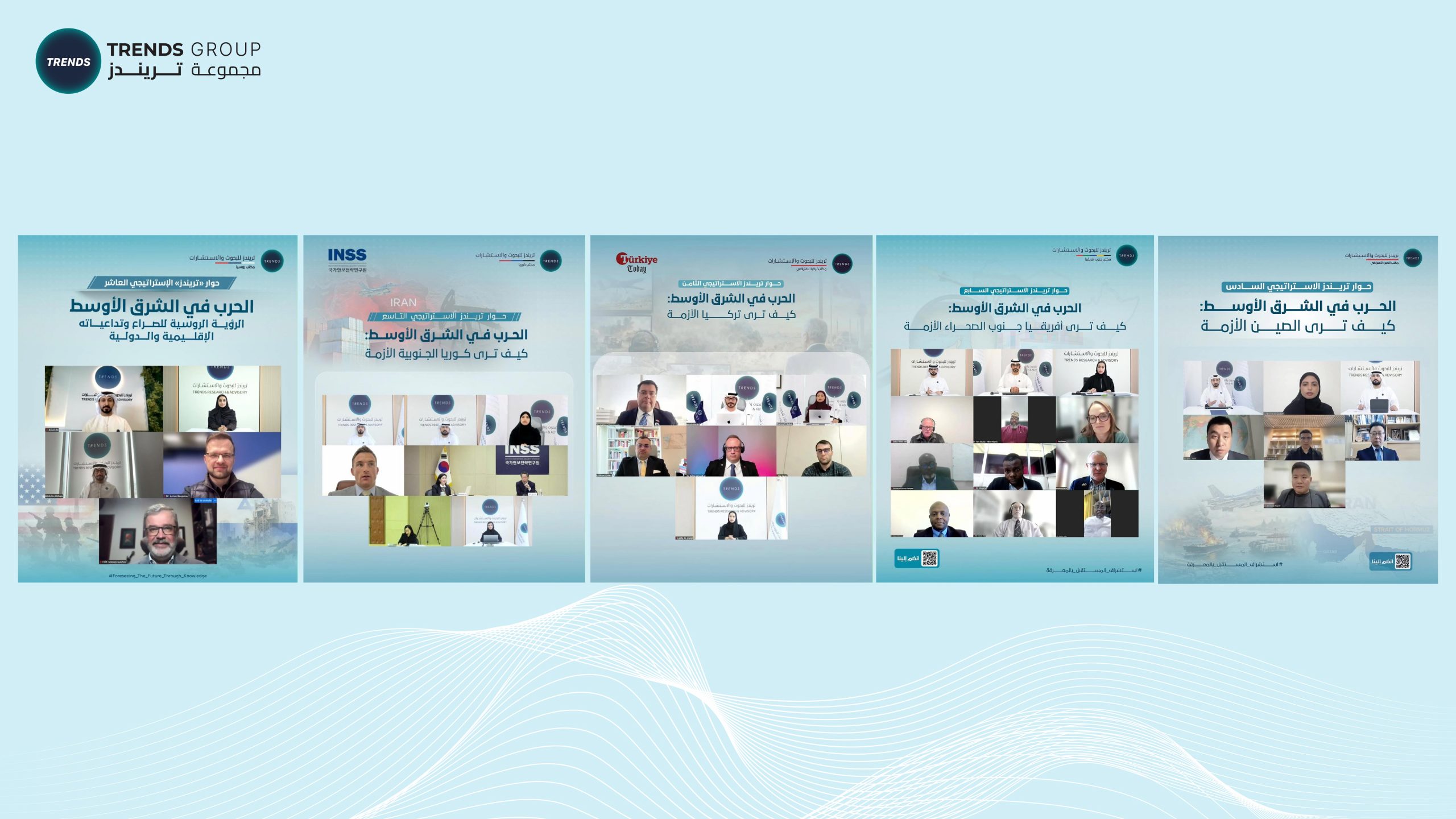
The sixth dialogue examined China’s Position and the Doctrine of Common Security. Held through TRENDS’ virtual office in Beijing and featuring prominent Chinese scholars, the discussion analyzed China’s approach to the crisis, which rejects military solutions, prioritizes protecting energy infrastructure and maritime routes as a red line for the global economy, and promotes Beijing’s concept of “common security.”
The seventh dialogue addressed “Regional Security and Changing International Dynamics.” It served as a bridge between global power perspectives and regional positioning, examining shifting alliances and the emergence of new international actors seeking to expand their influence amid U.S. preoccupation with the crisis.\
Neighboring States and Strategic Partners
The second phase of the series focused on the positions of neighboring countries and major Asian trading partners whose national security is directly affected by the conflict’s consequences.
The eighth dialogue analyzed The Turkish Perspective and the Calculations of Non-State Actors, highlighting Ankara’s complex strategic calculations regarding conflict fronts in Gaza, Lebanon, and Syria, as well as its efforts to safeguard economic interests and balance the growing influence of armed non-state actors.
The ninth dialogue, Seoul’s Security Doctrine and Energy Challenges, explored how the Middle East conflict has created a geopolitical shock that is reshaping South Korea’s security and defense doctrine, driven largely by its near-total dependence on Gulf energy supplies to sustain industrial growth.
The tenth dialogue focused on “Russia’s Role and the Balance of Power with the West,” examining Moscow’s strategic calculations and how it is leveraging the crisis within its broader competition with the United States and NATO.
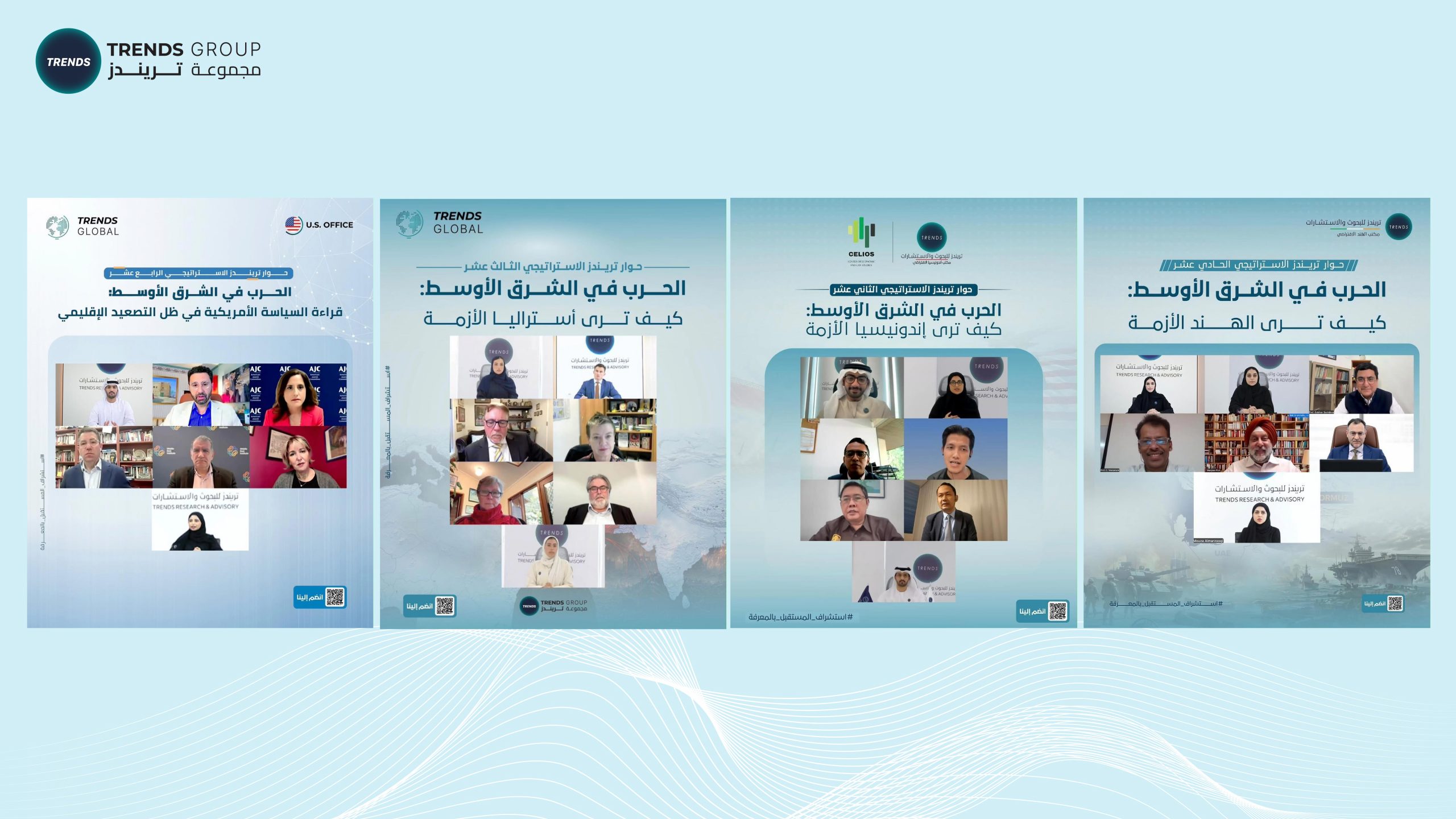
In the eleventh dialogue, experts discussed the Indian Perspective and the Middle East as a Vital Strategic Space, outlining New Delhi’s view of the region as directly linked to its national security and aspirations to be a global power, particularly regarding economic corridors and supply chains across the Arabian Sea.
The twelfth and thirteenth dialogues, centered on Regional Strategic Preparedness and Peacebuilding, evaluated the resilience of the Arab regional system to security shocks and explored mechanisms to enhance collective action and build a sustainable peace capable of countering expansionist regional ambitions.
Ground Realities, U.S. Policy, and Maritime Security
The fourteenth strategic dialogue offered an in-depth assessment of ongoing developments, titled U.S. Policy and the Era of Painful Stalemate. Organized by TRENDS’ office in the United States, the dialogue featured high-level participation from experts affiliated with the Middle East Institute and the Council on Foreign Relations.
The discussion concluded that the confrontation between Tehran and Washington has entered a phase of “painful stalemate,” characterized by three principal dimensions: Iran’s leverage through the Revolutionary Guard’s control over key decision-making structures; Tehran’s reliance on strategic patience and persistent threats to maritime security and the Strait of Hormuz as deterrence tools; and the U.S. dilemma in formulating an effective conventional deterrence strategy against non-state actors and transnational militias.
Participants also commended the preventive and pragmatic diplomacy pursued by the United Arab Emirates and other Gulf states, highlighting its success in preserving economic stability and avoiding risky geopolitical polarization.
The series concluded with the fifteenth strategic dialogue, organized by the TRENDS Dubai office under the title “Maritime Straits at the Heart of Global Conflict.” Participants emphasized that ongoing tensions and instability in strategic maritime chokepoints are exerting increasing pressure on global energy markets, supply chains, and international trade routes, raising transportation costs, disrupting production, fueling inflation, and exacerbating food security challenges worldwide.
Experts and academics noted that the legal status of maritime straits is clearly defined under the United Nations Convention on the Law of the Sea (UNCLOS), which classifies them as international waterways subject to the right of transit passage. Consequently, no state has the legal authority to block navigation, impose fees, or interfere with commercial shipping. However, recent crises in the Straits of Hormuz and Bab el-Mandeb have exposed a widening gap between international legal principles and enforcement capabilities, raising questions about the effectiveness of current mechanisms for safeguarding freedom of navigation amid escalating tensions.
Conclusion
The 15 strategic dialogues organized by TRENDS Global and TRENDS Research & Advisory through their international offices demonstrated that the Middle East crisis and the confrontation with Iran have transcended local dimensions, becoming a complex international conflict encompassing the military, economic, and cyber domains. This conflict is reshaping global energy security and the international security order.
The dialogues further revealed that escalating tensions in strategic maritime chokepoints have become a major source of pressure on energy markets, global supply chains, and international trade, contributing to higher transportation costs, inflationary pressures, and growing food security concerns. At the same time, recent developments in the Straits of Hormuz and Bab el-Mandeb have highlighted an expanding gap between international legal frameworks governing freedom of navigation and the mechanisms available to enforce them.
The series ultimately underscored the urgent need for innovative diplomatic approaches and more effective international cooperation mechanisms that go beyond traditional military solutions, helping to safeguard regional stability, secure vital maritime routes, and ensure the sustainability of global trade flows.

 Neighboring States and Strategic Partners
The second phase of the series focused on the positions of neighboring countries and major Asian trading partners whose national security is directly affected by the conflict’s consequences.
The eighth dialogue analyzed The Turkish Perspective and the Calculations of Non-State Actors, highlighting Ankara’s complex strategic calculations regarding conflict fronts in Gaza, Lebanon, and Syria, as well as its efforts to safeguard economic interests and balance the growing influence of armed non-state actors.
The ninth dialogue, Seoul’s Security Doctrine and Energy Challenges, explored how the Middle East conflict has created a geopolitical shock that is reshaping South Korea’s security and defense doctrine, driven largely by its near-total dependence on Gulf energy supplies to sustain industrial growth.
The tenth dialogue focused on “Russia’s Role and the Balance of Power with the West,” examining Moscow’s strategic calculations and how it is leveraging the crisis within its broader competition with the United States and NATO.
In the eleventh dialogue, experts discussed the Indian Perspective and the Middle East as a Vital Strategic Space, outlining New Delhi’s view of the region as directly linked to its national security and aspirations to be a global power, particularly regarding economic corridors and supply chains across the Arabian Sea.
The twelfth and thirteenth dialogues, centered on Regional Strategic Preparedness and Peacebuilding, evaluated the resilience of the Arab regional system to security shocks and explored mechanisms to enhance collective action and build a sustainable peace capable of countering expansionist regional ambitions.
Ground Realities, U.S. Policy, and Maritime Security
The fourteenth strategic dialogue offered an in-depth assessment of ongoing developments, titled U.S. Policy and the Era of Painful Stalemate. Organized by TRENDS’ office in the United States, the dialogue featured high-level participation from experts affiliated with the Middle East Institute and the Council on Foreign Relations.
The discussion concluded that the confrontation between Tehran and Washington has entered a phase of “painful stalemate,” characterized by three principal dimensions: Iran’s leverage through the Revolutionary Guard’s control over key decision-making structures; Tehran’s reliance on strategic patience and persistent threats to maritime security and the Strait of Hormuz as deterrence tools; and the U.S. dilemma in formulating an effective conventional deterrence strategy against non-state actors and transnational militias.
Participants also commended the preventive and pragmatic diplomacy pursued by the United Arab Emirates and other Gulf states, highlighting its success in preserving economic stability and avoiding risky geopolitical polarization.
The series concluded with the fifteenth strategic dialogue, organized by the TRENDS Dubai office under the title “Maritime Straits at the Heart of Global Conflict.” Participants emphasized that ongoing tensions and instability in strategic maritime chokepoints are exerting increasing pressure on global energy markets, supply chains, and international trade routes, raising transportation costs, disrupting production, fueling inflation, and exacerbating food security challenges worldwide.
Experts and academics noted that the legal status of maritime straits is clearly defined under the United Nations Convention on the Law of the Sea (UNCLOS), which classifies them as international waterways subject to the right of transit passage. Consequently, no state has the legal authority to block navigation, impose fees, or interfere with commercial shipping. However, recent crises in the Straits of Hormuz and Bab el-Mandeb have exposed a widening gap between international legal principles and enforcement capabilities, raising questions about the effectiveness of current mechanisms for safeguarding freedom of navigation amid escalating tensions.
Neighboring States and Strategic Partners
The second phase of the series focused on the positions of neighboring countries and major Asian trading partners whose national security is directly affected by the conflict’s consequences.
The eighth dialogue analyzed The Turkish Perspective and the Calculations of Non-State Actors, highlighting Ankara’s complex strategic calculations regarding conflict fronts in Gaza, Lebanon, and Syria, as well as its efforts to safeguard economic interests and balance the growing influence of armed non-state actors.
The ninth dialogue, Seoul’s Security Doctrine and Energy Challenges, explored how the Middle East conflict has created a geopolitical shock that is reshaping South Korea’s security and defense doctrine, driven largely by its near-total dependence on Gulf energy supplies to sustain industrial growth.
The tenth dialogue focused on “Russia’s Role and the Balance of Power with the West,” examining Moscow’s strategic calculations and how it is leveraging the crisis within its broader competition with the United States and NATO.
In the eleventh dialogue, experts discussed the Indian Perspective and the Middle East as a Vital Strategic Space, outlining New Delhi’s view of the region as directly linked to its national security and aspirations to be a global power, particularly regarding economic corridors and supply chains across the Arabian Sea.
The twelfth and thirteenth dialogues, centered on Regional Strategic Preparedness and Peacebuilding, evaluated the resilience of the Arab regional system to security shocks and explored mechanisms to enhance collective action and build a sustainable peace capable of countering expansionist regional ambitions.
Ground Realities, U.S. Policy, and Maritime Security
The fourteenth strategic dialogue offered an in-depth assessment of ongoing developments, titled U.S. Policy and the Era of Painful Stalemate. Organized by TRENDS’ office in the United States, the dialogue featured high-level participation from experts affiliated with the Middle East Institute and the Council on Foreign Relations.
The discussion concluded that the confrontation between Tehran and Washington has entered a phase of “painful stalemate,” characterized by three principal dimensions: Iran’s leverage through the Revolutionary Guard’s control over key decision-making structures; Tehran’s reliance on strategic patience and persistent threats to maritime security and the Strait of Hormuz as deterrence tools; and the U.S. dilemma in formulating an effective conventional deterrence strategy against non-state actors and transnational militias.
Participants also commended the preventive and pragmatic diplomacy pursued by the United Arab Emirates and other Gulf states, highlighting its success in preserving economic stability and avoiding risky geopolitical polarization.
The series concluded with the fifteenth strategic dialogue, organized by the TRENDS Dubai office under the title “Maritime Straits at the Heart of Global Conflict.” Participants emphasized that ongoing tensions and instability in strategic maritime chokepoints are exerting increasing pressure on global energy markets, supply chains, and international trade routes, raising transportation costs, disrupting production, fueling inflation, and exacerbating food security challenges worldwide.
Experts and academics noted that the legal status of maritime straits is clearly defined under the United Nations Convention on the Law of the Sea (UNCLOS), which classifies them as international waterways subject to the right of transit passage. Consequently, no state has the legal authority to block navigation, impose fees, or interfere with commercial shipping. However, recent crises in the Straits of Hormuz and Bab el-Mandeb have exposed a widening gap between international legal principles and enforcement capabilities, raising questions about the effectiveness of current mechanisms for safeguarding freedom of navigation amid escalating tensions.
 Conclusion
The 15 strategic dialogues organized by TRENDS Global and TRENDS Research & Advisory through their international offices demonstrated that the Middle East crisis and the confrontation with Iran have transcended local dimensions, becoming a complex international conflict encompassing the military, economic, and cyber domains. This conflict is reshaping global energy security and the international security order.
The dialogues further revealed that escalating tensions in strategic maritime chokepoints have become a major source of pressure on energy markets, global supply chains, and international trade, contributing to higher transportation costs, inflationary pressures, and growing food security concerns. At the same time, recent developments in the Straits of Hormuz and Bab el-Mandeb have highlighted an expanding gap between international legal frameworks governing freedom of navigation and the mechanisms available to enforce them.
The series ultimately underscored the urgent need for innovative diplomatic approaches and more effective international cooperation mechanisms that go beyond traditional military solutions, helping to safeguard regional stability, secure vital maritime routes, and ensure the sustainability of global trade flows.
Conclusion
The 15 strategic dialogues organized by TRENDS Global and TRENDS Research & Advisory through their international offices demonstrated that the Middle East crisis and the confrontation with Iran have transcended local dimensions, becoming a complex international conflict encompassing the military, economic, and cyber domains. This conflict is reshaping global energy security and the international security order.
The dialogues further revealed that escalating tensions in strategic maritime chokepoints have become a major source of pressure on energy markets, global supply chains, and international trade, contributing to higher transportation costs, inflationary pressures, and growing food security concerns. At the same time, recent developments in the Straits of Hormuz and Bab el-Mandeb have highlighted an expanding gap between international legal frameworks governing freedom of navigation and the mechanisms available to enforce them.
The series ultimately underscored the urgent need for innovative diplomatic approaches and more effective international cooperation mechanisms that go beyond traditional military solutions, helping to safeguard regional stability, secure vital maritime routes, and ensure the sustainability of global trade flows. 