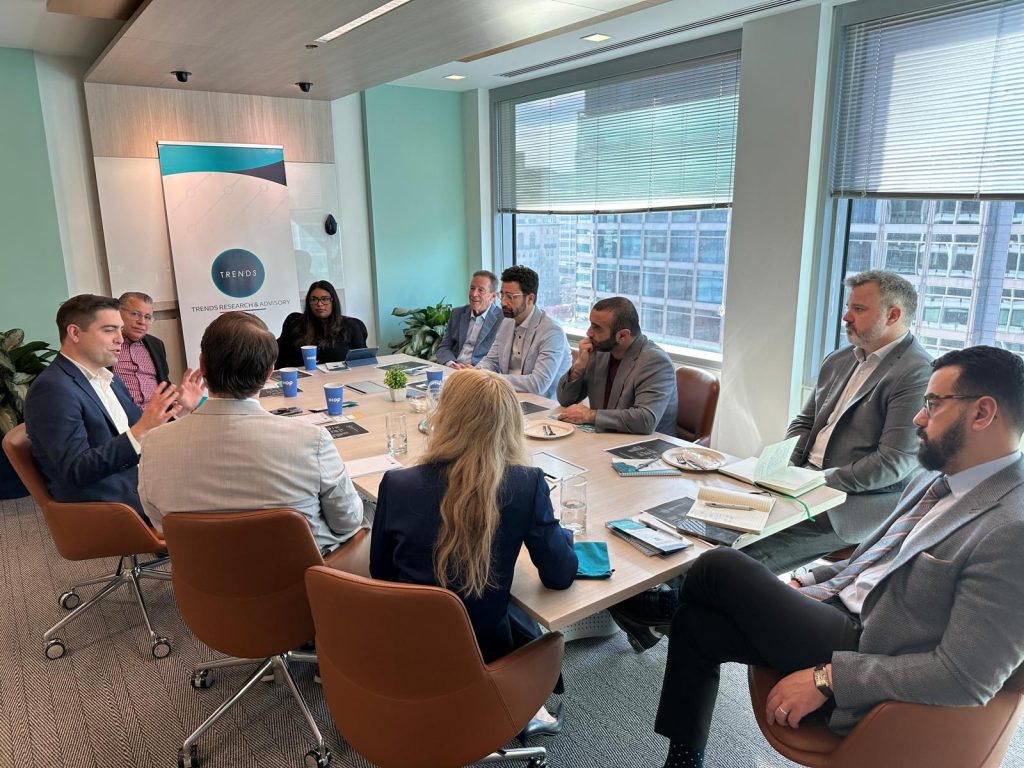
On March 10, 2026, TRENDS US hosted its fourth strategy session titled “Space: The New Middle East Frontier.” The discussion examined the rapid expansion of space activity across the Middle East and explored whether the region’s recent investments represent a durable transformation or a temporary surge driven by geopolitical ambition and economic diversification agendas. Participants analyzed the technological, political, and market dynamics shaping the region’s evolving role in the global space ecosystem.
The panel featured Frank Backes, former CEO of Capella Space and current President and Chairman of the Board of Space ISAC; Marchel Holle, Director of Civil Space at Varda Space Industries; and Natasha Ahmed, defense technology investor and operator, senior advisor with TRENDS US, and board member of the Space Force Association’s Washington, DC chapter.
The conversation was moderated by Ahmed and structured around three central themes:
- The rapidly expanding space ecosystem, which now includes not only launch (assured sovereign access to space) and satellite manufacturing but also energy infrastructure, communications networks, and data services.
- The constraints shaping regional space development including specialization of key capabilities/components manufacturing.
- The role of international partnerships in building sustainable space ecosystems.
The Middle East has also become a significant market participant and investor for emerging space tech companies, particularly US-founded. Recent investment rounds illustrate the scale of momentum in the sector and sovereign wealth interest:
- Firefly Aerospace’s public offering valued the company at roughly $9.8 billion
- Axiom Space raised $350 million in its Series D round at a $2.5 billion valuation with QIA participation
- Sierra Space raised $550 million in a Series C round at an $8 billion valuation with rumored partnership with Saudi Arabia
- Meanwhile, speculation around a future SpaceX IPO—potentially approaching trillion-dollar scale—underscores the enormous capital formation now shaping the industry.
The on-the-record strategy session convened policymakers, defense and space industry practitioners, and researchers focused on technology policy and regional security. The discussion highlighted both the immense progress and the structural limitations facing emerging space programs in the Middle East.

Key Insights and Recommendations
Introduction:
The Middle East’s interest in space is increasingly tied to national strategy and economic transformation. Recent dependencies on space-based imagery and satellite communications infrastructure for current situational responses only underscore the importance of the frontier space domain.
Historically, Middle Eastern countries participated in the space sector primarily as customers, purchasing satellite telecommunications capacity and Earth observation services from Western providers. Today, however, several countries see domestic capability as a key component of security and are attempting to move up the value chain by investing in local space agencies, launch partnerships and research programs.
The UAE’s early investments, such as the Mohammed bin Rashid Space Centre and the Emirates Mars Mission, demonstrate how targeted government funding and international collaboration can accelerate capability development. These initiatives have helped build domestic engineering talent and create national prestige around scientific achievement.
Saudi Arabia is pursuing a similar path but with a different scale and structure. Through organizations such as the Saudi Space Commission, the Kingdom is investing heavily in satellites, astronaut programs, and partnerships with global aerospace firms. These investments are closely aligned with Vision 2030, the country’s broader effort to diversify its economy beyond oil.
Despite this progress, attendees and panelists noted that most regional programs remain heavily dependent on international expertise and were restrained by US policy constraints.
First Part
Reentry, Sovereign Space Access, and Space Domain Awareness
As the number of satellites and national space programs grows rapidly, space congestion and security risks are increasing. Maintaining situational awareness in orbit, commonly referred to as space domain awareness (SDA), is becoming a critical capability for both governments and commercial operators.
Backes emphasized that monitoring threats in space increasingly requires coordination between governments and commercial operators. Space ISAC, a voluntary information-sharing organization run by industry participants, was created to enable this coordination. Through shared threat intelligence, operators can better detect cyber intrusions, signal interference, and other emerging risks to space infrastructure. Another area of concern is congestion. Backes noted that many of the systems responsible for tracking space objects and monitoring threats remain underfunded or fragmented, including U.S. efforts such as the Traffic Coordination System for Space (TRACS). Without more robust tracking infrastructure and international collaboration, congestion and collision risks will continue to rise.
For countries in the Middle East that are expanding their satellite fleets, participation in cooperative security frameworks such as Space ISAC will be essential. The security of space systems cannot be managed by any single country or organization. It requires a networked approach across the commercial space industrial base. Panelists recommend focusing on enabling international coordination in space.
Marchel Holle highlighted another emerging component of sovereign space infrastructure: reentry capability. As companies begin manufacturing materials and conducting research in microgravity, the ability to safely return payloads to Earth becomes strategically important. Varda Space Industries is developing the platforms necessary to propel the microgravity research frontier.
Governments seeking sovereign space access must therefore consider not only launch capability but also end-to-end mission infrastructure, including reentry systems, regulatory frameworks, and recovery logistics.
Second Part
Policy Constraints and International Collaboration
While delving deeper into reentry and logistics, Holle noted that policy regimes such as the Missile Technology Control Regime (MTCR) have been both an enabler and detriment to participation in space manufacturing. The MTCR was established in 1987 by the G7 to limit the proliferation of ballistic missile and unmanned delivery systems capable of carrying a 500 kg payload over 300 km. Although originally designed as a non-proliferation mechanism to prevent the spread of nuclear delivery systems, the MTCR also affects modern commercial space activities because many launch vehicles and reentry systems rely on technologies similar to those used in missile systems. As a result, access to certain propulsion systems, guidance technologies, and reentry vehicles can be restricted through export controls tied to the regime. Attendees and panelists spent a significant amount of time talking about signatories, particularly that UAE, Saudi Arabia, and other Asian spacefaring nations are not official signatories of MTCR.
In addition, export controls, technology transfer restrictions, and regulatory regimes such as ITAR (International Traffic in Arms Regulations) frequently complicate partnerships between U.S. companies and international partners. On the other side, sovereign country localization requirements and domestic capacity-building policies can also slow partnerships when companies are required to transfer technology or establish local manufacturing capabilities before operating in a region.
Due to these constraints, panelists emphasized that the goal for emerging space nations should therefore be strategic specialization rather than full vertical independence. By focusing on specific segments, such as launch services, satellite applications, or space data analytics, countries can integrate into the global space economy while still developing meaningful domestic capability. The reality of the space industry is that no single country builds the entire technology stack alone and any attempts to replicate the entire supply chain domestically can dilute resources and slow innovation.
Lastly, and worth noting, the Outer Space Treaty is another aging policy that needs revival as it also shapes how space activities are governed, particularly when it comes to liability, ownership of space assets, and the peaceful use of outer space.
Third Part
Orbital Infrastructure, Data Centers, and the Future of the Space Economy
Looking ahead ten to twenty years, panelists explored the possibility of entirely new industrial infrastructure operating in orbit, including orbital data centers, in-space manufacturing facilities, and large-scale autonomous platforms.
Frank Backes discussed the growing interest in on-orbit computing and quantum technologies taken from his experience at IonQ, noting that many current space missions suffer from limited onboard processing power compared to terrestrial computing systems. Satellites often transmit raw data back to Earth for processing, which creates latency and bandwidth limitations.
Backes and Ahmed underscored the importance of developing powerful edge-computing capabilities in orbit which could enabling satellites to process data directly in space. However, major technical challenges remain, particularly around radiation resilience and long-duration mission reliability.
The economics of orbital computing will ultimately depend on the tradeoff between transmitting large volumes of data to Earth versus processing information at the edge in space. Certain applications, such as Earth observation constellations or communications networks, may benefit significantly from greater onboard computing capacity.
On the in-space assembly and manufacturing side, Marchel Holle highlighted the potential of microgravity manufacturing, which may enable the production of materials and structures that cannot be produced under Earth’s gravitational conditions. Early areas of exploration include advanced semiconductor crystals and other specialized materials that may have positive impacts on scaling manufacturing.
Panelists emphasized that emerging space nations could play meaningful roles in this future ecosystem by investing in specialized infrastructure and forming partnerships with commercial operators.
While many of these concepts remain in early stages, the trajectory of investment and technological development suggests that the coming decades could see the emergence of a true industrial economy in orbit.
Speakers:
