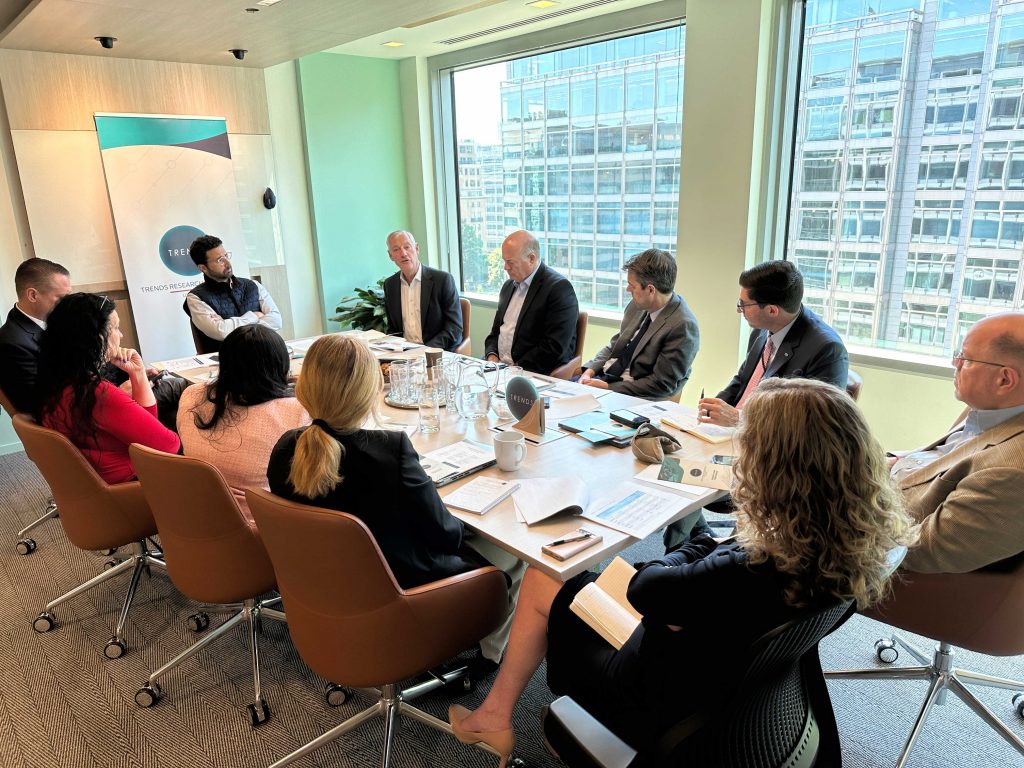
On May 5, 2026, TRENDS US hosted its fifth strategy session titled “Killing the Shahed.” The discussion underscored the significant threat posed by the Islamic Revolutionary Guard Corps(IRGC)’ Unmanned Aerial Systems (UAS), or drones; examined lessons that can be learned from the Ukrainian experience; and explored opportunities for collaboration between the United States and its Gulf partners.
The panel featured John Dowdy, a Senior Partner Emeritus at McKinsey & Company and an Advisory Board Member of Shield AI, and Tom Karako, the director of the Missile Defense Project and a senior fellow with the Defense and Security Department at the Center for Strategic and International Studies (CSIS).
The conversation was moderated by Bilal Y. Saab, Senior Managing Director of TRENDS US, and structured around three areas:
- A diagnosis of the challenges posed by Iranian UAS, and particularly the Shahed family.
- Solution sets to those challenges.
- Opportunities for cooperation and collaboration between the United States and its Gulf partners.
The on-the-record strategy session convened defense industry practitioners, and subject matter experts focused on defense policy, air and missile defense, nonproliferation, and regional and international security.

Key Insights and Recommendations
First Part
- “The future is here,” lamented one participant. And that future can be described as low-cost drones being shot down by capable but high-cost interceptors, making this exchange incredibly unsustainable for the long term.
- The counterargument to economic inefficiency is that this outcome remains preferable to a drone effectively hitting a critical target – an oil field, a desalination plant, a high-end radar, etc…- and causing more economic, political, and possibly strategic damage.
- We are facing “a drone attrition trap” – who is going to run out first? The attacker or the defender? This is less about tactical air superiority and more about inventory depth.
- Until we address this mathematical logic and come up with a long-term strategy – both the inventory and the economics – UAS are a strategic threat.
- There is a sense of urgency in the United States regarding this strategic challenge. Munitions production is on the rise, and more facilities are being built, but what is missing is defense contracts, and appropriations.
- Because of the war with Iran, the United States has expended a scarily large amount of offensive strike capabilities and defensive interceptors, and China is taking note.
- In 2019, the first Trump administration launched its Missile Defense Review, and it paid little attention to air defense. It was mostly about ballistic missile defense. We’re seeing the consequences of that gap today.
- One participant described five different kinds of costs when it comes to countering UAS:
- Cost exchange: expensive interceptor versus cheap drone.
- Cost versus value of the defended asset.
- Cost versus affordability.
- Operational cost, which includes not just the cost of the interceptor but also that of the deployment and maintenance of the (human, technical, and administrative) system enabling the employment of that interceptor.
- Political cost – one hit can impose significant political costs on the leadership of the defender and in the case of Gulf states, their image as a safe environment for international business.
- The threat environment in the Indo-Pacific is different when it comes to UAS. We’re dealing with Group 1 and Group 2 swarms of drones in the Indo-Pacific, which are typically harder to intercept.
- The United States is in a serious munitions crisis, which challenges deterrence.
- There is an evolving Axis of Aggressors – Russia, Iran, and North Korea – who are cooperating in ways that are less visible and understood and more strategic.
Second Part
- Civil defense, which Israel excels at, is underappreciated. There must be greater investments in civil defense.
- There is no systematic effort/process in the US defense community to incorporate lessons from the Ukrainians partly due to US arrogance.
- “Industrial solutions are fluid like water, and they will find a way,” said one participant.
- Counter-UAS solutions should focus more on capacity and training, both of which are lacking.
- The challenge or trade-off of high-powered microwave technology is the possibility of fratricide.
- Netting is an option (especially for First-Person View drones, or FPVs), but it depends on the quality and depth of the net, and also on the payload of the incoming drone.
- Because of the challenges of US acquisitions system, Americans tend to focus on/invest in one capability while neglecting others, making it incredibly challenging to adopt a system-of-systems approach to countering UAS.
- In Ukraine, the innovation/counter-innovation cycle with respect to drones is three weeks. In the United States, it is several months at best.
- Solution sets must address detection, tracking, and finally, interception.
Third Part
- There is merit in marrying Gulf capital with technological innovation, be it in Ukraine or the United States.
- Joint military exercises and operational integration are a must. Red Sands is a welcome start, but it is not enough.
- U.S. Central Command should facilitate the creation of a Gulf lab that specializes in technological innovation.
- Cooperation should go beyond Foreign Military Sales and include local production and industrial partnerships, enabling Gulf states to manufacture or assemble components domestically.
- Cooperation must focus on layered defenses—combining “soft-kill” methods (jamming, cyber takeover) with “hard-kill” interceptors.
Deepen investments in US-Gulf interoperability and experimentation.